Thank you for visiting SNEWPapers!
Sign up free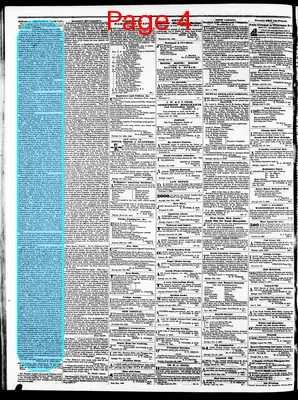
Letter to Editor
April 23, 1851
Weekly North Carolina Standard
Raleigh, Wake County, North Carolina
What is this article about?
Governor William H. Seward writes to the Massachusetts convention opposing the Fugitive Slave Law of 1850, deeming it unconstitutional, unwise, unnecessary, and tied to flawed compromises that undermine civil liberties and human rights.
Clipping

OCR Quality
95%
Excellent
Full Text
SEWARD ON THE FUGITIVE SLAVE LAW.
The following is Gov. Seward's letter to the Convention of the opponents of the Fugitive Slave Law, held at Boston on Tuesday:
AUBURN, Saturday, April 5, 1851.
Dear Sir: Your letter inviting me to attend a Convention of the People of Massachusetts opposed to the Fugitive Slave Law; and to communicate in writing my opinion of that statute, if I should be unable to attend the Convention, has been received.
While offering the pressure of duties here too long deferred as an apology for non-attendance, I pray you to assure the Committee in whose behalf you act, of my profound sense of their courtesy and kindness.
It would be an honor to be invited to address the people of Massachusetts on any subject, but it might well satisfy a generous ambition to be called upon to speak to that great and enlightened Commonwealth on a question of Human Rights and Civil Liberty.
I confess, Sir, that I have earnestly desired not to mingle in the popular discussions of the measures of the last Congress. The issue necessarily involves the claims of their advocates and adversaries in the public councils to the confidence of the country. Some of those advocates have entered the political arena criminating those from whom they had differed, while others have endeavored, by extraordinary means, either to control discussion or to suppress it altogether, and thus they have shown themselves disqualified by prejudice or interest, for practising that impartiality and candor which the occasion demanded.
I am unwilling even to seem to imply by reiterating arguments already before the public, either any distrust of the position of those with whom I stood in Congress, or impatience for that favorable popular verdict which I believe to be near, and know to be ultimately certain.
Nevertheless, there can be no impropriety in my declaring, when thus questioned, the opinions which will govern my vote upon any occasion when the Fugitive Slave Law shall come up for review, in the National Legislature. I think the act singularly unwise, because it is an attempt by a purely Federative Government to extend the economy of Slave States throughout States which repudiate Slavery as a moral, social and political evil. Any despotic Government would awaken sedition from its profoundest slumbers by such an attempt.
The attempt by this Government has aroused constitutional resistance, which will not cease until the effort shall be relinquished. He who teaches another faith than this, whether self-deceived or not, misleads. I think, also, that the attempt was unnecessary; that political ends—merely political ends—and not real evils, resulting from the escape of slaves, constituted the prevailing motives to the enactment.
I think, also, that the details of the measure are indefensible; that the denial to the alleged fugitive of a trial of his alleged obligation to labor, and of his escape from it, by a Court, and nothing less than a Court of Justice, constitutionally organized, and proceeding according to the course of the common law within the State where he is claimed, is palpably in derogation of the Constitution; that the rules of evidence which the law prescribes are oppressive of the weak and defenseless; and that Christendom might be searched in vain for a parallel to the provisions which make escape from bondage a crime, by a law retro-active in its effect, and without limitations of time to favor the presumption of freedom which, under rigorous penalties, compel free men to aid in the capture of slaves, and which offer unmistakable inducements to false claims and judgments.
Finally, whatever changes of opinion others may have undergone, I retain my earliest convictions that the Constitutional provision on which the law purports to be founded is merely a compact between the States; and that the Congress of the United States have no jurisdiction of the subject.
Nor is the law, which is so obnoxious in itself, commended to my favor by its connection with what are called the other measures of Compromise. Compromise implies a mingling of truth and error, right and wrong. One of those affiliated measures denied the admission of New Mexico, because she had determined to come in as a Free State, and remanded her, with permission to come back in the habiliments of slavery. Another distinctly intimated to the Mormons the consent of Congress that they should, if they could, plant a Slave State in the very recess of the continent. A third abolished a public slave mart in the City of Washington, without abating either the extent or the duration of slavery in the District of Columbia. A fourth obtained peace on humiliating terms from one of the youngest and feeblest members of the Confederacy, in an attitude of sedition. While a fifth only reluctantly admitted California as a Free State, when she had refused to contaminate herself with slavery. Which one of these measures has superfluous merit, to be received in extenuation of the Fugitive Slave law? But we are told, that bad as these measures were, they were the best that could be obtained. On the contrary, there were always votes enough for the admission of California. The Thirty-First Congress might have admitted her, and left the other questions to another Congress, which, instructed by the people, might have done better, and certainly could not have done worse.
Nor do I find the Fugitive Slave Law growing in my favor on the ground of the already falsified promise of an end of the agitation of Slavery in the Republic, an agitation which, whether beneficent or otherwise, is as inseparable from our political organization as the winds and clouds are from the atmosphere that encircles the earth.
I have weighed, moreover, the argument that some portion of the people in some of the States have made the perpetuity of the fugitive-slave law a condition of new declarations of loyalty to the Union. That loyalty is a duty resulting from the constitution, and is equally due, whether the measures of administration are satisfactory or unsatisfactory, I regret that anything should have happened to encourage a belief that loyalty could be accepted on conditions, and especially on the condition of forbearing to repeal a repealable statute.
But, since it is so I can only say that we, on whom the recent action of the government bears, as it seems to us, so unjustly, are in the Union for richer, for poorer, for better, for worse, whether in a majority or in a minority, whether in power or powerless, without condition, reservation, qualification, or limitation, forever and aye; that we are in the Union, not because we are satisfied with administration, but whether satisfied or not—not at all by means of 'compromises or understandings, but by virtue of the constitution; and that all other parties are in the Union on the same terms, for the same tenure, and by virtue of the same obligation; and so they will find their case to be, when they offer to plead violations of extra-constitutional conditions to justify secession. Whatever is irrepealable in any of this acts of the late Congress, no one will be mad enough to attempt to repeal. Whatever is repealable in those acts, and whatever shall be repealable in future acts of Congress—whether it shall favor freedom or slavery, no matter under what circumstances, nor with what auspices, nor with what solemnities it may have been adopted—must abide the trial of experience, of reason, and of truth. It is only in this way that the constitution can be maintained, and the Union can be saved. Its security consists in the adaptation to the physical and moral necessities of the broad and ever-extending empire which it protects and defends, and in the facility with which, without violence or sudden change, errors of administration can be corrected, and new exigencies can be met, so that the State, free or slaveholding, which may at any time be least favored, will be at all times safer and better off under this government, when worst administered, than it would be under any other, however wisely administered or favorably conducted.
I think, my dear Sir, that all this is virtually confessed now by those who, while they see that their complicated schemes, for that suppression of free debate, which they thought essential to the safety of the Union, have failed, nevertheless admit that the Union is no longer in danger: and therefore I think that we may at last congratulate ourselves on the discovery that not only are extra Constitutional compromises unnecessary, but that the Union has strength and stability enough to endure, notwithstanding that such compromises,—under the influence of an unwise legislative distrust, are sometimes unnecessarily and unavailingly made.
I am Sir, with great respect, your humble servant,
WILLIAM H. SEWARD.
John A. Andrew, Esq., Secretary of the Committee to call a Convention of the people of Massachusetts, on the subject of the Fugitive Slave Law, Boston.
The following is Gov. Seward's letter to the Convention of the opponents of the Fugitive Slave Law, held at Boston on Tuesday:
AUBURN, Saturday, April 5, 1851.
Dear Sir: Your letter inviting me to attend a Convention of the People of Massachusetts opposed to the Fugitive Slave Law; and to communicate in writing my opinion of that statute, if I should be unable to attend the Convention, has been received.
While offering the pressure of duties here too long deferred as an apology for non-attendance, I pray you to assure the Committee in whose behalf you act, of my profound sense of their courtesy and kindness.
It would be an honor to be invited to address the people of Massachusetts on any subject, but it might well satisfy a generous ambition to be called upon to speak to that great and enlightened Commonwealth on a question of Human Rights and Civil Liberty.
I confess, Sir, that I have earnestly desired not to mingle in the popular discussions of the measures of the last Congress. The issue necessarily involves the claims of their advocates and adversaries in the public councils to the confidence of the country. Some of those advocates have entered the political arena criminating those from whom they had differed, while others have endeavored, by extraordinary means, either to control discussion or to suppress it altogether, and thus they have shown themselves disqualified by prejudice or interest, for practising that impartiality and candor which the occasion demanded.
I am unwilling even to seem to imply by reiterating arguments already before the public, either any distrust of the position of those with whom I stood in Congress, or impatience for that favorable popular verdict which I believe to be near, and know to be ultimately certain.
Nevertheless, there can be no impropriety in my declaring, when thus questioned, the opinions which will govern my vote upon any occasion when the Fugitive Slave Law shall come up for review, in the National Legislature. I think the act singularly unwise, because it is an attempt by a purely Federative Government to extend the economy of Slave States throughout States which repudiate Slavery as a moral, social and political evil. Any despotic Government would awaken sedition from its profoundest slumbers by such an attempt.
The attempt by this Government has aroused constitutional resistance, which will not cease until the effort shall be relinquished. He who teaches another faith than this, whether self-deceived or not, misleads. I think, also, that the attempt was unnecessary; that political ends—merely political ends—and not real evils, resulting from the escape of slaves, constituted the prevailing motives to the enactment.
I think, also, that the details of the measure are indefensible; that the denial to the alleged fugitive of a trial of his alleged obligation to labor, and of his escape from it, by a Court, and nothing less than a Court of Justice, constitutionally organized, and proceeding according to the course of the common law within the State where he is claimed, is palpably in derogation of the Constitution; that the rules of evidence which the law prescribes are oppressive of the weak and defenseless; and that Christendom might be searched in vain for a parallel to the provisions which make escape from bondage a crime, by a law retro-active in its effect, and without limitations of time to favor the presumption of freedom which, under rigorous penalties, compel free men to aid in the capture of slaves, and which offer unmistakable inducements to false claims and judgments.
Finally, whatever changes of opinion others may have undergone, I retain my earliest convictions that the Constitutional provision on which the law purports to be founded is merely a compact between the States; and that the Congress of the United States have no jurisdiction of the subject.
Nor is the law, which is so obnoxious in itself, commended to my favor by its connection with what are called the other measures of Compromise. Compromise implies a mingling of truth and error, right and wrong. One of those affiliated measures denied the admission of New Mexico, because she had determined to come in as a Free State, and remanded her, with permission to come back in the habiliments of slavery. Another distinctly intimated to the Mormons the consent of Congress that they should, if they could, plant a Slave State in the very recess of the continent. A third abolished a public slave mart in the City of Washington, without abating either the extent or the duration of slavery in the District of Columbia. A fourth obtained peace on humiliating terms from one of the youngest and feeblest members of the Confederacy, in an attitude of sedition. While a fifth only reluctantly admitted California as a Free State, when she had refused to contaminate herself with slavery. Which one of these measures has superfluous merit, to be received in extenuation of the Fugitive Slave law? But we are told, that bad as these measures were, they were the best that could be obtained. On the contrary, there were always votes enough for the admission of California. The Thirty-First Congress might have admitted her, and left the other questions to another Congress, which, instructed by the people, might have done better, and certainly could not have done worse.
Nor do I find the Fugitive Slave Law growing in my favor on the ground of the already falsified promise of an end of the agitation of Slavery in the Republic, an agitation which, whether beneficent or otherwise, is as inseparable from our political organization as the winds and clouds are from the atmosphere that encircles the earth.
I have weighed, moreover, the argument that some portion of the people in some of the States have made the perpetuity of the fugitive-slave law a condition of new declarations of loyalty to the Union. That loyalty is a duty resulting from the constitution, and is equally due, whether the measures of administration are satisfactory or unsatisfactory, I regret that anything should have happened to encourage a belief that loyalty could be accepted on conditions, and especially on the condition of forbearing to repeal a repealable statute.
But, since it is so I can only say that we, on whom the recent action of the government bears, as it seems to us, so unjustly, are in the Union for richer, for poorer, for better, for worse, whether in a majority or in a minority, whether in power or powerless, without condition, reservation, qualification, or limitation, forever and aye; that we are in the Union, not because we are satisfied with administration, but whether satisfied or not—not at all by means of 'compromises or understandings, but by virtue of the constitution; and that all other parties are in the Union on the same terms, for the same tenure, and by virtue of the same obligation; and so they will find their case to be, when they offer to plead violations of extra-constitutional conditions to justify secession. Whatever is irrepealable in any of this acts of the late Congress, no one will be mad enough to attempt to repeal. Whatever is repealable in those acts, and whatever shall be repealable in future acts of Congress—whether it shall favor freedom or slavery, no matter under what circumstances, nor with what auspices, nor with what solemnities it may have been adopted—must abide the trial of experience, of reason, and of truth. It is only in this way that the constitution can be maintained, and the Union can be saved. Its security consists in the adaptation to the physical and moral necessities of the broad and ever-extending empire which it protects and defends, and in the facility with which, without violence or sudden change, errors of administration can be corrected, and new exigencies can be met, so that the State, free or slaveholding, which may at any time be least favored, will be at all times safer and better off under this government, when worst administered, than it would be under any other, however wisely administered or favorably conducted.
I think, my dear Sir, that all this is virtually confessed now by those who, while they see that their complicated schemes, for that suppression of free debate, which they thought essential to the safety of the Union, have failed, nevertheless admit that the Union is no longer in danger: and therefore I think that we may at last congratulate ourselves on the discovery that not only are extra Constitutional compromises unnecessary, but that the Union has strength and stability enough to endure, notwithstanding that such compromises,—under the influence of an unwise legislative distrust, are sometimes unnecessarily and unavailingly made.
I am Sir, with great respect, your humble servant,
WILLIAM H. SEWARD.
John A. Andrew, Esq., Secretary of the Committee to call a Convention of the people of Massachusetts, on the subject of the Fugitive Slave Law, Boston.
What sub-type of article is it?
Persuasive
Political
Ethical Moral
What themes does it cover?
Slavery Abolition
Constitutional Rights
Politics
What keywords are associated?
Fugitive Slave Law
William Seward
Constitutional Rights
Slavery Opposition
Compromise Of 1850
Civil Liberty
Union Loyalty
What entities or persons were involved?
William H. Seward
John A. Andrew, Esq., Secretary Of The Committee
Letter to Editor Details
Author
William H. Seward
Recipient
John A. Andrew, Esq., Secretary Of The Committee
Main Argument
the fugitive slave law is unwise, unnecessary, unconstitutional, and indefensible, as it extends slavery into free states, denies due process, and is part of flawed compromises; congress lacks jurisdiction over the subject, and loyalty to the union should not condition its repeal.
Notable Details
Criticizes Denial Of Trial By Jury For Fugitives
References Compromise Of 1850 Measures
Argues Constitutional Provision Is A State Compact
Emphasizes Unconditional Loyalty To The Union