Thank you for visiting SNEWPapers!
Sign up free
Alexandria Gazette & Daily Advertiser
Alexandria, Virginia
What is this article about?
John Spence, a self-taught mechanic from Linlithgow, Scotland, invents a perpetual motion machine using magnets and a non-conducting substance to alternate a beam's motion without contact, aiming to apply it to timepieces.
Clipping
OCR Quality
Full Text
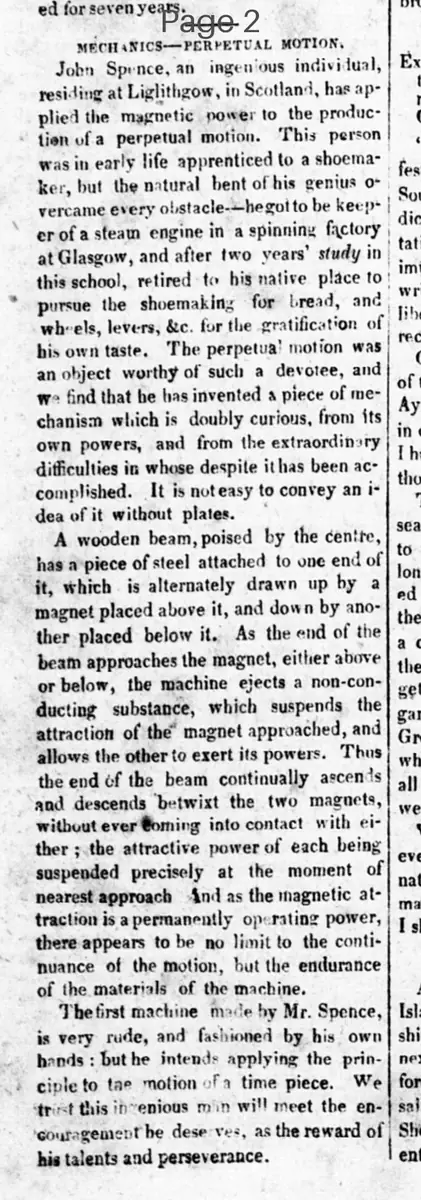
John Spence, an ingenious individual, residing at Linlithgow, in Scotland, has applied the magnetic power to the production of a perpetual motion. This person was in early life apprenticed to a shoemaker, but the natural bent of his genius overcame every obstacle—he got to be keeper of a steam engine in a spinning factory at Glasgow, and after two years' study in this school, retired to his native place to pursue the shoemaking for bread, and wheels, levers, &c. for the gratification of his own taste. The perpetual motion was an object worthy of such a devotee, and we find that he has invented a piece of mechanism which is doubly curious, from its own powers, and from the extraordinary difficulties in whose despite it has been accomplished. It is not easy to convey an idea of it without plates.
A wooden beam, poised by the centre, has a piece of steel attached to one end of it, which is alternately drawn up by a magnet placed above it, and down by another placed below it. As the end of the beam approaches the magnet, either above or below, the machine ejects a non-conducting substance, which suspends the attraction of the magnet approached, and allows the other to exert its powers. Thus the end of the beam continually ascends and descends betwixt the two magnets, without ever coming into contact with either; the attractive power of each being suspended precisely at the moment of nearest approach and as the magnetic attraction is a permanently operating power, there appears to be no limit to the continuance of the motion, but the endurance of the materials of the machine.
The first machine made by Mr. Spence, is very rude, and fashioned by his own hands: but he intends applying the principle to the motion of a time piece. We trust this ingenious man will meet the encouragement he deserves, as the reward of his talents and perseverance.
What sub-type of article is it?
What keywords are associated?
What entities or persons were involved?
Where did it happen?
Foreign News Details
Primary Location
Linlithgow, Scotland
Key Persons
Event Details
John Spence, apprenticed as a shoemaker but worked as a steam engine keeper in Glasgow, invented a perpetual motion mechanism. A wooden beam with steel at one end is poised centrally, drawn up by an upper magnet and down by a lower one. As it nears a magnet, a non-conducting substance suspends the attraction, allowing the other magnet to pull. The beam oscillates without contact, powered permanently by magnetic attraction, limited only by material endurance. His first machine is rudimentary, handmade, with plans to apply to a timepiece.