Thank you for visiting SNEWPapers!
Sign up free
Gazette Of The United States
New York, New York County, New York
What is this article about?
U.S. House of Representatives proceedings from February 3-5, 1790, including debates on bills for population enumeration, uniform naturalization, enforcement of laws in North Carolina, remission of fines and penalties, along with reports on memorials and petitions from Roger Alden, Joseph Henderson, John Carnes, and Ezra Smith. Several bills were recommitted amid discussions on residence requirements, representation ratios, and relief processes.
Merged-components note: Continuation of congressional proceedings on naturalization and enumeration bills, split across pages; sequential reading order and content flow indicate merge. Label changed from 'story' to 'domestic_news' as it reports on national legislative activities.
Clippings
1 of 2
OCR Quality
Full Text
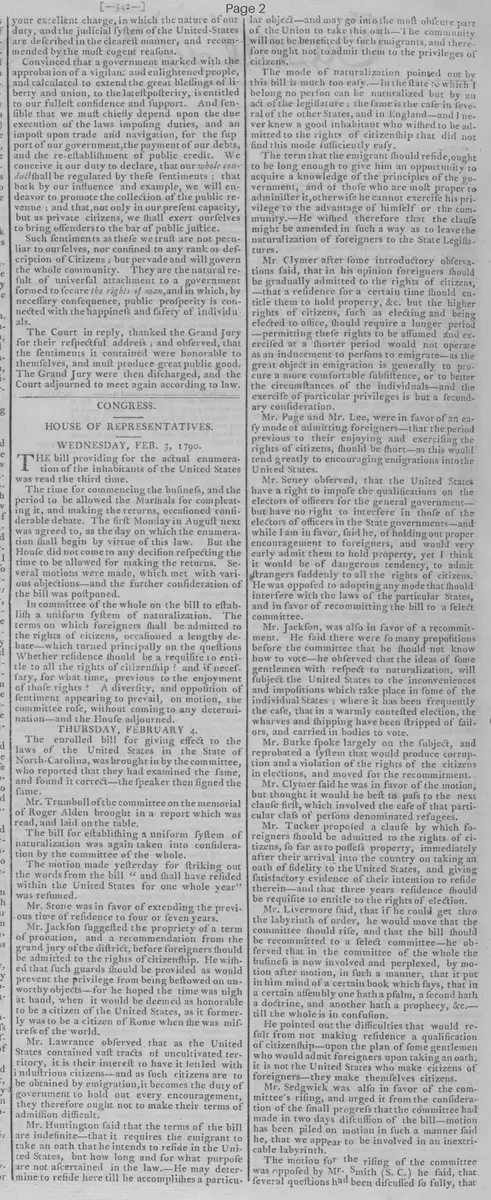
HOUSE OF REPRESENTATIVES.
WEDNESDAY, FEB. 3, 1790.
The bill for the enumeration of the inhabitants of the United States was read the third time.
The time for commencing the business, and the period to be allowed the Marshals for completing it, and making the returns, occasioned considerable debate. The first Monday in August next was agreed to, as the day on which the enumeration shall begin by virtue of this law. But the House did not come to any decision respecting the time to be allowed for making the returns. Several motions were made, which met with various objections and the further consideration of the bill was postponed.
In committee of the whole on the bill to establish a uniform system of naturalization. The terms on which foreigners shall be admitted to the rights of citizens, occasioned a lengthy debate—which turned principally on the questions Whether residence should be a requisite to entitle to all the rights of citizenship? and if necessary, for what time, previous to the enjoyment of those rights? A diversity, and opposition of sentiment appearing to prevail, on motion, the committee rose, without coming to any determination—and the House adjourned.
THURSDAY, FEBRUARY 4.
The enrolled bill for giving effect to the laws of the United States in the State of North-Carolina, was brought in by the committee, who reported that they had examined the same, and found it correct the Speaker then signed the same.
Mr. Trumbull of the committee on the memorial of Roger Alden brought in a report which was read, and laid on the table.
The bill for establishing a uniform system of naturalization was again taken into consideration by the committee of the whole.
The motion made yesterday for striking out the words from the bill "and shall have resided within the United States for one whole year" was resumed.
Mr. Stone was in favor of extending the previous time of residence to four or seven years.
Mr. Jackson suggested the propriety of a term of probation, and a recommendation from the grand jury of the district, before foreigners should be admitted to the rights of citizenship. He wished that such guards should be provided as would prevent the privilege from being bestowed on unworthy objects—for he hoped the time was nigh at hand, when it would be deemed as honorable to be a citizen of the United States, as it formerly was to be a citizen of Rome when she was mistress of the world.
Mr. Lawrence observed that as the United States contained vast tracts of uncultivated territory, it is their interest to have it settled with industrious citizens—and as such citizens are to be obtained by emigration, it becomes the duty of government to hold out every encouragement, they therefore ought not to make their terms of admission difficult.
Mr. Huntington said that the terms of the bill are indefinite—that it requires the emigrant to take an oath that he intends to reside in the United States, but how long and for what purpose are not ascertained in the law. He may determine to reside here till he accomplishes a particular object—and may go into the most obscure part of the Union to take this oath—I the community will not be benefited by such emigrants, and therefore ought not to admit them to the privileges of citizens.
The mode of naturalization pointed out by this bill is much too easy.—In the state to which I belong no person can be naturalized but by an act of the legislature; the same is the case in several of the other States, and in England and I never knew a good inhabitant who wished to be admitted to the rights of citizenship that did not find this mode sufficiently easy.
The term that the emigrant should reside, ought to be long enough to give him an opportunity to acquire a knowledge of the principles of the government, and of those who are not proper to administer it, otherwise he cannot exercise his privilege to the advantage of himself or the community.—He wished therefore that the clause might be amended in such a way as to leave the naturalization of foreigners to the State Legislatures.
Mr. Clymer after some introductory observations said, that in his opinion foreigners should be gradually admitted to the rights of citizens,—that a residence for a certain time should entitle them to hold property, &c. but the higher rights of citizens, such as electing and being elected to office, should require a longer period—permitting these rights to be assumed and exercised at a shorter period would not operate as an inducement to persons to emigrate—as the great object in emigration is generally to procure a more comfortable subsistence, or to better the circumstances of the individuals—and the exercise of particular privileges is but a secondary consideration.
Mr. Page and Mr. Lee, were in favor of an easy mode of admitting foreigners—that the period previous to their enjoying and exercising the rights of citizens, should be short—as this would tend greatly to encouraging emigrations into the United States.
Mr. Seney observed, that the United States have a right to impose the qualifications on the electors of officers for the general government—but have no right to interfere in those of the electors of officers in the State governments—and while I am in favor, said he, of holding out proper encouragement to foreigners, and would very early admit them to hold property, yet I think it would be of dangerous tendency, to admit strangers suddenly to all the rights of citizens.
He was opposed to adopting any mode that should interfere with the laws of the particular States, and in favor of recommitting the bill to a select committee.
Mr. Jackson, was also in favor of a recommittal. He said there were so many propositions before the committee that he should not know how to vote—he observed that the ideas of some gentlemen with respect to naturalization, will subject the United States to the inconveniences and impositions which take place in some of the individual States; where it has been frequently the case, that in a warmly contested election, the wharves and shipping have been stripped of sailors, and carried in bodies to vote.
Mr. Burke spoke largely on the subject, and reprobated a system that would produce corruption and a violation of the rights of the citizens in elections, and moved for the recommittal.
Mr. Clymer said he was in favor of the motion, but thought it would be best to pass to the next clause first, which involved the case of that particular class of persons denominated refugees.
Mr. Tucker proposed a clause by which foreigners should be admitted to the rights of citizens, so far as to possess property, immediately after their arrival into the country on taking an oath of fidelity to the United States, and giving satisfactory evidence of their intention to reside therein—and that three years residence should be requisite to entitle to the rights of election.
Mr. Livermore said, that if he could get thro the labyrinth of order, he would move that the committee should rise, and that the bill should be recommitted to a select committee—he observed that in the committee of the whole the business is now involved and perplexed, by motion after motion, in such a manner, that it put in him mind of a certain book which says, that in a certain assembly one hath a psalm, a second hath a doctrine, and another hath a prophecy, &c.— till the whole is in confusion.
He pointed out the difficulties that would result from not making residence a qualification of citizenship—upon the plan of some gentlemen who would admit foreigners upon taking an oath, it is not the United States who make citizens of foreigners they make themselves citizens.
Mr. Sedgwick was also in favor of the committee's rising, and urged it from the consideration of the small progress that the committee had made in two days discussion of the bill—motion has been piled on motion in such a manner said he, that we appear to be involved in an inextricable labyrinth.
The motion for the rising of the committee was opposed by Mr. Smith (S. C.) he said, that several questions had been discussed so fully, that The committee could now come to a decision as well, or better than at any other time—It is a question with some gentlemen whether residence shall be requisite to citizenship this it appeared necessary to determine previous to any further discussion —as the question will continually occur, till the sense of the committee is known—several other questions which depend on this, may now be decided, in this way the mind of the committee may be known, after which the bill may be recommitted to a select committee who may arrange the several parts of the bill so as to meet the general idea more fully.
The motion for the committee's rising was carried in the affirmative.
It was then voted that the bill be recommitted to a select committee consisting of a member from every State.
The House resumed the consideration of the bill for the actual enumeration of the inhabitants of the United States.—It was moved to recommit the bill.
Mr. Sedgwick adverting to the present rate of representation of the several States in Congress, and in which there is, said he, the most palpable inequality—observed, that it was absolutely necessary that such an enumeration as would be competent to equalizing the representation should be made previous to the next election—this is expected by the people on the idea of right and justice—and the constitution has wisely provided for it nor will the people who are not fully represented be easy without enjoying that weight and influence in the national legislature to which they are entitled—Mr. Sedgwick then read a proposition which he meant to offer as a clause to be incorporated in the bill when it shall be recommitted.
Mr. Jackson made some animadversions on this proposition, and reprobated its principles generally, more especially as it would not allow sufficient time to complete the enumeration, and particularly as it proposes that the President of the United States shall determine the number of inhabitants from the returns he shall receive from the Marshals, and the ratio of representation on those returns.
Mr. Smith (S. C.) objected to the proposition as not allowing sufficient time—he then went over the several periods which must probably elapse before the business of enumeration can be completed—from which it appeared that the object of the motion cannot be effected so as to make any alteration in the next election proper.
Mr. White made some observations on the proposition, and pointed out the difficulties that would attend the measure, as some of the States had passed laws regulating the time of elections—and presumed that the Legislature would never delegate to any man, or men, the power of determining the ratio of representation.
Mr. Lawrence was in favor of recommitting the bill : He observed, that it appeared to him, that the rule or ratio of representation ought to be determined previous to ascertaining the number of inhabitants—as in all probability that rule would be agreed to with less prejudice and partiality, while the contingencies which may affect it, are unknown.
Mr. Jackson observed, that this suggestion is an artifice, covered however with too thin a veil not to be seen thro'—it is too unsubstantial to support itself—the Constitution has settled the point already. He then recited those clauses which particularly point out the number of representatives which each State is entitled to elect, previous to any actual enumeration—the Constitution plainly directs an enumeration therefore, before the ratio of a future representation shall be settled.
Mr. Smith, (S. C.) observed, that the ratio of representation is already proposed by Congress in the amendments sent out to the Legislatures : He hoped that nothing would be done to impede the progress and ratification of those amendments.
Mr. Sedgwick said, that when he came forward with the proposition, he supposed it founded in such fair and equal principles, that he did not anticipate the smallest objection would have been made by any gentlemen whatever.
It is a simple proposition that justice should be done—that a more equal representation should be attempted, and effected—If inequalities do exist, and that they do, is very evident—can any gentleman object to a remedy ?
Some other observations were made, and then the motion for recommitting the bill to a committee of the whole House was put and carried in the affirmative.
FRIDAY, Feb. 5.
A memorial of Joseph Henderson, and John Carnes, executors to the estate of Edward Carnes, deceased, was read, and referred to the Secretary of the Treasury.
The report of the committee on the memorial of Roger Alden, was taken into consideration—this report after stating the services performed by Mr. Alden, in consequence of the charge which devolved on him by having the custody of the papers and records of the late Congress, proposes that he should be allowed a salary at the rate of 1000 dollars per annum, during the time he has been employed as aforesaid, also necessary expenses—and that the clerk which has been his assistant, be allowed at the rate of 500 dollars per annum.
This report was amended by adding these words after "per annum"—Until the Secretary of State shall enter on the duties of his office—and then accepted, and referred to the committee on appropriations.
The Secretary at war having reported onundry petitions and memorials referred to him—the reports were read, and laid on the table.
In committee of the whole on the bill for the remission, or mitigation of fines, forfeitures and penalties in certain cases. The bill was read and discussed in paragraphs. A motion was made that the following words, viz. "Offering to confess judgment for the same" previous to relief being granted, should be struck out.
Mr. Ames said he was indifferent whether the words were retained or struck out he wished however that the principles of the bill should be well understood—he conceived that a strict adherence to rule even if it should sometimes be attended with some degree of rigor, was a less evil than a lax mode of executing the laws ; that it may be considered as a great grievance to have frequent recourse to qualified interpretations of the laws—with regard to the revenue laws, it must strike every person that a certainty in the rule should be maintained in all possible cases—still fines, penalties and forfeitures may be incurred in such a way as may entitle to relief.—The object of the bill is to grant such relief with the least risque to the revenue, and in such way as that the person may receive it as soon as possible.
Mr. Sedgwick was in favor of the motion, and pointed out the injustice of requiring a confession previous to granting relief, as it would violate the feelings of a person not conscious of guilt—besides subjecting him inevitably to the loss of one half his property.
Mr. Burke wished the whole clause should be erased, he said it was like making a man confess murder and then hanging him for his confession.
Mr. Wadsworth stated a case to shew that this law would make the situation of persons designed to be relieved by it, much worse than it now is—and will eventually destroy the coasting trade.
Mr. Lawrence stated the process by the law as it now stands, by which persons absolutely violating the laws intentionally or through ignorance, are precluded from all relief he therefore insisted that it is necessary that this confession of judgment should accompany the application for relief, in cases designed to be provided for by the bill—without this confession the application appears to be absurd—he was therefore opposed to the motion for striking out the words.
Mr. Smith was in favor of striking out the words.
Mr. Sturges observed, that he did not conceive the relief proposed to be administered, ought to be considered in the light of mercy, but of justice. The mode of relief pointed out by this bill, let the circumstances be as they will, leaves the sufferer in a situation that no person ought to be liable to, who is not guilty of intentional and willful violation of the laws for at any rate he is to lose one half his property. He thought the case, stated by the gentleman from South Carolina, very pertinent to the present.
Mr. Fitzsimons said, he hoped if these words are struck out, that the whole clause would be erased, and that there would be a more equitable mode pointed out.
He adverted to the practice in England, where the application for relief is made to the Commissioners after trial.
Mr. White followed Mr. Fitzsimons in similar observations.
Mr. Ames entered into a full discussion of the principles of the bill and observed, that he doubted not when the committee had possessed themselves of a more perfect knowledge of its operation and tendency, it would meet with approbation.
With respect to the offender's losing his whole property on confession, he observed, that this inconvenience may be prevented, by the person's filing his petition previous to the entry's being made by the persons seizing the property— and this he will always have it in his power to do.
Mr. Burke said that the bill so far from affording the relief proposed, would prove a snare to the citizens, for a confession of guilt would inevitably involve the loss of one half of his property whether he merits punishment or not.
Mr. Sedgwick, Mr. Stone, and Mr. Scott spoke on the subject.
The motion for striking out the words being put was carried in the affirmative.
Mr. Fitzsimons then moved that the committee should rise—the committee rose, and the House agreed to the amendment.
It was then moved that the bill should be recommitted.—This motion was adopted.
The report of the Secretary at War on the petition of Ezra Smith was taken into consideration. This report went into a general consideration of the cases of sundry officers of the late army, whose particular circumstances appear to call for the interposition of government in their favor.
It was moved that this report should be referred to a select committee, who should be instructed to bring in a bill pursuant thereto.
This motion was opposed as establishing an improper precedent—it was contended that it ought to be previously discussed in a committee of the whole,and the result of their deliberations should be the basis of the bill that may be thought necessary.
On the other hand, it was said, that the state of facts is before the House, on which they may form a judgment, that the going into a committee of the whole would not throw any new light on the subject and that the House is now prepared to refer it to a select committee as fully as they can be after the form is gone through.
The motion for referring the report to a select committee was withdrawn—.It was then ordered that the report should lie on the table.
Adjourned till Monday 11 o'clock.
What sub-type of article is it?
What keywords are associated?
What entities or persons were involved?
Domestic News Details
Event Date
February 3 5, 1790
Key Persons
Outcome
bills on enumeration and naturalization recommitted; north-carolina bill signed; alden report amended and referred; fines remission bill amended and recommitted; memorials and war reports laid on table or referred.
Event Details
The House debated the enumeration bill, agreeing on August start but postponing returns timeline and later recommitting it amid discussions on equalizing representation. Extensive debate on naturalization bill focused on residence requirements (1-7 years proposed), probation, and state vs. federal control, leading to recommittal to a select committee. The North-Carolina laws bill was signed. Roger Alden's memorial report for salary and expenses was amended and referred. The fines remission bill saw debate on confessing judgment clause, which was struck, and the bill recommitted. Memorials from Henderson/Carnes and war secretary reports were referred or tabled; Ezra Smith's petition report tabled after motion withdrawal.