Thank you for visiting SNEWPapers!
Sign up free
Editorial
October 23, 1865
The Day Book
Norfolk, Virginia
What is this article about?
Post-Civil War editorial urging peace and reconciliation, highlighting Confederate soldiers' support for President Johnson's restoration efforts, and quoting the Richmond Times on the need for national pacification through religious, press, and political unity.
Clipping
OCR Quality
95%
Excellent
Full Text
peace.
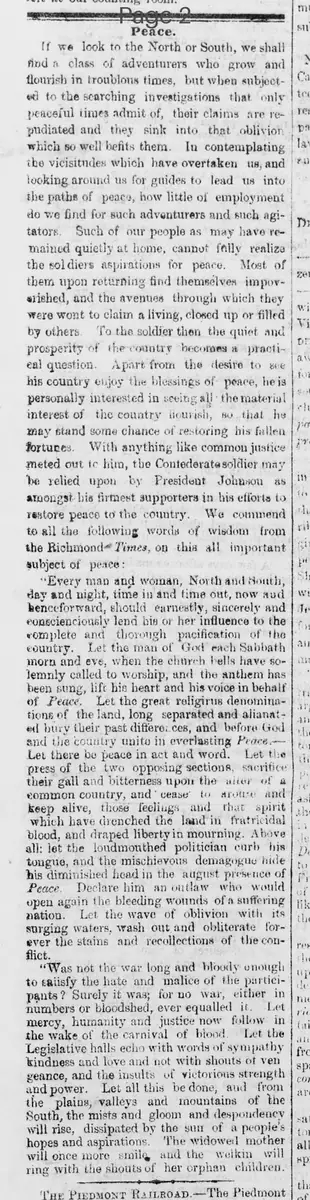
If we look to the North or South, we shall find a class of adventurers who grow and flourish in troublous times, but when subjected to the searching investigations that only peaceful times admit of, their claims are repudiated and they sink into that oblivion which so well befits them. In contemplating the vicissitudes which have overtaken us, and looking around us for guides to lead us into the paths of peace, how little of employment do we find for such adventurers and such agitators. Such of our people as may have remained quietly at home, cannot fully realize the soldiers aspirations for peace. Most of them upon returning find themselves impoverished, and the avenues through which they were wont to claim a living, closed up or filled by others. To the soldier then the quiet and prosperity of the country becomes a practical question. Apart from the desire to see his country enjoy the blessings of peace, he is personally interested in seeing all the material interest of the country nourish, so that he may stand some chance of restoring his fallen fortunes. With anything like common justice meted out to him, the Confederate soldier may be relied upon by President Johnson as amongst his firmest supporters in his efforts to restore peace to the country. We commend to all the following words of wisdom from the Richmond Times, on this all important subject of peace:
"Every man and woman, North and South, day and night, time in and time out, now and henceforward, should earnestly, sincerely and conscientiously lend his or her influence to the complete and thorough pacification of the country. Let the man of God each Sabbath morn and eve, when the church bells have solemnly called to worship, and the anthem has been sung, lift his heart and his voice in behalf of Peace. Let the great religious denominations of the land, long separated and alienated bury their past differences, and before God and the country unite in everlasting Peace. Let there be peace in act and word. Let the press of the two opposing sections, sacrifice their gall and bitterness upon the altar of a common country, and cease to arouse and keep alive, those feelings and that spirit which have drenched the land in fratricidal blood, and draped liberty in mourning. Above all: let the loudmouthed politician curb his tongue, and the mischievous demagogue hide his diminished head in the august presence of Peace. Declare him an outlaw who would open again the bleeding wounds of a suffering nation. Let the wave of oblivion with its surging waters, wash out and obliterate forever the stains and recollections of the conflict.
"Was not the war long and bloody enough to satisfy the hate and malice of the participants? Surely it was; for no war, either in numbers or bloodshed, ever equalled it. Let mercy, humanity and justice now follow in the wake of the carnival of blood. Let the Legislative halls echo with words of sympathy kindness and love and not with shouts of vengeance, and the insults of victorious strength and power. Let all this be done, and from the plains, valleys and mountains of the South, the mists and gloom and despondency will rise, dissipated by the sun of a people's hopes and aspirations. The widowed mother will once more smile, and the widow will ring with the shouts of her orphan children."
If we look to the North or South, we shall find a class of adventurers who grow and flourish in troublous times, but when subjected to the searching investigations that only peaceful times admit of, their claims are repudiated and they sink into that oblivion which so well befits them. In contemplating the vicissitudes which have overtaken us, and looking around us for guides to lead us into the paths of peace, how little of employment do we find for such adventurers and such agitators. Such of our people as may have remained quietly at home, cannot fully realize the soldiers aspirations for peace. Most of them upon returning find themselves impoverished, and the avenues through which they were wont to claim a living, closed up or filled by others. To the soldier then the quiet and prosperity of the country becomes a practical question. Apart from the desire to see his country enjoy the blessings of peace, he is personally interested in seeing all the material interest of the country nourish, so that he may stand some chance of restoring his fallen fortunes. With anything like common justice meted out to him, the Confederate soldier may be relied upon by President Johnson as amongst his firmest supporters in his efforts to restore peace to the country. We commend to all the following words of wisdom from the Richmond Times, on this all important subject of peace:
"Every man and woman, North and South, day and night, time in and time out, now and henceforward, should earnestly, sincerely and conscientiously lend his or her influence to the complete and thorough pacification of the country. Let the man of God each Sabbath morn and eve, when the church bells have solemnly called to worship, and the anthem has been sung, lift his heart and his voice in behalf of Peace. Let the great religious denominations of the land, long separated and alienated bury their past differences, and before God and the country unite in everlasting Peace. Let there be peace in act and word. Let the press of the two opposing sections, sacrifice their gall and bitterness upon the altar of a common country, and cease to arouse and keep alive, those feelings and that spirit which have drenched the land in fratricidal blood, and draped liberty in mourning. Above all: let the loudmouthed politician curb his tongue, and the mischievous demagogue hide his diminished head in the august presence of Peace. Declare him an outlaw who would open again the bleeding wounds of a suffering nation. Let the wave of oblivion with its surging waters, wash out and obliterate forever the stains and recollections of the conflict.
"Was not the war long and bloody enough to satisfy the hate and malice of the participants? Surely it was; for no war, either in numbers or bloodshed, ever equalled it. Let mercy, humanity and justice now follow in the wake of the carnival of blood. Let the Legislative halls echo with words of sympathy kindness and love and not with shouts of vengeance, and the insults of victorious strength and power. Let all this be done, and from the plains, valleys and mountains of the South, the mists and gloom and despondency will rise, dissipated by the sun of a people's hopes and aspirations. The widowed mother will once more smile, and the widow will ring with the shouts of her orphan children."
What sub-type of article is it?
War Or Peace
Moral Or Religious
What keywords are associated?
Civil War Peace
Reconstruction
Confederate Soldiers
President Johnson
National Pacification
Reconciliation
What entities or persons were involved?
President Johnson
Confederate Soldier
Richmond Times
Editorial Details
Primary Topic
Promotion Of Peace And Reconciliation After The Civil War
Stance / Tone
Strongly Supportive Of Peace Efforts And President Johnson
Key Figures
President Johnson
Confederate Soldier
Richmond Times
Key Arguments
Adventurers And Agitators Thrive In War But Fade In Peace
Soldiers Aspire To Peace For National Blessings And Personal Recovery
Confederate Soldiers Will Support Johnson With Justice
All Should Promote Pacification Through Religion, Press, And Politics
War Was Bloody Enough; Now Mercy And Justice Are Needed
Peace Will Dispel Southern Gloom And Bring Joy