Thank you for visiting SNEWPapers!
Sign up free
Gazette Of The United States And Daily Evening Advertiser
Philadelphia, Philadelphia County, Pennsylvania
What is this article about?
In Paris on Dec. 9, public anticipation builds for trials of former revolutionary committees amid denunciations of their crimes. The trial of deputy J.B. Carrier for Nantes atrocities begins Nov. 27 before the Revolutionary Tribunal, with procedural objections overruled and adjournment to the next day.
Clipping
OCR Quality
Full Text
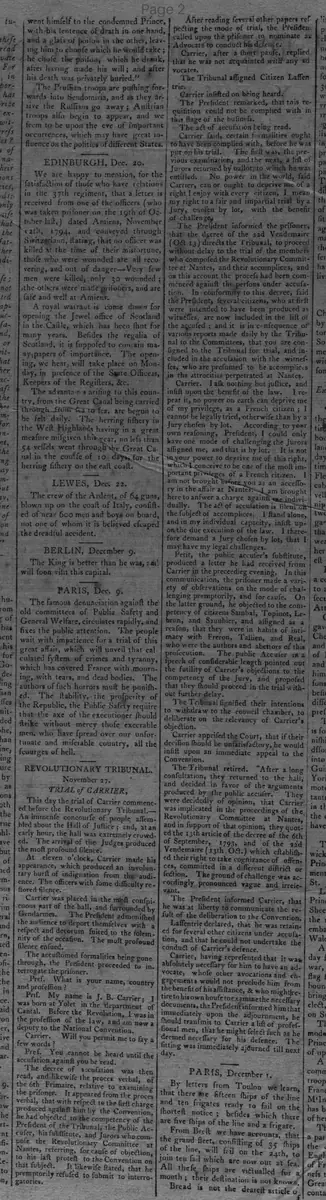
The famous denunciation against the old committees of Public Safety and General Welfare, circulates rapidly, and fixes the public attention. The people wait with impatience for a trial of this great affair, which will unveil that calculated system of crimes and tyranny, which has covered France with mourning, with tears, and dead bodies. The authors of such horrors must be punished. The stability, the prosperity of the Republic, the Public Safety require that the axe of the executioner should strike without mercy those execrable men, who have spread over our unfortunate and miserable country, all the scourges of hell.
REVOLUTIONARY TRIBUNAL.
November 27.
TRIAL of CARRIER,
This day the trial of Carrier commenced before the Revolutionary Tribunal.—An immense concourse of people assembled about the Hall of Justice; and, at an early hour, the hall was extremely crowded. The arrival of the Judges produced the most profound silence.
At eleven o'clock, Carrier made his appearance, which produced an involuntary burst of indignation from the audience. The officers with some difficulty restored silence.
Carrier was placed in the most conspicuous part of the hall, and surrounded by Gendarmes. The President admonished the audience to deport themselves with a respect and decorum suited to the dignity of the occasion. The most profound silence ensued.
The accustomed formalities being gone through, the President proceeded to interrogate the prisoner.
Pre. What is your name, country and profession?
Pri. My name is J. B. Carrier; I was born at Yolet in the department of Cantal. Before the Revolution, I was in the profession of the law, and am now a deputy to the National Convention.
Carrier. Will you permit me to say a few words?
Pre. You cannot be heard until the accusation against you be read.
The decree of accusation was then read, and likewise the proces verbal, of the 6th Frimaire, relative to examining the prisoner. It appeared from the proces verbal, that with respect to the first charge produced against him by the Convention, he had objected to the competency of the President of the Tribunal, the Public Accuser, his substitute, and Jurors who compose the Revolutionary Committee at Nantes, referring, for cause of objection, to his last protest to the Convention on that subject. It likewise stated, that he peremptorily refused to submit to interrogatories.
After reading several other papers respecting the mode of trial, the President called upon the prisoner to nominate an Advocate to conduct his defence.
Carrier, after a short pause, replied that he was not acquainted with any advocates.
The Tribunal assigned Citizen Laffentrie.
Carrier insisted on being heard.
The President remarked, that this requisition could not be complied with in this stage of the business.
The act of accusation being read.
Carrier said, certain formalities ought to have been complied with, before he was put on his trial. The first was, the previous examination, and the next, a list of Jurors returned by ballot, to which he was entitled. No power in the world, said Carrier, can or ought to deprive me of a right I enjoy with every citizen, I mean my right to a fair and impartial trial by a Jury, chosen by lot, with the benefit of challenge.
The President informed the prisoner, that the decree of the 22d Vendemaire (Oct 13) directs the tribunal, to proceed without delay to the trial of the members who composed the Revolutionary Committee at Nantes, and their accomplices, and on this account the proces had been commenced against the persons under accusation. In conformity to this decree, said the President, several citizens, who at first were intended to have been produced as witnesses, are now included in the list of the accused; and it is in consequence of various reports made daily by the Tribunal to the Committees, that you are consigned to the Tribunal for trial, and included in the accusation with the witnesses, who are presumed to be accomplices in the atrocities perpetrated at Nantes.
Carrier. I ask nothing but justice, and insist upon the benefit of the law. I repeat it, no power on earth can deprive me of my privilege, as a French citizen; I cannot be legally tried, otherwise than by a Jury chosen by lot. According to your own reasoning, President, I could only have one mode of challenging the Jurors assigned me, and that is by lot. It is not in your power to deprive me of this right, which I conceive to be one of the most important privileges of a French citizen. I am not brought before you as an accessory in the affair at Nantes. I am brought here to answer a charge against me individually. The act of accusation is silent on the subject of accomplices. I stand alone, and in my individual capacity, insist upon the due execution of the law. I therefore demand a Jury chosen by lot, that I may have my legal challenges.
Petit, the public accuser's substitute, produced a letter he had received from Carrier in the preceding evening. In this communication, the prisoner made a variety of observations on the mode of challenging peremptorily, and for cause. On the latter ground, he objected to the competency of citizens Sambal, Topinot, Lebrun, and Saunbier, and assigned as a reason, that they were in habits of intimacy with Freron, Tallien, and Real, who were the authors and abettors of this prosecution. The public Accuser in a speech of considerable length pointed out the futility of Carrier's objections to the competency of the Jury, and proposed that they should proceed in the trial without further delay.
The Tribunal signified their intentions to withdraw to the council chamber, to deliberate on the relevancy of Carrier's objection.
Carrier applied to the Court, that if their decision should be unsatisfactory, he would insist upon an immediate appeal to the Convention.
The Tribunal retired. After a long consultation, they returned to the hall, and decided in favor of the arguments produced by the public accuser. They were decidedly of opinion, that Carrier was implicated in the proceedings of the Revolutionary Committee at Nantes, and in support of that opinion, they quoted the 13th article of the decree of the 6th of September, 1793, and of the 22d Vendemaire (13th, Oct.) which established their right to take cognizance of offences, committed in a different district or section. The ground of challenge was accordingly pronounced vague and irrelevant.
The President informed Carrier, that he was at liberty to communicate the result of the deliberation to the Convention.
Laffentrie declared, that he was retained for several other citizens under accusation, and that he could not undertake the conduct of Carrier's defence.
Carrier, having represented that it was absolutely necessary for him to have an advocate, whose other avocations and engagements would not preclude him from the benefit of his assistance, & who might retire to his own house to examine the necessary documents, the President informed him that immediately upon the adjournment, he should transmit to Carrier a list of professional men, that he might select such as he deemed necessary for his defence. The sitting was immediately adjourned till next day.
What sub-type of article is it?
What keywords are associated?
What entities or persons were involved?
Where did it happen?
Foreign News Details
Primary Location
Paris
Event Date
Dec. 9 And November 27
Key Persons
Outcome
trial commenced; carrier's objections to jury and procedures overruled; assigned advocate unavailable, new list to be provided; adjourned till next day.
Event Details
Public anticipation grows in Paris for trials of former Committees of Public Safety and General Welfare due to circulating denunciations of their crimes and tyranny. On November 27, the trial of J.B. Carrier, deputy accused of atrocities at Nantes, begins before the Revolutionary Tribunal amid crowd indignation. Carrier objects to tribunal competency, demands jury by lot and challenges; tribunal overrules based on decrees, includes him as accomplice.