Thank you for visiting SNEWPapers!
Sign up free
Literary
June 5, 1790
Gazette Of The United States
New York, New York County, New York
What is this article about?
This essay continues arguing that the universal diffusion of literature precedes and prepares for the prevalence of religion. It examines how advanced civilizations like the Greeks and Romans were more receptive to rational religion and Christianity due to their literary progress, contrasting with ignorant societies.
Clipping
OCR Quality
98%
Excellent
Full Text
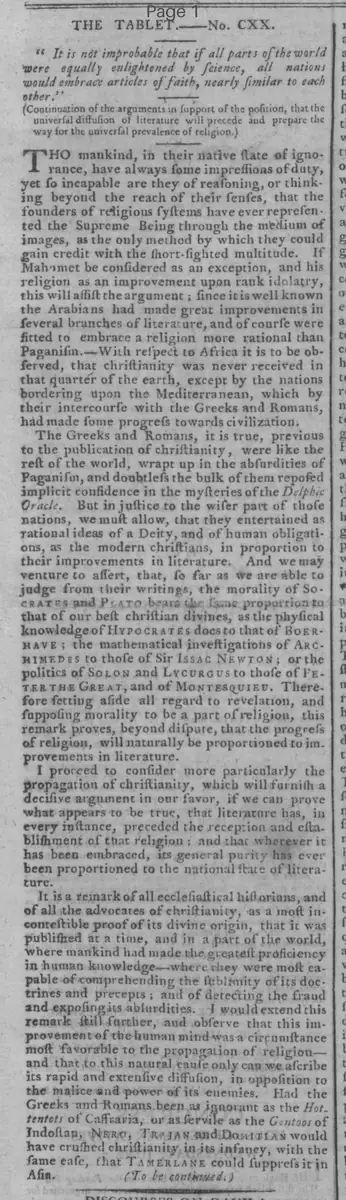
THE TABLET.-No. CXX.
It is not improbable that if all parts of the world were equally enlightened by science, all nations would embrace articles of faith, nearly similar to each other.
(Continuation of the arguments in support of the position, that the universal diffusion of literature will precede and prepare the way for the universal prevalence of religion.)
Though mankind, in their native state of ignorance, yet so incapable are they of reasoning, or thinking beyond the reach of their senses, that the founders of religious systems have ever represented the Supreme Being through the medium of images, as the only method by which they could gain credit with the short-sighted multitude. If Mahomet be considered as an exception, and his religion as an improvement upon rank idolatry, this will assist the argument; since it is well known the Arabians had made great improvements in several branches of literature, and of course were fitted to embrace a religion more rational than Paganism. With respect to Africa it is to be observed, that Christianity was never received in that quarter of the earth, except by the nations bordering upon the Mediterranean, which by their intercourse with the Greeks and Romans, had made some progress towards civilization. The Greeks and Romans, it is true, previous to the publication of Christianity, were like the rest of the world, wrapt up in the absurdities of Paganism, and doubtless the bulk of them reposed implicit confidence in the mysteries of the Delphic Oracle. But in justice to the wiser part of those nations, we must allow, that they entertained as rational ideas of a Deity, and of human obligations, as the modern Christians, in proportion to their improvements in literature. And we may venture to assert, that, so far as we are able to judge from their writings, the morality of SOCRATES and PLATO bears the same proportion to that of our best Christian divines, as the physical knowledge of HIPPOCRATES does to that of BOERHAave; the mathematical investigations of ARCHIMEDES to those of Sir ISAAC NEWTON; or the politics of Solon and Lycurgus to those of PETER THE GREAT, and of MONTESQUIEU. Therefore setting aside all regard to revelation, and supposing morality to be a part of religion, this remark proves, beyond dispute, that the progress of religion, will naturally be proportioned to improvements in literature.
I proceed to consider more particularly the propagation of Christianity, which will furnish a decisive argument in our favor, if we can prove what appears to be true, that literature has, in every instance, preceded the reception and establishment of that religion; and that wherever it has been embraced, its general purity has ever been proportioned to the national state of literature.
It is a remark of all ecclesiastical historians, and of all the advocates of Christianity, as a most incontestable proof of its divine origin, that it was published at a time, and in a part of the world, where mankind had made the greatest proficiency in human knowledge—where they were most capable of comprehending the sublimity of its doctrines and precepts; and of detecting the fraud and exposing its absurdities. I would extend this remark still further, and observe that this improvement of the human mind was a circumstance most favorable to the propagation of religion—and that to this natural cause only can we ascribe its rapid and extensive diffusion, in opposition to the malice and power of its enemies. Had the Greeks and Romans been as ignorant as the Hottentots of Caffraria, or as servile as the Gentoos of Indostan, NERO, TRAJAN and DOMITIAN would have crushed Christianity in its infancy, with the same ease, that Tamerlane could suppress it in Asia.
(To be continued.)
It is not improbable that if all parts of the world were equally enlightened by science, all nations would embrace articles of faith, nearly similar to each other.
(Continuation of the arguments in support of the position, that the universal diffusion of literature will precede and prepare the way for the universal prevalence of religion.)
Though mankind, in their native state of ignorance, yet so incapable are they of reasoning, or thinking beyond the reach of their senses, that the founders of religious systems have ever represented the Supreme Being through the medium of images, as the only method by which they could gain credit with the short-sighted multitude. If Mahomet be considered as an exception, and his religion as an improvement upon rank idolatry, this will assist the argument; since it is well known the Arabians had made great improvements in several branches of literature, and of course were fitted to embrace a religion more rational than Paganism. With respect to Africa it is to be observed, that Christianity was never received in that quarter of the earth, except by the nations bordering upon the Mediterranean, which by their intercourse with the Greeks and Romans, had made some progress towards civilization. The Greeks and Romans, it is true, previous to the publication of Christianity, were like the rest of the world, wrapt up in the absurdities of Paganism, and doubtless the bulk of them reposed implicit confidence in the mysteries of the Delphic Oracle. But in justice to the wiser part of those nations, we must allow, that they entertained as rational ideas of a Deity, and of human obligations, as the modern Christians, in proportion to their improvements in literature. And we may venture to assert, that, so far as we are able to judge from their writings, the morality of SOCRATES and PLATO bears the same proportion to that of our best Christian divines, as the physical knowledge of HIPPOCRATES does to that of BOERHAave; the mathematical investigations of ARCHIMEDES to those of Sir ISAAC NEWTON; or the politics of Solon and Lycurgus to those of PETER THE GREAT, and of MONTESQUIEU. Therefore setting aside all regard to revelation, and supposing morality to be a part of religion, this remark proves, beyond dispute, that the progress of religion, will naturally be proportioned to improvements in literature.
I proceed to consider more particularly the propagation of Christianity, which will furnish a decisive argument in our favor, if we can prove what appears to be true, that literature has, in every instance, preceded the reception and establishment of that religion; and that wherever it has been embraced, its general purity has ever been proportioned to the national state of literature.
It is a remark of all ecclesiastical historians, and of all the advocates of Christianity, as a most incontestable proof of its divine origin, that it was published at a time, and in a part of the world, where mankind had made the greatest proficiency in human knowledge—where they were most capable of comprehending the sublimity of its doctrines and precepts; and of detecting the fraud and exposing its absurdities. I would extend this remark still further, and observe that this improvement of the human mind was a circumstance most favorable to the propagation of religion—and that to this natural cause only can we ascribe its rapid and extensive diffusion, in opposition to the malice and power of its enemies. Had the Greeks and Romans been as ignorant as the Hottentots of Caffraria, or as servile as the Gentoos of Indostan, NERO, TRAJAN and DOMITIAN would have crushed Christianity in its infancy, with the same ease, that Tamerlane could suppress it in Asia.
(To be continued.)
What sub-type of article is it?
Essay
What themes does it cover?
Religious
Moral Virtue
What keywords are associated?
Literature
Religion
Christianity
Greek Roman
Morality
Propagation
Civilization
Paganism
Literary Details
Title
The Tablet. No. Cxx.
Subject
Continuation Of The Arguments In Support Of The Position, That The Universal Diffusion Of Literature Will Precede And Prepare The Way For The Universal Prevalence Of Religion.
Key Lines
Though Mankind, In Their Native State Of Ignorance, Yet So Incapable Are They Of Reasoning, Or Thinking Beyond The Reach Of Their Senses, That The Founders Of Religious Systems Have Ever Represented The Supreme Being Through The Medium Of Images, As The Only Method By Which They Could Gain Credit With The Short Sighted Multitude.
And We May Venture To Assert, That, So Far As We Are Able To Judge From Their Writings, The Morality Of Socrates And Plato Bears The Same Proportion To That Of Our Best Christian Divines, As The Physical Knowledge Of Hippocrates Does To That Of Boerhaave; The Mathematical Investigations Of Archimedes To Those Of Sir Isaac Newton; Or The Politics Of Solon And Lycurgus To Those Of Peter The Great, And Of Montesquieu.
It Is A Remark Of All Ecclesiastical Historians, And Of All The Advocates Of Christianity, As A Most Incontestable Proof Of Its Divine Origin, That It Was Published At A Time, And In A Part Of The World, Where Mankind Had Made The Greatest Proficiency In Human Knowledge—Where They Were Most Capable Of Comprehending The Sublimity Of Its Doctrines And Precepts; And Of Detecting The Fraud And Exposing Its Absurdities.
Had The Greeks And Romans Been As Ignorant As The Hottentots Of Caffraria, Or As Servile As The Gentoos Of Indostan, Nero, Trajan And Domitian Would Have Crushed Christianity In Its Infancy, With The Same Ease, That Tamerlane Could Suppress It In Asia.