Thank you for visiting SNEWPapers!
Sign up free
Editorial
September 16, 1934
Mcallen Daily Monitor
Mcallen, Brownsville, Harlingen, Hidalgo County, Cameron County, Texas
What is this article about?
In this 1934 editorial, Ralph G. Bray defends the National Recovery Administration (NRA) against partisan critics, arguing it is essential for economic recovery from the Great Depression, superior to the Hoover era's failures, and vital to preserving American democracy under Roosevelt, despite acknowledged flaws and chiselers.
Clipping
OCR Quality
95%
Excellent
Full Text
Sunday, September 16, 1934
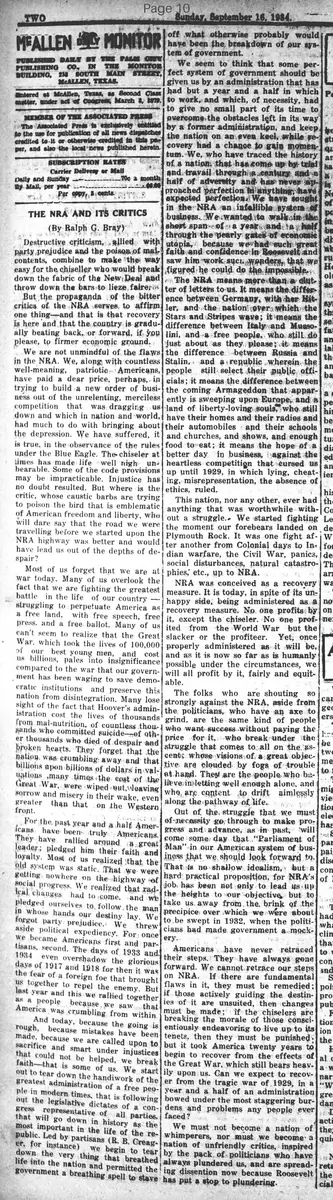
THE NRA AND ITS CRITICS
(By Ralph G. Bray)
Destructive criticism, allied with
party prejudice and the poison of malice
contents, combine to make the way
easy for the chiseller who would break
down the fabric of the New Deal and
throw down the bars to laissez-faireism.
But the propaganda of the bitter
critics of the NRA serves to affirm
one thing—and that is that recovery
is here and that the country is gradually
beating back, or forward, if you
please, to firmer economic ground.
We are not unmindful of the flaws
in the NRA. We, along with countless
well-meaning, patriotic Americans,
have paid a dear price, perhaps, in
trying to build a new order of business
out of the unrelenting, merciless
competition that was dragging us
down and which in nation and world
had much to do with bringing about
the depression. We have suffered, it
is true, in the observance of the rules
under the Blue Eagle. The chiseller at
times has made life well nigh unbearable.
Some of the code provisions
may be impracticable. Injustice has
no doubt resulted. But where is the
critic, whose caustic barbs are trying
to poison the bird that is emblematic
of American freedom and liberty, who
will dare say that the road we were
travelling before we started upon the
NRA highway was better and would
have led us out of the depths of despair?
Most of us forget that we are at
war today. Many of us overlook the
fact that we are fighting the greatest
battle in the life of our country—
struggling to perpetuate America as
a free land, with free speech, free
press, and a free ballot. Many of us
can't seem to realize that the Great
War, which took the lives of 100,000
of our best young men, and cost
us billions, pales into insignificance
compared to the war that our government
has been waging to save democratic
institutions and preserve this
nation from disintegration. Many lose
sight of the fact that Hoover's administration
cost the lives of thousands
from mal-nutrition, of countless thousands
who committed suicide, of other
thousands who died of despair and
broken hearts. They forget that the
nation was crumbling away and that
billions upon billions of dollars in valuations,
many times the cost of the
Great War, were wiped out, leaving
sorrow and misery in their wake, even
greater than that on the Western
front.
For the past year and a half Americans
have been truly Americans.
They have rallied around a great
leader; pledged him their faith and
loyalty. Most of us realized that the
old system was static. That we were
getting nowhere on the highway of
social progress. We realized that radical
changes had to come, and we
pledged ourselves to follow the man
in whose hands our destiny lay. We
forgot party prejudice. We threw
aside political expediency. For once
we became Americans first and partisans
second. The days of 1933 and
1934 even overshadow the glorious
days of 1917 and 1918 for then it was
the fear of a foreign foe that brought
us together to repel the enemy. But
last year and this we rallied together
as a people because we saw that
America was crumbling from within.
And today, because the going is
rough, because mistakes have been
made, because we are called upon to
sacrifice and smart under injustices
that could not be helped, we break
faith—that is some of us. We start
out to tear down the handiwork of the
greatest administration of a free people
in modern times, that is following
out the legislative dictates of a congress
representative of all parties,
that will go down in history as the
most important in the life of the republic.
Led by partisans (R. B. Creager,
for instance) we begin to tear
down the very thing that breathed
life into the nation and permitted the
government a breathing spell to stave
off what otherwise probably would
have been the breakdown of our system
of government.
We seem to think that some perfect
system of government should be
given us by an administration that has
had but a year and a half in which
to work, and which, of necessity, had
to give no small part of its time to
overcome the obstacles left in its way
by a former administration, and keep
the nation on an even keel, while recovery
had a chance to gain momentum.
We, who have traced the history
of a nation that has come up by trial
and travail through a century and a
half of adversity and has never approached
perfection in anything, have
expected perfection. We have sought
in the NRA an infallible system of
business. We wanted to walk in the
short span of a year and a half
through the pearly gates of economic
utopia, because we had such great
faith and confidence in Roosevelt and
saw him work such wonders, that we
figured he could do the impossible.
The NRA means more than a cluster
of letters to us. It means the difference
between Germany, with her Hitler,
and the nation over which the
Stars and Stripes wave; it means the
difference between Italy and Mussolini,
and a free people, who still do
just about as they please; it means
the difference between Russia and
Stalin, and a republic wherein the
people still select their public officials;
it means the difference between
the coming Armageddon that apparently
is sweeping upon Europe, and a
land of liberty-loving souls, who still
have their homes and their radios and
their automobiles and their schools
and churches, and shows, and enough
food to eat; it means the hope of a
better day in business, against the
heartless competition that cursed us
up until 1929, in which lying, cheating,
misrepresentation, the absence of
ethics, ruled.
This nation, nor any other, ever had
anything that was worthwhile without
a struggle. We started fighting
the moment our forebears landed on
Plymouth Rock. It was one fight after
another from Colonial days to Indian
warfare, the Civil War, panics,
social disturbances, natural catastrophes,
etc., up to NRA.
NRA was conceived as a recovery
measure. It is today, in spite of its unhappy
side, being administered as a
recovery measure. No one profits by
it, except the chiseler. No one profited
from the World War but the
slacker or the profiteer. Yet, once
properly administered as it will be,
and as it is now so far as is humanly
possible under the circumstances, we
will all profit by it, fairly and equitably.
The folks who are shouting so
strongly against the NRA, aside from
the politicians who have an axe to
grind, are the same kind of people
who want success without paying the
price for it, who break under the
struggle that comes to all on the ascent;
whose visions of a great objective
are clouded by fogs of trouble
at hand. They are the people who believe
in letting well enough alone, and
who are content to drift aimlessly
along the pathway of life.
Out of the struggle that we must
of necessity go through to make progress
and advance, as in past, will
come some day that 'Parliament of
Man' in our American system of business
that we should look forward to.
That is no shallow idealism, but a
hard practical proposition, for NRA's
job has been not only to lead us up
the heights to our objective, but to
take us away from the brink of the
precipice over which we were about
to be swept in 1932, when the politicians
had made government a mockery.
Americans have never retraced
their steps. They have always gone
forward. We cannot retrace our steps
on NRA. If there are fundamental
flaws in it, they must be remedied;
if those actively guiding the destinies
of it are unsuited, then changes
must be made; if the chiselers are
breaking the morale of those conscientiously
endeavoring to live up to its
Tenets, then they must be punished.
But it took America twenty years to
begin to recover from the effects of
the Great War, which still bears heavily
upon us. Can we expect to recover
from the tragic war of 1929, in a
year and a half of an administration
bowed under the most staggering burdens
and problems any people ever
faced?
We must not become a nation of
whimperers, nor must we become a
nation of unfriendly critics, inspired
by the pack of politicians who have
always plundered us, and are spreading
dissension now because Roosevelt
has put a stop to plundering.
THE NRA AND ITS CRITICS
(By Ralph G. Bray)
Destructive criticism, allied with
party prejudice and the poison of malice
contents, combine to make the way
easy for the chiseller who would break
down the fabric of the New Deal and
throw down the bars to laissez-faireism.
But the propaganda of the bitter
critics of the NRA serves to affirm
one thing—and that is that recovery
is here and that the country is gradually
beating back, or forward, if you
please, to firmer economic ground.
We are not unmindful of the flaws
in the NRA. We, along with countless
well-meaning, patriotic Americans,
have paid a dear price, perhaps, in
trying to build a new order of business
out of the unrelenting, merciless
competition that was dragging us
down and which in nation and world
had much to do with bringing about
the depression. We have suffered, it
is true, in the observance of the rules
under the Blue Eagle. The chiseller at
times has made life well nigh unbearable.
Some of the code provisions
may be impracticable. Injustice has
no doubt resulted. But where is the
critic, whose caustic barbs are trying
to poison the bird that is emblematic
of American freedom and liberty, who
will dare say that the road we were
travelling before we started upon the
NRA highway was better and would
have led us out of the depths of despair?
Most of us forget that we are at
war today. Many of us overlook the
fact that we are fighting the greatest
battle in the life of our country—
struggling to perpetuate America as
a free land, with free speech, free
press, and a free ballot. Many of us
can't seem to realize that the Great
War, which took the lives of 100,000
of our best young men, and cost
us billions, pales into insignificance
compared to the war that our government
has been waging to save democratic
institutions and preserve this
nation from disintegration. Many lose
sight of the fact that Hoover's administration
cost the lives of thousands
from mal-nutrition, of countless thousands
who committed suicide, of other
thousands who died of despair and
broken hearts. They forget that the
nation was crumbling away and that
billions upon billions of dollars in valuations,
many times the cost of the
Great War, were wiped out, leaving
sorrow and misery in their wake, even
greater than that on the Western
front.
For the past year and a half Americans
have been truly Americans.
They have rallied around a great
leader; pledged him their faith and
loyalty. Most of us realized that the
old system was static. That we were
getting nowhere on the highway of
social progress. We realized that radical
changes had to come, and we
pledged ourselves to follow the man
in whose hands our destiny lay. We
forgot party prejudice. We threw
aside political expediency. For once
we became Americans first and partisans
second. The days of 1933 and
1934 even overshadow the glorious
days of 1917 and 1918 for then it was
the fear of a foreign foe that brought
us together to repel the enemy. But
last year and this we rallied together
as a people because we saw that
America was crumbling from within.
And today, because the going is
rough, because mistakes have been
made, because we are called upon to
sacrifice and smart under injustices
that could not be helped, we break
faith—that is some of us. We start
out to tear down the handiwork of the
greatest administration of a free people
in modern times, that is following
out the legislative dictates of a congress
representative of all parties,
that will go down in history as the
most important in the life of the republic.
Led by partisans (R. B. Creager,
for instance) we begin to tear
down the very thing that breathed
life into the nation and permitted the
government a breathing spell to stave
off what otherwise probably would
have been the breakdown of our system
of government.
We seem to think that some perfect
system of government should be
given us by an administration that has
had but a year and a half in which
to work, and which, of necessity, had
to give no small part of its time to
overcome the obstacles left in its way
by a former administration, and keep
the nation on an even keel, while recovery
had a chance to gain momentum.
We, who have traced the history
of a nation that has come up by trial
and travail through a century and a
half of adversity and has never approached
perfection in anything, have
expected perfection. We have sought
in the NRA an infallible system of
business. We wanted to walk in the
short span of a year and a half
through the pearly gates of economic
utopia, because we had such great
faith and confidence in Roosevelt and
saw him work such wonders, that we
figured he could do the impossible.
The NRA means more than a cluster
of letters to us. It means the difference
between Germany, with her Hitler,
and the nation over which the
Stars and Stripes wave; it means the
difference between Italy and Mussolini,
and a free people, who still do
just about as they please; it means
the difference between Russia and
Stalin, and a republic wherein the
people still select their public officials;
it means the difference between
the coming Armageddon that apparently
is sweeping upon Europe, and a
land of liberty-loving souls, who still
have their homes and their radios and
their automobiles and their schools
and churches, and shows, and enough
food to eat; it means the hope of a
better day in business, against the
heartless competition that cursed us
up until 1929, in which lying, cheating,
misrepresentation, the absence of
ethics, ruled.
This nation, nor any other, ever had
anything that was worthwhile without
a struggle. We started fighting
the moment our forebears landed on
Plymouth Rock. It was one fight after
another from Colonial days to Indian
warfare, the Civil War, panics,
social disturbances, natural catastrophes,
etc., up to NRA.
NRA was conceived as a recovery
measure. It is today, in spite of its unhappy
side, being administered as a
recovery measure. No one profits by
it, except the chiseler. No one profited
from the World War but the
slacker or the profiteer. Yet, once
properly administered as it will be,
and as it is now so far as is humanly
possible under the circumstances, we
will all profit by it, fairly and equitably.
The folks who are shouting so
strongly against the NRA, aside from
the politicians who have an axe to
grind, are the same kind of people
who want success without paying the
price for it, who break under the
struggle that comes to all on the ascent;
whose visions of a great objective
are clouded by fogs of trouble
at hand. They are the people who believe
in letting well enough alone, and
who are content to drift aimlessly
along the pathway of life.
Out of the struggle that we must
of necessity go through to make progress
and advance, as in past, will
come some day that 'Parliament of
Man' in our American system of business
that we should look forward to.
That is no shallow idealism, but a
hard practical proposition, for NRA's
job has been not only to lead us up
the heights to our objective, but to
take us away from the brink of the
precipice over which we were about
to be swept in 1932, when the politicians
had made government a mockery.
Americans have never retraced
their steps. They have always gone
forward. We cannot retrace our steps
on NRA. If there are fundamental
flaws in it, they must be remedied;
if those actively guiding the destinies
of it are unsuited, then changes
must be made; if the chiselers are
breaking the morale of those conscientiously
endeavoring to live up to its
Tenets, then they must be punished.
But it took America twenty years to
begin to recover from the effects of
the Great War, which still bears heavily
upon us. Can we expect to recover
from the tragic war of 1929, in a
year and a half of an administration
bowed under the most staggering burdens
and problems any people ever
faced?
We must not become a nation of
whimperers, nor must we become a
nation of unfriendly critics, inspired
by the pack of politicians who have
always plundered us, and are spreading
dissension now because Roosevelt
has put a stop to plundering.
What sub-type of article is it?
Economic Policy
Partisan Politics
Social Reform
What keywords are associated?
Nra
New Deal
Economic Recovery
Roosevelt
Depression
Critics
Laissez Faire
Chiseler
Hoover Administration
What entities or persons were involved?
Nra
Ralph G. Bray
Roosevelt
Hoover
R. B. Creager
Hitler
Mussolini
Stalin
Editorial Details
Primary Topic
Defense Of The Nra Against Critics
Stance / Tone
Strongly Supportive Of Nra And Roosevelt Administration
Key Figures
Nra
Ralph G. Bray
Roosevelt
Hoover
R. B. Creager
Hitler
Mussolini
Stalin
Key Arguments
Destructive Criticism Aids Chiselers And Promotes Laissez Faireism
Nra Affirms Economic Recovery Is Underway
Flaws In Nra Acknowledged But Preferable To Pre Nra Depression Road
America Is At War Against Economic Despair Greater Than World War
Hoover Era Caused Massive Suffering And Economic Loss
Americans Rallied Behind Roosevelt Transcending Party Lines
Critics Betray The Administration After Initial Unity
Nra Prevents Descent Into Totalitarianism Like Germany Or Italy
Recovery Requires Struggle; Perfection Not Expected In Short Time
Nra Must Be Improved, Not Abandoned