Thank you for visiting SNEWPapers!
Sign up free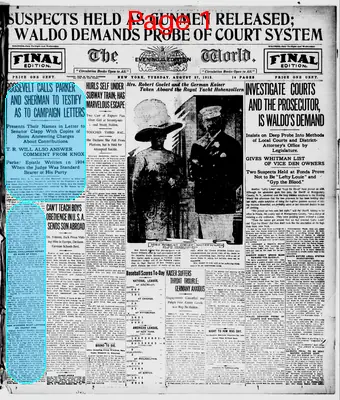
The Evening World
New York, New York County, New York
What is this article about?
At Oyster Bay on Aug. 27, Col. Roosevelt plans to submit letters to Sen. Clapp involving Alton B. Parker and James Sherman regarding 1904 campaign contributions from Standard Oil and Harriman. He challenges Philander C. Knox's comments and questions William Randolph Hearst's claims about letters.
Clipping
OCR Quality
Full Text
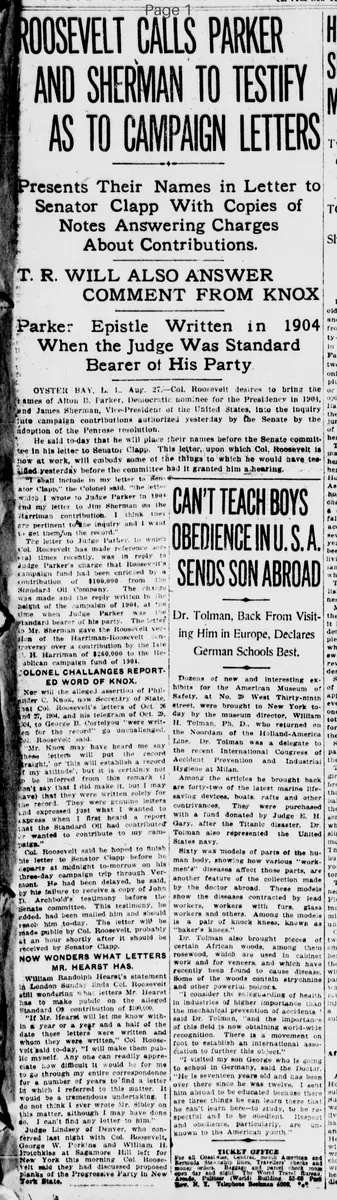
Presents Their Names in Letter to Senator Clapp With Copies of Notes Answering Charges About Contributions.
T. R. WILL ALSO ANSWER COMMENT FROM KNOX
Parker Epistle Written in 1904 When the Judge Was Standard Bearer of His Party
OYSTER BAY, L. I., Aug. 27.—Col. Roosevelt desires to bring the names of Alton B. Parker, Democratic nominee for the Presidency in 1904, and James Sherman, Vice-President of the United States, into the inquiry into campaign contributions authorized yesterday by the Senate by the adoption of the Penrose resolution.
He said to-day that he will place their names before the Senate committee in his letter to Senator Clapp.
This letter, upon which Col. Roosevelt is now at work, will embody some of the things to which he would have testified yesterday before the committee had it granted him a hearing.
"I shall include in my letter to Senator Clapp," the Colonel said, "the letter which I wrote to Judge Parker in 1904 and my letter to Jim Sherman on the Harriman contribution. I think they are pertinent to the inquiry and I want to get them on the record."
The letter to Judge Parker, to which Col. Roosevelt has made reference several times recently, was in reply to Judge Parker's charge that Roosevelt's campaign fund had been enriched by a contribution of $100,000 from the Standard Oil Company.
The charge was made and the reply written in the height of the campaign of 1904, at the time when Judge Parker was the standard bearer of his party.
The letter to Mr. Sherman gave the Roosevelt version of the Harriman-Roosevelt controversy over a contribution by the late E. H. Harriman of $250,000 to the Republican campaign fund of 1904.
COLONEL CHALLENGES REPORT ED WORD OF KNOX.
Nor will the alleged assertion of Philander C. Knox, now Secretary of State, that Col. Roosevelt's letters of Oct. 26 and 27, 1904, and his telegram of Oct. 29 to George B. Cortelyou "were written for the record" go unchallenged.
Col. Roosevelt said:
"Mr. Knox may have heard me say these letters will put the record straight,' or 'this will establish a record of my attitude,' but it is certainly not to be inferred from this remark (I don't say that I did make it, but I may have) that they were written solely for the record.
They were genuine letters and expressed just what I wanted to say or wanted to contribute to my campaign.
That the Standard Oil had contributed expresses what I first heard a report paign.
His letter to Senator Clapp before he Col. Roosevelt said he hoped to finish departs at midnight to-morrow on his three-day campaign trip through Vermont.
He had been delayed, he said, by his failure to receive a copy of John D. Archbold's testimony before the Senate committee.
This testimony, he added, had been mailed him and should reach him to-day.
The letter will be made public by Col. Roosevelt, probably at an hour shortly after it should be received by Senator Clapp.
NOW WONDERS WHAT LETTERS MR. HEARST HAS.
William Randolph Hearst's statement in London Sunday finds Col. Roosevelt still wondering what letters Mr. Hearst has to make public on the alleged Standard Oil contribution of $100,000.
"If Mr. Hearst will let me know within a year or a year and a half of the date these letters were written and whom they were written to, Col. Roosevelt said to-day, "I will make them public myself. Any one can readily appreciate how difficult it would be for me to go through my entire correspondence for a number of years to find a letter in which I referred to this matter. It would be a tremendous undertaking. I do not think I ever wrote Mr. Sibley on this matter, although I may have done so. I can't find any letter to him."
Judge Lindsey of Denver, who conferred last night with Col. Roosevelt, George W. Perkins and William H. Hotchkiss at Sagamore Hill left for New York this morning.
Col. Roosevelt said they had discussed proposed planks of the Progressive Party in New York State.
What sub-type of article is it?
What themes does it cover?
What keywords are associated?
What entities or persons were involved?
Where did it happen?
Story Details
Key Persons
Location
Oyster Bay, L. I.
Event Date
Aug. 27
Story Details
Col. Roosevelt prepares a letter to Sen. Clapp including his 1904 replies to Parker on Standard Oil contribution charges and to Sherman on Harriman contribution, to submit to Senate inquiry on campaign funds. He challenges Knox's remarks on his letters and questions Hearst's claims about undisclosed letters.