Thank you for visiting SNEWPapers!
Sign up free
Story
December 27, 1934
Montana Labor News
Butte, Silver Bow County, Montana
What is this article about?
Wall Street reacts positively to President Roosevelt's announcement of a board to cap war profits, seeing opportunities in wage controls, favorable appointees like Baruch and Johnson, and MacArthur's reappointment amid hints of impending war.
Clipping
OCR Quality
98%
Excellent
Full Text
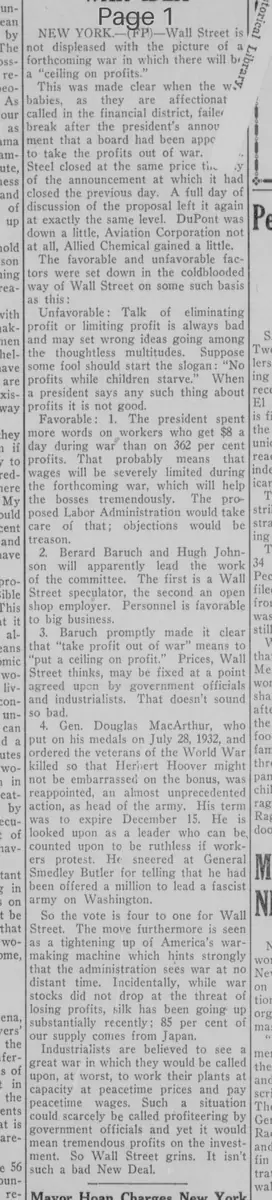
NEW YORK.-(FP)-Wall Street is not displeased with the picture of forthcoming war in which there will be a "ceiling on profits."
This was made clear when the war babies, as they are affectionately called in the financial district, failed to break after the president's announcement that a board had been appointed to take the profits out of war.
Steel closed at the same price today as of the announcement at which it had closed the previous day. A full day of discussion of the proposal left it again at exactly the same level. DuPont was down a little, Aviation Corporation not at all, Allied Chemical gained a little.
The favorable and unfavorable factors were set down in the coldblooded way of Wall Street on some such basis as this:
Unfavorable: Talk of eliminating profit or limiting profit is always bad and may set wrong ideas going among the thoughtless multitudes. Suppose some fool should start the slogan: "No profits while children starve." When a president says any such thing about profits it is not good.
Favorable: 1. The president spent more words on workers who get $8 a day during war than on 362 per cent profits. That probably means that wages will be severely limited during the forthcoming war, which will help the bosses tremendously. The proposed Labor Administration would take care of that; objections would be treason.
2. Bernard Baruch and Hugh Johnson will apparently lead the work of the committee. The first is a Wall Street speculator, the second an open shop employer. Personnel is favorable to big business.
3. Baruch promptly made it clear that "take profit out of war" means to "put a ceiling on profit." Prices, Wall Street thinks, may be fixed at a point agreed upon by government officials and industrialists. That doesn't sound so bad.
4. Gen. Douglas MacArthur, who put on his medals on July 28, 1932, and ordered the veterans of the World War killed so that Herbert Hoover might not be embarrassed on the bonus, was reappointed, an almost unprecedented action, as head of the army. His term was to expire December 15. He is looked upon as a leader who can be counted upon to be ruthless if workers protest. He sneered at General Smedley Butler for telling that he had been offered a million to lead a fascist army on Washington.
So the vote is four to one for Wall Street. The move furthermore is seen as a tightening up of America's war-making machine which hints strongly that the administration sees war at no distant time. Incidentally, while war stocks did not drop at the threat of losing profits, silk has been going up substantially recently; 85 per cent of our supply comes from Japan.
Industrialists are believed to see a great war in which they would be called upon, at worst, to work their plants at capacity at peacetime prices and pay peacetime wages. Such a situation could scarcely be called profiteering by government officials and yet it would mean tremendous profits on the investment. So Wall Street grins. It isn't such a bad New Deal.
This was made clear when the war babies, as they are affectionately called in the financial district, failed to break after the president's announcement that a board had been appointed to take the profits out of war.
Steel closed at the same price today as of the announcement at which it had closed the previous day. A full day of discussion of the proposal left it again at exactly the same level. DuPont was down a little, Aviation Corporation not at all, Allied Chemical gained a little.
The favorable and unfavorable factors were set down in the coldblooded way of Wall Street on some such basis as this:
Unfavorable: Talk of eliminating profit or limiting profit is always bad and may set wrong ideas going among the thoughtless multitudes. Suppose some fool should start the slogan: "No profits while children starve." When a president says any such thing about profits it is not good.
Favorable: 1. The president spent more words on workers who get $8 a day during war than on 362 per cent profits. That probably means that wages will be severely limited during the forthcoming war, which will help the bosses tremendously. The proposed Labor Administration would take care of that; objections would be treason.
2. Bernard Baruch and Hugh Johnson will apparently lead the work of the committee. The first is a Wall Street speculator, the second an open shop employer. Personnel is favorable to big business.
3. Baruch promptly made it clear that "take profit out of war" means to "put a ceiling on profit." Prices, Wall Street thinks, may be fixed at a point agreed upon by government officials and industrialists. That doesn't sound so bad.
4. Gen. Douglas MacArthur, who put on his medals on July 28, 1932, and ordered the veterans of the World War killed so that Herbert Hoover might not be embarrassed on the bonus, was reappointed, an almost unprecedented action, as head of the army. His term was to expire December 15. He is looked upon as a leader who can be counted upon to be ruthless if workers protest. He sneered at General Smedley Butler for telling that he had been offered a million to lead a fascist army on Washington.
So the vote is four to one for Wall Street. The move furthermore is seen as a tightening up of America's war-making machine which hints strongly that the administration sees war at no distant time. Incidentally, while war stocks did not drop at the threat of losing profits, silk has been going up substantially recently; 85 per cent of our supply comes from Japan.
Industrialists are believed to see a great war in which they would be called upon, at worst, to work their plants at capacity at peacetime prices and pay peacetime wages. Such a situation could scarcely be called profiteering by government officials and yet it would mean tremendous profits on the investment. So Wall Street grins. It isn't such a bad New Deal.
What sub-type of article is it?
Historical Event
What themes does it cover?
Justice
Triumph
What keywords are associated?
Wall Street
War Profits
Profit Ceiling
Roosevelt Announcement
Baruch Johnson
Macarthur Reappointment
Bonus Army
What entities or persons were involved?
Bernard Baruch
Hugh Johnson
Gen. Douglas Macarthur
Herbert Hoover
General Smedley Butler
Where did it happen?
New York, Wall Street
Story Details
Key Persons
Bernard Baruch
Hugh Johnson
Gen. Douglas Macarthur
Herbert Hoover
General Smedley Butler
Location
New York, Wall Street
Story Details
Wall Street assesses the president's war profit limitation proposal as largely favorable, citing wage controls, business-friendly appointees, profit ceilings via price fixing, and MacArthur's reappointment indicating war preparations, leading to stable or rising stocks.