Thank you for visiting SNEWPapers!
Sign up free
Editorial
February 3, 1876
The Working Christian
York, Charleston, Columbia, York County, Charleston County, Richland County, South Carolina
What is this article about?
An editorial discourse on church debts critiques applying commercial principles to churches, emphasizing that Christians must maintain public worship based on prosperity, not business models, and condemns laymen profiting from or skimping on church support as sinful.
Clipping
OCR Quality
98%
Excellent
Full Text
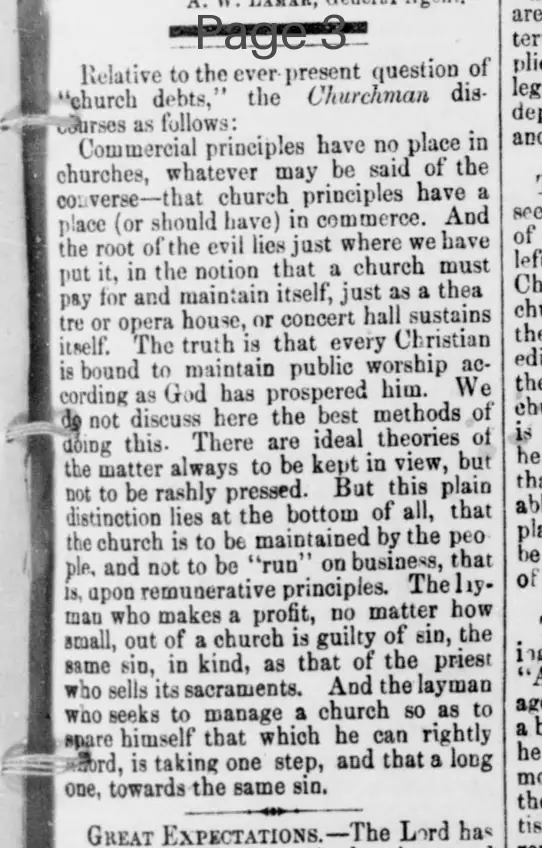
Relative to the ever present question of church debts, the Churchman discourses as follows:
Commercial principles have no place in churches. Whatever may be said of the converse—that church principles have a place (or should have) in commerce. And the root of the evil lies just where we have put it, in the position that a church must pay for and maintain itself, just as a theater or opera house, or concert hall sustains itself. The truth is that every Christian is bound to maintain public worship according as God has prospered him. We do not discuss here the best methods of doing this. There are ideal theories of the matter always to be kept in view, but not to be rashly pressed. But this plain distinction lies at the bottom of all, that the church is to be maintained by the people, and not to be "run" on business, that is, upon remunerative principles. The layman who makes a profit, no matter how small, out of a church is guilty of sin, the same sin, in kind, as that of the priest who sells its sacraments. And the layman who seeks to manage a church so as to spare himself that which he can rightly afford, is taking one step, and that a long one, towards the same sin.
Commercial principles have no place in churches. Whatever may be said of the converse—that church principles have a place (or should have) in commerce. And the root of the evil lies just where we have put it, in the position that a church must pay for and maintain itself, just as a theater or opera house, or concert hall sustains itself. The truth is that every Christian is bound to maintain public worship according as God has prospered him. We do not discuss here the best methods of doing this. There are ideal theories of the matter always to be kept in view, but not to be rashly pressed. But this plain distinction lies at the bottom of all, that the church is to be maintained by the people, and not to be "run" on business, that is, upon remunerative principles. The layman who makes a profit, no matter how small, out of a church is guilty of sin, the same sin, in kind, as that of the priest who sells its sacraments. And the layman who seeks to manage a church so as to spare himself that which he can rightly afford, is taking one step, and that a long one, towards the same sin.
What sub-type of article is it?
Moral Or Religious
What keywords are associated?
Church Debts
Commercial Principles
Christian Duty
Layman Sin
Public Worship
Church Maintenance
What entities or persons were involved?
The Churchman
Christians
Layman
Priest
Editorial Details
Primary Topic
Opposition To Commercial Principles In Church Maintenance
Stance / Tone
Moral Critique Of Business Like Church Management
Key Figures
The Churchman
Christians
Layman
Priest
Key Arguments
Commercial Principles Have No Place In Churches
Church Should Be Maintained By People, Not Run On Business Principles
Every Christian Is Bound To Maintain Public Worship According To Prosperity
Layman Profiting From Church Is Sinful, Akin To Priest Selling Sacraments
Layman Avoiding Rightful Contribution Is A Step Toward Sin