Thank you for visiting SNEWPapers!
Sign up free
Fowle's New Hampshire Gazette And General Advertiser
Portsmouth, Rockingham County, New Hampshire
What is this article about?
The Massachusetts General Court, in session amid public tumults and grievances, debated and acted on issues including army regulation, suspending habeas corpus, taxes, public debt, land sales, martial law, official salaries, and debt recovery, with mixed outcomes on key proposals.
Merged-components note: Continuation of the Boston government proceedings article across pages.
Clippings
1 of 2
OCR Quality
Full Text
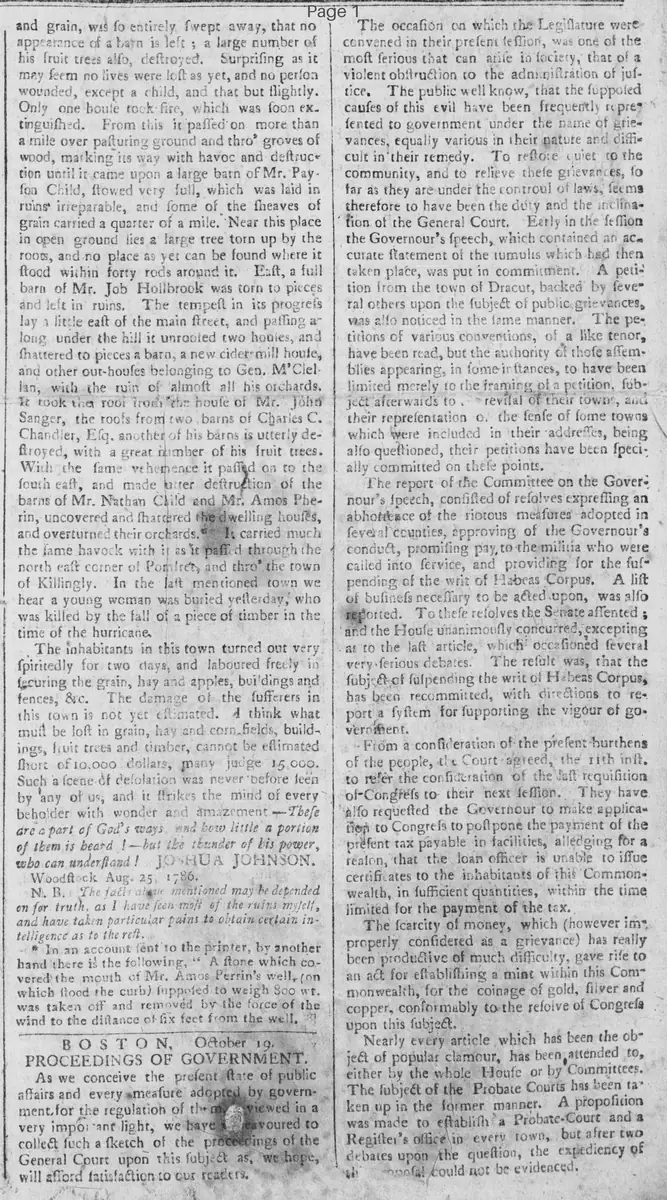
PROCEEDINGS OF GOVERNMENT.
As we conceive the present state of public affairs and every measure adopted by government for the regulation of the army is viewed in a very important light, we have endeavoured to collect such a sketch of the proceedings of the General Court upon this subject as, we hope, will afford satisfaction to our readers.
The occasion on which the Legislature were convened in their present session, was one of the most serious that can arise in society, that of a violent obstruction to the administration of justice. The public well know, that the supposed causes of this evil have been frequently represented to government under the name of grievances, equally various in their nature and difficult in their remedy. To restore order to the community, and to relieve these grievances, so far as they are under the controul of laws, seems therefore to have been the duty and the inclination of the General Court. Early in the session the Governour's speech, which contained an accurate statement of the tumults which had then taken place, was put in committee. A petition from the town of Dracut, backed by several others upon the subject of public grievances, was also noticed in the same manner. The petitions of various conventions, of a like tenor, have been read, but the authority of those assemblies appearing, in some instances, to have been limited merely to the framing of a petition, subject afterwards to a revision of their towns, and their representation of the sense of some towns which were included in their addresses, being also questioned, their petitions have been peculiarly committed on these points. The report of the Committee on the Governour's speech, consisted of resolves expressing an abhorrence of the riotous measures adopted in several counties, approving of the Governour's conduct, promising pay to the militia who were called into service, and providing for the suspending of the writ of Habeas Corpus. A list of business necessary to be acted upon, was also reported. To these resolves the Senate assented; and the House unanimously concurred, excepting as to the last article, which occasioned several very serious debates. The result was, that the subject of suspending the writ of Habeas Corpus, has been recommitted, with directions to report a system for supporting the vigour of government. From a consideration of the present burthens of the people, the Court agreed, the 8th inst. to refer the consideration of the Massachusetts requisition of Congress to their next session. They have also requested the Governour to make application to Congress to postpone the payment of the present tax payable in facilities, alleging for a reason, that the loan officer is unable to issue certificates to the inhabitants of this Commonwealth, in sufficient quantities, within the time limited for the payment of the tax. The scarcity of money, which (however improperly considered as a grievance) has really been productive of much difficulty, gave rise to an act for establishing a mint within this Commonwealth, for the coinage of gold, silver and copper, conformably to the resolve of Congress upon this subject. Nearly every article which has been the object of popular clamour, has been attended to, either by the whole House or by Committees. The subject of the Probate Courts has been taken up in the former manner. A proposition was made to establish a Probate-Court and a Register's office in every town, but after two debates upon the question, the expediency of the proposal could not be evidenced.
The House have had before them several times, a report of a Committee appointed the last session, to consider of a mode of paying the principal and interest of the public debt. This report raised many of the impost and excise duties already laid, and proposed several new objects for taxation. In short, so extensive were the principles of it, that the House proceeded for some time with a design of raising the whole revenue of government in this manner, which would entirely supersede all taxes upon polls and estates, as now in use. But many difficulties arising, especially in the equitable adjustment of the tax upon houses, it was at length voted, that it would not be expedient to raise all the supplies of government in this mode; and the report has been committed for incorporating it into the income and excise laws.
The sale of the Eastern lands, being considered an object of great consequence in sinking the public debt, a Committee has been appointed on that subject and a plan is now before the House for surveying a number of townships, and for selling them at public auction in June next, if not previously disposed of by the Committee on this business.
A law martial is also under consideration, providing rules for the regulation of troops stationed in the forts and garrisons within this Commonwealth, and of the militia, or any part thereof, when called into actual service.
On Tuesday last, a Committee, appointed to examine into the salaries and emoluments of the civil officers of government, made a report of the annual amount of them, a sketch of which we herewith exhibit.
Governour.--Salary before the Revolution 130l. and perquisites at least 100l. total 230l. Present salary, without any perquisites 200l.
Lieutenant Governour.--No salary before the Revolution--perquisites supposed to be 50l. Present perquisites (he having no salary) supposed to amount to the same.
Judges of the Superior Court.--Before the Revolution. Chief Justice 200l. the other four Justices, each, 50l. and fees of office more than equal to their travelling expenses, besides being allowed to hold other offices.--The present Judges allowance--Chief Justice 75l. the other four, each, 50l. no emolument allowed, all fees taken being deducted out of these sums.
Treasurer--Before the Revolution, 267l. and allowed to hold other offices.--Present salary 350l. and his whole time employed.
Secretary.--Before the Revolution 140l. and his Fees supposed to be 200l. total 340l.--Present salary 250l. from which the fees of office are deducted.
Agents, before the Revolution, each, 40l.
Members of Congress, 6l per day, including all charges.
Officers of Harvard College.--President, before the Revolution, 200l. Hollisian Professor 100l. Professor of Mathematicks 100l. Hancock Professor 40l. with additional grants to each. The present officers the same.
Clerk of the House of Representatives.--Before the Revolution, 100l. and pay as a member.--Present Clerk 120l. the several sessions taking up much more time.
Collector of Impost and Excise for the county of Suffolk, acknowledges receiving, from June 1, 1785, to May 31, 1786, 507l. 1s. 11d. Out of which he pays two deputies 50l. each, which leaves him 267l. 1s. 0d.--Fees for taking bonds, at 1s. each, set against the expense of office, printing, paper, books, wood, coal, &c.
Naval-Officer for the County of Suffolk.--Whole annual amount of fees 680l. 19s. 5d. 7/12ths of which being paid into the Treasury, leaves 283l. 14s. 9d. from which deduct for absolute expenses and rent 233l. 8s. 8d. leaves for his support 50l. 6s. 1d.
Besides the above mentioned, the report contained a calculation of the incomes of several other officers; but the materials not being complete, prevented that certainty which has been obtained as to those who are paid out of the publick Treasury.
The report brought on a question, whether it was consistent with the constitution to diminish the Governour's salary? but the time not admitting of a full discussion of it a reference took place:
Yesterday the committee appointed to consider of the distress to which many of the inhabitants of this Commonwealth are subjected in discharging executions for private debts, on account of the great scarcity of a circulating medium, submitted the following question to the Court, viz. Whether a tender act, or an act suspending the operation of law, respecting the recovery of debts and levying of executions, will not be inconsistent with the constitution of this Commonwealth and militate with the confederation and treaty of peace: unless the debts due to British creditors excepted? The question, so far as it concerns the confederation and treaty of peace was one in Senate, where it was determined that a tender act, or suspension of law as aforesaid, would be inconsistent with both. But the question being put in the House, whether they concur with the Hon. Senate, in their decision on the question, it passed in the negative by a large majority. Leave was then given to bring in a tender-act, which being laid on the table, was read and committed.
What sub-type of article is it?
What keywords are associated?
What entities or persons were involved?
Where did it happen?
Domestic News Details
Primary Location
Boston
Event Date
October 19
Key Persons
Outcome
resolves passed abhorring riots and approving governour's conduct; habeas corpus suspension recommitted; tax considerations deferred; mint act established; probate court proposal rejected; public debt report committed; land sale plan proposed; martial law under consideration; tender act leave granted despite senate opposition.
Event Details
The General Court addressed public tumults, grievances via petitions, Governour's speech; debated army regulation, habeas corpus, taxes, mint, probate courts, public debt payment, Eastern lands sale, martial law, official salaries, and debt recovery amid scarcity of money.