Thank you for visiting SNEWPapers!
Sign up free
Literary
May 4, 1841
Southport Telegraph
Kenosha, Southport, Kenosha County, Wisconsin
What is this article about?
Alice Herbert, daughter of a wealthy London banker, navigates high society and unrequited love for Henry Ashton. After her father's suicide amid bankruptcy and her mother's death in poverty, she heads to Canada. Ashton rescues her from a Bristol hotel fire, averting her ship's doomed voyage, and they marry.
Clipping
OCR Quality
82%
Good
Full Text
SELECTED MISCELLANY.
ALICE HERBERT, THE BANKER'S DAUGHTER.
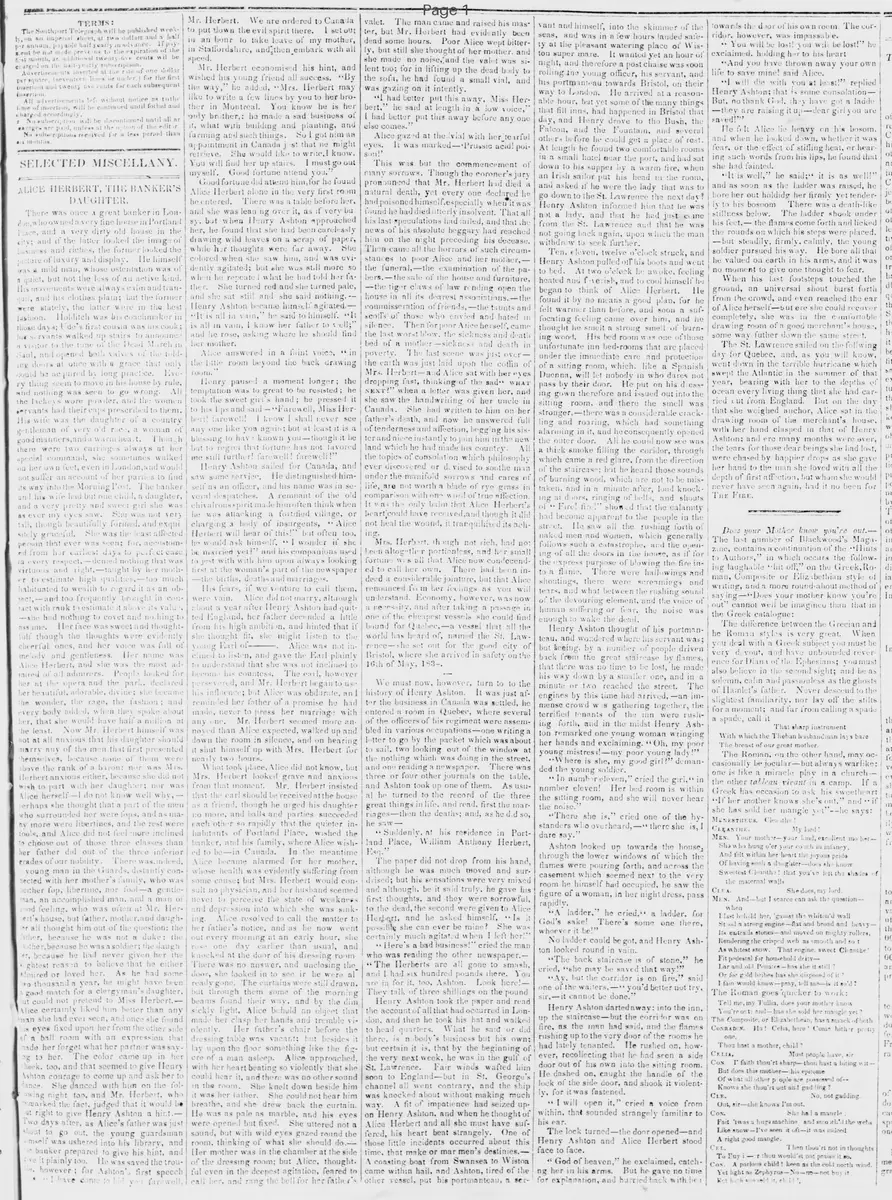
There was once a great banker in London, who owned a very fine house in Portland Place, and a very dirty old house in the Alley; and if the latter looked the image of business and riches, the former looked the picture of luxury and display. He himself was a mild man, whose ostentation was of a quiet, but not the less active kind. His movements were always calm and quiet, and his clothes plain; but the former were stately, the latter wore in the best fashion. Holditch was bootjack in those days; Uncle's first cousin was his cook; his servants walked up stairs to announce a visitor to the tune of the Dead March in Saul, and opened both valves of the folding doors at once with a grace that could be acquired by long practice. Everything seem to move in his house by rule. Nothing was seen to go wrong. All the lackeys wore powder, and the women servants had their caps prescribed to them. His wife was the daughter of a country gentleman of very old race, a woman of good manners, and a warm heart. Though there were two carriages always at her disposal, she sometimes walked on her own feet, even in London, and would not suffer an account of her parties to find its way into the Morning Post. The banker and his wife had but one child, a daughter, and a very pretty and sweet girl she was as ever my eyes saw. She was not very tall, though beautifully formed, and exquisitely graceful. She was the least affected person that ever was seen; for, accustomed from her earliest days to perfect ease in every respect, -denied nothing that was virtuous and right,-taught by her mother to estimate high qualities,-too much habituated to wealth to regard it as an object,-and too frequently brought in contract with rank to estimate it at its value. -she had nothing to covet and nothing to desire. Her face was sweet and thoughtful though the thoughts were evidently cheerful ones, and her voice was full of melody and gentleness. Her name was Alice Herbert, and she was the most admired of all admirers. People looked for her at the opera and the park, declared her beautiful, adorable, divine; she became the wonder, the rage, the fashion; and everybody added, when they spoke about her, that she would have half a million at the least. Now Mr. Herbert himself was not at all anxious that his daughter should marry any of the men that first presented themselves, because none of them were above the rank of a baron: nor was Mrs. Herbert anxious either., because she did not wish to part with her daughter; nor was Alice herself-I do not know well why,-perhaps she thought that a part of the men who surrounded her were fops, and as many more were libertines, and the rest were tools. and Alice did not feel more inclined to choose out of those three classes than her father did out of the three inferior grades of our nobility. There was, indeed, a young man in the Guards, distantly connected with her mother's family, who was neither fop, libertine, nor tool-a gentleman, an accomplished man, and a man of good feeling. who was often at Mr. Herbert's house, but father, mother, and daughter all thought him out of the question: the father. because he was not a duke: the mother,because he was a soldier; the daughter, because he had never given her the slightest reason to believe that he either admired or loved her. As he had some two thousand a year, he might have been good match for a clergyman's daughter, but could not pretend to Miss Herbert. Alice certainly liked him better than any man she had ever seen, and once she found his eyes fixed upon her from the other side of a ball room with an expression that made her forget what her partner was saying to her. The color came up in her cheek. too, and that seemed to give Henry Ashton courage to come up and ask her to dance. She danced with him on the following night too, and Mr. Herbert. who marked the fact, judged that it would be but right to give Henry Ashton a hint. Two days after, as Alice's father was just about to go out, the young guardsman himself was ushered into his library, and the banker prepared to give his hint, and give it plainly too. He was saved the trouble. however: for Ashton's first speech was: "I have come to hand in my resignation, Mr. Herbert. We are ordered to Canada to put down the evil spirit there. I set out in an hour to take leave of my mother, in Staffordshire, and then embark with all speed."
Mr. Herbert economised his hint, and wished his young friend all success. "By the way," he added, "Mrs. Herbert may like to write a few lines by you to her brother in Montreal. You know he is her only brother.: he made a sad business of it, what with building and planting, and farming and such things. So I got him an appointment in Canada just that he might retrieve. She would like to write,I know. You will find her up stairs. I must go out myself. Good fortune attend you."
Good fortune did attend him,for he found Alice Herbert alone in the very first room he entered. There was a table before her, and she was leaning over it, as if very busy, but when Henry Ashton approached her, he found that she had been carelessly drawing wild leaves on a scrap of paper, while her thoughts were far away. She colored when she saw him, and was evidently agitated; but she was still more so when he revealed what he had told her father. She turned red and she turned pale, and she sat still and she said nothing. Henry Ashton became himself agitated. "It is all in vain," he said to himself. "It is all in vain, I know her father to tell;" and he rose, asking where he should find her mother.
Alice answered in a faint voice, "in the little room beyond the back drawing room."
Henry paused a moment longer; the temptation was too great to be resisted; he took the sweet girl's hand; he pressed it to his lips and said-"Farewell, Miss Herbert! Farewell! I know I shall never see any one like you again; but at least it is a blessing to have known you-though it be but to regret that fortune has not favored me still further! Farewell! farewell!"
Henry Ashton sailed for Canada, and saw some service. He distinguished himself as an officer, and his name was in several despatches. A remnant of the old chivalrous spirit made him often think when he was attacking a fortified village, or charging a body of insurgents, "Alice Herbert will hear of this!" but often too, he would ask himself, "I wonder if she be married yet?"and his companions used to jest with him upon always looking first at the woman's part of the newspaper —the births, deaths and marriages.
His fears. if we venture to call them. were vain. Alice did not marry, although about a year after Henry Ashton had quitted England, her father descended a little from his high ambition, and hinted that it she thought fit, she might listen to the young Earl of-. Alice was not inclined to listen, and gave the Earl plainly to understand that she was not inclined to become his countess. The earl, however persevered, and Mr. Herbert began to use his influence; but Alice was obdurate, and reminded her father of a promise he had made, never to press her marriage with any one. Mr. Herbert seemed more unmoved than Alice expected, walked up and down the room in silence, and on hearing it shut himself up with Mrs. Herbert for nearly two hours.
What took place, Alice did not know. but Mrs. Herbert looked grave and anxious from that moment. Mr, Herbert insisted that the earl should be received at the house as a friend. though he urged his daughter to no more, and balls and parties succeeded each other so rapidly that the quieter inhabitants of Portland Place, wished the banker, and his family, where Alice wished to be-in Canada. In the meantime Alice became alarmed for her mother, whose health was evidently suffering from some cause; but Mrs. Herbert would consult no physician, and her husband seemed never to perceive the state of weakness and depression into which she was sinking. Alice resolved to call the matter to her father's notice, and as he now went out every morning at an early hour, she rose one day earlier than usual, and knocked at the door of his dressing room There was no answer, and unclosing the door, she looked in to see if he were already gone. The curtains were still drawn. but through them some of the morning beams found their way, and by the dim sickly light. Alice beheld an object that made her clasp her hands and tremble violently. Her father's chair before the dressing table was vacant; but besides it lay upon the floor something like the figure of a man asleep. Alice approached, with her heart beating so violently that she could hear it, and there was no other sound in the room. She knelt down beside him it was her father. She could not hear him breathe, and she drew back the curtain. He was as pale as marble. and his eyes were opened but fixed. She uttered not a sound. but with wild eyes gazed round the room, thinking of what she should do. Her mother was in the chamber at the side of the dressing room; but Alice, thoughtful even in the deepest agitation, feared to call her, and rang the bell for her father's valet. The man came and raised his master, but Mr. Herbert had evidently been dead some hours. Poor Alice wept bitterly, but still she thought of her mother. and she made no noise,and the valet was silent too; for in lifting up the dead body to the sofa, he had found a small vial, and was gazing on it intently.
"I had better put this away, Miss Herbert," he said at length in a low voice," I had better put this away before any one else comes."
Alice gazed at the vial with her tearful eyes. It was marked-Prussic acid! poison!'
This was but the commencement of many sorrows. Though the coroner's jury pronounced that Mr. Herbert had died a natural death, yet every one declared he had poisoned himself,especially when it was found he had died utterly insolvent. That all his last speculations had failed, and that the news of his absolute beggary had reached him on the night preceding his decease. Then came all the horrors of such circumstances to poor Alice and her mother,-the funeral,-the examination of the papers,-the sale of the house and furniture. -the tiger claws of law rending open the house in all its dearest associations,--the commisseration of friends,-the taunts and scoffs of those who envied and hated in silence. Then for poor Alice herself, came the last worst blow. the sickness and death bed of a mother -sickness and death in poverty. The last scene was just over-the earth was just laid upon the coffin of Mrs. Herbert-and Alice sat with her eyes dropping fast, thinking of the sad "what next?" when a letter was given her, and she saw the handwriting of her uncle in Canada. She had written to him on her father's death, and now he answered full of tenderness and affection, begging his sister and niece instantly to join him in the new land which he had made his country. All the topics of consolation which philosophy ever discovered or devised to soothe man under the manifold sorrows and cares of life, are not worth a blade of rye grass in comparison with one word of true affection. It was the only balm that Alice Herbert's heart could have received,and though it did not heal the wound, it tranquillised its aching.
Mrs. Herbert, though not rich, had not been altogether portionless, and her small fortune was all that Alice now condescended to call her own. There had been indeed a considerable jointure, but that Alice renounced from her feelings as you will understand. Economy, however, was now a necessity, and after taking a passage in one of the cheapest vessels she could find bound for Quebec,-a vessel that all the world has heard of. named the St. Lawrence-she set out for the good city of Bristol, where she arrived in safety on the 16th of May. 183-.
We must now, however, turn to the history of Henry Ashton. It was just after the business in Canada was settled, he entered a room in Quebec, where several of the officers of his regiment were assembled in various occupations-one writing a letter to go by the packet which was about to sail, two looking out of the window at the nothing which was doing in the street, and one reading a newspaper. There was three or four other journals on the table. and Ashton took up one of them. As usual he turned to the record of the three great things in life, and read, first the marriages-then the deaths; and, as he did so. he saw-
'Suddenly, at his residence in Portland Place, William Anthony Herbert, Esq.'
The paper did not drop from his hand, although he was much moved and surprised; but his sensations were very mixed and although, be it said truly, he gave his first thoughts, and they were sorrowful, to the dead, the second were given to Alice Herbert, and he asked himself, "Is it possible she can ever be mine? She was certainly much agitated, when I left her!"
"Here's a bad business!"cried the man who was reading the other newspaper. -"The Herberts are all gone to smash, and I had six hundred pounds there. You are in for it, too, Ashton. Look here!- They talk of three shillings on the pound Henry Ashton took the paper and read the account of all that had occurred in London, and then he took his hat and walked to head quarters. What he said or did there, is nobody's business but his own: but certain it is, that by the beginning of the very next week, he was in the gulf of St. Lawrence. Fair winds wafted him soon to England-but in St. George's channel all went contrary, and the ship was knocked about without making much way. A fit of impatience had seized upon Henry Ashton, and when he thought of Alice Herbert and all she must have suffered. his heart beat strangely. One of those little incidents occurred about this time. that make or mar men's destinies. -A coasting boat from Swansea to Weston came within hail, and Ashton, tired of the other vessel, put his portmanteau, a servant and himself. into the skimmer of the seas, and was in a few hours landed safely at the pleasant watering place of Weston super mare. It wanted yet an hour of night, and therefore a post chaise was soon rolling the young officer, his servant, and his portmanteau towards Bristol, on their way to London. He arrived at a reasonable hour, but yet some of the many things that fill inns, had happened in Bristol that day, and Henry drove to the Bush, the Falcon, and the Fountain, and several others before he could get a place of rest. At length he found two comfortable rooms in a small hotel near the port, and had sat down to his supper by a warm fire, when an Irish sailor put his head in the room, and asked if he were the lady that was to go down to the St. Lawrence the next day? Henry Ashton informed him that he was not a lady. and that he had just come from the St. Lawrence and that he was not going back again, upon which the man withdrew to seek further.
Ten, eleven, twelve o'clock struck, and Henry Ashton pulled off his boots and went to bed. At two o'clock he awoke, feeling heated and feverish, and to cool himself he began to think of Alice Herbert. He found it by no means a good plan, for he felt warmer than before, and soon a suffocating feeling came over him, and he thought he smelt a strong smell of burning wood. His bed room was one of those unfortunate inn bed-rooms that are placed under the immediate care and protection of a sitting room, which. like a Spanish Duenna, will let nobody in who dares not pass by their door. He put on his dressing gown therefore and issued out into the sitting room, and there the smell was stronger,-there was a considerable crackling and roaring, which had something alarming in it, and he consequently opened the outer door. All he could now see was a thick smoke filling the corridor, through which came a red glare. from the direction of the staircase: but he heard those sounds of burning wood. which are not to be mistaken, and in a minute after, loud knocking at doors, ringing of bells, and shouts of"Fire! fire!" showed that the calamity had become apparent to the people in the street. He saw all the rushing forth of naked men and women, which generally follows such a catastrophe, and the opening of all the doors in the house, as if for the express purpose of blowing the fire into a flame. There were hallowings and shoutings, there were screamings and tears, and what between the rushing sound of the devouring element, and the voice of human suffering or fear, the noise was enough to wake the dead.
Henry Ashton thought of his portmanteau, and wondered where his servant was: but seeing, by a number of people driven back from the great staircase by flames, that there was no time to be lost, he made his way down by a smaller one, and in a minute or two reached the street. The engines by this time had arrived, -an immense crowd was gathering together, the terrified tenants of the inn were rushing forth, and in the midst Henry Ashton remarked one young woman wringing her hands and exclaiming. "Oh, my poor young mistress!-my poor young lady!"
"Where is she, my good girl?" demanded the young soldier.
"In number eleven," cried the girl,"in number eleven! Her bed room is within the sitting room, and she will never hear the noise."
"There she is." cried one of the by-standers who overheard,-"there she is, I dare say."
Ashton looked up towards the house, through the lower windows of which the flames were pouring forth, and across the casement which seemed next to the very room he himself had occupied. he saw the figure of a woman. in her night dress, pass rapidly.
"A ladder," he cried," a ladder. for (God's sake! There's some one there, whoever it be'"
No ladder could be got, and Henry Ashton looked round in vain.
"The back staircase is of stone," he cried, "she may be saved that way!"
"Ay. but the corridor is on fire," said one of the waiters,-" you'd better not try, sir,-it cannot be done.
Henry Ashton darted away: into the inn, up the staircase-but the corridor was on fire, as the man had said, and the flames rushing up to the very door of the rooms he had lately tenanted." He rushed on, however, recollecting that he had seen a side door out of his own into the sitting room. He dashed on, caught the handle of the lock of the side door, and shook it violently. for it was fastened.
"I will open it." cried a voice from within, that sounded strangely familiar to his ear.
The lock turned-the door opened-and Henry Ashton and Alice Herbert stood face to face.
"God of heaven," he exclaimed, catching her in his arms. But he gave no time for explanation, and hurried back with her towards the door of his own room. The corridor, however, was impassable.
"… You will be lost! you will be lost!"he exclaimed, holding her to his heart
"And you have thrown away your own life to save mine! said Alice.
"I will die with you at least!" replied Henry Ashton; that is some consolation- But, no thank God, they have got a ladder -they are raising it up-dear girl you are saved!"
He felt Alice lie heavy on his bosom, and when he looked down, whether it was fear, or the effect of stifling heat, or hearing such words from his lips, he found that she had fainted.
It is well," he said;…' it is as well!" and as soon as the ladder was raised, he bore her out holding her firmly yet tenderly to his bosom There was a death-like stillness below. The ladder shook under his feet,- the flames come forth and licked the rounds on which his steps were placed, --but steadily, firmly, calmly, the young soldier pursued his way. He bore all that he valued on earth in his arms, and it was no moment to give one thought to fear. When his last footsteps touched the ground, an universal shout burst forth from the crowd, and even reached the ear of Alice herself-but ere she could recover completely, she was in the comfortable drawing room of a good merchant's house. some way further down the same street.
The St. Lawrence sailed on the following day for Quebec. and, as you will know, went down in the terrible hurricane which swept the Atlantic in the summer of that year, bearing with her to the depths of ocean every living thing that she had carried out from England. But on the day that she weighed anchor, Alice sat in the drawing room of the merchant's house. with her hand clasped in that of Henry Ashton; and ere many months were over. the tears for those dear beings she had lost, were chased by happier drops as she gave her hand to the man she loved with all the depth of first affection, but whom she would never have seen again, had it not been for THE FIRE.
ALICE HERBERT, THE BANKER'S DAUGHTER.
There was once a great banker in London, who owned a very fine house in Portland Place, and a very dirty old house in the Alley; and if the latter looked the image of business and riches, the former looked the picture of luxury and display. He himself was a mild man, whose ostentation was of a quiet, but not the less active kind. His movements were always calm and quiet, and his clothes plain; but the former were stately, the latter wore in the best fashion. Holditch was bootjack in those days; Uncle's first cousin was his cook; his servants walked up stairs to announce a visitor to the tune of the Dead March in Saul, and opened both valves of the folding doors at once with a grace that could be acquired by long practice. Everything seem to move in his house by rule. Nothing was seen to go wrong. All the lackeys wore powder, and the women servants had their caps prescribed to them. His wife was the daughter of a country gentleman of very old race, a woman of good manners, and a warm heart. Though there were two carriages always at her disposal, she sometimes walked on her own feet, even in London, and would not suffer an account of her parties to find its way into the Morning Post. The banker and his wife had but one child, a daughter, and a very pretty and sweet girl she was as ever my eyes saw. She was not very tall, though beautifully formed, and exquisitely graceful. She was the least affected person that ever was seen; for, accustomed from her earliest days to perfect ease in every respect, -denied nothing that was virtuous and right,-taught by her mother to estimate high qualities,-too much habituated to wealth to regard it as an object,-and too frequently brought in contract with rank to estimate it at its value. -she had nothing to covet and nothing to desire. Her face was sweet and thoughtful though the thoughts were evidently cheerful ones, and her voice was full of melody and gentleness. Her name was Alice Herbert, and she was the most admired of all admirers. People looked for her at the opera and the park, declared her beautiful, adorable, divine; she became the wonder, the rage, the fashion; and everybody added, when they spoke about her, that she would have half a million at the least. Now Mr. Herbert himself was not at all anxious that his daughter should marry any of the men that first presented themselves, because none of them were above the rank of a baron: nor was Mrs. Herbert anxious either., because she did not wish to part with her daughter; nor was Alice herself-I do not know well why,-perhaps she thought that a part of the men who surrounded her were fops, and as many more were libertines, and the rest were tools. and Alice did not feel more inclined to choose out of those three classes than her father did out of the three inferior grades of our nobility. There was, indeed, a young man in the Guards, distantly connected with her mother's family, who was neither fop, libertine, nor tool-a gentleman, an accomplished man, and a man of good feeling. who was often at Mr. Herbert's house, but father, mother, and daughter all thought him out of the question: the father. because he was not a duke: the mother,because he was a soldier; the daughter, because he had never given her the slightest reason to believe that he either admired or loved her. As he had some two thousand a year, he might have been good match for a clergyman's daughter, but could not pretend to Miss Herbert. Alice certainly liked him better than any man she had ever seen, and once she found his eyes fixed upon her from the other side of a ball room with an expression that made her forget what her partner was saying to her. The color came up in her cheek. too, and that seemed to give Henry Ashton courage to come up and ask her to dance. She danced with him on the following night too, and Mr. Herbert. who marked the fact, judged that it would be but right to give Henry Ashton a hint. Two days after, as Alice's father was just about to go out, the young guardsman himself was ushered into his library, and the banker prepared to give his hint, and give it plainly too. He was saved the trouble. however: for Ashton's first speech was: "I have come to hand in my resignation, Mr. Herbert. We are ordered to Canada to put down the evil spirit there. I set out in an hour to take leave of my mother, in Staffordshire, and then embark with all speed."
Mr. Herbert economised his hint, and wished his young friend all success. "By the way," he added, "Mrs. Herbert may like to write a few lines by you to her brother in Montreal. You know he is her only brother.: he made a sad business of it, what with building and planting, and farming and such things. So I got him an appointment in Canada just that he might retrieve. She would like to write,I know. You will find her up stairs. I must go out myself. Good fortune attend you."
Good fortune did attend him,for he found Alice Herbert alone in the very first room he entered. There was a table before her, and she was leaning over it, as if very busy, but when Henry Ashton approached her, he found that she had been carelessly drawing wild leaves on a scrap of paper, while her thoughts were far away. She colored when she saw him, and was evidently agitated; but she was still more so when he revealed what he had told her father. She turned red and she turned pale, and she sat still and she said nothing. Henry Ashton became himself agitated. "It is all in vain," he said to himself. "It is all in vain, I know her father to tell;" and he rose, asking where he should find her mother.
Alice answered in a faint voice, "in the little room beyond the back drawing room."
Henry paused a moment longer; the temptation was too great to be resisted; he took the sweet girl's hand; he pressed it to his lips and said-"Farewell, Miss Herbert! Farewell! I know I shall never see any one like you again; but at least it is a blessing to have known you-though it be but to regret that fortune has not favored me still further! Farewell! farewell!"
Henry Ashton sailed for Canada, and saw some service. He distinguished himself as an officer, and his name was in several despatches. A remnant of the old chivalrous spirit made him often think when he was attacking a fortified village, or charging a body of insurgents, "Alice Herbert will hear of this!" but often too, he would ask himself, "I wonder if she be married yet?"and his companions used to jest with him upon always looking first at the woman's part of the newspaper —the births, deaths and marriages.
His fears. if we venture to call them. were vain. Alice did not marry, although about a year after Henry Ashton had quitted England, her father descended a little from his high ambition, and hinted that it she thought fit, she might listen to the young Earl of-. Alice was not inclined to listen, and gave the Earl plainly to understand that she was not inclined to become his countess. The earl, however persevered, and Mr. Herbert began to use his influence; but Alice was obdurate, and reminded her father of a promise he had made, never to press her marriage with any one. Mr. Herbert seemed more unmoved than Alice expected, walked up and down the room in silence, and on hearing it shut himself up with Mrs. Herbert for nearly two hours.
What took place, Alice did not know. but Mrs. Herbert looked grave and anxious from that moment. Mr, Herbert insisted that the earl should be received at the house as a friend. though he urged his daughter to no more, and balls and parties succeeded each other so rapidly that the quieter inhabitants of Portland Place, wished the banker, and his family, where Alice wished to be-in Canada. In the meantime Alice became alarmed for her mother, whose health was evidently suffering from some cause; but Mrs. Herbert would consult no physician, and her husband seemed never to perceive the state of weakness and depression into which she was sinking. Alice resolved to call the matter to her father's notice, and as he now went out every morning at an early hour, she rose one day earlier than usual, and knocked at the door of his dressing room There was no answer, and unclosing the door, she looked in to see if he were already gone. The curtains were still drawn. but through them some of the morning beams found their way, and by the dim sickly light. Alice beheld an object that made her clasp her hands and tremble violently. Her father's chair before the dressing table was vacant; but besides it lay upon the floor something like the figure of a man asleep. Alice approached, with her heart beating so violently that she could hear it, and there was no other sound in the room. She knelt down beside him it was her father. She could not hear him breathe, and she drew back the curtain. He was as pale as marble. and his eyes were opened but fixed. She uttered not a sound. but with wild eyes gazed round the room, thinking of what she should do. Her mother was in the chamber at the side of the dressing room; but Alice, thoughtful even in the deepest agitation, feared to call her, and rang the bell for her father's valet. The man came and raised his master, but Mr. Herbert had evidently been dead some hours. Poor Alice wept bitterly, but still she thought of her mother. and she made no noise,and the valet was silent too; for in lifting up the dead body to the sofa, he had found a small vial, and was gazing on it intently.
"I had better put this away, Miss Herbert," he said at length in a low voice," I had better put this away before any one else comes."
Alice gazed at the vial with her tearful eyes. It was marked-Prussic acid! poison!'
This was but the commencement of many sorrows. Though the coroner's jury pronounced that Mr. Herbert had died a natural death, yet every one declared he had poisoned himself,especially when it was found he had died utterly insolvent. That all his last speculations had failed, and that the news of his absolute beggary had reached him on the night preceding his decease. Then came all the horrors of such circumstances to poor Alice and her mother,-the funeral,-the examination of the papers,-the sale of the house and furniture. -the tiger claws of law rending open the house in all its dearest associations,--the commisseration of friends,-the taunts and scoffs of those who envied and hated in silence. Then for poor Alice herself, came the last worst blow. the sickness and death bed of a mother -sickness and death in poverty. The last scene was just over-the earth was just laid upon the coffin of Mrs. Herbert-and Alice sat with her eyes dropping fast, thinking of the sad "what next?" when a letter was given her, and she saw the handwriting of her uncle in Canada. She had written to him on her father's death, and now he answered full of tenderness and affection, begging his sister and niece instantly to join him in the new land which he had made his country. All the topics of consolation which philosophy ever discovered or devised to soothe man under the manifold sorrows and cares of life, are not worth a blade of rye grass in comparison with one word of true affection. It was the only balm that Alice Herbert's heart could have received,and though it did not heal the wound, it tranquillised its aching.
Mrs. Herbert, though not rich, had not been altogether portionless, and her small fortune was all that Alice now condescended to call her own. There had been indeed a considerable jointure, but that Alice renounced from her feelings as you will understand. Economy, however, was now a necessity, and after taking a passage in one of the cheapest vessels she could find bound for Quebec,-a vessel that all the world has heard of. named the St. Lawrence-she set out for the good city of Bristol, where she arrived in safety on the 16th of May. 183-.
We must now, however, turn to the history of Henry Ashton. It was just after the business in Canada was settled, he entered a room in Quebec, where several of the officers of his regiment were assembled in various occupations-one writing a letter to go by the packet which was about to sail, two looking out of the window at the nothing which was doing in the street, and one reading a newspaper. There was three or four other journals on the table. and Ashton took up one of them. As usual he turned to the record of the three great things in life, and read, first the marriages-then the deaths; and, as he did so. he saw-
'Suddenly, at his residence in Portland Place, William Anthony Herbert, Esq.'
The paper did not drop from his hand, although he was much moved and surprised; but his sensations were very mixed and although, be it said truly, he gave his first thoughts, and they were sorrowful, to the dead, the second were given to Alice Herbert, and he asked himself, "Is it possible she can ever be mine? She was certainly much agitated, when I left her!"
"Here's a bad business!"cried the man who was reading the other newspaper. -"The Herberts are all gone to smash, and I had six hundred pounds there. You are in for it, too, Ashton. Look here!- They talk of three shillings on the pound Henry Ashton took the paper and read the account of all that had occurred in London, and then he took his hat and walked to head quarters. What he said or did there, is nobody's business but his own: but certain it is, that by the beginning of the very next week, he was in the gulf of St. Lawrence. Fair winds wafted him soon to England-but in St. George's channel all went contrary, and the ship was knocked about without making much way. A fit of impatience had seized upon Henry Ashton, and when he thought of Alice Herbert and all she must have suffered. his heart beat strangely. One of those little incidents occurred about this time. that make or mar men's destinies. -A coasting boat from Swansea to Weston came within hail, and Ashton, tired of the other vessel, put his portmanteau, a servant and himself. into the skimmer of the seas, and was in a few hours landed safely at the pleasant watering place of Weston super mare. It wanted yet an hour of night, and therefore a post chaise was soon rolling the young officer, his servant, and his portmanteau towards Bristol, on their way to London. He arrived at a reasonable hour, but yet some of the many things that fill inns, had happened in Bristol that day, and Henry drove to the Bush, the Falcon, and the Fountain, and several others before he could get a place of rest. At length he found two comfortable rooms in a small hotel near the port, and had sat down to his supper by a warm fire, when an Irish sailor put his head in the room, and asked if he were the lady that was to go down to the St. Lawrence the next day? Henry Ashton informed him that he was not a lady. and that he had just come from the St. Lawrence and that he was not going back again, upon which the man withdrew to seek further.
Ten, eleven, twelve o'clock struck, and Henry Ashton pulled off his boots and went to bed. At two o'clock he awoke, feeling heated and feverish, and to cool himself he began to think of Alice Herbert. He found it by no means a good plan, for he felt warmer than before, and soon a suffocating feeling came over him, and he thought he smelt a strong smell of burning wood. His bed room was one of those unfortunate inn bed-rooms that are placed under the immediate care and protection of a sitting room, which. like a Spanish Duenna, will let nobody in who dares not pass by their door. He put on his dressing gown therefore and issued out into the sitting room, and there the smell was stronger,-there was a considerable crackling and roaring, which had something alarming in it, and he consequently opened the outer door. All he could now see was a thick smoke filling the corridor, through which came a red glare. from the direction of the staircase: but he heard those sounds of burning wood. which are not to be mistaken, and in a minute after, loud knocking at doors, ringing of bells, and shouts of"Fire! fire!" showed that the calamity had become apparent to the people in the street. He saw all the rushing forth of naked men and women, which generally follows such a catastrophe, and the opening of all the doors in the house, as if for the express purpose of blowing the fire into a flame. There were hallowings and shoutings, there were screamings and tears, and what between the rushing sound of the devouring element, and the voice of human suffering or fear, the noise was enough to wake the dead.
Henry Ashton thought of his portmanteau, and wondered where his servant was: but seeing, by a number of people driven back from the great staircase by flames, that there was no time to be lost, he made his way down by a smaller one, and in a minute or two reached the street. The engines by this time had arrived, -an immense crowd was gathering together, the terrified tenants of the inn were rushing forth, and in the midst Henry Ashton remarked one young woman wringing her hands and exclaiming. "Oh, my poor young mistress!-my poor young lady!"
"Where is she, my good girl?" demanded the young soldier.
"In number eleven," cried the girl,"in number eleven! Her bed room is within the sitting room, and she will never hear the noise."
"There she is." cried one of the by-standers who overheard,-"there she is, I dare say."
Ashton looked up towards the house, through the lower windows of which the flames were pouring forth, and across the casement which seemed next to the very room he himself had occupied. he saw the figure of a woman. in her night dress, pass rapidly.
"A ladder," he cried," a ladder. for (God's sake! There's some one there, whoever it be'"
No ladder could be got, and Henry Ashton looked round in vain.
"The back staircase is of stone," he cried, "she may be saved that way!"
"Ay. but the corridor is on fire," said one of the waiters,-" you'd better not try, sir,-it cannot be done.
Henry Ashton darted away: into the inn, up the staircase-but the corridor was on fire, as the man had said, and the flames rushing up to the very door of the rooms he had lately tenanted." He rushed on, however, recollecting that he had seen a side door out of his own into the sitting room. He dashed on, caught the handle of the lock of the side door, and shook it violently. for it was fastened.
"I will open it." cried a voice from within, that sounded strangely familiar to his ear.
The lock turned-the door opened-and Henry Ashton and Alice Herbert stood face to face.
"God of heaven," he exclaimed, catching her in his arms. But he gave no time for explanation, and hurried back with her towards the door of his own room. The corridor, however, was impassable.
"… You will be lost! you will be lost!"he exclaimed, holding her to his heart
"And you have thrown away your own life to save mine! said Alice.
"I will die with you at least!" replied Henry Ashton; that is some consolation- But, no thank God, they have got a ladder -they are raising it up-dear girl you are saved!"
He felt Alice lie heavy on his bosom, and when he looked down, whether it was fear, or the effect of stifling heat, or hearing such words from his lips, he found that she had fainted.
It is well," he said;…' it is as well!" and as soon as the ladder was raised, he bore her out holding her firmly yet tenderly to his bosom There was a death-like stillness below. The ladder shook under his feet,- the flames come forth and licked the rounds on which his steps were placed, --but steadily, firmly, calmly, the young soldier pursued his way. He bore all that he valued on earth in his arms, and it was no moment to give one thought to fear. When his last footsteps touched the ground, an universal shout burst forth from the crowd, and even reached the ear of Alice herself-but ere she could recover completely, she was in the comfortable drawing room of a good merchant's house. some way further down the same street.
The St. Lawrence sailed on the following day for Quebec. and, as you will know, went down in the terrible hurricane which swept the Atlantic in the summer of that year, bearing with her to the depths of ocean every living thing that she had carried out from England. But on the day that she weighed anchor, Alice sat in the drawing room of the merchant's house. with her hand clasped in that of Henry Ashton; and ere many months were over. the tears for those dear beings she had lost, were chased by happier drops as she gave her hand to the man she loved with all the depth of first affection, but whom she would never have seen again, had it not been for THE FIRE.
What sub-type of article is it?
Prose Fiction
What themes does it cover?
Love Romance
Death Mortality
Social Manners
What keywords are associated?
Banker Daughter
Romance
Bankruptcy
Suicide
Hotel Fire
Rescue
Marriage
Canada Voyage
Literary Details
Title
Alice Herbert, The Banker's Daughter.
Key Lines
"Farewell, Miss Herbert! Farewell! I Know I Shall Never See Any One Like You Again; But At Least It Is A Blessing To Have Known You Though It Be But To Regret That Fortune Has Not Favored Me Still Further! Farewell! Farewell!"
"God Of Heaven," He Exclaimed, Catching Her In His Arms.
"I Will Die With You At Least!" Replied Henry Ashton; That Is Some Consolation But, No Thank God, They Have Got A Ladder They Are Raising It Up Dear Girl You Are Saved!"
All The Topics Of Consolation Which Philosophy Ever Discovered Or Devised To Soothe Man Under The Manifold Sorrows And Cares Of Life, Are Not Worth A Blade Of Rye Grass In Comparison With One Word Of True Affection.