Thank you for visiting SNEWPapers!
Sign up free
The Key West Citizen
Key West, Monroe County, Florida
What is this article about?
Analysis of Germany's WWII 'secret weapons' and blitzkrieg strategy, explaining its initial successes and ultimate failure due to overambition, and how Allies countered with improved firepower, tactics, and weapons like bazookas and tank-destroyers.
Clipping
OCR Quality
Full Text
By ROBERT M. FARRINGTON
AP Features Writer
WASHINGTON, D. C., May 9.-Germany's success was responsible for her defeat.
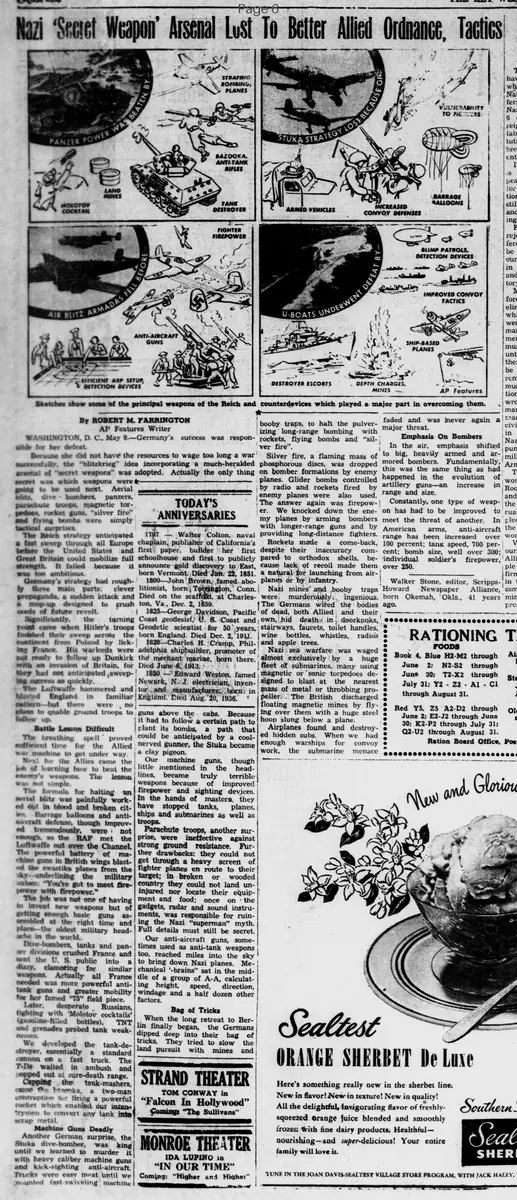
Because she did not have the resources to wage too long a war successfully, the "blitzkrieg" idea incorporating a much-heralded arsenal of "secret weapons" was adopted. Actually the only thing secret was which weapons were going to be used next. Aerial blitz, divebombers, panzers, parachute troops, magnetic torpedoes, rocket guns, "silver fire" simply...
The Reich strategy anticipated a fast sweep through all Europe before the "United States and Great Britain could mobilize full strength. It failed because it was too ambitious.
Germany's strategy had roughly three main parts: clever propaganda, a sudden attack and a mop-up designed to crush seeds of future revolt.
Significantly, the turning point came when Hitler's troops finished their sweep across the continent from Poland by licking France.
His warlords were not ready to follow up Dunkirk with an invasion of Britain, for they had not anticipated sweeping success so quickly.
The Luftwaffe hammered and blasted England in familiar pattern but there were no plans to enable ground troops to follow up.
Battle Lesson Difficult
The breathing spell proved sufficient time for the Allied war machine to get under way.
Next for the Allies came the job of learning how to beat the enemy's weapons. The lesson was not simple.
The formula for halting an aerial blitz was painfully worked out in blood and broken cities. Barrage balloons and anti-aircraft defense, though improved tremendously, were not enough, so the RAF met the Luftwaffe out over the Channel.
The powerful battery of machine guns in British wings blasted the swastika planes from the sky-underlining the military axiom: "You've got to meet firepower with firepower."
The job was not one of having to invent new weapons but of getting enough basic guns assembled at the right time and place the oldest military headache in the world.
Dive-bombers, tanks and panzer divisions crushed France and sent the U. S. public into a dizzy, clamoring for similar weapons. Actually all France needed was more powerful anti-tank guns and greater mobility for her famed "75" field piece.
Later desperate Russians, fighting with Molotov cocktails (gasoline-filled bottles), TNT and grenades probed tank weaknesses.
We developed the tank-destroyer, essentially a standard cannon on a fast truck. The T-Ds waited in ambush and popped out at sure-death range.
Capping the tank-mashers, came the bazooka, a two-man contraption for firing a powerful rocket which enabled our infantrymen to convert any tank into scrap metal.
Machine Guns Deadly
Another German surprise, the Stuka dive-bomber, was king until we learned to murder it with heavy caliber machine guns and kick-sighting anti-aircraft.
guns above the cabs.
Because it had to follow a certain path to plant its bombs, a path that could be anticipated by a cool-nerved gunner, the Stuka became a clay pigeon.
Our machine guns, though little mentioned in the headlines, became truly terrible weapons because of improved firepower and sighting devices.
In the hands of masters they have stopped tanks, planes, ships and submarines as well as troops.
Parachute troops, another surprise, were ineffective against strong ground resistance. Further drawbacks: they could not get through a heavy screen of fighter planes en route to their target; in broken or wooded country they could not land uninjured nor locate their equipment and food; once on the ground gadgets, radar and sound instruments, was responsible for ruining the Nazi "superman" myth.
Full details must still be secret.
Our anti-aircraft guns, sometimes used as anti-tank weapons too, reached miles into the sky to bring down Nazi planes. Mechanical "brains" sat in the middle of a group of A-A, calculating height, speed, direction, windage and a half dozen other factors.
Bag of Tricks
When the long retreat to Berlin finally began, the Germans dipped deep into their bag of tricks. They tried to slow the land pursuit with mines and booby traps, to halt the pulverizing long-range bombing with rockets, flying bombs and "silver fire".
Silver fire, a flaming mass of phosphorous discs, was dropped on bomber formations by enemy planes. Glider bombs controlled by radio and rockets fired by enemy planes were also used.
The answer again was firepower. We knocked down the enemy planes by arming bombers with longer-range guns and by providing long-distance fighters.
Rockets made a come-back, despite their inaccuracy compared to orthodox shells, because lack of recoil made them a natural for launching from airplanes or by infantry.
Nazi mines and booby traps were murderously ingenious.
The Germans wired the bodies of dead, both Allied and their own, hid death in doorknobs, stairways, faucets, toilet handles, wine bottles, whistles, radios and apple trees.
Nazi sea warfare was waged almost exclusively by a huge fleet of submarines, many using magnetic or sonic torpedoes designed to blast at the nearest mass of metal or throbbing propeller. The British discharged floating magnetic mines by flying over them with a huge steel hoop slung below a plane.
Airplanes found and destroyed hidden subs. When we had enough warships for convoy work, the submarine menace faded and was never again a major threat.
Emphasis On Bombers
In the air, emphasis shifted to big, heavily armed and armored bombers.
Fundamentally, this was the same thing as had happened in the evolution of artillery guns-an increase in range and size.
Constantly, one type of weapon has had to be improved to meet the threat of another.
In American arms, anti-aircraft range has been increased over 100 percent; tank speed, 700 percent; bomb size, well over 300; individual soldier's firepower, over 250.
What sub-type of article is it?
What keywords are associated?
What entities or persons were involved?
Where did it happen?
Foreign News Details
Primary Location
Germany
Event Date
May 9
Key Persons
Outcome
germany's blitzkrieg failed due to overambition; allies countered with improved anti-aircraft, tank-destroyers, bazookas, machine guns, and convoy systems, leading to the retreat to berlin and fading submarine threat.
Event Details
Germany adopted blitzkrieg with secret weapons like divebombers, panzers, parachute troops, magnetic torpedoes, rocket guns, and silver fire, aiming for quick sweep through Europe. Strategy included propaganda, sudden attacks, and mop-up. Turning point after France; failed invasion of Britain. Allies learned to counter aerial blitz with RAF fighters, anti-tank guns, Molotov cocktails, tank-destroyers, bazookas, heavy machine guns against Stukas, and radar. Germans used mines, booby traps, rockets, flying bombs in retreat. Submarine warfare countered by airplanes, convoys. Emphasis shifted to heavy bombers.