Thank you for visiting SNEWPapers!
Sign up free
Story
September 3, 1918
The Dawson News
Dawson, Terrell County, Georgia
What is this article about?
Prosperous Navajo Indians, enriched by war-time economy, cattle, and blanket monopoly, adopt modern clothes and automobiles, preferring high-quality vehicles over traditional ways.
Clipping
OCR Quality
98%
Excellent
Full Text
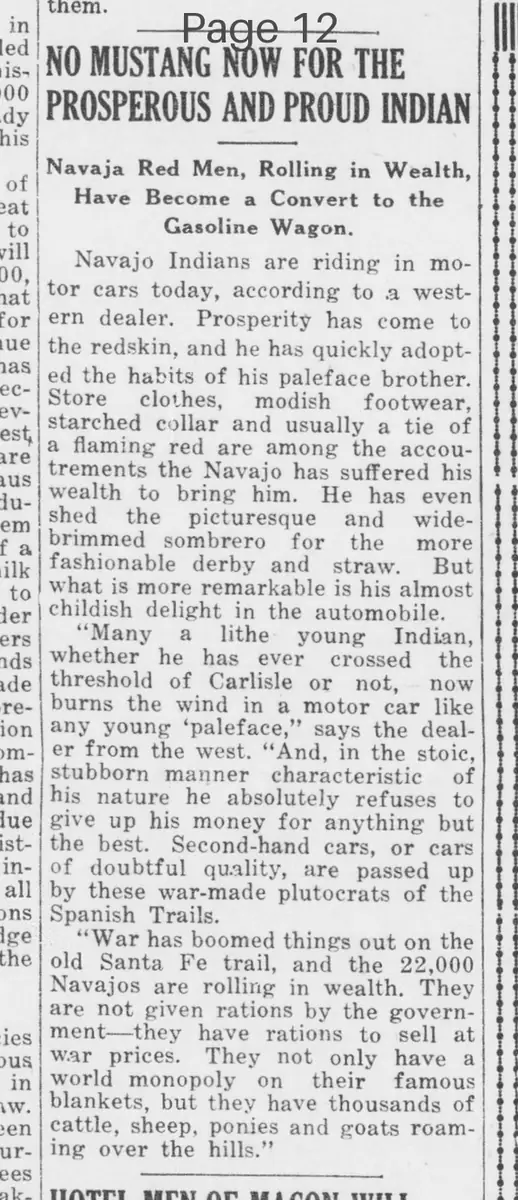
NO MUSTANG NOW FOR THE PROSPEROUS AND PROUD INDIAN
Navajo Red Men, Rolling in Wealth, Have Become a Convert to the Gasoline Wagon.
Navajo Indians are riding in motor cars today, according to a western dealer. Prosperity has come to the redskin, and he has quickly adopted the habits of his paleface brother. Store clothes, modish footwear, starched collar and usually a tie of a flaming red are among the accoutrements the Navajo has suffered his wealth to bring him. He has even shed the picturesque and wide-brimmed sombrero for the more fashionable derby and straw. But what is more remarkable is his almost childish delight in the automobile.
"Many a lithe young Indian, whether he has ever crossed the threshold of Carlisle or not, now burns the wind in a motor car like any young 'paleface,'" says the dealer from the west. "And, in the stoic, stubborn manner characteristic of his nature he absolutely refuses to give up his money for anything but the best. Second-hand cars, or cars of doubtful quality, are passed up by these war-made plutocrats of the Spanish Trails.
"War has boomed things out on the old Santa Fe trail, and the 22,000 Navajos are rolling in wealth. They are not given rations by the government—they have rations to sell at war prices. They not only have a world monopoly on their famous blankets, but they have thousands of cattle, sheep, ponies and goats roaming over the hills."
Navajo Red Men, Rolling in Wealth, Have Become a Convert to the Gasoline Wagon.
Navajo Indians are riding in motor cars today, according to a western dealer. Prosperity has come to the redskin, and he has quickly adopted the habits of his paleface brother. Store clothes, modish footwear, starched collar and usually a tie of a flaming red are among the accoutrements the Navajo has suffered his wealth to bring him. He has even shed the picturesque and wide-brimmed sombrero for the more fashionable derby and straw. But what is more remarkable is his almost childish delight in the automobile.
"Many a lithe young Indian, whether he has ever crossed the threshold of Carlisle or not, now burns the wind in a motor car like any young 'paleface,'" says the dealer from the west. "And, in the stoic, stubborn manner characteristic of his nature he absolutely refuses to give up his money for anything but the best. Second-hand cars, or cars of doubtful quality, are passed up by these war-made plutocrats of the Spanish Trails.
"War has boomed things out on the old Santa Fe trail, and the 22,000 Navajos are rolling in wealth. They are not given rations by the government—they have rations to sell at war prices. They not only have a world monopoly on their famous blankets, but they have thousands of cattle, sheep, ponies and goats roaming over the hills."
What sub-type of article is it?
Curiosity
Historical Event
What themes does it cover?
Fortune Reversal
Social Manners
What keywords are associated?
Navajo Indians
Prosperity
Automobiles
Cultural Adaptation
War Wealth
Santa Fe Trail
What entities or persons were involved?
Navajo Indians
Where did it happen?
Santa Fe Trail
Story Details
Key Persons
Navajo Indians
Location
Santa Fe Trail
Story Details
Prosperous Navajo Indians adopt modern attire and automobiles due to wealth from war economy, livestock, and blanket monopoly, delighting in high-quality cars while rejecting inferior ones.