Thank you for visiting SNEWPapers!
Sign up free
Editorial
November 4, 1909
Bismarck Daily Tribune
Bismarck, Burleigh County, North Dakota
What is this article about?
J.M. Anderson, Secretary-Treasurer of the American Society of Equity, addresses North Dakota farmers post their third annual convention in Valley City on October 28, highlighting the society's successes in achieving higher wheat prices through organized marketing, criticizing speculators, and urging continued cooperation via their cooperative exchange to eliminate speculation.
Clipping
OCR Quality
98%
Excellent
Full Text
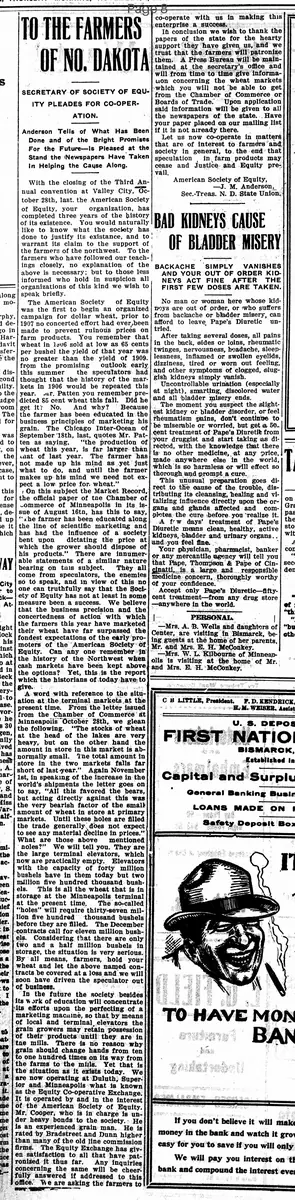
TO THE FARMERS OF NO. DAKOTA
SECRETARY OF SOCIETY OF EQUITY PLEADS FOR CO-OPERATION.
Anderson Tells of What Has Been Done and of the Bright Promises For the Future--Is Pleased at the Stand the Newspapers Have Taken In Helping the Cause Along
With the closing of the Third Annual convention at Valley City, October 28th, last, the American Society of Equity, your organization, has completed three years of the history of its existence. You would naturally like to know what the society has done to justify its existence, and to warrant its claim to the support of the farmers of the northwest. To the farmers who have followed our teachings closely, no explanation of the above is necessary: but to those less informed who hold in suspicion all organizations of this kind we wish to speak briefly.
The American Society of Equity was the first to begin an organized campaign for dollar wheat. Prior to 1907 no concerted effort had ever been made to prevent ruinous prices on farm products. You remember that wheat in 1906 sold as low as 65 cents per bushel the yield of that year was no greater than the yield of 1909. From the promising outlook early this summer the speculators had thought, that the history of the markets in 1906 would be repeated this year. Mr. Patten you remember predicted 55 cent wheat this fall. Did he get it? No. And why? Because the farmer has been educated in the business principles of marketing his grain. The Chicago Inter-Ocean of September 18th, last, quotes Mr. Patten as saying, "the production of wheat this year is far larger than that of last year. The farmer has not made up his mind as yet just what to do, and until the farmer makes up his mind we need not expect a low price for wheat." On this subject the Market Record the official paper of the Chamber of Commerce of Minneapolis in its issue of August 16th, has this to say, "The farmer has been educated along the line of scientific marketing and has had the influence of a society bent upon dictating the price at which the grower should dispose of his products." There are innumerable statements of a similar nature bearing on this subject. They all come from speculators, the enemies so to speak, and in view of this no one can truthfully say that the Society of Equity has not at least in some measure been a success.
We believe that the business precision and the concertedness of action with which the farmers this year have marketed their wheat have far surpassed the fondest expectations of the early promoters of the American Society Equity. Can any one remember in the history of the Northwest when cash markets have been kept above the options? Yet, this is the report which the historians of today have to give.
A word with reference to the situation at the terminal markets at the present time. From the letter issued from the Chamber of Commerce at Minneapolis October 28th, we glean the following. "The stocks of wheat at the head of the lakes are very heavy, but on the other hand the amount in store in this market is abnormally small. The total amount in store in the two markets falls far short of last year." Again November 1st, in speaking of the increase in the world's shipments the letter goes on to say, "All this favored the bears, but acting directly against this was the very bearish factor of the small amount of wheat in store at primary markets. Until these holes are filled the trade generally does not expect to see any material decline in prices."
What are those above mentioned 'holes?' We will tell you. They are the large terminal elevators, which now are practically empty. Elevators with the capacity of forty million bushels have in them today but two million five hundred thousand bushels. This is all the wheat that is in storage at the Minneapolis terminal at the present time. The so-called "holes" will require thirty-seven million five hundred thousand bushels before they are filled. The December contracts call for eleven million bushels. Considering that there are only two and a half million bushels in storage, the situation is very serious. By all means, farmers, hold your wheat and let the above named contracts be covered at a loss and we will soon have driven the speculator out of business.
In the future the society besides its work of education will concentrate its efforts upon the perfecting of a marketing machine, so that by means of local and terminal elevators the grain growers may retain possession of their products until they are in the mills. There is no reason why grain should change hands from ten to one hundred times on its way from the farms to the mills. Yet that is the situation as it exists today.
We are now operating at Duluth, Superior and Minneapolis what is known as the Equity Co-operative Exchange. It is operated by and in the interest of the American Society of Equity. Mr. Cooper, who is in charge is under heavy bonds to the society. He is an experienced grain man. He is rated by Bradstreet and Dunn higher than many of the old line commission firms. The Equity Exchange has given satisfaction to all that have patronized it thus far. Any inquiries concerning the same will be cheerfully answered if addressed to this office. We are asking the farmers to co-operate with us in making this enterprise a success
In conclusion we wish to thank the papers of the state for the hearty support they have given us, and we trust that the farmers will patronize them. A Press Bureau will be maintained at the secretary's office and will from time to time give Information concerning the wheat markets which you will not be able to get from the Chamber of Commerce or Boards of Trade. Upon application said information will be given to all the newspapers of the state. Have your paper placed on our mailing list if it is not already there.
Let us now co-operate in matters that are of interest to farmers and society in general, to the end that speculation in farm products may cease and Justice and Equity prevail.
American Society of Equity,
-J. M. Anderson, Sec.-Treas.
N. D. State Union,
SECRETARY OF SOCIETY OF EQUITY PLEADS FOR CO-OPERATION.
Anderson Tells of What Has Been Done and of the Bright Promises For the Future--Is Pleased at the Stand the Newspapers Have Taken In Helping the Cause Along
With the closing of the Third Annual convention at Valley City, October 28th, last, the American Society of Equity, your organization, has completed three years of the history of its existence. You would naturally like to know what the society has done to justify its existence, and to warrant its claim to the support of the farmers of the northwest. To the farmers who have followed our teachings closely, no explanation of the above is necessary: but to those less informed who hold in suspicion all organizations of this kind we wish to speak briefly.
The American Society of Equity was the first to begin an organized campaign for dollar wheat. Prior to 1907 no concerted effort had ever been made to prevent ruinous prices on farm products. You remember that wheat in 1906 sold as low as 65 cents per bushel the yield of that year was no greater than the yield of 1909. From the promising outlook early this summer the speculators had thought, that the history of the markets in 1906 would be repeated this year. Mr. Patten you remember predicted 55 cent wheat this fall. Did he get it? No. And why? Because the farmer has been educated in the business principles of marketing his grain. The Chicago Inter-Ocean of September 18th, last, quotes Mr. Patten as saying, "the production of wheat this year is far larger than that of last year. The farmer has not made up his mind as yet just what to do, and until the farmer makes up his mind we need not expect a low price for wheat." On this subject the Market Record the official paper of the Chamber of Commerce of Minneapolis in its issue of August 16th, has this to say, "The farmer has been educated along the line of scientific marketing and has had the influence of a society bent upon dictating the price at which the grower should dispose of his products." There are innumerable statements of a similar nature bearing on this subject. They all come from speculators, the enemies so to speak, and in view of this no one can truthfully say that the Society of Equity has not at least in some measure been a success.
We believe that the business precision and the concertedness of action with which the farmers this year have marketed their wheat have far surpassed the fondest expectations of the early promoters of the American Society Equity. Can any one remember in the history of the Northwest when cash markets have been kept above the options? Yet, this is the report which the historians of today have to give.
A word with reference to the situation at the terminal markets at the present time. From the letter issued from the Chamber of Commerce at Minneapolis October 28th, we glean the following. "The stocks of wheat at the head of the lakes are very heavy, but on the other hand the amount in store in this market is abnormally small. The total amount in store in the two markets falls far short of last year." Again November 1st, in speaking of the increase in the world's shipments the letter goes on to say, "All this favored the bears, but acting directly against this was the very bearish factor of the small amount of wheat in store at primary markets. Until these holes are filled the trade generally does not expect to see any material decline in prices."
What are those above mentioned 'holes?' We will tell you. They are the large terminal elevators, which now are practically empty. Elevators with the capacity of forty million bushels have in them today but two million five hundred thousand bushels. This is all the wheat that is in storage at the Minneapolis terminal at the present time. The so-called "holes" will require thirty-seven million five hundred thousand bushels before they are filled. The December contracts call for eleven million bushels. Considering that there are only two and a half million bushels in storage, the situation is very serious. By all means, farmers, hold your wheat and let the above named contracts be covered at a loss and we will soon have driven the speculator out of business.
In the future the society besides its work of education will concentrate its efforts upon the perfecting of a marketing machine, so that by means of local and terminal elevators the grain growers may retain possession of their products until they are in the mills. There is no reason why grain should change hands from ten to one hundred times on its way from the farms to the mills. Yet that is the situation as it exists today.
We are now operating at Duluth, Superior and Minneapolis what is known as the Equity Co-operative Exchange. It is operated by and in the interest of the American Society of Equity. Mr. Cooper, who is in charge is under heavy bonds to the society. He is an experienced grain man. He is rated by Bradstreet and Dunn higher than many of the old line commission firms. The Equity Exchange has given satisfaction to all that have patronized it thus far. Any inquiries concerning the same will be cheerfully answered if addressed to this office. We are asking the farmers to co-operate with us in making this enterprise a success
In conclusion we wish to thank the papers of the state for the hearty support they have given us, and we trust that the farmers will patronize them. A Press Bureau will be maintained at the secretary's office and will from time to time give Information concerning the wheat markets which you will not be able to get from the Chamber of Commerce or Boards of Trade. Upon application said information will be given to all the newspapers of the state. Have your paper placed on our mailing list if it is not already there.
Let us now co-operate in matters that are of interest to farmers and society in general, to the end that speculation in farm products may cease and Justice and Equity prevail.
American Society of Equity,
-J. M. Anderson, Sec.-Treas.
N. D. State Union,
What sub-type of article is it?
Agriculture
Economic Policy
Trade Or Commerce
What keywords are associated?
American Society Of Equity
Wheat Marketing
Farmer Cooperation
Speculation In Grain
Cooperative Exchange
Dollar Wheat
Terminal Elevators
North Dakota Farmers
What entities or persons were involved?
American Society Of Equity
J. M. Anderson
Mr. Patten
Mr. Cooper
Equity Co Operative Exchange
Chamber Of Commerce Of Minneapolis
Editorial Details
Primary Topic
Plea For Cooperation In American Society Of Equity To Improve Wheat Marketing And Eliminate Speculation
Stance / Tone
Supportive Of Farmer Organization And Anti Speculator
Key Figures
American Society Of Equity
J. M. Anderson
Mr. Patten
Mr. Cooper
Equity Co Operative Exchange
Chamber Of Commerce Of Minneapolis
Key Arguments
Society Initiated Organized Campaign For Dollar Wheat Since Before 1907
Farmers' Education In Marketing Prevented Low Prices Predicted By Speculators Like Patten
Current Low Storage In Terminal Elevators Creates Bullish Market
Urge Holding Wheat To Force Speculators To Cover Contracts At Loss
Future Focus On Perfecting Cooperative Marketing Via Elevators
Equity Co Operative Exchange Operates In Farmers' Interest At Duluth, Superior, Minneapolis
Thank Newspapers For Support And Offer Press Bureau For Market Info