Thank you for visiting SNEWPapers!
Sign up free
The Rhode Island Republican
Newport, Newport County, Rhode Island
What is this article about?
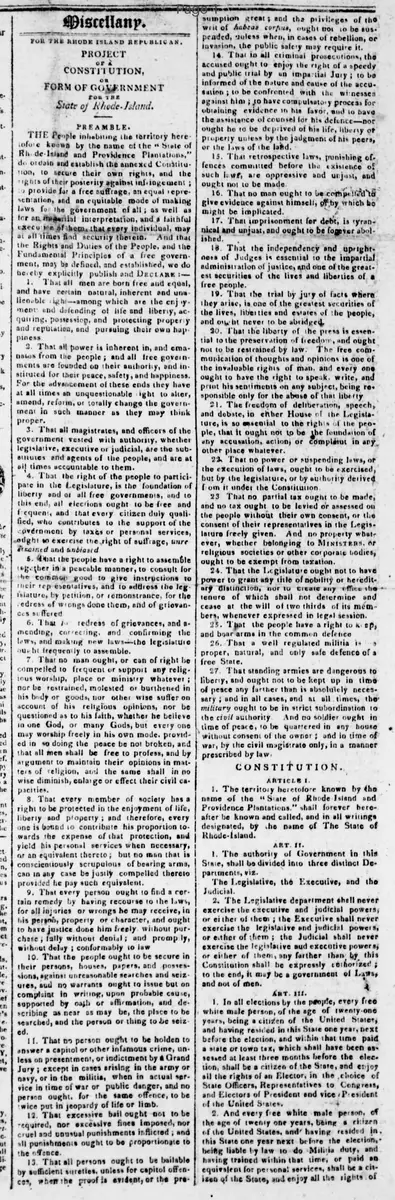
Proposed 19th-century constitution for Rhode-Island featuring a bill of rights preamble and articles on government separation, voter qualifications, legislative assembly, and executive branch. Text concludes mid-Article VI.
Merged-components note: These components form a single continuous article proposing a constitution for Rhode Island, spanning multiple columns and pages with sequential reading order and matching text flow; the third component's label corrected from 'notice' to 'story' as it is narrative constitutional content.
Clippings
1 of 2
OCR Quality
Full Text
FOR THE RHODE ISLAND REPUBLICAN.
PROJECT
OF
CONSTITUTION,
OR
FORM OF GOVERNMENT
FOR THE
State of Rhode-Island.
PREAMBLE.
THE People inhabiting the territory heretofore known by the name of the "State of Rhode-Island and Providence Plantations," do ordain and establish the annexed Constitution, to secure their own rights, and the rights of their posterity against infringement; to provide for a free suffrage, an equal representation, and an equitable mode of making laws for the government of all; as well as for an impartial interpretation, and a faithful execution of them, that every individual, may at all times find safety therein. And that the Rights and Duties of the People, and the Fundamental Principles of a free government, may be defined, and established, we do hereby explicitly publish and Declare :-
1. That all men are born free and equal, and have certain natural, inherent and unalienable rights - among which are the enjoyment and defending of life and liberty, acquiring, possession, and protecting property and reputation, and pursuing their own happiness.
2. That all power is inherent in, and emanates from the people; and all free governments are founded on their authority, and instituted for their peace, safety, and happiness. For the advancement of these ends they have at all times an unquestionable right to alter, amend, reform, or totally change the government in such manner as they may think proper.
3. That all magistrates, and officers of the government vested with authority, whether legislative, executive or judicial, are the substitutes and agents of the people, and are at all times accountable to them.
4. That the right of the people to participate in the Legislature, is the foundation of liberty and of all free governments, and to this end, all elections ought to be free and frequent, and that every citizen duly qualified, who contributes to the support of the government by taxes or personal services, ought to exercise the right of suffrage, unrestrained and unbiased.
5. That what the people have a right to assemble together in a peaceable manner, to consult for the common good to give instructions to their representatives, and to address the legislature, by petition, or remonstrance, for the redress of wrongs done them, and of grievances suffered.
6. That in redress of grievances, and amending, correcting, and confirming the laws, and making new laws - in the legislature ought frequently to assemble.
7. That no man ought, or can of right be compelled to frequent or support any religious worship, place or ministry whatever; nor be restrained, molested or burthened in his body or goods, nor otherwise suffer on account of his religious opinions, nor be questioned as to his faith, whether he believe in one God, or many Gods, but every one may worship freely in his own mode. provided in so doing the peace be not broken, and that all men shall be free to profess, and by argument to maintain their opinions in matters of religion, and the same shall in no wise diminish, enlarge or affect their civil capacities.
8. That every member of society has a right to be protected in the enjoyment of life, liberty and property; and therefore, every one is bound to contribute his proportion towards the expense of that protection, and yield his personal services when necessary, or an equivalent thereto; but no man that is conscientiously scrupulous of bearing arms, can in any case be justly compelled thereto provided he pay such equivalent.
9. That every person ought to find a certain remedy by having recourse to the laws, for all injuries or wrongs he may receive, in his person, property or character, and ought to have justice done him freely, without purchase; fully without denial; and promptly, without delay; conformably to law.
10. That the people ought to be secure in their persons, houses, papers, and possessions, against unreasonable searches and seizure, and no warrants ought to issue but on complaint in writing, upon probable cause, supported by oath or affirmation, and describing as near as may be, the place to be searched, and the person or thing to be seized.
11. That no person ought to be holden to answer a capital or other infamous crime, unless on presentment, or indictment by a Grand Jury; except in cases arising in the army or navy, or in the militia, when in actual service in time of war or public danger, and no person ought, for the same offence, to be twice put in jeopardy of life or limb.
12. That excessive bail ought not to be required, nor excessive fines imposed, nor cruel and unusual punishments inflicted; and all punishments ought to be proportionate to the offence.
13. That all persons ought to be bailable by sufficient sureties, unless for capital offences, when the proof is evident, or the presumption great; and the privileges of the writ of habeas corpus, ought not to be suspended, unless when, in cases of rebellion, or invasion, the public safety may require it.
14. That in all criminal prosecutions, the accused ought to enjoy the right of a speedy and public trial by an impartial Jury; to be informed of the nature and cause of the accusation: to be confronted with the witnesses against him; to have compulsory process for obtaining evidence in his favor, and to have the assistance of counsel for his defence - nor ought he to be deprived of his life, liberty or property unless by the judgment of his peers, or the laws of the land.
15. That retrospective laws, punishing offences committed before the existence of such laws, are oppressive and unjust, and ought not to be made.
16. That no man ought to be compelled to give evidence against himself, or by which he might be implicated.
17. That imprisonment for debt, is tyrannical and unjust, and ought to be forever abolished.
18. That the independency and uprightness of Judges is essential to the impartial administration of justice, and one of the greatest securities of the lives and liberties of a free people.
19. That the trial by jury of facts whereever arise, is one of the greatest securities of the lives, liberties and estates of the people, and ought never to be abridged.
20. That the liberty of the press is essential to the preservation of freedom, and ought not to be restrained by law. The free communication of thoughts and opinions is one of the invaluable rights of man, and every one ought to have the right to speak, write, and print his sentiments on any subject, being responsible only for the abuse of that liberty.
21. The freedom of deliberation, speech, and debate, in either House of the Legislature, is so essential to the rights of the people, that it ought not to be the foundation of any accusation, action or complaint in any other place whatever.
22. That no power of suspending laws, or the execution of laws, ought to be exercised, but by the legislature, or by authority derived from it under the Constitution.
23. That no partial tax ought to be made and no tax ought to be levied or assessed on the people without their own consent, or the consent of their representatives in the Legislature freely given. And no property whatever, whether belonging to Ministers. or religious societies or other corporate bodies, ought to be exempt from taxation.
24. That the Legislature ought not to have power to grant any title of nobility or hereditary distinction, nor to create any office the tenure of which shall not determine and cease at the will of two thirds of its members, whenever expressed in legal session.
25. That the people have a right to keep, and bear arms in the common defence.
26. That a well regulated militia is proper, natural, and only safe defence of a free State.
27. That standing armies are dangerous to liberty, and ought not to be kept up in time of peace any farther than is absolutely necessary; and in all cases, and at all times, the military ought to be in strict subordination to the civil authority. And no soldier ought in time of peace, to be quartered in any house without consent of the owner; and in time of war, by the civil magistrate only, in a manner prescribed by law.
CONSTITUTION.
ARTICLE I.
1. The territory heretofore known by the name of the "State of Rhode Island and Providence Plantations." shall forever hereafter be known and called, and in all writings designated, by the name of The State of Rhode-Island.
ART. II.
1. The authority of Government in this State, shall be divided into three distinct Departments, viz. The Legislative, the Executive, and the Judicial.
2. The Legislative department shall never exercise the executive and judicial powers, or either of them; the Executive shall never exercise the legislative and judicial powers, or either of them; the Judicial shall never exercise the legislative and executive powers, or either of them, any farther than by this Constitution shall be expressly authorized; to the end, it may be a government of Laws, and not of men.
ART. III.
1. In all elections by the people, every free white male person, of the age of twenty-one years, being a citizen of the United States; and having resided in this State one year, next before the election, and within that time paid a state or town tax, which shall have been assessed at least three months before the election, shall be a citizen of the State, and enjoy all the rights of an Elector, in the choice of State Officers, Representatives to Congress, and Electors of President and Vice-President of the United States.
2. And every free white male person, of the age of twenty one years, being a citizen of the United States, and having resided in this State one year next before the election, being liable by law to do Militia duty, and having trained within that time, or paid an equivalent for personal services, shall be a citizen of the State, and enjoy all the rights of
ARTICLE III.
1. Every white male citizen of the United States, of the age of twenty-one years, who has actually been an inhabitant and resident therein one year next preceding the election, and has resided three months next preceding the election in the town, district or plantation, in which he offers to vote, shall be entitled to vote for all officers to be elected, and in all meetings for public purposes in the town, district or plantation where he resides.
2. And every person having either of the foregoing qualifications, and having resided three months in the town in which he offers to vote, shall be qualified to vote for town officers, and in town concerns.
3. Provided nevertheless, that every person who has not been heretofore admitted free, shall before he is permitted to vote at any election, produce to the town clerk of the town of which he is an inhabitant, evidence of his possessing the qualifications of an Elector and have his name registered as such, in a book kept for that purpose, in which the names of all the electors in such town shall be registered. The oath or affirmation of a person that he verily believes he is twenty one years of age, and the receipt of a collector of taxes, or a certificate of a Commanding Officer of a Company of Militia, shall be sufficient evidence of such qualification. And the certificate of a town clerk, that a person has been duly registered as an elector, or the book in which the name of such elector is registered, shall be sufficient evidence of the right of an Elector, at any election in this State.
4. Electors shall, in all cases except treason, felony, or breach of the peace, be privileged from arrest during their attendance at elections, and in going to and returning from them.
5. All elections of State officers shall be by ballot, and the Electors, shall in no instance be obliged to write their names upon their ballots.
ARTICLE IV.
1. The Legislative authority shall be vested in a General Assembly which shall consist of a Senate and House of Representatives.
2. The House of Representatives shall be composed of members chosen annually on the first Wednesday of May, in each town, by the inhabitants possessing the qualifications of elector of Town Officers.
3. No person shall be a Representative, who shall not have been a citizen and inhabitant of the State for one year next preceding his election, and the last three months an inhabitant of the Town in which he shall be chosen, unless he shall have been absent on public business of the United States, or of this State.
4. Within one year after this Constitution shall be in operation, and within every subsequent term of ten years, an enumeration of the electors shall be taken in such manner as shall be directed by law; the number of Representatives shall at the several periods of making such enumeration be fixed by the General Assembly, and apportioned among the several towns according to the number of electors in each, at such ratio, that the whole number of Representatives shall never be less than seventy, nor over fifty; provided nevertheless, that each town shall be entitled at least to one representative. And within one year after the taking of the first enumeration herein provided for, and within one year after the taking of every subsequent enumeration, the State taxes shall be apportioned among the several towns according to the number of electors in each.
ARTICLE V.
1. The Senate shall be composed of twelve Senators, to be chosen in Districts annually, by the electors duly qualified of the several towns comprised in each District; for that purpose, the State shall be divided into three Senatorial Districts, as follows; each of which Districts shall elect four Senators.
2. The several Towns in the Counties of Newport, and Bristol, shall form one District and be called the Eastern District; The several Towns in the county of Providence, shall form one District, and be called the Northern District; the several Towns in the counties of Washington and Kent, shall form one District, and be called the Western District.
3. The electors of the several towns comprising in each District, qualified to vote for state officers, shall on the same day, and at the same place where the Representatives are chosen, vote by ballot for four persons as Senators for the Districts respectively.
4. In choosing Senators, each elector shall vote for four persons at one ballot; and the names of the persons voted for shall be written or printed at full length on one piece of paper, and designated by adding the name of the town of which each is an inhabitant.
5. The Moderators of the Town Meetings in the several towns in each District, shall receive the votes of all the electors present duly qualified, and shall with the assistance of two persons appointed by such town meeting for that purpose, sort and count them; and the Town Clerk shall make a fair record of the name of every person voted for, and the number of votes for each; and a fair copy of this record shall be attested by the Moderator and Town Clerk, and sealed up in presence of the citizens before the meeting is closed, and directed to the Speaker of the House of Representatives, with a superscription expressing the purport of the contents thereof, and the town and District in which the votes were given in, and the Town Clerk shall deliver the same to a Representative of such town, whose duty it shall be to take charge of the same, and deliver it, or cause it to be delivered to the Speaker of the House of Representatives, in open Assembly, as soon as it shall have met to organize the Government.
6. A Committee of nine members of the House of Representatives, consisting of three from the Towns within each District, shall be appointed to examine the returned copies of such records of the votes for Senators; and report the result of the votes in each District: and those persons shall be declared elected Senator by each District, and take their seats accordingly, who shall have a majority of the votes given in.
7. In case it should appear that there should not be the full number of Senators returned elected by a majority of votes in any District, the deficiency shall be supplied in the following manner viz. The members of the House of Representatives, and such Senators as shall be declared elected, shall take the names of such persons as shall be found to have the highest number of votes in such District, and not elected, amount to twice the number of Senators wanting, if there be so many voted for, and out of those they shall elect by ballot a number of Senators sufficient to fill up the vacancies in such District, and in this manner, all such vacancies shall be filled in every District. Whenever any vacancy happens in the Senate, by death, resignation or otherwise; the Governor, or presiding officer of the Senate, shall issue writs of election to the several towns comprising the District where the vacancy shall occur, for a new election to fill such Vacancy.--and in the manner before described all vacancies shall be supplied as soon as may be after they occur.
8. No person shall be a Senator, who shall not have attained the age of twenty five years and have been a citizen and inhabitant of the State for the space of three years next preceding his election, and the last six months an inhabitant within the District in which he shall be chosen, unless he shall have been absent on public business of the United States or of this State.
9. The Senate shall have power to elect one of its own Members President pro-tempore, who shall preside in the absence of the Governor.
ARTICLE VI.
1. The Supreme Executive Authority of this State shall be vested in a Governor, and in case of his death absence from the State or disability from whatever cause in the President pro-tempore of the Senate.
2. The Governor, and a Secretary of State, an Attorney General, and a General Treasurer, shall be chosen annually in the following manner.
3. The electors of the several towns in this State, qualified to vote for state officers shall on the same day, and at the same place where the Representatives are chosen, vote at one ballot for a Governor, Secretary of State, Attorney General, and General-Treasurer. The names of the Persons voted for shall be written or printed at full length on one piece of paper with the offices against their respective names in the foregoing order.
4. The Moderators of the Town Meetings of the several towns throughout the State, shall receive the votes of all the electors present and duly qualified, and shall with the assistance of two persons appointed by such town meetings sort and count them, and the Town Clerk shall make a fair record of the names of every person voted for--for each of the aforesaid offices, and the number of votes for each, and a fair copy of this record shall be attested by the Moderator and Town Clerk and sealed in presence of the citizens before the meeting is closed, and directed to the Speaker of the House of Representatives with a superscription expressing the purport of the contents thereof, and the name of the town where the votes were given in; and the town clerk shall deliver the same to a Representative of such town, whose duty it shall be to take charge of the same, and deliver it or cause it to be delivered to the Speaker of the House of Representatives in open Assembly as soon as it shall have met to organize the Government.
5. A Committee of ten members of the House of Representatives, consisting of two from each county shall be appointed to examine the returned copies of such records of the votes for Governor, Secretary of State, Attorney General and General Treasurer; and report the aggregate number of votes given in for each person, for each of the said offices, and the one shall be chosen Governor who shall have a majority of the votes given in for that office, and if no one shall have such majority, one of the two having the greatest number of votes for that office shall be chosen Governor, by the joint ballot of both Houses of the General Assembly in grand committee; and in like manner the choice of the Secretary of State, the Attorney General and the General Treasurer shall be determined, in case either of them should not be elected by a majority of the votes of the electors.
6. No person shall be eligible to the office of Governor who shall not have attained the age of thirty years and been a citizen and inhabitant of the State for five years next preceding his election, unless he shall have been absent on public business of the United States. or of this State.
7. No Member of Congress, nor practising Attorney, nor person holding any office under the United States shall exercise the office of Governor.
8. The Governor shall be Commander in Chief of the Army and Navy of the State' and of the Militia, except when they shall be called into the service of the United States.
9. He shall have power to grant reprieves until the end of the session of the General Assembly then next ensuing the date of reprieve, and in the General Assembly shall be vested the power of pardoning.
10. He shall at stated times receive for his services a compensation to be fixed by law, which shall not be increased nor diminished during the year for which he shall have been elected.
11. He may require information in writing from any of the officers of the government upon any subject relating to their respective offices.
12. He shall from time to time give the General Assembly information of affairs concerning the State, and recommend to their consideration. and adoption, such measures as he shall judge expedient.
13. He shall take care that the laws shall be faithfully executed.
14. He may on extraordinary occasions convene the General Assembly by Proclamation, or by warrants directed to the Sheriffs of the several counties, requiring them to warn all the members within their respective counties, to assemble at such time as he may think proper, at the place where they last met; unless it shall be in possession of an enemy--or infected with a contagious distemper, so that the lives or personal safety of the members would be endangered. and in these Cases, he may convene them at such place as he may think proper, and shall state to them when assembled, the purpose for which they are convened.
15. He shall preside in the Senate when in session as a separate branch of the Legislature --and also in the Grand Committee when the two Houses are joined, but shall not in either have any vote, unless the members present be equally divided on a question.
16. Whenever the President pro-tempore of the Senate shall preside in consequence of the death, absence or disability of the Governor he shall perform all the duties incumbent on the Governor, and shall have and exercise all the powers and authorities with which by this Constitution the Governor is vested, during the remainder of the year, and until another shall be elected.
17. No person shall be chosen Secretary of State, Attorney General, nor General Treasurer, who shall not have attained the age of twenty five years, and been a citizen and inhabitant of the State for three years next preceding his election, unless he shall have been absent on public business of the United States, or of this State. Nor shall either of the persons so chosen, during the period of office, sustain any other office under this State or the United States (except as attorney in the courts of this State or the United States. They shall have a compensation for their services to be fixed by law, which shall not be increased nor diminished during the year for which they shall have been elected.
18. The Secretary of State, shall always attend the sessions of the General Assembly, as Secretary to the Senate, and in case of his absence, that body may appoint a Secretary pro-tempore of the Senate.
[To be concluded in our next.]
What sub-type of article is it?
What themes does it cover?
What keywords are associated?
Where did it happen?
Story Details
Location
State Of Rhode Island
Story Details
The people of Rhode-Island ordain a constitution to secure rights, provide free suffrage, equal representation, and equitable laws. It declares natural rights including life, liberty, property, and happiness; power inherent in the people; accountability of officers; rights to assemble, petition, religious freedom, protection, remedy, security against searches, due process, bail, trial by jury, free press, and more. Articles establish the state name, separation of powers, voter qualifications, legislative structure with House and Senate, senatorial districts, election procedures, executive authority vested in Governor and other officers.