Thank you for visiting SNEWPapers!
Sign up free
Jenks's Portland Gazette
Portland, Cumberland County, Maine
What is this article about?
On June 4, the Massachusetts House debated a Senate resolution to appoint presidential electors by joint legislative ballot. Proponents argued its constitutionality and expediency to secure Adams' re-election; opponents claimed it violated the people's rights. The resolution passed 192-71.
Clipping
OCR Quality
Full Text
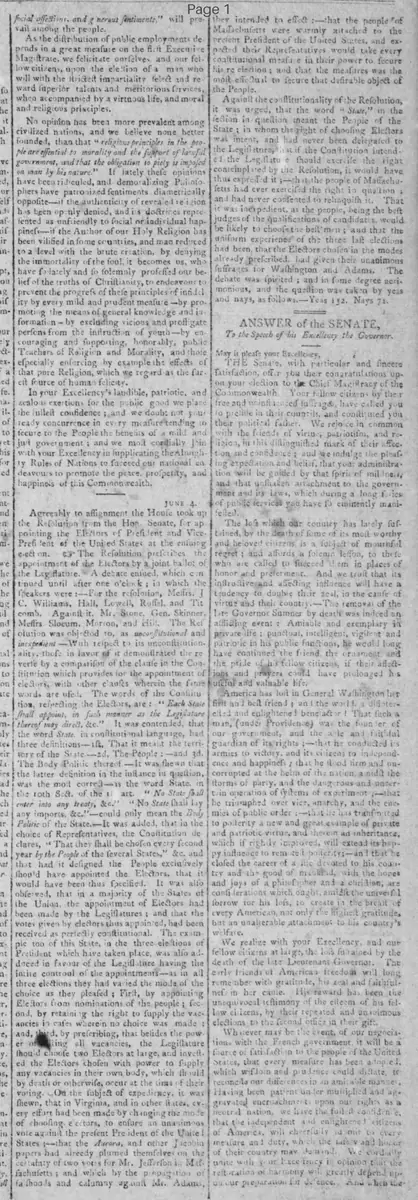
Agreeably to assignment the House took up the Resolution from the Hon. Senate, for appointing the Electors of President and Vice-President of the United States at the ensuing election. The Resolution prescribes the appointment of the Electors by a joint ballot of the Legislature. A debate ensued, which continued until after one o'clock: in which the speakers were:—For the resolution, Messrs. J. C. Williams, Hall, Lowell, Russell, and Titcomb. Against it, Mr. Stone, Gen. Skinner, Messrs. Slocum, Morton, and Hill. The Resolution was opposed, as unconstitutional and inexpedient—With respect to its unconstitutionality, those in favor of it demonstrated the reverse by a comparison of the clause in the Constitution in which provides for the appointment of electors, with other clauses wherein the same words are used. The words of the Constitution, respecting the Electors, are: "Each State shall appoint, in such manner as the Legislature thereof may direct, &c." It was contended, that the word State, in constitutional language, had three definitions—1st, That it meant the territory of the State.—2d, The People:—and 3d, The Body Politic thereof—It was shewn that the latter definition in the instance in question, was the most correct—is the word State, in the 10th Sect. of the 1st art. "No State shall enter into any treaty, &c." "No State shall lay any imposts, &c."—could only mean the Body Politic of the State.—It was added, that in the choice of Representatives, the Constitution declares, "That they shall be chosen every second year by the People of the several States," &c. and that had it designed the People exclusively should have appointed the Electors, that it would have been thus specified. It was also observed, that in a majority of the States of the Union, the appointment of Electors had been made by the Legislatures; and that the votes given by electors thus appointed, had been received as perfectly constitutional. The example too of this State, in the three elections of President which have taken place, was also adduced in favour of the Legislature having the entire controul of the appointments—as in all three elections they had varied the mode of the choice as they pleased: First, by appointing Electors from nominations of the people; second, by retaining the right to supply the vacancies in cases wherein no choice was made; and, third, by prescribing, that besides the power of filling all vacancies, the Legislature should choose two Electors at large, and invested the Electors chosen with power to supply any vacancies in their own body, which should by death or otherwise, occur at the time of their voting.—On the subject of expediency, it was shewn, that in Virginia, and in other states, every effort had been made by changing the mode of choosing electors, to ensure an unanimous vote against the present President of the United States—that the Aurora, and other Jacobin papers had already plumed themselves on the certainty of two votes for Mr. Jefferson in Massachusetts; and which by the propagation of falsehoods and calumny against Mr. Adams, they intended to effect—that the people of Massachusetts were warmly attached to the present President of the United States, and expected their Representatives would take every constitutional measure in their power to secure his re-election; and that the measure was the most effectual to secure that desirable object of the People.
Against the constitutionality of the Resolution, it was urged, that the word "State," in the section in question meant the People of the State: in whom the right of choosing Electors was vested, and had never been delegated to the Legislature, but if the Constitution intended that the Legislature should exercise the right contemplated by the Resolution, it would have thus expressed it;—that the people of Massachusetts had ever exercised the right in question: and had never consented to relinquish it. That it was inexpedient, as the people, being the best judges of the qualifications of candidates, would be likely to choose the best men; and that the uniform experience of the three last elections had been, that the Electors chosen in the modes already prescribed, had given their unanimous suffrages for Washington and Adams. The debate was spirited; and in some degree acrimonious, and the question was taken by yeas and nays, as follows.—Yeas 192. Nays 71.
What sub-type of article is it?
What keywords are associated?
What entities or persons were involved?
Where did it happen?
Domestic News Details
Primary Location
Massachusetts
Event Date
June 4.
Key Persons
Outcome
the resolution passed by yeas 192, nays 71.
Event Details
The House debated a Senate resolution to appoint presidential electors by joint ballot of the Legislature. Proponents argued it was constitutional, citing the U.S. Constitution's language allowing state legislatures to direct appointments, historical precedents in other states and prior Massachusetts elections, and expedient to counter efforts in other states to oppose Adams' re-election and ensure his support. Opponents argued it was unconstitutional, vesting the right in the people, and inexpedient as the people had reliably chosen suitable electors who supported Washington and Adams in past elections. The debate was spirited and acrimonious.