Thank you for visiting SNEWPapers!
Sign up free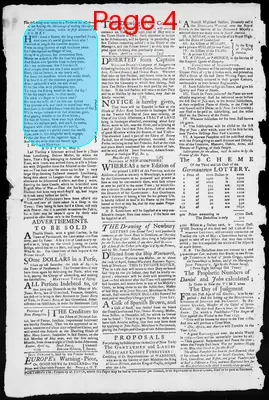
Poem
May 11, 1759
The New Hampshire Gazette
Portsmouth, Rockingham County, New Hampshire
What is this article about?
A poem by a secluded observer lamenting his inability to make precise astronomical observations of the comet he discovered, praising its appearance and urging scientists to study its path, period, and velocity. Attributed to Sir Isaac Newton.
Clipping
OCR Quality
98%
Excellent
Full Text
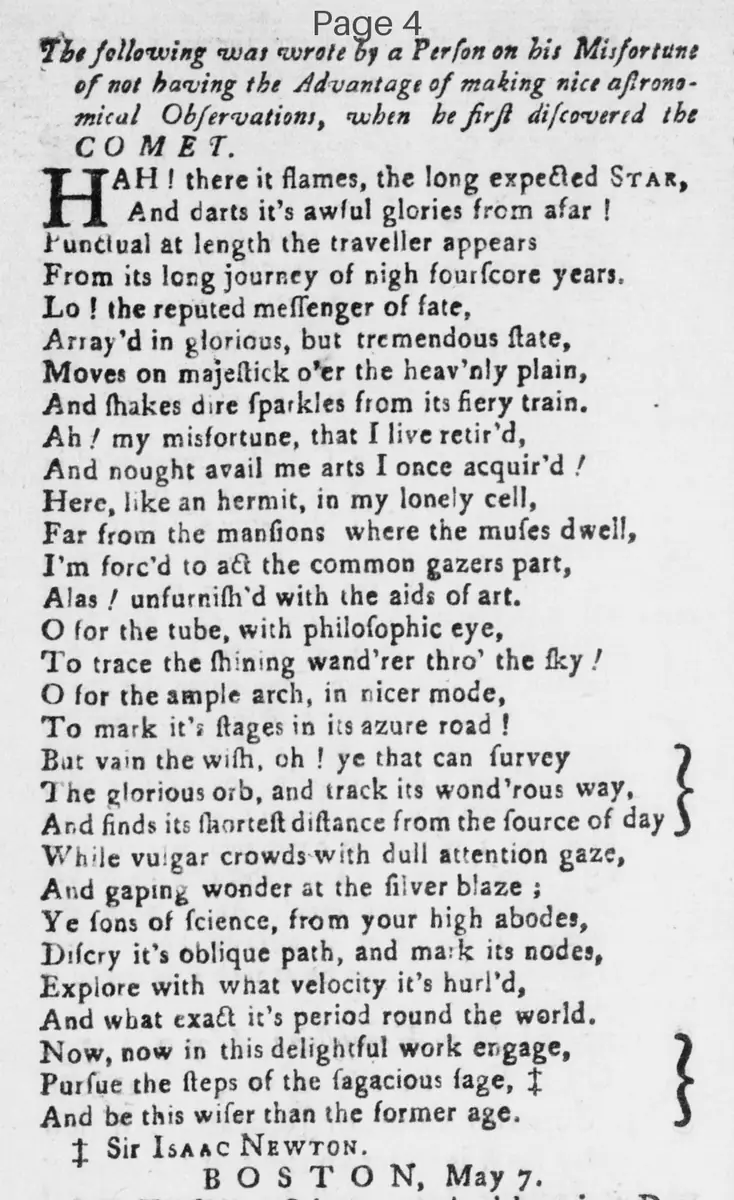
The following was wrote by a Person on his Misfortune of not having the Advantage of making nice astronomical Observations, when he first discovered the COMET.
AH! there it flames, the long expected Star,
And darts it's awful glories from afar!
Punctual at length the traveller appears
From its long journey of nigh fourscore years.
Lo! the reputed messenger of fate,
Array'd in glorious, but tremendous state,
Moves on majestick o'er the heav'nly plain,
And shakes dire sparkles from its fiery train.
Ah! my misfortune, that I live retir'd,
And nought avail me arts I once acquir'd!
Here, like an hermit, in my lonely cell,
Far from the mansions where the muses dwell,
I'm forc'd to act the common gazers part,
Alas! unfurnish'd with the aids of art.
O for the tube, with philosophic eye,
To trace the shining wand'rer thro' the sky!
O for the ample arch, in nicer mode,
To mark it's stages in its azure road!
But vain the wish, oh! ye that can survey
The glorious orb, and track its wond'rous way,
And find its shortest distance from the source of day
While vulgar crowds with dull attention gaze,
And gaping wonder at the silver blaze;
Ye sons of science, from your high abodes.
Discry it's oblique path, and mark its nodes,
Explore with what velocity it's hurl'd,
And what exact it's period round the world.
Now, now in this delightful work engage,
Pursue the steps of the sagacious sage,
And be this wiser than the former age.
Sir Isaac Newton.
AH! there it flames, the long expected Star,
And darts it's awful glories from afar!
Punctual at length the traveller appears
From its long journey of nigh fourscore years.
Lo! the reputed messenger of fate,
Array'd in glorious, but tremendous state,
Moves on majestick o'er the heav'nly plain,
And shakes dire sparkles from its fiery train.
Ah! my misfortune, that I live retir'd,
And nought avail me arts I once acquir'd!
Here, like an hermit, in my lonely cell,
Far from the mansions where the muses dwell,
I'm forc'd to act the common gazers part,
Alas! unfurnish'd with the aids of art.
O for the tube, with philosophic eye,
To trace the shining wand'rer thro' the sky!
O for the ample arch, in nicer mode,
To mark it's stages in its azure road!
But vain the wish, oh! ye that can survey
The glorious orb, and track its wond'rous way,
And find its shortest distance from the source of day
While vulgar crowds with dull attention gaze,
And gaping wonder at the silver blaze;
Ye sons of science, from your high abodes.
Discry it's oblique path, and mark its nodes,
Explore with what velocity it's hurl'd,
And what exact it's period round the world.
Now, now in this delightful work engage,
Pursue the steps of the sagacious sage,
And be this wiser than the former age.
Sir Isaac Newton.
What sub-type of article is it?
Ode
What themes does it cover?
Science Progress
What keywords are associated?
Comet Observation
Astronomical Misfortune
Sir Isaac Newton
Celestial Discovery
Scientific Pursuit
What entities or persons were involved?
Sir Isaac Newton
Poem Details
Author
Sir Isaac Newton
Subject
On His Misfortune Of Not Having The Advantage Of Making Nice Astronomical Observations, When He First Discovered The Comet
Form / Style
Rhymed Couplets
Key Lines
Ah! There It Flames, The Long Expected Star,
And Darts It's Awful Glories From Afar!
Ah! My Misfortune, That I Live Retir'd,
O For The Tube, With Philosophic Eye,
Ye Sons Of Science, From Your High Abodes.