Thank you for visiting SNEWPapers!
Sign up free
Editorial
July 21, 1827
Constitutional Whig
Richmond, Virginia
What is this article about?
Editorial from Lynchburg Virginian criticizes Richmond Enquirer's inconsistent support for Andrew Jackson in 1828 presidential race, quoting their 1824 denunciation of him as unfit, rash, and a curse on the country, urging former Crawford backers not to switch.
Clipping
OCR Quality
98%
Excellent
Full Text
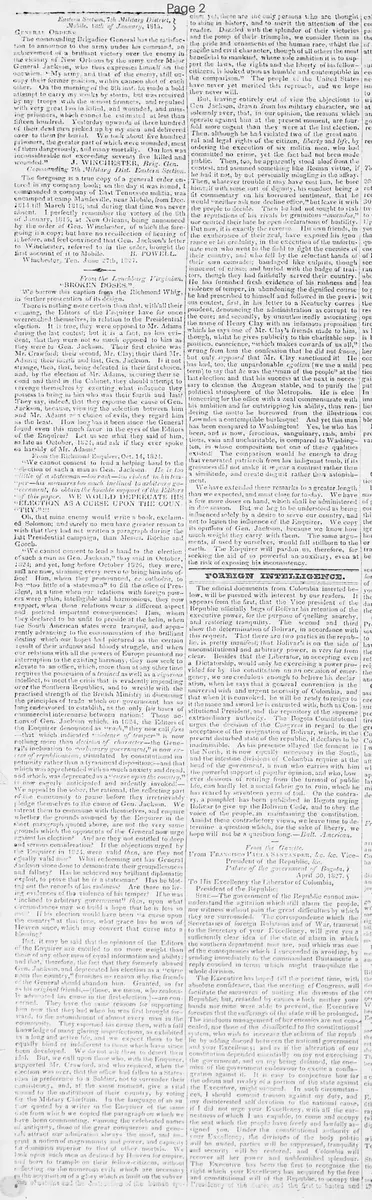
From the Lynchburg Virginian.
"BROKEN DOSES."
We borrow this caption from the Richmond Whig: in further prosecution of its design.
There is nothing more certain than that, with all their cunning, the Editors of the Enquirer have for once overreached themselves, in relation to the Presidential election. It is true, they were opposed to Mr. Adams during the last contest; but it is a fact, no less evident, that they were not so much opposed to him as they were to Gen. Jackson. Their first choice was Mr. Crawford: their second, Mr. Clay; their third Mr. Adams; their fourth and last, Gen. Jackson. Is it not strange, then, that, being defeated in their first choice, and, by the election of Mr. Adams, securing their second and third in the Cabinet, they should attempt to revenge themselves by exerting what influence they possess to bring in him who was their fourth and last?
They say, indeed, that they espouse the cause of Gen. Jackson, because, viewing the selection between him and Mr. Adams as a choice of evils, they regard him as the least. How long has it been since the General found even this much favor in the eyes of the Editors of the Enquirer? Let us see what they said of him, so late as October, 1824, and ask if they ever spoke so harshly of Mr. Adams?
From the Richmond Enquirer, Oct. 14, 1824.
"We cannot consent to lend a helping hand to the election of such a man as Gen. Jackson. He is too little of a statesman—too rash—too violent in his temper—his measures too much inclined to arbitrary government, to obtain the humble support of the Editors of this paper. WE WOULD DEPRECATE HIS ELECTION AS A CURSE UPON THE COUNTRY."!!!
Oh, that mine enemy would write a book, exclaimed Solomon; and surely no men have greater reason to wish that they had not written a paragraph during the last Presidential campaign, than Messrs. Ritchie and Gooch.
"We cannot consent to lend a hand to the election of such a man as Gen. Jackson," they said in October, 1824; and yet, long before October 1826, they were, and are now, straining every nerve to bring him into office! Him, whom they pronounced, ex cathedra, to be "too little of a statesman" to fill the office of President, at a time when our relations with foreign powers were plain, intelligible and harmonious, they now support, when those relations wear a different aspect and portend important consequences! Him, whom they declared to be unfit to preside at the helm, when the South American states were tranquil, and apparently advancing to the consummation of the brilliant destiny which our hopes had pictured as the certain result of their arduous and bloody struggle, and when our relations with all the powers of Europe promised no interruption to the existing harmony, they now seek to elevate to an office, which, more than at any other time requires the possession of a trained as well as a vigorous intellect, to meet the crisis that is evidently impending over the Southern Republics, and to wrestle with the practised strength of the British Ministry in discussing the principles of trade which our government has so long endeavored to establish, as the only fair basis of commercial intercourse between nations! Those actions of Gen. Jackson which, in 1824, the Editors of the Enquirer denounced as "rash," they now call firm—that which indicated violence of temper" is now nothing more than decision of character—the General's inclination to "arbitrary government," is now excess of republicanism, stimulated by constitutional impetuosity rather than a tyrannical disposition;—and that which was apprehended with so much anxiety and dread, and which, was deprecated as a "curse upon the country." is now eagerly anticipated and ardently invoked!-
We appeal to the sober, the rational, the reflecting part of the community to pause before they irrevocably pledge themselves to the cause of Gen. Jackson. We entreat them to commune with themselves, and enquire whether the grounds assumed by the Enquirer in the short paragraph quoted above, are not the very same grounds which the opponents of the General now urge against his election? "And are they not entitled to deep and serious consideration? If the objections urged by the Enquirer in 1824, were valid then, are they not equally valid now? What redeeming act has General Jackson since done to demonstrate their groundlessness and fallacy? Has he achieved any brilliant diplomatic exploit, to prove that he is a statesman? Has he blotted out the records of his rashness? Are there no living evidences of the violence of his temper? If he was inclined to arbitrary government" then, upon what circumstances may we build a hope that he is less so now? If his election would have been "a curse upon the country" at that time, what grace has he won of heaven since, which may convert that curse into a blessing?
But, it may be said that the opinions of the Editors of the Enquirer are entitled to no more weight than those of any other men of equal information and ability: and that, therefore, the fact that they formerly abused Gen. Jackson, and deprecated his election as a "curse upon the country," furnishes no reason why the friends of the General should abandon him. Granted, so far as his original friends,—(those, we mean, who zealously advocated his cause in the first election.)—are concerned. They have the same reasons for supporting him now that they had when he was first brought forward, to the astonishment of almost every man in the community. They espoused his cause then, with a full knowledge of many glaring imperfections, as exhibited in a long and active life, and we expect them to be equally blind or indifferent to those which have since been developed. We do not ask them to desert their idol. But, we call upon those who, with the Enquirer, supported Mr. Crawford, and who rejoiced, when the election was over, that the office had fallen to a Statesman in preference to a Soldier, not to surrender their consistency, and, at the same time, give a vital wound to the institutions of their country, by voting for the Military Chieftain. In the language of an author quoted by a writer in the Enquirer of the same date from whence we copied the paragraph on which we have been commenting. "Among the celebrated names of antiquity, those of the great conquerors and generals, attract our admiration always the most, and imprint a notion of magnanimity and power, and capacity for dominion superior to that of other mortals. We look upon such men as destined by Heaven for empire, and born to trample on their fellow-citizens, without reflecting on the numerous evils which are necessary to the acquisition of a glory which is built on the subversion of nations and the destruction of the human species: such, these are the only persons who are thought to shine in history, and to merit the attention of the reader. Dazzled with the splendor of their victories and the pomp of their triumphs, we consider them as the pride and ornaments of the human race, whilst the pacific and civil character, though of all others the most beneficial to mankind, whose sole ambition it is to support the laws, the rights and the liberty of his fellow-citizens, is looked upon as humble and contemptible in the comparison." The people of the United States have never yet merited this reproach, and we hope they never will.
But, leaving entirely out of view the objections to Gen. Jackson, drawn from his military character, we solemnly aver, that, in our opinion, the reasons which operate against him at the present moment, are fourfold more cogent than they were at the last election. Then, although he had violated two of the great natural and legal rights of the citizen, liberty and life, by ordering the execution of six militia men, who had committed no crime, yet the fact had not been made public. Then, too, he apparently stood aloof from the contest, and assumed something like Roman virtue, if he had it not, by not personally mingling in the affray. Then, whatever trouble it may have cost him, he bore himself with some sort of dignity, his conduct being a fit commentary on his borrowed sentiment, that he would "neither ask nor decline office." but leave it with the people to decide. Then he had not sought to stab the reputations of his rivals by gratuitous "innuendos," nor courted their hate by open declarations of hostility. But now, it is exactly the reverse. His own friends, in the exuberance of their zeal, have exposed his ignorance or his credulity, in the execution of the unfortunate men who went to the field to fight the enemies of their country, and who fell by the reluctant hands of their own comrades; bandaged like culprits, though innocent of crime; and buried with the badge of traitors, though they had faithfully served their country. He has furnished fresh evidence of his rashness and violence of temper, in abandoning the dignified course he had prescribed to himself and followed in the previous contest. first, in his letter to a Kentucky correspondent, denouncing the administration as corrupt to the core; and secondly, by unauthorizedly associating the name of Henry Clay with an infamous proposition which he says one of Mr. Clay's friends made to him, though, whilst he gives publicity to this charitable supposition, conscience, "which makes cowards of us all," wrung from him the confession that he did not know, but only supposed that Mr. Clay sanctioned it! He has had, too, the unpardonable egotism (we use a mild term) to say that he was the "man of the people" at the last election; and that his success at the next is necessary to cleanse the Augean stable, and to purify the political atmosphere of the Metropolis. He is electioneering for the office with a zeal commensurate with his ambition and far outstripping his ability, thus rendering the motto he borrowed from the illustrious Lowndes a contemptible burlesque! And yet this man has been compared to Washington! Yes, he who has been, and is now, ferocious, sanguinary, rash, ambitious, vain and uncharitable, is compared to Washington, in whose composition not one of these qualities existed! The comparison would be enough to drag that venerated patriarch from his indignant tomb, if its grossness did not make it appear a contrast rather than a similitude, and create disgust rather than astonishment.
We have extended these remarks to a greater length than we expected, and must close for to-day. We have a few more doses on hand, which shall be administered in due season. But we beg to be understood as being influenced solely by a desire to serve our country, and not to lessen the influence of the Enquirer. We copy its opinions of Gen. Jackson, because we know how much weight they carry with them. The same arguments, if used by ourselves, would fall stillborn to the earth. The Enquirer will pardon us, therefore, for seeking the aid of so powerful an auxiliary, even at the risk of exposing his inconsistency.
"BROKEN DOSES."
We borrow this caption from the Richmond Whig: in further prosecution of its design.
There is nothing more certain than that, with all their cunning, the Editors of the Enquirer have for once overreached themselves, in relation to the Presidential election. It is true, they were opposed to Mr. Adams during the last contest; but it is a fact, no less evident, that they were not so much opposed to him as they were to Gen. Jackson. Their first choice was Mr. Crawford: their second, Mr. Clay; their third Mr. Adams; their fourth and last, Gen. Jackson. Is it not strange, then, that, being defeated in their first choice, and, by the election of Mr. Adams, securing their second and third in the Cabinet, they should attempt to revenge themselves by exerting what influence they possess to bring in him who was their fourth and last?
They say, indeed, that they espouse the cause of Gen. Jackson, because, viewing the selection between him and Mr. Adams as a choice of evils, they regard him as the least. How long has it been since the General found even this much favor in the eyes of the Editors of the Enquirer? Let us see what they said of him, so late as October, 1824, and ask if they ever spoke so harshly of Mr. Adams?
From the Richmond Enquirer, Oct. 14, 1824.
"We cannot consent to lend a helping hand to the election of such a man as Gen. Jackson. He is too little of a statesman—too rash—too violent in his temper—his measures too much inclined to arbitrary government, to obtain the humble support of the Editors of this paper. WE WOULD DEPRECATE HIS ELECTION AS A CURSE UPON THE COUNTRY."!!!
Oh, that mine enemy would write a book, exclaimed Solomon; and surely no men have greater reason to wish that they had not written a paragraph during the last Presidential campaign, than Messrs. Ritchie and Gooch.
"We cannot consent to lend a hand to the election of such a man as Gen. Jackson," they said in October, 1824; and yet, long before October 1826, they were, and are now, straining every nerve to bring him into office! Him, whom they pronounced, ex cathedra, to be "too little of a statesman" to fill the office of President, at a time when our relations with foreign powers were plain, intelligible and harmonious, they now support, when those relations wear a different aspect and portend important consequences! Him, whom they declared to be unfit to preside at the helm, when the South American states were tranquil, and apparently advancing to the consummation of the brilliant destiny which our hopes had pictured as the certain result of their arduous and bloody struggle, and when our relations with all the powers of Europe promised no interruption to the existing harmony, they now seek to elevate to an office, which, more than at any other time requires the possession of a trained as well as a vigorous intellect, to meet the crisis that is evidently impending over the Southern Republics, and to wrestle with the practised strength of the British Ministry in discussing the principles of trade which our government has so long endeavored to establish, as the only fair basis of commercial intercourse between nations! Those actions of Gen. Jackson which, in 1824, the Editors of the Enquirer denounced as "rash," they now call firm—that which indicated violence of temper" is now nothing more than decision of character—the General's inclination to "arbitrary government," is now excess of republicanism, stimulated by constitutional impetuosity rather than a tyrannical disposition;—and that which was apprehended with so much anxiety and dread, and which, was deprecated as a "curse upon the country." is now eagerly anticipated and ardently invoked!-
We appeal to the sober, the rational, the reflecting part of the community to pause before they irrevocably pledge themselves to the cause of Gen. Jackson. We entreat them to commune with themselves, and enquire whether the grounds assumed by the Enquirer in the short paragraph quoted above, are not the very same grounds which the opponents of the General now urge against his election? "And are they not entitled to deep and serious consideration? If the objections urged by the Enquirer in 1824, were valid then, are they not equally valid now? What redeeming act has General Jackson since done to demonstrate their groundlessness and fallacy? Has he achieved any brilliant diplomatic exploit, to prove that he is a statesman? Has he blotted out the records of his rashness? Are there no living evidences of the violence of his temper? If he was inclined to arbitrary government" then, upon what circumstances may we build a hope that he is less so now? If his election would have been "a curse upon the country" at that time, what grace has he won of heaven since, which may convert that curse into a blessing?
But, it may be said that the opinions of the Editors of the Enquirer are entitled to no more weight than those of any other men of equal information and ability: and that, therefore, the fact that they formerly abused Gen. Jackson, and deprecated his election as a "curse upon the country," furnishes no reason why the friends of the General should abandon him. Granted, so far as his original friends,—(those, we mean, who zealously advocated his cause in the first election.)—are concerned. They have the same reasons for supporting him now that they had when he was first brought forward, to the astonishment of almost every man in the community. They espoused his cause then, with a full knowledge of many glaring imperfections, as exhibited in a long and active life, and we expect them to be equally blind or indifferent to those which have since been developed. We do not ask them to desert their idol. But, we call upon those who, with the Enquirer, supported Mr. Crawford, and who rejoiced, when the election was over, that the office had fallen to a Statesman in preference to a Soldier, not to surrender their consistency, and, at the same time, give a vital wound to the institutions of their country, by voting for the Military Chieftain. In the language of an author quoted by a writer in the Enquirer of the same date from whence we copied the paragraph on which we have been commenting. "Among the celebrated names of antiquity, those of the great conquerors and generals, attract our admiration always the most, and imprint a notion of magnanimity and power, and capacity for dominion superior to that of other mortals. We look upon such men as destined by Heaven for empire, and born to trample on their fellow-citizens, without reflecting on the numerous evils which are necessary to the acquisition of a glory which is built on the subversion of nations and the destruction of the human species: such, these are the only persons who are thought to shine in history, and to merit the attention of the reader. Dazzled with the splendor of their victories and the pomp of their triumphs, we consider them as the pride and ornaments of the human race, whilst the pacific and civil character, though of all others the most beneficial to mankind, whose sole ambition it is to support the laws, the rights and the liberty of his fellow-citizens, is looked upon as humble and contemptible in the comparison." The people of the United States have never yet merited this reproach, and we hope they never will.
But, leaving entirely out of view the objections to Gen. Jackson, drawn from his military character, we solemnly aver, that, in our opinion, the reasons which operate against him at the present moment, are fourfold more cogent than they were at the last election. Then, although he had violated two of the great natural and legal rights of the citizen, liberty and life, by ordering the execution of six militia men, who had committed no crime, yet the fact had not been made public. Then, too, he apparently stood aloof from the contest, and assumed something like Roman virtue, if he had it not, by not personally mingling in the affray. Then, whatever trouble it may have cost him, he bore himself with some sort of dignity, his conduct being a fit commentary on his borrowed sentiment, that he would "neither ask nor decline office." but leave it with the people to decide. Then he had not sought to stab the reputations of his rivals by gratuitous "innuendos," nor courted their hate by open declarations of hostility. But now, it is exactly the reverse. His own friends, in the exuberance of their zeal, have exposed his ignorance or his credulity, in the execution of the unfortunate men who went to the field to fight the enemies of their country, and who fell by the reluctant hands of their own comrades; bandaged like culprits, though innocent of crime; and buried with the badge of traitors, though they had faithfully served their country. He has furnished fresh evidence of his rashness and violence of temper, in abandoning the dignified course he had prescribed to himself and followed in the previous contest. first, in his letter to a Kentucky correspondent, denouncing the administration as corrupt to the core; and secondly, by unauthorizedly associating the name of Henry Clay with an infamous proposition which he says one of Mr. Clay's friends made to him, though, whilst he gives publicity to this charitable supposition, conscience, "which makes cowards of us all," wrung from him the confession that he did not know, but only supposed that Mr. Clay sanctioned it! He has had, too, the unpardonable egotism (we use a mild term) to say that he was the "man of the people" at the last election; and that his success at the next is necessary to cleanse the Augean stable, and to purify the political atmosphere of the Metropolis. He is electioneering for the office with a zeal commensurate with his ambition and far outstripping his ability, thus rendering the motto he borrowed from the illustrious Lowndes a contemptible burlesque! And yet this man has been compared to Washington! Yes, he who has been, and is now, ferocious, sanguinary, rash, ambitious, vain and uncharitable, is compared to Washington, in whose composition not one of these qualities existed! The comparison would be enough to drag that venerated patriarch from his indignant tomb, if its grossness did not make it appear a contrast rather than a similitude, and create disgust rather than astonishment.
We have extended these remarks to a greater length than we expected, and must close for to-day. We have a few more doses on hand, which shall be administered in due season. But we beg to be understood as being influenced solely by a desire to serve our country, and not to lessen the influence of the Enquirer. We copy its opinions of Gen. Jackson, because we know how much weight they carry with them. The same arguments, if used by ourselves, would fall stillborn to the earth. The Enquirer will pardon us, therefore, for seeking the aid of so powerful an auxiliary, even at the risk of exposing his inconsistency.
What sub-type of article is it?
Partisan Politics
What keywords are associated?
Presidential Election
Andrew Jackson
Richmond Enquirer
Political Inconsistency
1828 Campaign
Thomas Ritchie
John Adams
Henry Clay
William Crawford
What entities or persons were involved?
Gen. Jackson
Richmond Enquirer
Messrs. Ritchie And Gooch
Mr. Adams
Mr. Crawford
Mr. Clay
Richmond Whig
Editorial Details
Primary Topic
Critique Of Enquirer's Support For Jackson
Stance / Tone
Strongly Anti Jackson And Critical Of Enquirer's Inconsistency
Key Figures
Gen. Jackson
Richmond Enquirer
Messrs. Ritchie And Gooch
Mr. Adams
Mr. Crawford
Mr. Clay
Richmond Whig
Key Arguments
Enquirer's Past Denunciation Of Jackson As Unfit In 1824 Contradicts Current Support
Jackson Lacks Statesmanship, Is Rash And Violent
No Evidence Jackson Has Changed Since 1824
Urges Former Crawford Supporters To Maintain Consistency Against Military Chieftain
Jackson's Execution Of Innocent Militiamen Shows Violation Of Rights
Jackson's Recent Actions Reveal Ambition, Egotism, And Attacks On Rivals
Comparison Of Jackson To Washington Is Absurd And Insulting