Thank you for visiting SNEWPapers!
Sign up free
Alexandria Gazette
Alexandria, Alexandria County, District Of Columbia
What is this article about?
Senator Thomas Hart Benton's speech in the U.S. Senate critiques the Bank of the United States' defense against President Jackson's removal of deposits, accusing it of electioneering, personal attacks, and misuse of funds through resolutions and publications from 1829-1833.
Merged-components note: Merged table into the Benton speech story as it represents the financial statement exhibited and discussed in the text, with sequential reading order.
Clipping
OCR Quality
Full Text
On the Removal of the Deposites.
[Continued.]
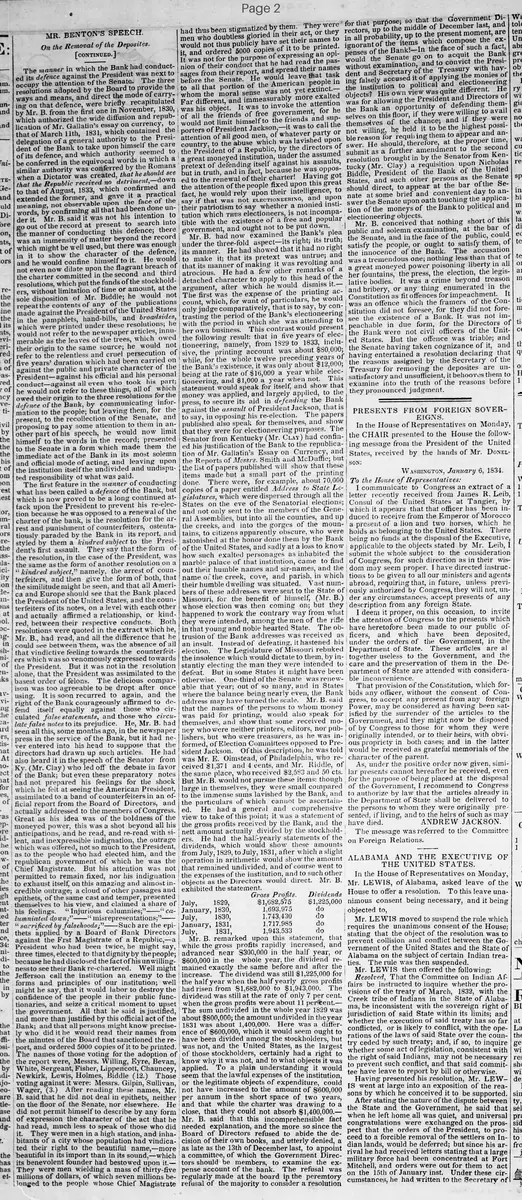
The manner in which the Bank had conducted its defence against the President was next to occupy the attention of the Senate. The three resolutions adopted by the Board to provide the ways and means, and direct the mode of carrying on that defence, were briefly recapitulated by Mr. B. from the first one in November, 1830, which authorized the wide diffusion and republication of Mr. Gallatin's essay on currency, to that of March 11th, 1831, which contained the delegation of a general authority to the President of the Bank to take upon himself the care of its defence, and which authority seemed to be conferred in the equivocal words in which a similar authority was conferred by the Romans when a Dictator was created, that he should see that the Republic received no detriment,-down to that of August, 1833, which confirmed and extended the former, and gave it a practical meaning, not observable upon the face of the words, by confirming all that had been done under it.' Mr. B. said it was not his intention to go out of the record at present to search into the manner of conducting this defence; there was an immensity of matter beyond the record in it to show the character of the defence. which might be well used, but there was enough in it to show the character of the defence. and he would confine himself to it. He would not even now dilate upon the flagrant breach of the charter committed in the second and third resolutions, which put the funds of the stockholders, without limitation of time or amount, at the sole disposition of Mr. Biddle; he would not repeat the contents of any of the publications made against the President of the United States in the pamphlets, hand-bills, and broadsides, which were printed under these resolutions; he would not refer to the newspaper articles, innumerable as the leaves of the trees, which owed their origin to the same source; he would not refer to the relentless and cruel persecution of five years' duration which had been carried on against the public and private character of the President-against his official and his personal conduct-against all even who took his part; he would not refer to these things, all of which owed their origin to the three resolutions for the defence of the Bank, by communicating information to the people; but leaving them, for the present, to the recollection of the Senate, and proposing to pay some attention to them in another part of his speech, he would now limit himself to the words in the record; presented to the Senate in a form which made them the immediate act of the Bank in its most solemn and official mode of acting, and leaving upon the institution itself the undivided and undisputed responsibility of what was said.
The first feature in the manner of conducting what has been called a defence of the Bank, but which is now proved to be a long continued attack upon the President to prevent his re-election because he was opposed to a renewal of the charter of the bank. is the resolution for the arrest and punishment of counterfeiters, ostentatiously paraded by the Bank in its report, and styled by them a kindred subject to the President's first assault. They say that the form of the resolution, in the case of the President, was the same as the form of another resolution on a "kindred subject." namely. the arrest of counterfeiters, and then give the form of both, that the similitude might be seen. and that all America and Europe should see that the Bank placed the President of the United States. and the counterfeiters of its notes. on a level with each other and actually affirmed a relationship, or kind. red, between their respective conducts. Both resolutions were quoted in the extract which he, Mr. B., had read, and all the difference that he could see between them, was the absence of all that vindictive feeling towards the counterfeiters which was so venomously expressed towards the President. But it was not in the resolution alone, that the President was assimilated to the basest order of felons. The delicious comparison was too agreeable to be dropt after once using. It is soon recurred to again, and the right of the Bank courageously affirmed to defend itself equally against those who circulated false statements, and those who circulate false notes to its prejudice. He, Mr. B. had seen all this, some months ago, in the newspaper press in the service of the Bank, but it had never entered into his head to suppose that the directors had drawn up such articles. He had also heard it in the speech of the Senator from Ky. (Mr. Clay) who led off the debate in favor of the Bank; but even these preparatory notes had not prepared his feelings for the shock which he felt at seeing the American President. assimilated to a band of counterfeiters in an official report from the Board of Directors, and actually addressed to the members of Congress. Great as his idea was of the boldness of the moneyed power, this was a shot beyond all his anticipations, and he read, and re-read with silent, and inexpressible indignation, the outrage which was offered, not so much to the President, as to the people who had elected him, and the republican government of which he was the Chief Magistrate. But his attention was not permitted to remain fixed, nor his indignation to exhaust itself, on this amazing and almost incredible outrage; a cloud of other passages and epithets, of the same cast and temper, presented themselves to his view, and claimed a share of his feelings.
"Injurious calumnies; calumniated down;"
"misrepresentations; sacrificed by falsehoods;"
Such are the epithets applied by a Board of Bank Directors against the First Magistrate of a Republic,--a President who had been twice, he might say, three times, elected to that dignity by the people; because he had disclosed the fact of his unwillingness to see their Bank re-chartered. Well might Jefferson call the institution an enemy to the forms and principles of our institution; well might he say, that it would labor to destroy the confidence of the people in their public functionaries, and seize a critical moment to upset the government. All that he said is justified, and more than justified by this official act of the Bank; and that all persons might know precisely who did it he would read their names from the minutes of the Board that sanctioned the report, and ordered 5000 copies of it to be printed. The names of those voting for the adoption of the report were, Messrs. Willing, Eyre, Bevan, White, Sergeant, Fisher, Lippencott, Chauncey, Newkirk, Lewis, Holmes, Biddle (12.) Those voting against it were: Messrs. Gilpin, Sullivan, Wager, (3.) After reading these names, Mr. B. said that he did not deal in epithets, neither on the floor of the Senate, nor elsewhere. He did not permit himself to describe by any form of expression the character of the act that he had read, much less to speak of those who did it. They were men in a high station, and inhabitants of a city whose population had vindicated their right to the beautiful name,--more beautiful in its import than in its sound,-which its benevolent founder had bestowed upon it.- They were men wielding a mass of thirty-five millions of dollars, of which seven millions belonged to the people whose Chief Magistrate had thus been stigmatized by them. They were men who doubtless gloried in their act, or they would not thus publicly have set their names to it, and ordered 5000 copies of it to be printed. It was not for the purpose of expressing an opinion of their conduct that he had read the passages from their report, and spread their names before the Senate. He would leave that task to all that portion of the American people in whom the moral sense was not yet extinct.-
Far different, and immeasurably more exalted was his object. It was to invoke the attention of all the friends of free government, for he would not limit himself to the friends and supporters of President Jackson,--it was to call the attention of all good men, of whatever party or country, to the abuse which was lavished upon the President of a Republic, by the directors of a great moneyed institution, under the assumed pretext of defending itself against his assaults, but in truth, and in fact, because he was opposed to the renewal of their charter! Having got the attention of the people fixed upon this great fact, he would rely upon their intelligence, to say if that was not ELECTIONEERING, and upon their patriotism to say whether a monied institution which THus electioneers, is not incompatible with the existence of a free and popular government, and ought not to be put down.
Mr. B. had now examined the Bank's plea under the three-fold aspect-its right; its truth; its manner. He had showed that it had no right to make it; that its pretext was untrue; and that its manner of making it was revolting and atrocious. He had a few other remarks of a detached character to apply to this head of the argument, after which he would dismiss it.-
The first was the expense of the printing account, which, for want of particulars, he would only judge comparatively, that is to say, by contrasting the period of the Bank's electioneering with the period in which she was attending to her own business. This contrast would present the following result: that in five years of electioneering, namely, from 1829 to 1833, inclusive, the printing account was about $50,000; while, for the whole twelve preceding years of the Bank's existence, it was only about $12,000; being at the rate of $16,000 a year while electioneering, and $1,000 a year when not. This statement would speak for itself, and show that money was applied, and largely applied, to the press, to secure its aid in defending the Bank against the assault of President Jackson, that is to say, in opposing his re-election. The papers published also speak for themselves, and show that they were for electioneering purposes. The Senator from Kentucky (Mr. Clay) had confined his justification of the Bank to the republication of Mr. Gallatin's Essay on Currency, and the Reports of Messrs. Smith and McDuffie; but the list of papers published will show that these items made but a small part of the printing done. There were, for example, about 70,000 copies of a paper entitled Address to State Legislatures, which were dispersed through all the States on the eve of the Senatorial elections; and not only sent to the members of the General Assemblies, but into all the counties, and up the creeks, and into the gorges of the mountains, to citizens apparently obscure, who were astonished at the honor done them by the Bank of the United States, and sadly at a loss to know how such exalted personages as inhabited the marble palace of that institution, came to find out their humble names and sir-names, and the name of the creek, cove, and parish, in which their humble dwelling was situated. Vast numbers of these addresses were sent to the State of Missouri, for the benefit of himself, (Mr. B.) whose election was then coming on; but they happened to work the contrary way from what they were intended, among the men of the rifle in that young and noble hearted State. The obtrusion of the Bank addresses was received as an insult. Instead of defeating, it hastened his election. The Legislature of Missouri rebuked the insolence which would dictate to them, by instantly electing the man they were intended to defeat. But in some States it might have been otherwise. One-third of the Senate was renewable that year; out of so many, and in States where the balance being nearly even, the Bank address may have turned the scale. Mr. B. said that the names of the persons to whom money was paid for printing, would also speak for themselves, and show that some received money who were neither printers, editors, nor publishers, but who were treasurers, as he was informed, of Election Committees opposed to President Jackson. Of this description, he was told was Mr. E. Olmstead, of Philadelphia, who received $1,371 and 4 cents, and Mr. Riddle, of the same place, who received $2,583 and 50 cts. But Mr. B. would not pursue these items: though large in themselves, they were small compared to the immense sums lavished by the Bank, and the particulars of which cannot be ascertained. 'He had a general and comprehensive view to take of this point; it was a statement of the gross profits received by the Bank, and the nett amount actually divided by the stockholders. He had the half-yearly statements of the dividends, which would show these amounts from July, 1829, to July, 1831, after which a slight operation in arithmetic would show the amount that remained undivided. and of course went to the expenses of the institution, and to such other objects as the Directors would direct.
Mr. B. exhibited the statement.
Mr. B. remarked upon this statement, that while the gross profits rapidly increased, and advanced near $300,000 in the half year, or $600,000 in the whole year, the dividend remained exactly the same before and after the increase. The dividend was still $1,225,000 for the half year when the half yearly gross profits had risen from $1,682,000 to $1,943,000." The dividend was still at the rate of only 7 per cent. when the gross profits were about 11 per cent.- The sum undivided in the whole year 1829 was about $800,000; the amount undivided in the year 1831 was about 1,400,000. Here was a difference of $600,000, which it would seem ought to have been divided among the stockholders, but was not, and the United States, as the largest of those stockholders, certainly had a right to know why it was not, and to what objects it was applied. To a plain understanding it would seem that the lawful expenses of the institution or the legitimate objects of expenditure, could not have increased to the amount of $600,000 per annum in the short space of two years, and that while the charter was drawing to a close, that they could not absorb $1,400,000.-
Mr. B. said that this incomprehensible fact needed explanation, and the more so since the Board of Directors refused to abide the decision of their own books, and utterly denied, as late as the 13th of December last, to appoint a committee, of which the Government Directors should be members, to examine the expense account of the bank. The refusal was regularly made at the board in the peremptory refusal of the majority to consider a resolution for that purpose; so that the Government Directors, up to the middle of December last, and in all probability, up to the present moment, are ignorant of the items which compose the expenses of the Bank! In the face of such a fact. would the Senate go on to acquit the Bank without examination, and to convict the President and Secretary of the Treasury with having falsely accused it of applying the monies of the institution to political and electioneering objects? His own view was quite different. He was for allowing the President and Directors of the Bank an opportunity of defending themselves on this floor, if they were willing to avail themselves of the chance; and if they were not willing, he held it to be the highest possible reason for requiring them to appear and answer. He should, therefore, at the proper time, submit as a further amendment to the second resolution brought in by the Senator from Kentucky (Mr. Clay) a requisition upon Nicholas Biddle, President of the Bank of the United States, and such other persons as the Senate should direct, to appear at the bar of the Senate at some brief and convenient day to answer the Senate upon oath touching the application of the moneys of the Bank to political and electioneering objects.
Mr. B. conceived that nothing short of this public and solemn examination, at the bar of the Senate, and in the face of the public, could satisfy the people, or ought to satisfy them, of the innocence of the Bank. The accusation was a tremendous one; nothing less than that of a great moneyed power poisoning liberty in all her fountains, the press, the election, the legislative bodies.' It was a crime beyond treason and bribery, or any thing enumerated in the Constitution as fit offences for impeachment. It was an offence which the framers of the Constitution did not foresee, for they did not foresee the existence of a Bank. It. was not impeachable in due form, for the Directors of the Bank were not civil officers of the United States. But the offence was triable; and the Senate having taken cognizance of it, and having entertained a resolution declaring that the reasons assigned by the Secretary of the Treasury for removing the deposites are unsatisfactory and insufficient, it behooves them to examine into the truth of the reasons before they pronounced judgment.
| Gross Profits. | Dividends | |
| July, 1829, | $1,682,575 | $1,225,000 |
| January, 1830, | 1,693,975 | do |
| July, 1830, | 1,743,430 | do |
| January, 1831, | 1,717,985 | do |
| July, 1831, | 1,943,533 | do |
What sub-type of article is it?
What themes does it cover?
What keywords are associated?
What entities or persons were involved?
Where did it happen?
Story Details
Key Persons
Location
U.S. Senate, Philadelphia
Event Date
1829 1833
Story Details
Senator Benton critiques the Bank of the United States' resolutions and actions as electioneering against President Jackson's re-election over charter renewal, highlighting attacks equating the President to counterfeiters, excessive printing expenses, and undivided profits suggesting misuse of funds, calling for Senate examination of Bank directors.