Thank you for visiting SNEWPapers!
Sign up free
Literary
July 25, 1844
The Hillsborough Recorder
Hillsboro, Orange County, North Carolina
What is this article about?
In this didactic short story, young wife Emelie, upset by her husband Reed's smoking habit, withholds kisses on her friend's advice until he quits. When he relapses, she smokes with him to demonstrate commitment, leading him to stop permanently. They use the saved money to aid an impoverished elderly acquaintance, Mrs. Ellison.
Clipping
OCR Quality
95%
Excellent
Full Text
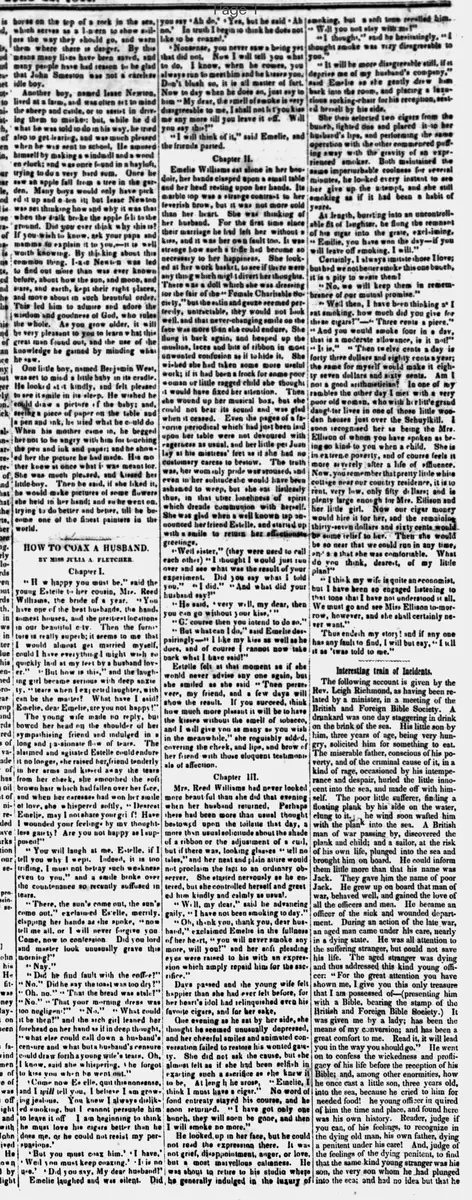
HOW TO COAX A HUSBAND.
BY MISS JULIA A. FLETCHER.
Chapter I.
"How happy you must be," said the young Estelle to her cousin, Mrs. Reed Williams, the bride of a year. "You have one of the best husbands, the handsomest house, and the prettiest location in our beautiful city. Then the furniture is really superb; it seems to me that I would almost get married myself, could I have everything so bright with so quickly laid at my feet by a husband lover."
But how is this," and the laughing girl became serious with deep anxiety. "Tears when I expected laughter, what can be the matter! What have I said? Emelie, dear Emelie, are you not happy!"
The young wife made no reply, but bowed her head on the shoulder of her sympathizing friend and indulged in a long and passionate flow of tears.
The alarmed and agitated Estelle could endure it no longer, she raised her friend tenderly in her arms and kissed away the tears from her cheek, she smoothed the soft brown hair which had fallen over her face, and when her caresses had won her smile of love, she whispered softly, "Dearest Emelie, may I not share your grief! Have I wounded your feelings by my thoughtless gaiety? Are you not happy as I supposed?"
"You will laugh at me, Estelle, if I tell you why I wept. Indeed, it is too trifling, I must not betray such weakness even to you." and a smile broke over the countenance so recently suffused in tears.
"There, the sun's come out, the sun's come out," exclaimed Estelle, merrily, clapping her hands as she spoke, "now tell me all, or I will never forgive you. Come, now to confession. Did your lord and master look unusually grave this morning?"
"Nay."
"Did he find fault with the coffee?"
"No."
"Did he say the toast was too dry?"
"Oh, no."
"That the bread was stale?"
"No."
"That your morning dress was too negligee?"
"No."
"What could it be then?" and the arch girl leaned her forehead on her hand as if in deep thought, "what else could call down a husband's censure and what but a husband's censure could draw forth a young wife's tears. Oh, I know," said she whispering, "he forgot to kiss you when he went out."
"Come now Estelle, quit this nonsense, and I will tell you, I believe I am growing jealous. You know I always disliked smoking, but I cannot persuade him to leave it off. I am beginning to think he must love his cigars better than he does me, or he could not resist my persuasions."
"But you must coax him."
"I have."
"Well you must keep coaxing."
"It is no use."
"Did you say, 'My dear husband?'"
Emelie laughed and was silent. "Did you say 'Ah do,' 'Yes, but he said 'Ah no.' In truth I begin to think he does not like to be coaxed."
"No nonsense, you never saw a thing yet that did not. Now I will tell you what to do. I know, when he comes, you always run to meet him and he kisses you. Don't blush so, it is all matter of fact. Now to-day when he does so, just say to him—'My dear, the smell of smoke is very disagreeable to me, I shall not let you kiss me any more till you leave it off.' Will you say this?"
"I will think of it," said Emelie, and the friends parted.
Chapter II.
Emelie Williams sat alone in her boudoir, her hands clasped upon a small table and her head resting upon her hands. Its marble top was a strange contrast to her feverish brow, but it was not more cold than her heart. She was thinking of her husband. For the first time since their marriage he had left her without a kiss, and it was her own fault too. It was strange how such a trifle had become so necessary to her happiness. She looked at her work basket, to see if there were any thing which might divert her thoughts. There was a doll which she was dressing for the fair of the "Female Charitable Society," but satin and gauze seemed perfectly intractable, they would not look well, and that never-changing smile on the face was more than she could endure. She flung it back again, and heaped up the muslin, laces and bits of ribbon in great unwonted confusion as if to hide it. She wished she had taken some more useful work; if it had been a frock for some poor woman or little ragged child she thought it would have fixed her attention. Then she wound up her musical box, but she could not bear its sound and was glad when it ceased. Even the pages of favorite periodical which had just been laid upon her table were not devoured with eagerness as usual, and her little pet Juan lay at his mistress' feet as if she had no customary caresses to bestow. The truth was, her womanly pride was aroused, and even in her solitude she would have been ashamed to weep, but she sat listlessly thus, in that utter loneliness of spirit which dreads communion with herself. She was glad when a well known rap announced her friend Estelle, and started up with a smile to return her affectionate greetings.
"Well sister," (they were used to call each other) "I thought I would just run over and see what was the result of your experiment. Did you say what I told you?"
"I did."
"And what did your husband say?"
"He said, 'very well, my dear, then you can go without your kiss.'"
"Of course then you thought to do so."
"But what can I do," said Emelie despairingly. "I like my kisses as well as he does, and of course I cannot now take back what I have said?"
Estelle felt at that moment as if she would never advise any one again, but she smiled as she said "Then persevere, my friend, and a few days will show the result. If you succeed, think how much more pleasant it will be to have the kisses without the smell of tobacco, and I will give you as many as you wish in the meanwhile." she roguishly added, covering the cheek, and lips, and brow of her friend with those eloquent testimonials of affection.
Chapter III.
Mrs. Reed Williams had never looked more beautiful than she did that evening when her husband returned. Perhaps there had been more than usual thought bestowed upon the toilette that day, a more than usual solicitude about the shade of a ribbon or the adjustment of a curl, but if there was, looking glasses "tell no tales," and her neat and plain attire would not proclaim the fact to an ordinary observer. She started nervously as he entered, but she controlled herself and greeted him kindly and calmly as usual.
"Well, my dear," said he advancing gaily, "I have not been smoking to-day."
"Oh, thank you, thank you, dear husband," exclaimed Emelie in the fullness of her heart, "you will never smoke any more, will you?" and her soft pleading eyes were raised to his with an expression which amply repaid him for the sacrifice.
Days passed and the young wife felt happier than she had ever felt before, for her heart's idol had relinquished even his favorite cigars, and for her sake.
One evening as he sat by her side, she thought he seemed unusually depressed, and her cheerful smiles and animated conversation failed to restore his wonted gaiety. She did not ask the cause, but she almost felt as if she had been selfish in exacting such a sacrifice as she knew it to be. At length he arose, "Emelie, I think I must have a cigar."
No word of fond entreaty stayed his course, and he soon returned. "I have got only one bunch, they will soon be gone, and then I will smoke no more."
He looked up in her face, but he could not read the expression there. It was not grief, disappointment, anger, or love, but a most marvellous calmness. He was about to retire to his study where he generally indulged in the luxury of smoking, but a soft tone recalled him.
"Will you not stay with me?"
"I thought," said he hesitatingly, "thought smoke was very disagreeable to you."
"It will be more disagreeable still, if it deprive me of my husband's company." and Emelie as she gently drew him back into the room, and placing a luxurious rocking-chair for his reception, seated herself by his side.
She then selected two cigars from the bunch, lighted one and placed it to her husband's lips, and performing the same operation with the other commenced puffing away with the gravity of an experienced smoker. Both maintained the same imperturbable coolness for several minutes, he looked every instant to see her give up the attempt, and she still smoking as if it had been a habit of years.
As length, bursting into an uncontrollable fit of laughter, he flung the remnant of his cigar into the grate, exclaiming, "Emilie, you have won the day—if you will leave off smoking, I will."
"Certainly. I always imitate those I love; but had we not better smoke this one bunch, it is a pity to waste them?"
"No, we will keep them in remembrance of our mutual promise."
"Well then, I have been thinking as I sat smoking, how much did you give for these cigars?"
"Three cents a piece."
"And you would smoke four in a day, that is a moderate allowance, is it not?"
"It is."
"Then twelve cents a day is forty three dollars and eighty cents a year; the same for myself would make it eighty seven dollars and sixty cents. Am I not a good arithmetician? In one of my rambles the other day I met with a very poor old woman, who with her little granddaughter lives in one of those little wooden houses just over the Schuylkill. I soon recognized her as being the Mrs. Ellison of whom you have spoken as being so kind to you when a child. She is in extreme poverty, and of course feels it more severely after a life of affluence. Now, you remember that pretty little white cottage near our country residence, it is to rent, very low, only fifty dollars; and is plenty large enough for Mrs. Ellison and her little girl. Now our cigar money would hire it for her, and the remaining thirty-seven dollars and sixty cents would be some relief to her. There she would be so near that we could run in any time, and see that she was comfortable. What do you think, dearest, of my little plan!"
"I think my wife is quite an economist, but I have been so engaged listening to that tone that I have not understood it all. We must go and see Mrs. Ellison to-morrow, however, and she shall certainly never want."
Thus endeth my story! and if any one has any fault to find, I will but say, "I tell it as 'twas told to me."
BY MISS JULIA A. FLETCHER.
Chapter I.
"How happy you must be," said the young Estelle to her cousin, Mrs. Reed Williams, the bride of a year. "You have one of the best husbands, the handsomest house, and the prettiest location in our beautiful city. Then the furniture is really superb; it seems to me that I would almost get married myself, could I have everything so bright with so quickly laid at my feet by a husband lover."
But how is this," and the laughing girl became serious with deep anxiety. "Tears when I expected laughter, what can be the matter! What have I said? Emelie, dear Emelie, are you not happy!"
The young wife made no reply, but bowed her head on the shoulder of her sympathizing friend and indulged in a long and passionate flow of tears.
The alarmed and agitated Estelle could endure it no longer, she raised her friend tenderly in her arms and kissed away the tears from her cheek, she smoothed the soft brown hair which had fallen over her face, and when her caresses had won her smile of love, she whispered softly, "Dearest Emelie, may I not share your grief! Have I wounded your feelings by my thoughtless gaiety? Are you not happy as I supposed?"
"You will laugh at me, Estelle, if I tell you why I wept. Indeed, it is too trifling, I must not betray such weakness even to you." and a smile broke over the countenance so recently suffused in tears.
"There, the sun's come out, the sun's come out," exclaimed Estelle, merrily, clapping her hands as she spoke, "now tell me all, or I will never forgive you. Come, now to confession. Did your lord and master look unusually grave this morning?"
"Nay."
"Did he find fault with the coffee?"
"No."
"Did he say the toast was too dry?"
"Oh, no."
"That the bread was stale?"
"No."
"That your morning dress was too negligee?"
"No."
"What could it be then?" and the arch girl leaned her forehead on her hand as if in deep thought, "what else could call down a husband's censure and what but a husband's censure could draw forth a young wife's tears. Oh, I know," said she whispering, "he forgot to kiss you when he went out."
"Come now Estelle, quit this nonsense, and I will tell you, I believe I am growing jealous. You know I always disliked smoking, but I cannot persuade him to leave it off. I am beginning to think he must love his cigars better than he does me, or he could not resist my persuasions."
"But you must coax him."
"I have."
"Well you must keep coaxing."
"It is no use."
"Did you say, 'My dear husband?'"
Emelie laughed and was silent. "Did you say 'Ah do,' 'Yes, but he said 'Ah no.' In truth I begin to think he does not like to be coaxed."
"No nonsense, you never saw a thing yet that did not. Now I will tell you what to do. I know, when he comes, you always run to meet him and he kisses you. Don't blush so, it is all matter of fact. Now to-day when he does so, just say to him—'My dear, the smell of smoke is very disagreeable to me, I shall not let you kiss me any more till you leave it off.' Will you say this?"
"I will think of it," said Emelie, and the friends parted.
Chapter II.
Emelie Williams sat alone in her boudoir, her hands clasped upon a small table and her head resting upon her hands. Its marble top was a strange contrast to her feverish brow, but it was not more cold than her heart. She was thinking of her husband. For the first time since their marriage he had left her without a kiss, and it was her own fault too. It was strange how such a trifle had become so necessary to her happiness. She looked at her work basket, to see if there were any thing which might divert her thoughts. There was a doll which she was dressing for the fair of the "Female Charitable Society," but satin and gauze seemed perfectly intractable, they would not look well, and that never-changing smile on the face was more than she could endure. She flung it back again, and heaped up the muslin, laces and bits of ribbon in great unwonted confusion as if to hide it. She wished she had taken some more useful work; if it had been a frock for some poor woman or little ragged child she thought it would have fixed her attention. Then she wound up her musical box, but she could not bear its sound and was glad when it ceased. Even the pages of favorite periodical which had just been laid upon her table were not devoured with eagerness as usual, and her little pet Juan lay at his mistress' feet as if she had no customary caresses to bestow. The truth was, her womanly pride was aroused, and even in her solitude she would have been ashamed to weep, but she sat listlessly thus, in that utter loneliness of spirit which dreads communion with herself. She was glad when a well known rap announced her friend Estelle, and started up with a smile to return her affectionate greetings.
"Well sister," (they were used to call each other) "I thought I would just run over and see what was the result of your experiment. Did you say what I told you?"
"I did."
"And what did your husband say?"
"He said, 'very well, my dear, then you can go without your kiss.'"
"Of course then you thought to do so."
"But what can I do," said Emelie despairingly. "I like my kisses as well as he does, and of course I cannot now take back what I have said?"
Estelle felt at that moment as if she would never advise any one again, but she smiled as she said "Then persevere, my friend, and a few days will show the result. If you succeed, think how much more pleasant it will be to have the kisses without the smell of tobacco, and I will give you as many as you wish in the meanwhile." she roguishly added, covering the cheek, and lips, and brow of her friend with those eloquent testimonials of affection.
Chapter III.
Mrs. Reed Williams had never looked more beautiful than she did that evening when her husband returned. Perhaps there had been more than usual thought bestowed upon the toilette that day, a more than usual solicitude about the shade of a ribbon or the adjustment of a curl, but if there was, looking glasses "tell no tales," and her neat and plain attire would not proclaim the fact to an ordinary observer. She started nervously as he entered, but she controlled herself and greeted him kindly and calmly as usual.
"Well, my dear," said he advancing gaily, "I have not been smoking to-day."
"Oh, thank you, thank you, dear husband," exclaimed Emelie in the fullness of her heart, "you will never smoke any more, will you?" and her soft pleading eyes were raised to his with an expression which amply repaid him for the sacrifice.
Days passed and the young wife felt happier than she had ever felt before, for her heart's idol had relinquished even his favorite cigars, and for her sake.
One evening as he sat by her side, she thought he seemed unusually depressed, and her cheerful smiles and animated conversation failed to restore his wonted gaiety. She did not ask the cause, but she almost felt as if she had been selfish in exacting such a sacrifice as she knew it to be. At length he arose, "Emelie, I think I must have a cigar."
No word of fond entreaty stayed his course, and he soon returned. "I have got only one bunch, they will soon be gone, and then I will smoke no more."
He looked up in her face, but he could not read the expression there. It was not grief, disappointment, anger, or love, but a most marvellous calmness. He was about to retire to his study where he generally indulged in the luxury of smoking, but a soft tone recalled him.
"Will you not stay with me?"
"I thought," said he hesitatingly, "thought smoke was very disagreeable to you."
"It will be more disagreeable still, if it deprive me of my husband's company." and Emelie as she gently drew him back into the room, and placing a luxurious rocking-chair for his reception, seated herself by his side.
She then selected two cigars from the bunch, lighted one and placed it to her husband's lips, and performing the same operation with the other commenced puffing away with the gravity of an experienced smoker. Both maintained the same imperturbable coolness for several minutes, he looked every instant to see her give up the attempt, and she still smoking as if it had been a habit of years.
As length, bursting into an uncontrollable fit of laughter, he flung the remnant of his cigar into the grate, exclaiming, "Emilie, you have won the day—if you will leave off smoking, I will."
"Certainly. I always imitate those I love; but had we not better smoke this one bunch, it is a pity to waste them?"
"No, we will keep them in remembrance of our mutual promise."
"Well then, I have been thinking as I sat smoking, how much did you give for these cigars?"
"Three cents a piece."
"And you would smoke four in a day, that is a moderate allowance, is it not?"
"It is."
"Then twelve cents a day is forty three dollars and eighty cents a year; the same for myself would make it eighty seven dollars and sixty cents. Am I not a good arithmetician? In one of my rambles the other day I met with a very poor old woman, who with her little granddaughter lives in one of those little wooden houses just over the Schuylkill. I soon recognized her as being the Mrs. Ellison of whom you have spoken as being so kind to you when a child. She is in extreme poverty, and of course feels it more severely after a life of affluence. Now, you remember that pretty little white cottage near our country residence, it is to rent, very low, only fifty dollars; and is plenty large enough for Mrs. Ellison and her little girl. Now our cigar money would hire it for her, and the remaining thirty-seven dollars and sixty cents would be some relief to her. There she would be so near that we could run in any time, and see that she was comfortable. What do you think, dearest, of my little plan!"
"I think my wife is quite an economist, but I have been so engaged listening to that tone that I have not understood it all. We must go and see Mrs. Ellison to-morrow, however, and she shall certainly never want."
Thus endeth my story! and if any one has any fault to find, I will but say, "I tell it as 'twas told to me."
What sub-type of article is it?
Prose Fiction
What themes does it cover?
Social Manners
Temperance
Moral Virtue
What keywords are associated?
Coaxing Husband
Anti Smoking
Domestic Marriage
Temperance Tale
Charity Aid
Female Friendship
What entities or persons were involved?
By Miss Julia A. Fletcher
Literary Details
Title
How To Coax A Husband
Author
By Miss Julia A. Fletcher
Subject
A Tale Of Coaxing A Husband To Quit Smoking And Redirecting Savings To Charity
Form / Style
Didactic Short Story In Three Chapters
Key Lines
"My Dear, The Smell Of Smoke Is Very Disagreeable To Me, I Shall Not Let You Kiss Me Any More Till You Leave It Off."
"Emilie, You Have Won The Day—If You Will Leave Off Smoking, I Will."
"Then Twelve Cents A Day Is Forty Three Dollars And Eighty Cents A Year; The Same For Myself Would Make It Eighty Seven Dollars And Sixty Cents."
Thus Endeth My Story! And If Any One Has Any Fault To Find, I Will But Say, "I Tell It As 'Twas Told To Me."