Thank you for visiting SNEWPapers!
Sign up free
The National Intelligencer And Washington Advertiser
Washington, District Of Columbia
What is this article about?
Editorial calls for reconciliation after Thomas Jefferson's election, outlining republican principles like economy, non-entanglement, law obedience, and free inquiry. Urges federalists to adopt neutral stance and fair discussion. Describes celebrations in various cities, including Philadelphia's inauguration procession.
Merged-components note: Continuation of an editorial piece on political reconciliation, republican principles, and celebrations of the election, with direct text flow and sequential reading order.
Clipping
OCR Quality
Full Text
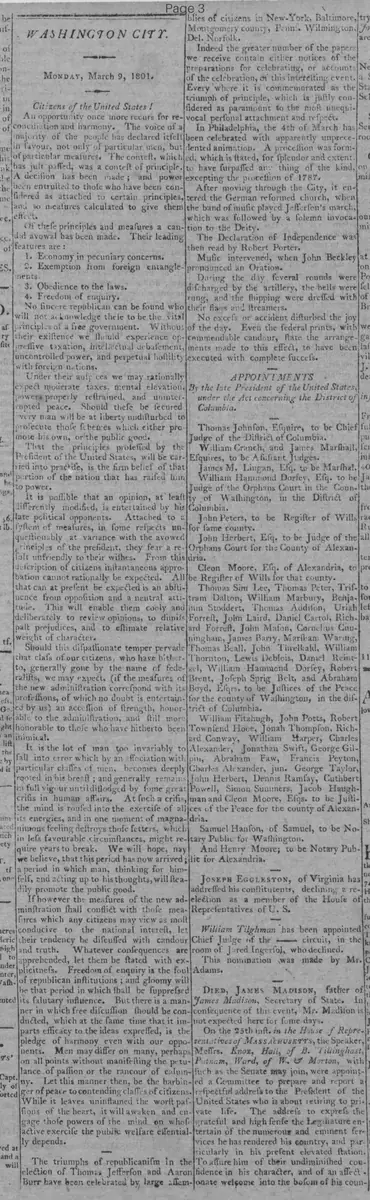
An opportunity once more recurs for reconciliation and harmony. The voice of a majority of the people has declared itself in favour, not only of particular men, but of particular measures. The contest which has just passed, was a contest of principle. A decision has been made: and power been entrusted to those who have been considered as attached to certain principles, and to measures calculated to give them effect.
Of these principles and measures a candid avowal has been made. Their leading features are:
1. Economy in pecuniary concerns.
2. Exemption from foreign entanglements.
3. Obedience to the laws.
4. Freedom of enquiry.
No sincere republican can be found who will not acknowledge these to be the vital principles of a free government. Without their existence we should experience oppressive taxation, intellectual debasement, uncontrolled power, and perpetual hostility with foreign nations.
Under their auspices we may rationally expect moderate taxes, mental elevation, power properly restrained, and uninterrupted peace. Should these be secured every man will be at liberty undisturbed to prosecute those schemes which either promote his own, or the public good.
That the principles professed by the President of the United States, will be carried into practice, is the firm belief of that portion of the nation that has raised him to power.
It is possible that an opinion, at least differently modified, is entertained by his late political opponents. Attached to a system of measures, in some respects unquestionably at variance with the avowed principles of the president, they fear a revolt unfriendly to their wishes. From this description of citizens instantaneous approbation cannot rationally be expected. All that can at present be expected is an abstinence from opposition and a neutral attitude. This will enable them cooly and deliberately to review opinions, to dismiss past prejudices, and to estimate relative weight of character.
Should this dispassionate temper pervade that class of our citizens, who have hitherto, generally gone by the name of federalists, we may expect (if the measures of the new administration correspond with its professions, of which no doubt is entertained by us) an accession of strength, honorable to the administration, and still more honorable to those who have hitherto been inimical.
It is the lot of man too invariably to fall into error which by an association with particular classes of men, becomes deeply rooted in his breast; and generally remains in full vigour until dislodged by some great crisis in human affairs. At such a crisis, the mind is roused into the exercise of all its energies, and in one moment of magnanimous feeling destroys those fetters, which in less favourable circumstances, might require years to break. We will hope, nay we believe, that this period has now arrived; a period in which man, thinking for himself, and acting up to his thoughts, will readily promote the public good.
If however the measures of the new administration shall conflict with those measures which any citizens may view as most conducive to the national interest, let their tendency be discussed with candour and truth. Whatever consequences are apprehended, let them be stated with explicitness. Freedom of enquiry is the soul of republican institutions; and gloomy will be that period in which shall be suppressed its salutary influence. But there is a manner in which free discussion should be conducted, which at the same time that it imparts efficacy to the ideas expressed, is the pledge of harmony even with our opponents. Men may differ on many, perhaps on all points without manifesting the petulance of passion or the rancour of calumny. Let this manner then, be the harbinger of peace to contending classes of citizens. While it leaves uninflamed the worst passions of the heart, it will awaken and engage those powers of the mind on whose active exercise the public welfare essentially depends.
The triumphs of republicanism in the election of Thomas Jefferson and Aaron Burr have been celebrated by large assemblies of citizens in New-York, Baltimore, Montgomery county, Penns. Wilmington, Del. Norfolk.
Indeed the greater number of the papers we receive contain either notices of the preparations for celebrating, or accounts of the celebration, of this interesting event. Every where it is commemorated as the triumph of principle, which is justly considered as paramount to the most unequivocal personal attachment and respect.
In Philadelphia, the 4th of March has been celebrated with apparently unprecedented animation. A procession was formed, which is stated, for splendor and extent, to have surpassed any thing of the kind, excepting the procession of 1787. After moving through the City, it entered the German reformed church, when the band of music played Jefferson's march, which was followed by a solemn invocation to the Deity.
The Declaration of Independence was then read by Robert Porter. Music intervened, when John Beckley pronounced an Oration.
During the day several rounds were discharged by the artillery, the bells were rung, and the shipping were dressed with their flags and streamers.
No excess or accident disturbed the joy of the day. Even the federal prints, with commendable candour, state the arrangements made to this effect, to have been executed with complete success.
What sub-type of article is it?
What keywords are associated?
What entities or persons were involved?
Editorial Details
Primary Topic
Reconciliation And Republican Principles After Jefferson's Election
Stance / Tone
Supportive Of Unity And Fair Discourse Among Republicans And Federalists
Key Figures
Key Arguments