Thank you for visiting SNEWPapers!
Sign up free
The Daily Inter Mountain
Elkins, Randolph County, West Virginia
What is this article about?
Colonel Theodore Roosevelt received a notable reception at London's Guildhall on May 31, despite national mourning reducing pomp. As an alien, he got an address of welcome instead of the city's freedom. The article explains the historic ceremony's procedures, privileges, and history.
Clipping
OCR Quality
Full Text
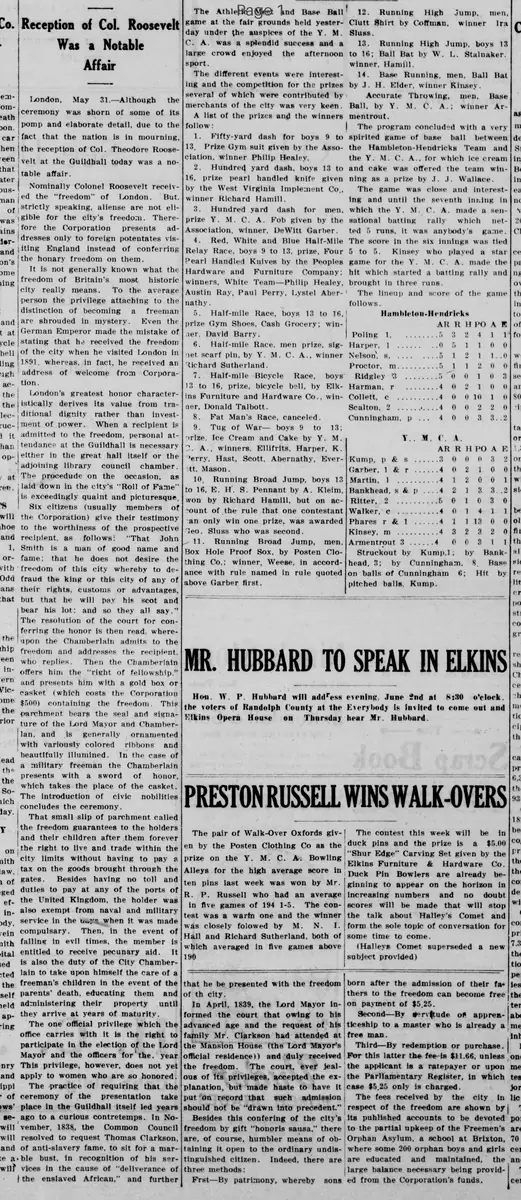
Was a Notable
Affair
London, May 31.-Although the ceremony was shorn of some of its pomp and elaborate detail, due to the fact that the nation is in mourning, the reception of Col. Theodore Roosevelt at the Guildhall today was a notable affair.
Nominally Colonel Roosevelt received the "freedom" of London. But, strictly speaking, aliens are not eligible for the city's freedom. Therefore the Corporation presents addresses only to foreign potentates visiting England instead of conferring the honorary freedom on them.
It is not generally known what the freedom of Britain's most historic city really means. To the average person the privilege attaching to the distinction of becoming a freeman are shrouded in mystery. Even the German Emperor made the mistake of stating that he received the freedom of the city when he visited London in 1891, whereas, in fact, he received an address of welcome from Corporation.
London's greatest honor characteristically derives its value from traditional dignity rather than investment of power. When a recipient is admitted to the freedom, personal attendance at the Guildhall is necessary either in the great hall itself or the adjoining library council chamber.
The procedure on the occasion, as laid down in the city's "Roll of Fame" is exceedingly quaint and picturesque. Six citizens (usually members of the Corporation) give their testimony to the worthiness of the prospective recipient, as follows: "That John Smith is a man of good name and fame: that he does not desire the freedom of this city whereby to defraud the king or this city of any of their rights, customs or advantages, but that he will pay his scot and bear his lot; and so they all say."
The resolution of the court for conferring the honor is then read, whereupon the Chamberlain admits to the freedom and addresses the recipient, who replies. Then the Chamberlain offers him the "right of fellowship," and presents him with a gold box or casket (which costs the Corporation $500) containing the freedom. This parchment bears the seal and signature of the Lord Mayor and Chamberlain, and is generally ornamented with variously colored ribbons and beautifully illumined. In the case of a military freeman the Chamberlain presents with a sword of honor, which takes the place of the casket.
The introduction of civic nobilities concludes the ceremony.
That small slip of parchment called the freedom guarantees to the holders and their children after them forever the right to live and trade within the city limits without having to pay a tax on the goods brought through the gates. Besides having no toll and duties to pay at any of the ports of the United Kingdom, the holder was also exempt from naval and military service in the days when it was made compulsory. Then, in the event of falling in evil times, the member is entitled to receive pecuniary aid. It is also the duty of the City Chamberlain to take upon himself the care of a freeman's children in the event of the parents' death, educating them and administering their property until they arrive at years of maturity.
The one official privilege which the office carries with it is the right to participate in the election of the Lord Mayor and the officers for the year. This privilege, however, does not yet apply to women who are so honored.
The practice of requiring that the ceremony of the presentation take place in the Guildhall itself led years ago to a curious contretemps. In November, 1838, the Common Council resolved to request Thomas Clarkson, of anti-slavery fame, to sit for a marble bust, in recognition of his services in the cause of "deliverance of the enslaved African," and further that he be presented with the freedom of the city.
In April, 1839, the Lord Mayor informed the court that owing to his advanced age and the request of his family Mr. Clarkson had attended at the Mansion House (the Lord Mayor's official residence) and duly received the freedom. The court, ever jealous of its privileges, accepted the explanation, but made haste to have it put on record that such admission should not be "drawn into precedent."
Besides this conferring of the city's freedom by gift "honoris causa," there are, of course, humbler means of obtaining it open to the ordinary undistinguished citizen.
Indeed, there are three methods:
First-By patrimony, whereby sons born after the admission of their fathers to the freedom can become free on payment of $5.25.
Second--By servitude on apprenticeship to a master who is already a free man.
Third-By redemption or purchase. For this latter the fee is $11.66, unless the applicant is a ratepayer or upon the Parliamentary Register, in which case $5.25 only is charged.
The fees received by the city in respect of the freedom are shown by its published accounts to be devoted to the partial upkeep of the Freemen's Orphan Asylum, a school at Brixton where some 200 orphan boys and girls are educated and maintained, the large balance necessary being provided from the Corporation's funds.
What sub-type of article is it?
What keywords are associated?
What entities or persons were involved?
Where did it happen?
Foreign News Details
Primary Location
London
Event Date
May 31
Key Persons
Outcome
received address of welcome from the corporation instead of honorary freedom due to alien status; notable affair despite reduced pomp from national mourning.
Event Details
Colonel Theodore Roosevelt was received at the Guildhall in a ceremony shorn of pomp due to national mourning. As an alien, he received an address rather than the freedom of the city. The article details the historic procedures, privileges, and methods of obtaining the freedom of London.