Thank you for visiting SNEWPapers!
Sign up free
The New York Herald
New York, New York County, New York
What is this article about?
US Department of State circular dated Nov. 11, 1854, includes Attorney General C. Cushing's opinion stating that marriages by US consuls abroad are invalid unless compliant with local laws, except in non-Christian countries where US law governs due to exterritoriality.
Clipping
OCR Quality
Full Text
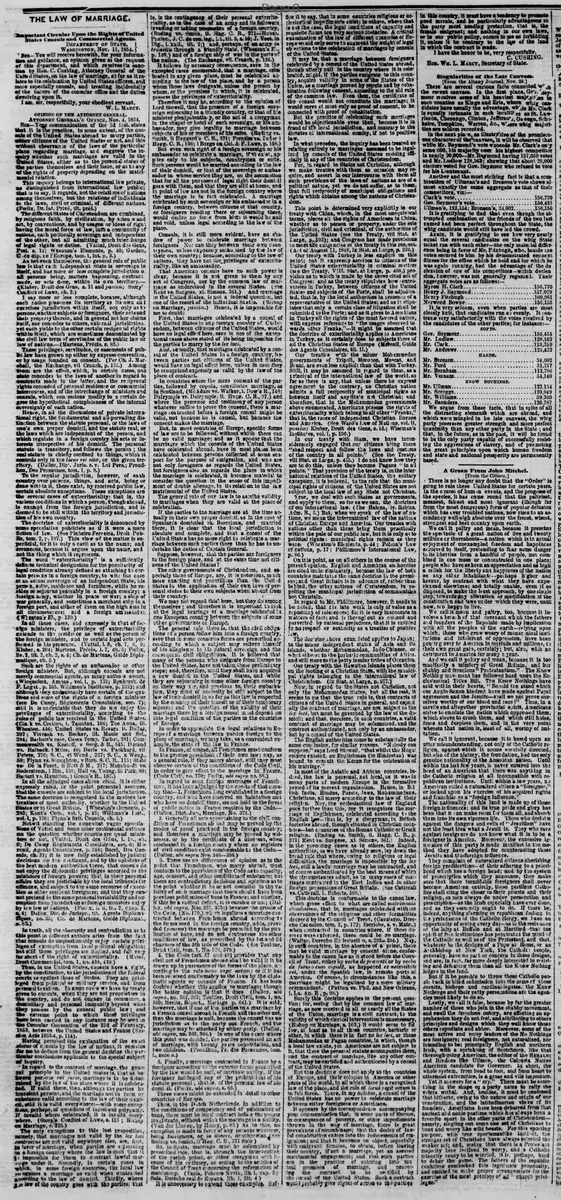
Important Circular Upon the Rights of United States Consuls and Commercial Agents.
Department of State,
Washington, Nov. 11, 1854.
Sir—You will receive herewith, for your information and guidance, an opinion given at the request of this department, and which receives its sanction by Hon. C. Cushing, Attorney General of the United States, on the law of marriage, so far as it relates to its celebration by United States officers, and more especially consuls, and treating incidentally of the nature of the consular office and the duties devolving upon it.
I am, sir, respectfully, your obedient servant,
W. L. MARCY.
OPINION OF THE ATTORNEY GENERAL.
Attorney General's Office, Nov. 4, 1854.
Sir—Your communication of the 3d inst. states that it is the practice, to some extent, of the consuls of the United States abroad to marry parties, either citizens of the United States or not, and this without observance of the laws of the particular place regarding marriage, and suggests the inquiry whether such marriages are valid in the United States, either as to the personal status of the parties themselves and their issue, or as to any the rights of property depending on the matrimonial relation.
This inquiry belongs to international law private, as distinguished from international law public; that is to say, it regards, not the relations of nations among themselves, but the relations of individuals to the laws, civil or criminal, of different nations. (Foelix, Dr. Int. Privé, tit. prél.)
The different States of Christendom are combined by religious faith, by civilization, by science and art, by conventions, and by usages or ideas of right having the moral force of law, into a community of nations, each politically sovereign and independent of the other, but all admitting much interchange of legal rights or duties. (Vattel, Droit des Gens, Prel. § 11; Wheaton's Elements, p. 40; Garden, C. de dip. de l'Europe, tom. i, int. p. 3.)
As between themselves, the general rule of public law is that each independent State is sovereign in itself, and has more or less complete jurisdiction over all persons being, matters happening, contracts made, or acts done, within its own territory. (Kluber, Droit des Gens, § 21 and passim; Story's Conflict of Laws, ch. 2.)
I say more or less complete, because, although each nation possesses its territory as its own and exercises jurisdiction within itself, not only as to persons, whether subjects or foreigners, their acts and their property therein, and in general neither claims itself, nor concedes to others, external jurisdiction, yet each yields to the other certain reciprocal rights within itself, which are sometimes denominated by the civil law term of servitudes of the public law or law of nations. (Martens, Précis. § 83.)
These privileges, servitudes, or easements of public law have grown up either by express convention, or by usage founded on consent. (Per Ch. J. Marshall, the Exchange, vii Cranch, p. 136. Among them are the effect, which, in certain cases, one state concedes to the laws of another in regard to contracts made in the latter, and the reciprocal rights conceded of personal residence or commercial intercourse, and of the interchange of ministers and consuls, which concessions modify to a certain degree the hypothetical completeness of the internal sovereignty of each nation.
Hence, in all the discussions of private international right, the fundamental and all-pervading distinction between the statute personal, or the laws of one's own proper domicil, and the statute real, or the laws which are independent of the person, and which regulate in a foreign country his acts or interests irrespective of his domicil. The personal statute is transitory, and follows the person; the real statute is chiefly confined to things, which it controls only in the locus rei sita, or the given territory. (Dalloz, Dic'. Juris. S. V. Loi Pers.; Proudhon, Des Personnes, tom. 1, p. 8.)
To the regular jurisdiction, however, of each country over persons, things, and acts, being or done within it, there exist, by received public law, certain absolute exceptions. These exceptions are the several cases of exterritoriality: that is, the various conditions in which a person, though abroad, is exempt from the foreign jurisdiction, and is deemed to be still within the territory and jurisdiction of his own country.
The doctrine of exterritoriality is denounced by some speculative publicists as if it were a mere fiction of law. (See Pinheiro Ferreira, Droit Pub. tom. 2, p. 197.) This view of the matter is superficial, for it is only a cavil as to the name; and erroneous, because it argues upon the name, and not the thing which it represents.
The word "exterritoriality" is a sufficiently definite technical designation for the peculiarity of legal condition already defined as attaching to certain persons in a foreign country, to wit: the case of an actual sovereign of an independent State, his person, suite, residence and furniture, while he resides or sojourns peaceably in a foreign country; a foreign army, whether in peace or war; a ship of war generally, and sometimes a merchant ship in a foreign port, and either of them on the high seas in all circumstances; and a foreign ambassador. (Wheaton's El., p. 139.)
In all these cases, and expressly in that of foreign ministers, the privilege of exterritoriality extends to the residence as well as the person of the foreign minister, and to certain legal acts performed in his presence. (Vattel, l. 4, ch. 7, § 8, 9; Kluber, § 204; Martens, Précis, l. 7, ch. 5; Foelix, liv. 2, tit. 2, ch. 2, § 4; Ch. de Martens, Guide Diplomatique, ch. 5.)
Such are the rights of an ambassador or other foreign minister. But, although consuls are not merely commercial agents, as many authors assert (Wicquefort, Ambes. vol. i. p. 133; Bynkersh. de F. Legit., p. 165. Wildman's Institutes, p. 165); and although they undoubtedly have certain of the qualities and some of the rights of a foreign minister (see De Cussy, Règlements Consulaires, sec. 7): still it is undeniable that they do not enjoy the privileges of exterritoriality, according to the rules of public law received in the United States.
Clark vs. Cretico, i. Taunton, 106; The Anna, iii Wheaton, 446; United States vs. Ravara ii. Dallas, 297; Viveash vs. Becker, iii. Maule and Sel. 284: Barbuit's case, Cases Temp. Talbot, 281: Commonwealth vs. Kosloff, v Serg. & R., 545; Durand vs. Halback. i Miles, 46; Davis vs. Packard, vii Peters, 276; S. C., vi Wend. 327; S. C., x Wend. 50; Flynn vs. Stoughton, v Barb. S. C. R., 115; State vs. De la Foret, ii Nott & M., 217; Manheim vs. Soderstrom, i Bin., 138; Hall vs. Young. iii Pick, 80; Sartori vs. Hamilton, i Green's R., 107.
In all the adjudged cases above cited, it is either expressly ruled, or the point presented assumes, that the consuls are subject to the local jurisdiction. The same doctrine is recognized in the modern law treatises of most authority, whether in the United States or in Great Britain. [Wheaton's elements, p. 293; Kent's Com., vol. i, p. 43; Wildman's Inst., vol. i, p. 130; Flynn's Brit. Consuls, ch. 5.]
Notwithstanding the somewhat vague speculations of Vattel and some other continental authors on the question whether consuls are quasi ministers or not, (Vattel, Droit des Gens, l. 4, ch. 8; De Cussy Reglements Consulaires, sec. 6; Moreuil, Agents Consulaires, p. 348; Borel, Des Consuls. ch. 3): it is now fully established by judicial decisions on the continent, and by the opinions of the best modern authorities there, that consuls do not enjoy the diplomatic privileges accorded to the ministers of foreign powers; that in their personal affairs they are justiciable by the local tribunals for offences, and subject to the same recourse of execution as other resident foreigners; and that they cannot pretend to the same personal inviolability and exemption from jurisdiction as foreign ministers enjoy by the law of nations. (Foelix, l. ii, tit. 2, chap. 2 § 4; Dalloz, Dic. de Jurispr., tit. Agents Diplom. et Cons., no. 35; Ch. de Martens, Guide Diplomatique, § 83.)
In truth, all the obscurity and contradiction as to this point in different authors arise from the fact that consuls do unquestionably enjoy certain privileges of exemption from local political obligation; but still these privileges are limited, and fall very far short of the right of exterritoriality. (Morse, Droit Commercial, tom. 1, no. 433, 439.)
Thus, in the United States, consuls have a right, by the constitution, to the jurisdiction of the federal courts as against those of States. They are privileged from political or military service, and from personal taxation. In some cases we have by treaty given to consuls, when they are not proprietors in the country, and do not engage in commerce, a domiciliary and personal immunity beyond what they possess by the general public law; and the extreme point to which these privileges have been carried in any instance may be seen in the Consular Convention of the 23d of February, 1853, between the United States and France (Session Acts 1853-4, p. 114).
Having premised this explanation of the exact status of consuls by the law of nations, it remains for me to deduce from the general doctrine the particular conclusions applicable to the special subject of inquiry.
In regard to the contract of marriage, the general principle in the United States is, that as between persons sui juris, marriage is to be determined by the law of the place where it is celebrated. If valid there, then, although the parties be transient persons, and the marriage not in form or substance valid according to the law of their domicil, still it is valid everywhere:—with some exceptions perhaps of questions of incest and polygamy.
If invalid where celebrated, it is invalid everywhere. (Story's Conflict of Laws, § 113; Bishop on Marriage, § 125.)
The only exceptions to this last proposition, namely, that marriages not valid by the lex loci contractus are not valid anywhere else, are, first, in favor of marriage, when parties are sojourning in a foreign country where the law is such that it is impossible for them to contract lawful marriage under it. Secondly, in certain cases in which, in some foreign countries, the local law recognizes a marriage as valid when contracted according to the law of domicil. Thirdly, where the law of the country goes with the parties; that is, in the contingency of their personal exterritoriality, as in the case of an army and its followers invading or taking possession of a foreign country, (Ruding vs. Smith, ii. Hag. C. R., 371-Huber. Prael. J. C. de con. leg., l. i., tit. 3, n. 10; J. Voet. in Dig., l. xxii., tit. 2:) and, perhaps, of an army in transitu through a friendly State, (Wheaton's El., p. 140,) and of a foreign ship of war in the ports of the nation. (The Exchange, vii. Cranch, p. 136.)
It follows by necessary consequence, save in the excepted cases enumerated, that a marriage, celebrated in any given place, must be celebrated according to the law of the place, and by a person whom those laws designate, unless the person by whom, or the premises in which, it is celebrated, possess the privileges of exterritoriality.
Therefore it may be, according to the opinion of Lord Stowell, that the presence of a foreign sovereign sojourning in a friendly country, or that of his minister plenipotentiary, or the act of a clergyman in the chapel or hotel of such sovereign, or his ambassador, may give legality to marriage between subjects of his or members of his suite. (Ruding vs. Smith, ii Haggard's C. R., 371; Prentiss vs. Tudor i Hagg. C. R., 136; i Burge on Col. & F. Laws, p. 158.)
But even such right of a foreign sovereign or his ambassador to celebrate a marriage, if it exist, applies only to his subjects, countrymen or suite. Such persons would be married according to the law of their domicil, or that of the sovereign or ambassador in whose service they are, on the assumption that for all the purposes of legal right their domicil goes with them, and that they are still at home, and in point of law are not in the foreign country where the marriage is in fact celebrated. A marriage celebrated by such sovereign or his ambassador in a foreign country, between citizens of that country, or foreigners residing there or sojourning there, would derive no force from him: it would be null and void, unless legal according to the law of the place.
Consuls, it is still more evident, have no shadow of power to celebrate marriage between foreigners Nor can they between their own countrymen, unless expressly authorized by the law of their own country; because, according to the law of nations, they have not the privileges of exterritoriality, like an ambassador.
That American consuls have no such power is clear, because it is not given to them by any act of Congress, nor by the common law of marriage as understood in the several States. (See Kent vs. Burgess, xi. Simons, 36.) And marriage in the United States, is not a federal question, but one of the resort of the individual States. (Bishop on Marriage, passim. Hence, it is impossible for me to doubt:
First, that marriages celebrated by a consul of the United States in any foreign country of Christendom, between citizens of the United States, would have no legal effect here, save in one of the exceptional cases above stated of its being impossible for the parties to marry by the lex loci.
And, secondly, that marriages celebrated by a consul of the United States in a foreign country, between parties not citizens of the United States, would have no legal effect here, unless in case they be recognized expressly as valid by the law of the place of contract.
In countries where the mere consent of the parties, followed by copula, constitutes marriage, as in Scotland, (Mc Adam vs. Walker, i. Dow's R., 148; Dalrymple vs. Dalrymple, ii. Hagg. C. R., 97.) and where the presence and testimony of any person whatever suffice to prove the consent, there a marriage contracted before a foreign consul may be valid, not because he is consul, but because the consent makes the marriage.
But, in most countries of Europe, specific forms of law are to be followed, without which there can be no valid marriage; and as it appears that the marriages which the consuls of the United States have celebrated abroad, have in most places been celebrated between persons collected at some seaport for the purpose of emigration, and who are not only foreigners as regards the United States, but foreigners also as regards the place in which the marriage is celebrated, it becomes material to consider the question in the sense of this impediment of double alienage, in its relation to the law matrimonial of the United States.
The general rule of our law is to ascribe validity to marriages when they are valid at the place of celebration.
If the parties to the marriage are at the time actually in their own proper domicil, as in the case of Spaniards domiciled in Barcelona, and married there. it is clear that the local jurisdiction is absolute and complete, and that a consul of the United States has no more right to celebrate a marriage between such parties there than he has to undertake the duties of Captain General.
Suppose, however, that the parties are foreigners to the foreign place. and at the same time not citizens of the United States?
The other governments of Christendom, and especially those of Europe, are, it is notorious, much more exacting and punctilious than the United States in the application of their own laws of personal status to their own subjects when absent from their country.
We may not regard this here, but they do among themselves; and therefore it is important to look at the legal bearings of a marriage celebrated in one European country between the subjects of some other governments of Europe.
The general rule there is, that the civil obligations of a person follow him into a foreign country, save that in some countries forms are prescribed according to which a subject may relieve himself of his allegiance to his natural sovereign and the consequent civil obligations. It is believed that many of the persons who emigrate from Europe to the United States, have not taken these preliminary steps; and, therefore, until they shall have acquired a new domicil in the United States, and while they are sojourning in some other foreign country on their way thither, and previous to, their embarkation, they must of necessity be still subject to the law of their domicil in so far as this law is respected by the country of their transit or of their temporary sojourn; and the question of the validity of their marriage there by a foreign consul must depend on this legal condition of the parties in the countries of Europe.
In order to appreciate the legal relations in Europe of a marriage between parties foreign to the place of marriage, we may take, as a convenient example, the state of the law in France.
In France, of course. all Frenchmen must conform to the precise provisions of their own law; nay, as a general rule, if they marry abroad, still they must observe certain of the conditions of the Code Civil, in order to give effect to the marriage in France. (Code Civil, art. 170; Foelix, ubi supra no. 88.)
In regard to such foreign marriages of Frenchmen, it has been adjudged by the courts of that country that—1. Frenchmen long established in a foreign country, and who have reserved no habitation and who have no domicil there, are not held to the forms of public notice in France required by the Code.— (Dalloz, Dict. Ju., Marriage, No. 371.)
2. Generally all acts appertaining to the civil condition of Frenchmen abroad may be proved by the modes of proof practised in the foreign country; and therefore a marriage may be proved by witnesses, or by the certificate of a diocesan, when celebrated in a foreign country where no registers of civil condition exist conformable to the Code.— (Dalloz, ubi supra Nos. 346—356.)
3. There are no differences of opinion as to the point that Frenchmen, who marry abroad, must conform to the provisions of the Code as to capacity, age, consent, and other conditions of substance; but there are contradictory decisions and opinions as to the point whether it be or not essential to the validity of such marriage that there should have been previous publication of banns in France; and whether, if this be a radical defect, it is curable or not; (Dalloz. ubi supra, Nos. 357. 375:) because the article of the Code, (No. 170.) which legalizes a marriage contracted between Frenchmen abroad according to the forms used in the foreign country, adds, provided (pourvu) the marriage be preceded by the publication of banns, and do not contravene the other conditions of law. as prescribed by the 1st and 2d chapters of the 5th title of the Code. (See Toullier. Droit Civil. tom. 1. No. 576, 579.)
4. The Code (art. 47 and 48) provides that any civil act of Frenchmen abroad shall be valid if it be drawn up in pursuance of the forms of the place, according to the rule locus regit actum: or if it has been received conformably to the laws by the diplomatic agents or consuls of France. It has been doubted whether this applies to marriage; though the better opinion is that it does. (Dalloz, ubi supra, no. 362, 363; Toullier, Droit Civil, tom. 1, no. 360; Merlin, Repert., Mariage p. 641.) It is said. however, that if one of the parties to a marriage by a French consul abroad is French and the other not, then the marriage is null, because the consul has no jurisdiction as to the party not French, and the marriage may be attacked by either party. (Dalloz, ubi supra, no. 365, 366.) In one of the cases where this point was decided, the parties possessed an act of marriage, with twenty years cohabitation, and two children. (Proudhon, Tr. des Personnes, tom. i., note a.)
5. Finally, a marriage contracted in France by a foreigner according to the exterior forms prescribed by the law would be null, of intrinsic nullity. if the foreigner infringed any of the prohibitions of his statute personal; that is, of the personal law of his domicil. (Foelix, ubi supra, § 88.)
These views might be extended in detail to other countries of Europe.
Thus, in the Dutch Netherlands, in addition to the conditions of competency and of publication of banns, there must be legal contract before the proper magistrate, without which the marriage is a nullity. (Van der Linden, by Henry, p. 83.) As to this, no exception is made in favor of any persons whatever. being foreigners, or in itinere, or otherwise. See Ruding vs. Smith, ii Hag. C. R, 371 note)
So, in Spain, marriage must be solemnized by prescribed rule, that is, through the intervention of the parish priest, or other clergymen with license of his ordinary, according to the articles of the Council of Trent concerning the reformation of matrimony. (Tapia. Febrero Novis., lib. i, cap. 2; Sala. Derecho real de España. lib. i, tit. 4)
It is unnecessary to extend these examples, Suffice it to say. that in some countries religious or ecclesiastical impediments exist; in others, where that is not the case, the legal conditions of capacity and requisite forms are very serious obstacles. A critical examination of the law of different countries of Europe would only serve to augment the weight of legal objections to the celebration of marriages by consuls of the United States.
It may be, that a marriage between foreigners celebrated by a consul of the United States abroad, though utterly null in the country where it is celebrated, might, if the parties emigrate to this country, acquire validity in some of the States of the Union, as a marriage proved by repute and by cohabitation following consent, according to the old rule of the common law. Even then, the certificate of the consul would not constitute the marriage; it would serve at most only as proof of consent, to be connected with proof of cohabitation.
But the practice of celebrating such marriages would be objectionable even then, because it is in fraud of the local jurisdiction, and contrary to the dictates of international comity, if not to positive law.
In what precedes, the inquiry has been treated as relating entirely to marriages assumed to be legalized by consuls of the United States residing officially in any of the countries of Christendom.
For, in regard to States not Christian, although we make treaties with them as occasion may require, and assert in our intercourse with them all such provisions of the laws of nations as are of a political nature, yet we do not suffer, as to them, that full reciprocity of municipal obligations and rights which obtains among the nations of Christendom.
This point is determined very explicitly in our treaty with China, which, in the most unequivocal terms, places all the rights of Americans in China, whether as to person or property, under the sole jurisdiction, civil and criminal, of the authorities of the United States (see the Treaty, viii Stat. at Large, p. 592); and Congress has made provisions to meet the exigencies of the treaty in this respect. (Act of August 11, 1848, ix Stat. at Large, p. 276.)
Our treaty with Turkey is less explicit on this point; but it expressly ascribes to citizens of the United States exterritoriality in criminal matters (see the Treaty, viii. Stat. at Large, p. 408,) provision as to which is made by the above cited act of Congress: and as the treaty stipulates how controversies in Turkey, between citizens of the United States and subjects of the Porte, shall be adjudicated, that is, by the local authorities in presence of a representative of the United States; and as it stipulates that only a certain class of litigation shall be submitted to the Porte; and as it gives to Americans in Turkey all the rights of the most favored nation, with express reference to 'the usages observed towards other Franks," it might be assumed that the doctrine of exterritoriality applies to Americans in Turkey, as it certainly does to subjects there of all the Christian States of Europe (Moreuil, Guide des Agens Consulaires, tit. II.)
Our treaties with the minor Mohammedan governments of Tripoli, Morocco, Muscat, and Bruni, are even less explicit than that with Turkey. Still, it may be assumed in regard to them, as a principle of the international law of the world, so far as there is any, that unless there be express agreement to the contrary, no Christian nation admits a full reciprocity of municipal rights as between itself and any State not Christian; and therefore, that in the Mohammedan governments above enumerated, Americans possess the rights of exterritoriality which belong to all other "Franks," that is, the races of independent Christian Europe and America. (See Ward's Law of Nations, vol. ii, passim; Kluber, Droit des Gens, § 104.; Wiseman's Institutes, vol. i, p. 130.)
In our treaty with Siam, we have inconsiderately engaged that our citizens being there "shall respect and follow the laws and customs of the country in all points." (See the Treaty, viii Stat. at Large, p. 455.) I do not know how they are to do this, unless they become Pagans "in all points. " That provision of the treaty is, in the international relations of the United States, the solitary exception. it is believed. to the rule that the municipal rights of citizens of the United States are not subject to the local law of any State not Christian.
True, we deal with such States as governments, and apply to them, so far as we can, the doctrines of our International law. (The Helena, iv. Robins. Adm. R., 5.) But. when we speak of the law of nations, we mean the international law of the nations of Christian Europe and America, Our treaties with nations other than these bring them practically within the pale of our public law, but it is only as to political rights: municipal rights remain as they were. (Wheaton's Elements, p. 44; Polson's Law of Nations, p. 17; Phillimore's International Law, p. 86.)
On this point, as on all others in the course of the present opinion, English and American authorities are cited indiscriminately, because the law of both countries maintains the same doctrine in the premises: and Great Britain is in advance of, rather than behind. the other nations of Christendom. in repelling the municipal jurisdiction of communities not Christian.
In regard to Mr. Phillimore, however, it needs to be noted, that his late work is only of value as a repository of references; for it is very inaccurate in matters of fact; and is throughout so colored and perverted by national prejudices, that it is entitled to no respect or authority as a treatise of positive law
The doctrine above enunciated applies to Japan; to the minor independent states of Asia and its islands, whether Mohammedan, Indo-Chinese, or what not; to the barbarous communities of Africa. and still more to the petty insular tribes of Oceanica.
Our treaty with the Hawaiian Islands places them on the footing of a Christian State, with the municipal rights belonging to the international law of Christendom. (ix Stat. at Large, p. 977.)
Now, in regard to the States not Christian, not only the Mohammedan States, but all the rest, it seems to me that the true rule is, that contracts of citizens of the United States in general, and especially the contract of marriage, are not subject to the lex loci, but must be governed by the law of the domicil; and that, therefore, in such countries, a valid contract of marriage may be solemnized, and the contract authenticated, not only by an ambassador but by a consul of the United States.
The English authorities come to substantially the same conclusion, for similar reasons. "Nobody can suppose," says Lord Stowell, "that whilst the Mogul empire existed, an Englishman (in Hindustan) was bound to consult the Koran for the celebration of his marriage."
In most of the Asiatic and African countries, indeed, the law is personal, not local, as it was in many parts of modern Europe in the formative period of its present organization. Hence, in British India, Hindus, Parsis, Jews, Mohammedans, Christians. all marry according to the law of their religion. Nay, the ecclesiastical law of England goes further than this, for it recognizes the marriage of Englishmen, celebrated according to the English law—that is, by a clergyman, in British factories abroad, though situated in Christian countries—but countries of the Roman Catholic or Greek religion. (Ruding vs. Smith, ii. Hagg. C. R., p. 371; Kent vs. Burgess, xi. Simone, 361.) Indeed, in the preceding cases, as in others, the English authorities, as we have already seen, lay down the broad rule that where, owing to religious or legal difficulties. the marriage is impossible by the lex loci, still a lawful marriage may be contracted, and of course authenticated by the best means of which the circumstances admit, as in many cases of marriages contracted in the East Indies and in other foreign possessions of Great Britain. (See Catterall vs. Catterall. i. Roberts, 580.)
This doctrine is conformable to the canon law. which gives effect to what are called matrimonia clandestina. that is, marriages celebrated without observances of the religious and other formalities decreed by the Council of Trent. (Cavalario, Derecho Canonico, tom. 2, p. 172; Escriche, S. v. Matr.,) when contracted in countries where, if those decrees were enforced, there could be no marriage. (Walter, Derecho Ecclesiastico, § 292-294.) Nay, in such countries, in the absence of a priest, there may be valid marriage by consent alone, conformably to the canon law as it stood before the Council of Trent, either by verba de presenti or by verba de futuro cum copula, as happened ex necessitate rei, under the Spanish law, in remote parts of America. Of course, in circumstances like this, a marriage might be legalized by a mere military commandant. (Patton vs. Phil. and New Orleans, i. La. An. R, p. 98.)
Surely this doctrine applies to the present question; for, seeing that by the common law of marriage, as now received in all or nearly all the States of the Union, marriage is a civil contract, to the validity of which clerical intervention is unnecessary, (Bishop on Marriage, § 163,) it would seem to follow, at least as to all those countries, barbaric or other, in which there is in fact no lex loci, or those Mohammedan or Pagan countries, in which, though a local law exists, yet Americans are not subject to it, that there the personal statute accompanies them, and the contract of marriage, like any other contract may be certified and authenticated by a consul of the United States.
But this doctrine does not apply to the countries of Europe, and their colonies in America or other parts of the world, in all which there is a recognised law of the place, and the rule of locus regit actum is in full force. There, in my opinion, a consul of the United States has no power to celebrate marriage between either foreigners or Americans.
It appears by the correspondence accompanying your communication that, in some parts of Europe, in consequence of poverty, or other impediments thrown in the way of marriage. there is great prevalence of concubinage; that the desire of lawful cohabitation enters into the inducements of emigration; and that it becomes an object, especially with emigrant females, to obtain, before leaving their country, if not a marriage, yet an assured matrimonial engagement; and that such parties are in the practice of entering into mutual promises of marriage. and. procuring the contract to be certified by the consul of the United States. Such a contract would probably give rights of action to the parties in this country, it must have a tendency to promote good morals, and be particularly advantageous to the party most needing protection, that is, the female emigrant; and nothing in our own laws, or in our public policy, occurs to me as forbidding it, unless it be contrary to the law of the land in which the contract is made.
I have the honor to be, very respectfully,
C. CUSHING.
Hon. Wm. L. Marcy, Secretary of State.
What sub-type of article is it?
What keywords are associated?
What entities or persons were involved?
Where did it happen?
Domestic News Details
Primary Location
Washington
Event Date
Nov. 11, 1854
Key Persons
Event Details
The Department of State issues a circular with an opinion from Attorney General C. Cushing on the validity of marriages performed by United States consuls abroad. The opinion concludes that such marriages are generally invalid unless following the local laws or in exceptional cases, particularly in non-Christian countries where exterritoriality applies.