Thank you for visiting SNEWPapers!
Sign up free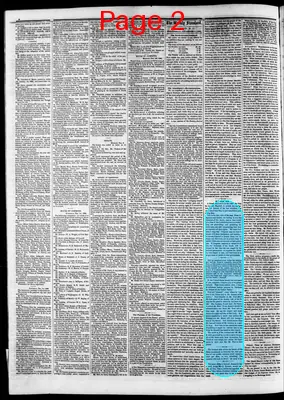
Editorial
December 5, 1866
The Weekly North Carolina Standard
Raleigh, Wake County, North Carolina
What is this article about?
Editorial demands Congress protect Southern Unionists from persecution by former rebel leaders, supports Mr. Pool's U.S. Senate election as a loyal Unionist, and criticizes disloyal figures like Graham and Manly while mocking state politics.
Clipping
OCR Quality
82%
Good
Full Text
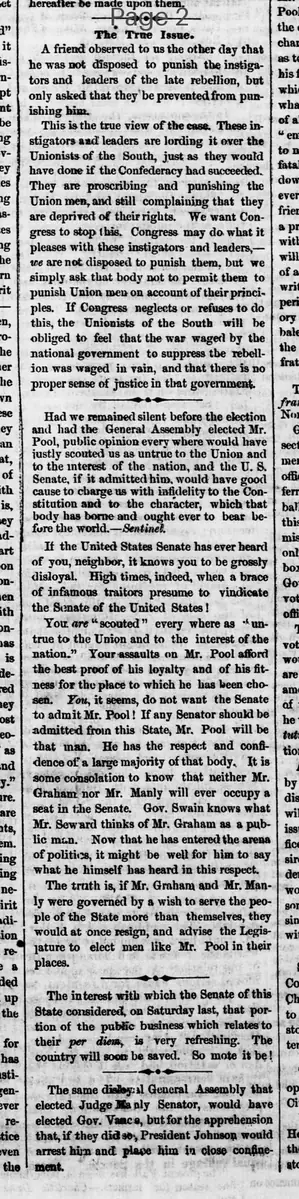
The True Issue.
A friend observed to us the other day that he was not disposed to punish the instigators and leaders of the late rebellion, but only asked that they be prevented from punishing him.
This is the true view of the case. These instigators and leaders are lording it over the Unionists of the South, just as they would have done if the Confederacy had succeeded. They are proscribing and punishing the Union men, and still complaining that they are deprived of their rights. We want Congress to stop this. Congress may do what it pleases with these instigators and leaders—we are not disposed to punish them, but we simply ask that body not to permit them to punish Union men on account of their principles. If Congress neglects or refuses to do this, the Unionists of the South will be obliged to feel that the war waged by the national government to suppress the rebellion was waged in vain, and that there is no proper sense of justice in that government.
Had we remained silent before the election and had the General Assembly elected Mr. Pool, public opinion everywhere would have justly scouted us as untrue to the Union and to the interest of the nation, and the U. S. Senate, if it admitted him, would have good cause to charge us with infidelity to the Constitution and to the character which that body has borne and ought ever to bear before the world.—Sentinel.
If the United States Senate has ever heard of you, neighbor, it knows you to be grossly disloyal. High times, indeed, when a brace of infamous traitors presume to vindicate the Senate of the United States!
You are "scouted" everywhere as untrue to the Union and to the interest of the nation. Your assaults on Mr. Pool afford the best proof of his loyalty and of his fitness for the place to which he has been chosen. You, it seems, do not want the Senate to admit Mr. Pool! If any Senator should be admitted from this State, Mr. Pool will be that man. He has the respect and confidence of a large majority of that body. It is some consolation to know that neither Mr. Graham nor Mr. Manly will ever occupy a seat in the Senate. Gov. Swain knows what Mr. Seward thinks of Mr. Graham as a public man. Now that he has entered the arena of politics, it might be well for him to say what he himself has heard in this respect.
The truth is, if Mr. Graham and Mr. Manly were governed by a wish to serve the people of the State more than themselves, they would at once resign, and advise the Legislature to elect men like Mr. Pool in their places.
The interest with which the Senate of this State considered, on Saturday last, that portion of the public business which relates to their per diem, is very refreshing. The country will soon be saved. So mote it be!
The same disloyal General Assembly that elected Judge Manly Senator, would have elected Gov. Vance, but for the apprehension that, if they did so, President Johnson would arrest him and place him in close confinement.
A friend observed to us the other day that he was not disposed to punish the instigators and leaders of the late rebellion, but only asked that they be prevented from punishing him.
This is the true view of the case. These instigators and leaders are lording it over the Unionists of the South, just as they would have done if the Confederacy had succeeded. They are proscribing and punishing the Union men, and still complaining that they are deprived of their rights. We want Congress to stop this. Congress may do what it pleases with these instigators and leaders—we are not disposed to punish them, but we simply ask that body not to permit them to punish Union men on account of their principles. If Congress neglects or refuses to do this, the Unionists of the South will be obliged to feel that the war waged by the national government to suppress the rebellion was waged in vain, and that there is no proper sense of justice in that government.
Had we remained silent before the election and had the General Assembly elected Mr. Pool, public opinion everywhere would have justly scouted us as untrue to the Union and to the interest of the nation, and the U. S. Senate, if it admitted him, would have good cause to charge us with infidelity to the Constitution and to the character which that body has borne and ought ever to bear before the world.—Sentinel.
If the United States Senate has ever heard of you, neighbor, it knows you to be grossly disloyal. High times, indeed, when a brace of infamous traitors presume to vindicate the Senate of the United States!
You are "scouted" everywhere as untrue to the Union and to the interest of the nation. Your assaults on Mr. Pool afford the best proof of his loyalty and of his fitness for the place to which he has been chosen. You, it seems, do not want the Senate to admit Mr. Pool! If any Senator should be admitted from this State, Mr. Pool will be that man. He has the respect and confidence of a large majority of that body. It is some consolation to know that neither Mr. Graham nor Mr. Manly will ever occupy a seat in the Senate. Gov. Swain knows what Mr. Seward thinks of Mr. Graham as a public man. Now that he has entered the arena of politics, it might be well for him to say what he himself has heard in this respect.
The truth is, if Mr. Graham and Mr. Manly were governed by a wish to serve the people of the State more than themselves, they would at once resign, and advise the Legislature to elect men like Mr. Pool in their places.
The interest with which the Senate of this State considered, on Saturday last, that portion of the public business which relates to their per diem, is very refreshing. The country will soon be saved. So mote it be!
The same disloyal General Assembly that elected Judge Manly Senator, would have elected Gov. Vance, but for the apprehension that, if they did so, President Johnson would arrest him and place him in close confinement.
What sub-type of article is it?
Partisan Politics
Constitutional
What keywords are associated?
Southern Unionists
Rebel Leaders
Congress Protection
Mr Pool
Senate Election
Disloyal Politicians
Reconstruction Loyalty
What entities or persons were involved?
Unionists Of The South
Instigators And Leaders Of The Rebellion
Congress
Mr. Pool
Sentinel
Mr. Graham
Mr. Manly
Gov. Swain
Mr. Seward
President Johnson
Gov. Vance
Editorial Details
Primary Topic
Protection Of Southern Unionists And Support For Loyal Politicians
Stance / Tone
Strongly Pro Union And Anti Disloyalty
Key Figures
Unionists Of The South
Instigators And Leaders Of The Rebellion
Congress
Mr. Pool
Sentinel
Mr. Graham
Mr. Manly
Gov. Swain
Mr. Seward
President Johnson
Gov. Vance
Key Arguments
Former Rebels Are Punishing Southern Unionists And Must Be Stopped By Congress
No Desire To Punish Rebels But Prevent Them From Harming Union Men
Election Of Mr. Pool Demonstrates Loyalty To Union
Criticism Of Sentinel As Disloyal
Assaults On Pool Prove His Fitness For Senate
Graham And Manly Should Resign For Disloyalty
Mockery Of State Senate's Focus On Per Diem
Disloyal Assembly Avoided Electing Vance Due To Fear Of Arrest