Thank you for visiting SNEWPapers!
Sign up free
Gazette Of The United States, & Philadelphia Daily Advertiser
Philadelphia, Philadelphia County, Pennsylvania
What is this article about?
Report of U.S. House debates on May 10 and 25, 1798, over a bill authorizing the President to raise a 10,000-man provisional army against potential French invasion. Speakers like Macon, Brent, Dayton, and Smith argue on constitutionality, militia efficacy, expense, and national defense needs.
Merged-components note: These components form a continuous narrative of the congressional debate on the provisional army bill, split across columns on page 1 and continuing to page 2.
Clippings
1 of 2
OCR Quality
Full Text
THURSDAY, MAY 10.
Concluded from our last.
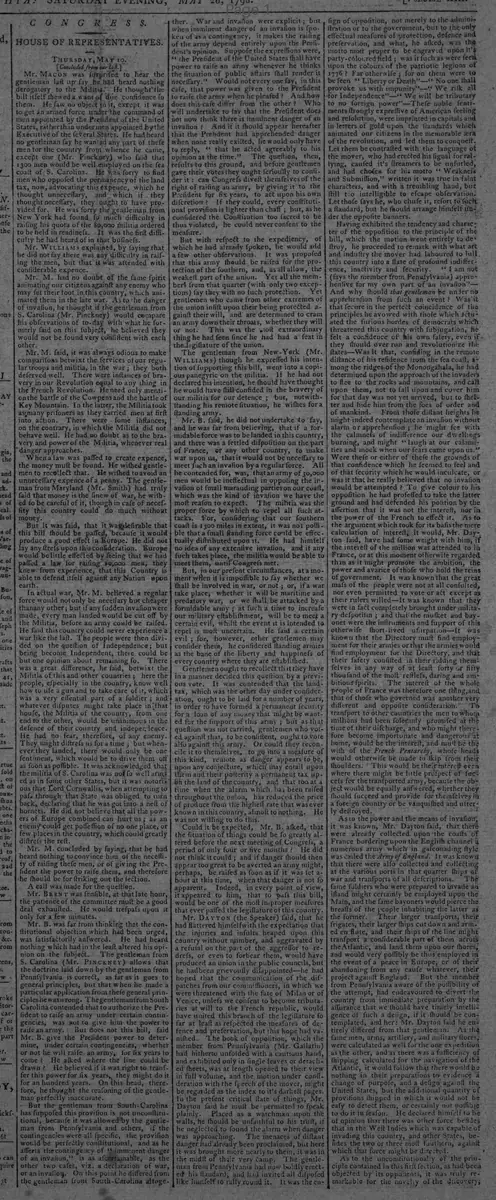
Mr. Macon was surprised to hear the gentleman last say he had heard nothing derogatory to the Militia. He thought the bill itself showed a want of due confidence in them. He saw no object in it, except it was to get an armed force under the command of men appointed by the President of the United States, rather than under men appointed by the Executive of the several States. He had heard no gentleman say he wanted any part of these men for the country from whence he came, except one (Mr. Pinckney) who said that 1300 men would be well employed on the sea coast of S. Carolina. He was sorry to find men who opposed the permanency of the land tax, now, advocating this expence, which he thought unnecessary, and which if they thought necessary, they ought to have provided for. He was sorry the gentleman from New York had found so much difficulty in raising his quota of the 80,000 militia ordered to be held in readiness. It was the first difficulty he had heard of in that business.
Mr. WILLIAMS explained, by saying that he did not say there was any difficulty in raising the men, but that it was attended with considerable expence.
Mr. M. had no doubt of the same spirit animating our citizens against any enemy who may set their foot in this country, which animated them in the late war. As to the danger of invasion, he thought if the gentleman from S. Carolina (Mr. Pinckney) would compare his observations of to-day with what he formerly said on this subject, he believed they would not be found very consistent with each other.
Mr. M. said, it was always odious to make comparisons betwixt the services of our regular troops and militia, in the war ; they both deserved well. There were instances of bravery in our Revolution equal to any thing in the French Revolution. He need only mention the battle of the Cowpens and the battle of King's Mountain. In the latter, the Militia took as many prisoners as they carried men at first into action. There were some instances, on the contrary, in which the Militia did not behave well. He had no doubt as to the bravery and power of the Militia, whenever real danger approaches.
When a law was passed to create expence, the money must be found. He wished gentlemen to recollect that. He wished to avoid an unnecessary expence of a penny. The gentleman from Maryland (Mr. Smith) had truly said that money is the sinew of war, he wished to be careful of it, though in case of necessity this country could do much without money.
But it was said, that it was desirable that this bill should be passed. because it would produce a good effect in Europe. He did not lay any stress upon this consideration. Europe would be little affected by seeing that we had passed a law for raising 10,000 men, they knew from experience, that this Country is able to defend itself against any Nation upon earth.
In actual war, Mr. M. believed a regular force would not only be necessary but cheaper than any other; but if any sudden invasion were made, every man landed would be cut off by the Militia, before an army could be raised.
He said this country could never experience a war like the last. The people were then divided on the question of Independence; but being become Independent, there could be but one opinion about remaining so. There was a great difference, he said, betwixt the Militia of this and other countries; here the people, especially in the country, know well how to use a gun and to take care of it, which was a very essential part of a soldier ; and whatever disputes might take place in that house, the Militia of the country, from one end to the other, would be unanimous in the defence of their country and independence.
He had no fear, therefore, of any enemy. They might distress us for a time ; but whenever they landed, there would only be one sentiment, which would be to drive them off as soon as possible. It was acknowledged that the militia of S. Carolina was not so well armed, as in some other States, but it was notorious that Lord Cornwallis, when attempting to pass through that State was obliged to turn back, declaring that he was got into a nest of hornets. He did not believe that all the powers of Europe combined can hurt us; as an enemy could get possession of no one place, or few places in the country, which could greatly distress the rest.
Mr. M. concluded by saying, that he had heard nothing to convince him of the necessity of raising these men, or of giving the President the power to raise them, and therefore he should be for striking out the section.
A call was made for the question.
Mr. Brent was sensible, at that late hour, the patience of the committee must be a good deal exhausted. He would trespass upon it only for a few minutes.
Mr. B. was far from thinking that the constitutional objection which had been urged, was satisfactorily answered. He had heard nothing which had in the least altered his opinion on the subject. The gentleman from S. Carolina (Mr. Pinckney) allows that the doctrine laid down by the gentleman from Pennsylvania is correct, as far as it goes to general principles, but that when he made a particular application from these general principles he was wrong, The gentleman from South Carolina contended that to authorize the President to raise an army under certain contingencies, was not to give him the power to raise an army. But does not this bill, said Mr. B. give the President power to determine, under certain contingencies, whether or not he will raise an army, for six years to come ? He asked where the line could be drawn ? He believed if it was right to transfer this power for six years, they might do it for an hundred years. On this head, therefore, he thought the reasoning of the gentleman perfectly inaccurate.
But the gentleman from South-Carolina has supposed this provision is not unconstitutional, because it was allowed by the gentleman from Pennsylvania and others, if the contingencies were all specific, the provision would be perfectly constitutional, and as he asserts the contingency of " imminent danger of an invasion," is as ascertainable, as the other two cases, viz. a declaration of war, or an invasion. On this point he differed from the gentleman from South-Carolina altogether.
The war and invasion were explicit; but when imminent danger of an invasion is spoken of as a contingency, it makes the raising of the army depend entirely upon the President's opinion. "Suppose the expressions were, " the President of the United States shall have power to raise an army whenever he thinks the situation of public affairs shall render it necessary." Would not every one say, in this case, that power was given to the President to raise the army when he pleased? And how does this case differ from the other? Who will undertake to say that the President does not now think there is imminent danger of an invasion ? And if it should appear hereafter that the President had apprehended danger when none really existed, he would only have to reply, " that he acted agreeably to his opinion at the time." The question, then, results to this ground, and before gentlemen gave their votes they ought seriously to consider it : can Congress divest themselves of the right of raising an army, by giving it to the President for six years, to act upon his own discretion ? If they could, every constitutional provision is lighter than chaff ; but, as he considered the Constitution too sacred to be thus violated, he could never consent to the measure,
But with respect to the expediency. of which he had already spoken, he would add a few other observations. It was proposed that this army should be raised for the protection of the southern, and, as all allow, the weakest part of the union. Yet all the members from that quarter (with only two exceptions) say they wish no such protection. Yet gentlemen who came from other extremes of the union insist upon their being protected against their will, and' are determined to cram an army down their throats, whether they will or not. This was the most extraordinary thing he had seen since he had had a seat in the Legislature of the union.
The gentleman from New-York (Mr. Williams) though he expressed his intention of supporting this bill, went into a copious panegyric on the militia. If he had not declared his intention, he should have thought he would have still confided in the bravery of our militia for our defence ; but, notwithstanding his remote situation, he wishes for a standing army.
Mr. B. said, he did not undertake to say, and he was far from believing, that if a formidable force was to be landed in this country, and there was a settled disposition on the part of France, or any other country, to make war upon us, that it would not be necessary to meet such an invasion by a regular force. All he contended for, was, that an army of 10,000 men would be ineffectual in opposing the invasion of small marauding parties on our coast, which was the kind of invasion we have the most reason to expect. The militia was the proper force by which to repel all such attacks. For, considering that our southern coast is 1200 miles in extent, it was not possible that a small standing force could be effectually distributed upon it. He had himself no idea of any extensive invasion, and if any such takes place, the militia would be able to meet them, until Congress met.
But, in our present circumstances, at a moment when it is impossible to say whether we shall be involved in war, or not ; or, if a war take place, whether it will be maritime and predatory war, or we shall be attacked by a formidable army ; at such a time to increase our military establishment, will be to meet a certain evil, whilst the event it is intended to repel is most uncertain. He said a certain evil ; for, however, other gentlemen may consider them, he considered standing armies as the bane of the liberty and happiness of every country where they are established.
Gentlemen ought to recollect that they have in a manner decided this question by a previous vote. It was contended that the land tax, which was the other day under consideration, ought to be laid for a number of years, in order to have formed a permanent security for a loan of any money that might be wanted for the support of this army ; but as that question was not carried, gentlemen who voted against that, to be consistent, ought to vote also against this army. Or could they reconcile it to themselves, to go into a measure of this kind, remote as danger appears to be, upon any conjecture, which may entail upon them and their posterity a permanent tax upon the land of the country, and that too at a time when the alarm which has been raised throughout the union, has reduced the price of produce from the highest rate that was ever known in this country, almost to nothing. He was not willing to do this.
Could it be expected, Mr. B. asked, that the situation of things could be greatly altered before the next meeting of Congress, a period of only four or five months ? He did not think it could; and if danger should then appear too great to be averted an army might, perhaps, be raised as soon as if it was set about at this time, when that danger is not so apparent. Indeed, in every point of view, it appeared to him, that to pass this bill, would be one of the most improper measures that ever passed the legislature of this country.
Mr. Dayton (the Speaker) said, that he had flattered himself with the expectation that the injuries and insults heaped upon this country without number, and aggravated by a refusal on the part of the aggressor to redress, or even to forbear them, would have produced an union in the public councils, but he had been grievously disappointed—he had hoped that the communication of the dispatches from our commissioners, in which we were threatened with the fate of Milan or of Venice, unless we consent to become tributaries at will to the French republic. would have united this branch of the legislature so far at least as respected the measures of defence and preservation, but this hope had vanished. The book of opposition, which the member from Pennsylvania (Mr. Gallatin) had hitherto unfolded with a cautious hand, and exhibited only in single leaves or detached sheets. was at length opened to their view in full volume, and the motion under consideration with the speech of the mover, might be regarded as the index to it's darkest pages.
In the present critical state of things, Mr. Dayton said he must be permitted to speak plainly. Placed as a watchman upon the walls, he should be unfaithful to his trust, if he neglected to sound the alarm when danger was approaching. The menaces of distant danger had already been proclaimed, but here it was brought more nearly to them, it was in the midst of their very camp. The gentleman from Pennsylvania had now boldly erected his standard, and had invited all disposed like himself to rally round it. It was the ensign of opposition, not merely to the administration or to the government, but to the only effectual measures of protection, defence and preservation, and what, he asked, was the motto most proper to be engraved upon it's party-coloured field ; was it such as were seen upon the colours of the patriotic legions of 1776? Far otherwise; for on them were to be seen " Liberty or Death"—" No one shall provoke us with impunity"—" We risk all for Independence"" We will be tributary to no foreign power" These noble sentiments strongly expressive of American feeling and resolution, were imprinted in capitals and in letters of gold upon the standards which animated our citizens in the memorable era of the revolution, and led them to conquest.
Let them be contrasted with the language of the mover, who had erected his flag for rallying, caused it's streamers to be unfurled, and had chosen for his motto " Weakness and Submission," written it was true in faint characters, and with a trembling hand, but still too intelligible to escape observation. Let those says he, who chuse it, resort to such a standard, but he should range himself under the opposite banners.
Having exhibited the tendency and character of the opposition to the principle of the bill, which the motion went entirely to destroy, he proceeded to remark with what art and industry the mover had laboured to lull this country into a state of profound indifference, inactivity and security. " I am not (says the member from Pennsylvania) apprehensive for my own part of an invasion"'— And why should that gentleman be under no apprehension from such an event? Was'it that secure in the perfect coincidence of the principles he avowed with those which actuated the furious hordes of democrats which threatened this country with subjugation, his felt a confidence of his own safety, even if they should over run and revolutionize the states—Was it that, confiding in the remote distance of his residence from the sea coast, a among the ridges of the Monongahela. he had determined upon the approach of the invaders to flee to the rocks and mountains, and call upon them, not to fall upon and cover him for that day was not yet arrived. but to shelter and hide him from the foes of order and of mankind. From those distant heights he might indeed contemplate an invasion without alarm or apprehension ; he might see with the calmness of indifference our dwellings burning, and might "laugh at our calamities and mock when our fears came upon us."
Were these or either of these the grounds of that confidence which he seemed to feel and of that security which he would inculcate, or was it that he really believed that no invasion would be attempted & To give colour to his opposition he had professed to take the latter ground and had defended his position by the assertion that it was not the interest, nor in the power of the French to effect it. As to the argument which took for its basis the mere calculation of interest, it would, Mr. Dayton said, have had some weight with him, if the interest of the million was attended to in France, or at this moment otherwise regarded than as it might promote the ambition, the power and avarice of those who hold the reins of government. It was known that the great mass of the people were not at all consulted, nor even permitted to vote or act except as their rulers willed—It was known that they were in fact completely brought under military despotism ; and that the musket and bayonet were the instruments and support of this otherwise short-lived usurpation—It was known that the Directory must find employment for their armies or that the armies would find employment for the Directory, and that their safety consisted in their ridding themselves in any way of at least forty or fifty thousand of the most restless, daring and ambitious spirits. The interest of the whole people of France was therefore one thing,and that of those who governed was another very different and opposite consideration.— 'To transport to other countries the men to whom millions had been solemnly promised at the time of their discharge, and who might therefore become importunate and dangerous at home, would be the interest, and must be the wish of the French Pentarchy, whose heads would otherwise be made to skip from their shoulders. This would be their interest even where there might be little prospect of success for the transported army, because the object would be equally answered, whether they should succeed and provide for themselves in a foreign country or be vanquished and utterly destroyed.
As to the power and the means of invasion. it was known, Mr. Dayton said, that there were already collected. upon the coasts of France bordering upon the English channel numerous army which in gasconading style was called the Army of England. It was known that there were also collected and collecting at the various ports in that quarter ships of war and transports of all descriptions. The same soldiers who were prepared to invade an island might certainly be employed upon the Main, and the same bayonets would pierce the breasts of the people inhabiting the latter as the former. Their larger transports, their frigates, their larger ships cut down and armed en flute, and their ships of the line might transport a considerable part of them across the Atlantic, and land them upon our Shores, and would very possibly be thus employed in the event of a peace in Europe, or of their abandoning from any cause whatever, their project against England. But the member from Pennsylvania aware of the possibility of the attempt, had endeavoured to divert the country from immediate preparation by the assurance that we should have timely intelligence of such a design, if it should be contemplated, and here Mr. Dayton said he entirely differed from that gentleman. As the same men, arms, artillery, and military stores, were calculated as well for the one expedition as the other, and as there was a sufficiency of shipping calculated for the navigation of the Atlantic, it would follow that there would be nothing in their preparations to evidence a change of purpose, and a design against the United States, but the additional quantity of provisions shipped in which it would not be easy to detect them, or certainly not possible to do it in season, He declared himself to be of opinion that there was other force besides that in the West Indies which was capable of invading this country, and other States, besides the two or three most southern, against which that force might be directed.
As to the unconstitutionality of the principle contained in this first section, as had been objected by its opponents, it was truly remarkable for the novelty of the discovery;
which was now for the first time made by the enlightened members of the 5th Congress, although not a session had passed since 1797 in which there same had not been acted upon and sanctioned. Mr. Dayton said, he recollected perfectly well that six years ago, in the session of 1792, the section which contains this very principle in its broadest latitude was drawn up and moved by a very respectable member from the State of Virginia, one indeed of the most respectable of those who had ever occupied a seat in that House, and who was a member of the Federal Convention. (Mr. Madison). That gentleman had done him the favor to show him the proposition before it was moved, and to ask if he would give it his support, which it received not only from himself but from the whole house. It thus became incorporated with the act passed in that year, and that too without the least suggestion from any member of its being unconstitutional, either then or at any time since, although it had been renewed in many of their laws.
Without remarking upon the accuracy or elegance of the expression of the eloquent gentleman from Virginia (Mr. Brent) when he spoke of Congress "cramming an army down their throats" he should pass to another which was exceptionable, not in the abstract, but in the application which seemed to have been intended by it, "slaves fight for hire, but freemen for liberty" was the expression.
If it were at all applicable to the bill before them, it must necessarily be applied also to those, who were engaged for the same term in the service of their country and contributed so greatly to achieve its independence. Did the gentleman mean to brand with this appellation the men who had endured hunger, cold and nakedness, and braved every danger in the revolutionary war, merely because they were enlisted for a term of years, and received pay for their services? Would he call those slaves, who, at that crisis when thousands shrunk from the conflict, presented their breasts and bayonets between him and danger? Were they slaves who made him what he is, The Representative of an Independent People, and to whom he is indebted for the privilege of speaking in these Councils? It was a sentiment which should be taken back, and reserved for other and fitter occasions, where it would not be construed as applying to those meritorious men who had heretofore protected him and their country, and whose services might soon be wanted again.
He complained of want of candour in the member from Pennsylvania continuing to urge the objection of unconstitutionality,-after he had himself admitted that it would be entirely removed by the amendment proposed by the Select Committee with a single alteration and after that gentleman had by his own motion to strike out the whole section, prevented that amendment from being previously made init.
Mr. Dayton concluded by saying that he called on those gentlemen who were desirous of providing for the defence of this country, here to make their stand, and to oppose unitedly a motion so fatal to its interests and safety-He invited them to unite with him in defending inch by inch the important provisions of this bill in all its parts, and only to yield as compelled by numbers composing a majority against them.
Mr. Brent assured the gentleman last up that he had given a very improper explanation to words which he had uttered- If he had made use of any expression that could be construed into a reflection upon the brave army who fought in our revolutionary war, he would not hesitate a moment to retract it, because he was desirous of giving to that patriotic band every praise which they deserved.
The gentleman from New-Jersey was also inaccurate in ascribing the expression to him.— It was first used by the gentleman from North Carolina (Mr. R. Williams) when remarking upon what had fallen from the gentleman from Maryland (Mr. S. Smith) he observed that the people of the United States are free, and so long as they continue to enjoy the blessings of a good government, they would be equal to the repelling of any attack which may be made against them, and he used the expression which he (Mr. B.) afterwards quoted, when replying to some comments which had been made upon it by the gentleman from Maryland. He thought the gentleman from North-Carolina was correct in his idea ; he believed the militia of this country fought for nobler considerations than money—they fight for liberty and independence.
Mr. R. Williams said, the gentleman from New-Jersey had given his words a construction which would offend every man in the United States. He had made use of the expression to enforce his idea of the preferableness of the militia over a standing army for the defence of the country; of men who fought in defence of the blessings they enjoyed, over those who fought merely for hire.
He could not see how the gentleman from N. Jersey could have misunderstood it in the way in which he had stated it.
With respect to any thing which the gentleman had said with respect to the opposition which had been shewn to this bill, it would not deter him from acting as he thought best would serve the interests of his country. He did not himself wish to dictate to any man how he ought to act, nor did he wish to be dictated to. All had the same interest, he supposed, to support, and if they differed about the means of effecting it, it ought not be charged against them as a crime. He wondered, therefore, when gentlemen could not compel others to think with them, that they should think it necessary to abuse them. Such conduct went to destroy the freedom of debate.
If members are not to be at liberty to compare their thoughts without having illiberal motives ascribed to them, harmony and good order could not be expected to subsist amongst them. He lived in a remote part of the country, but he believed, in time of danger, neither he nor the people who sent him, would call upon the mountains to hide them, as the gentleman from New-Jersey had insinuated.
They had never shewn that disposition But the gentleman from New-Jersey, on this and former occasions, chuses to single out a particular character in that House for his severest censure. He did not know why he should do this; if there was any blame to be imputed to any man for opposing this bill, he should wish to have his share of it, in the way in which it was usual for that gentleman to bestow it-a way which he, however, thought unwarrantable.
A motion was made for the committee to rise, and negatived.
Mr. S. Smith said, did he think with the Speaker, that this question was the touchstone by which to determine whether members were willing to defend their country or not, he should waive his opinion and vote with him.
From the receipt of the last dispatches from France, he had made up his mind to go into essential measures for the defence of the country, but not to go into any thing which he did not think essential; and if he differed from the gentleman from New-Jersey on this question. he trusted he would not impute that difference to a determination not to defend his country.
Mr. S. said, he never did consider this as an essential bill: but he agreed to take it with the amendments proposed by the select committee. When he did this, however, it was upon the idea that gentlemen who were desirous of voting for measures of defence would also have voted for raising money to pay them.
Upon this view, though contrary to his sentiments, he promised his support to the bill. The question which was decided on Monday (the question determining whether the land-tax should be for one year or annual) was that which ought to have been a rallying point. It was then gentlemen threw from them the strongest possible defence, when they declared they would not tax themselves more than one year for the defence of their liberties and independence-and not now upon a question of raising a body of 10,000 men, which would scarcely serve for an advance-guard.
Money was the thing wanted. There had not been a single object of defence which he had not voted for; and he had been the means of bringing forward the touchstone with respect to paying the expence; and what was the consequence? The question for making the land-tax annual was lost, 60 to 20, so that the tax was only to be laid for one year, which would produce two millions of dollars a year hence. Was not this weakness itself? He thought it was. What was meant by charges brought against gentlemen of being unwilling to defend their country? No one could seriously believe for one moment any such thing. Gentlemen may talk of raising men as much as they please-They can be got whenever they are wanted. Money was the thing wanted, and not 10,000 men, whom he could raise in one half of his own district, in three days notice. Besides, 80,000 men were held in readiness, and might be called out in whole or in part, at any time. Indeed, since gentlemen who are so loud in speaking of defensive measures, have opposed the raising of money, he could scarcely consider them in earnest.
Mr. S. said he did not mean to go at length into this subject; he only wished to convince the Speaker that persons might be opposed to this bill without being opposed to the taking of measures for the defence of the country.
Mr. Dayton wished the gentleman from Maryland, to answer one or two things. If 10,000 men could only be considered as an advance-guard, why was he so anxious to reduce the number from 20,000 to 10,000, and urge him (Mr. D.) to agree to the reduction?
That gentleman did this, spoke of a compromise which had taken place in the select committee, and that if he (Mr. D.) would support it, the bill would pass without opposition. Is it not extraordinary, that after this, he should now be lectured by that gentleman, and that he himself should now be found opposing the compromise which he had before recommended? He thought it was.
Mr. S. Smith said, he had no idea of lecturing the Speaker. He was making an apology for his own vote. Mr. S. said, he was asked why he wished to reduce the 20,000 men to 10,000? He never proposed any such thing. It was a compromise offered to him by the Chairman of the committee, and of the two evils he chose the least, though he did not think the men necessary. But since gentlemen had declined to vote for the necessary money to support the expence, he thought himself excused from voting for these men at all. Whenever the time comes for defending the country, he had no doubt about finding men enough. He knew of no disaffected or seditious persons of whom certain gentlemen seemed so much afraid. He knew of no American who could not be trusted; and if the militia had arms put into their hands they would be equal to the repelling of any predatory attack. Should war take place, he should then be in favour of a regular army; and if war should not take place, then the expence of raising the army would be saved.
Mr. Findley wished to mention one fact. The gentleman from New-Jersey had made an ungenerous and unfounded insinuation as to the want of spirit of the people in the country from whence he and his colleague (Mr. Gallatin) came, by saying that he supposed that gentleman would go to his retreat on the Monongahela, and call upon the mountains to hide him. Does experience justify the reflection? He did not live in that part of the country during the war; but he recollected that there were two regiments of men from Westmoreland who fought bravely in New-Jersey.
Mr. Sewall rose to explain the business relative to the compromise which General Smith had mentioned, but was prevented by a call to order, and by the interference of the Chair,
Mr. Lyon said, he should not have risen at this late hour, had not the gentleman from New-Jersey called to his mind some arguments against this bill. In the first place, that gentleman told the committee that the French have got a band of soldiers which they do not know what to do with. Mr. L. wished to keep this country out of a similar situation, and therefore he was opposed to this bill.—
Another reason, the gentleman says this force is now necessary. [Mr. Dayton said, nothing had fallen from him. ] Mr. L. said he so understood him, that from the present situation of things in France, and particularly of the army of England, and of the vessels preparing to transport them, that it was now necessary to raise these men, and that the President would think it necessary. Mr. L. had no doubt the President did think so, and he was not willing that he should have an opportunity of carrying his wishes into effect. He supposed gentlemen were aware that they could not at present prevail with the House to raise an army, and they therefore take this way of putting it in the President's power to raise it, without their consent.
The question for striking out the first section was put and negatived 47 to 44.
The committee rose and had leave to sit again.
Adjourned.
FRIDAY, May 25,
Mr. A. Foster presented an address from Portsmouth, N. H. approbatory of the conduct of the Executive, and expressive of determinations to support every measure of Government.
Mr. Otis presented an address from 130 inhabitants of Roxbury, Massachusetts, to the same effect.
Mr. Brent also laid some Resolutions upon the table from Fairfax County, Virginia, to the same effect.
Mr. Varnum presented a Memorial from the freeholders and others of Hopkinton, Massachusetts, against the arming of merchants vessels, and against War generally.
These addresses were severally referred to the committee of the whole on the State of the Union.
The bill for the relief of William Imlay, was read the third time and passed.
Mr. Harper, from the committee of ways and means, reported a bill to provide for the assessment and collection of Direct Taxes, which was twice read and committed.
Mr. Pinckney asked and obtained leave of absence for the remainder of the session, on the ground of his family concerns requiring his attendance at home.
Mr. Harper, after premising that he understood many of our sailors were suffering in Foreign Ports for want of the means of returning home, from having been captured on board our vessels, moved the following Resolution, which was agreed to, and a committee of three members appointed to carry it into effect.
"Resolved that a committee be appointed to enquire and report, by bill or otherwise, whether any and what further proceedings are necessary to be made by law, for enabling the President of the United States to afford to American Seamen who may be left in Foreign Countries, by reason of the capture or detention of the vessels to which they belonged, the means of returning home."
On motion of Mr. Sewall, the house again resolved itself into a committee of the whole on the bill authorizing the President to raise a Provisional Army ; when
Mr. Dawson rose, and moved to strike out that part of the amendment of the select committee, which is in the following words :
"imminent danger of such invasion, discovered in his opinion, to exist." He said he would state his reasons for making this motion.
That the situation of the United States, at this time, said Mr. D. is extremely awful and delicate, is acknowledged by all; and he agreed in the sentiment which had been so often expressed, that Congress ought to adopt every measure for our security which existing circumstances may require and our constitution authorizes, whether we may have been brought into that situation by the aggressions of other governments, or by the policy of our own administration, Some, he knew, there are who are persuaded that every act of our Government towards foreign nations, has been just and impartial;- others there are who think that we may have committed errors, and that we ought, on conviction, to redress them. Some there are who attribute the conduct of the French Republic towards us to a supposed division in our public councils, and between the people and their government ; whilst others are apprehensive that intemperate, acrimonious language, and inflated declamation, on our part, may have irritated a Nation, proud in her victory and giddy with success. Whether to any, or to which of these several causes we are to attribute our present situation, Mr. D. said he, would not enquire, and should think it wise to keep out of view, as far as possible, questions which have so much agitated the Union, and divided her councils; he was of opinion that all parties should unite their endeavours to avert the impending storm, and if they cannot do it, they should be prepared to meet it like men resolved to support the constitution, the liberty and independence of their country.
These being sentiments and principles to which he was for ever wedded, he must express his astonishment at insinuations which had been so often heard within those walls, from gentlemen elated in their own estimation, who are constantly pluming feathers in their own caps, and ascribing to others who differ from them in opinion, at least an indifference to the interests of their country. With what delicacy these charges had been made, he left with the gentlemen themselves to determine, with what propriety they had been urged, an impartial public will decide. To that tribunal he cheerfully appealed ; and he felt a confidence, that if by the aggressions of other governments, or the policy of our own, our country should be involved in war, the gentleman with whom he had the honour to act, would be found as ready to meet danger, and as firm in supporting the liberty and independence of our country, as their vaunting opponents.
With these impressions upon his mind, he should readily vote in favour of the bill under consideration, however large the number of men, or great the expence, could he persuade himself that existing circumstances require the adoption of the measure, or that the constitution would authorize the delegation of power.
But, believing as he did; that there are no dangers which at this time threaten our country, which may not be met by the Militia of it, and persuaded as he was that the constitution does not authorize the proposed delegation of power, he must be opposed to the bill.
On a review of the subject before the committee, two, and only two points present themselves to our enquiry, and these have been so fully treated by gentlemen who had preceded him in the debate (especially by the able member from Pennsylvania, Mr. Gallatin, and his very eloquent colleague, Mr. Brent) that an attempt on his part to enforce their arguments, would be adding sophistry for reasoning, and declamation for persuasion. He would, therefore, sit down with moving his amendment.
A call for the question was made.
Mr. Sewall would only observe, that this question was the same which had been debated for several days. He left the public to judge of the candour of gentlemen in thus repeating questions upon the committee. If the bill was to produce any effect at all, it must have its principal effect from these words.
As to the constitutional scruple, he believed no one would lay any stress upon it. If this motion did not prevail (which he trusted it would not) he should move to confine the power proposed to be given to the President, to the recess of Congress ; and if imminent danger should exist in the mean time, the President certainly ought to have the power to begin to raise these men.
The question was put and negatived 48 to 41.
Mr. Sewall then moved the following words to be introduced into the committee's amendment, viz. "before the next session of Congress, which is or shall be appointed by law."
This motion, after a number of observations upon it, as to the propriety of its form, was agreed to, in these words before the next session of Congress.
(To be continued.)
What sub-type of article is it?
What themes does it cover?
What keywords are associated?
What entities or persons were involved?
Where did it happen?
Story Details
Key Persons
Location
Us Congress
Event Date
Thursday, May 10 And Friday, May 25
Story Details
Debate in the US House of Representatives on a bill to authorize the President to raise a provisional army of 10,000 men in case of imminent invasion, primarily from France. Opponents argue it is unconstitutional, unnecessary given the militia's strength, and expensive without funding; proponents emphasize the threat and need for preparedness. Motions to strike sections are defeated narrowly.