Thank you for visiting SNEWPapers!
Sign up free
New York Daily Tribune
New York, New York County, New York
What is this article about?
Report on Fenian movement seeking Irish independence from Britain, with US support including funds, arms, and planned invasions. Ireland's Lord Lieutenant proclaims martial law in southern counties amid preparations. Article analyzes improbability of success due to England's superior numbers and resources.
Clipping
OCR Quality
Full Text
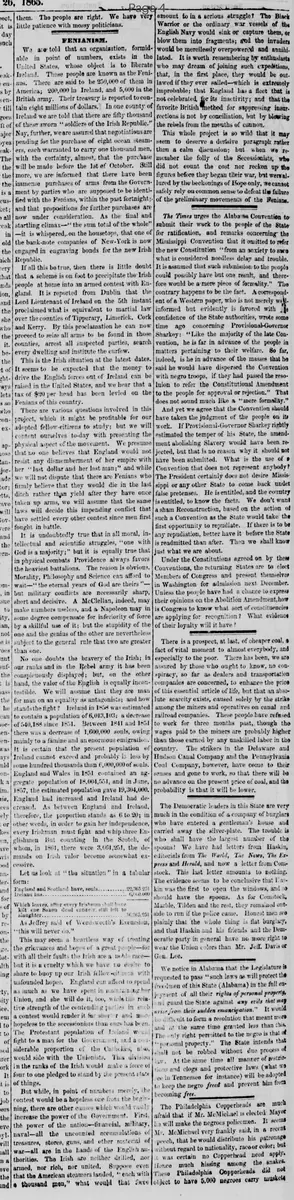
We are told that an organization, formidable in point of numbers, exists in the United States, whose object is to liberate Ireland. These people are known as the Fenians. There are said to be 250,000 of them in America: 200,000 in Ireland, and 5,000 in the British army. Their treasury is reported to contain eight millions of dollars.; In one county of Ireland we are told that there are fifty thousand of these sworn "soldiers of the Irish Republic." Nay, further, we are assured that negotiations are pending for the purchase of eight ocean steamers, each warranted to carry one thousand men, with the certainty, almost, that the purchase will be made before the 1st of October. Still more, we are informed that there have been immense purchases of arms from the Government by parties who are supposed to be identified with the Fenians, within the past fortnight; and that propositions for further purchases are now under consideration. As the final and startling climax—"of the sum total of the whole"—it is whispered, on the housetops, that one of the bank-note companies of New-York is now engaged in engraving bonds for the new Irish Republic.
If all this be true, then there is little doubt that a scheme is on foot to precipitate the Irish people at home into an armed contest with England. It is reported from Dublin that the Lord Lieutenant of Ireland on the 5th instant proclaimed what is equivalent to martial law over the counties of Tipperary, Limerick, Cork and Kerry. By this proclamation he can now proceed to seize all arms to be found in those counties, arrest all suspected parties, search every dwelling and institute the curfew.
This is the Irish situation at the latest dates. It seems to be expected that the money to drive the English forces out of Ireland can be raised in the United States, and we hear that a tax of $20 per head has been levied on the Fenians of this country.
There are various questions involved in this project, which it might be profitable for our adopted fellow-citizens to study: but we will content ourselves to-day with presenting the physical aspect of the movement. We presume that no one believes that England would not resist any dismemberment of her empire with her "last dollar and her last man;" and while we will not dispute that there are Fenians who firmly believe that they would die in the last ditch rather than yield after they have once taken up arms, we will assume that the same laws will decide this impending conflict that have settled every other contest since men first fought in battle.
It is undoubtedly true that in all moral, intellectual and scientific struggles, "one with God is a majority;" but it is equally true that in physical combats Providence always favors the heaviest battalions. The reason is obvious. Morality, Philosophy and Science can afford to wait—"the eternal years of God are theirs"— but military conflicts are necessarily sharp, short and decisive. A McClellan, indeed, may make numbers useless, and a Napoleon may in some degree compensate for inferiority of force by a skillful use of it; but the stupidity of the one and the genius of the other are nevertheless subject to the general rule that two are greater than one.
No one doubts the bravery of the Irish: in our ranks and in the Rebel army it has been conspicuously displayed; but, on the other hand, the valor of the English is equally incontestable. We will assume that they are man for man on an equality as antagonists: and how stands the fight? Ireland in 1858 was estimated to contain a population of 6,013,103: a decrease of 540,188 since 1851. Between 1841 and 1851 there was a decrease of 1,600,000 souls, owing mainly to a famine and an enormous emigration. It is certain that the present population of Ireland cannot exceed and probably is less by some hundred thousands than 6,000,000 of souls. England and Wales in 1851 contained an aggregate population of 18,004,551, and in June, 1857, the estimated population gave 19,304,000. England had increased and Ireland had decreased. As between England and Ireland, therefore, the proportion stands as 6 to 20; in other words, in order to gain her independence, every Irishman must fight and whip three Englishmen But counting in the Scotch, of whom, in 1861, there were 3,061,251, the demands on Irish valor become somewhat excessive.
Let us look at "the situation" in a tabular form:
England and Scotland have, souls. 22,365,251
Ireland has 6,000,000
Which leaves, after every Irishman shall have kilt one Saxon dead, entuev, still left to slaughter... 16,365,251
As Jeffrey said of Wordsworth's Excursion, "this will never do."
This may seem a heartless way of treating the grievances and hopes of a great people—for with all their faults the Irish are a noble race—but it is a cruelty which we have no desire to share to buoy up our Irish fellow-citizens with unfounded hopes. England can afford to spend as much as we have spent in maintaining her Union, and she will do it, too, while the relative strength of the contending parties in such a contest would render it far shorter and more hopeless to the secessionists than ours has been. The Protestant population of Ireland would fight to a man for the Government, and a considerable proportion of the Catholics, also, would side with the Unionists. This division in the ranks of the Irish would make a force of four to one pledged to stand by the present state of things.
But while, in point of numbers merely, the contest would be a hopeless one from the beginning, there are other causes which would vastly increase the power of the Government. First, the power of the nation—financial, military, naval—all the uncounted accumulations of treasures, stores, guns, and other material of war all are in the hands of the English authorities. The Irish are neither drilled, nor armed, nor rich, nor united. Suppose even that the American steamers landed, "each with a thousand men," what would that force amount to in a serious struggle? The Black Warrior or the ordinary war vessels of the English Navy would sink or capture them, or blow them into fragments; and the invaders would be mercilessly overpowered and annihilated. It is worth remembering by enthusiasts who may dream of joining such expeditions that, in the first place, they would be outlawed if they ever sailed—which is extremely improbable; that England has a fleet that is not celebrated for its inactivity; and that the favorite British method for suppressing insurrections is not by conciliation, but by blowing the rebels from the mouths of cannon.
This whole project is so wild that it may seem to deserve a derisive paragraph rather than a calm discussion; but when we remember the folly of the Secessionists, who did not count the cost nor reckon up the figures before they began their war, but were lured by the beckonings of Hope only, we cannot safely rely on common sense to defeat the failure of the preliminary movements of the Fenians.
What sub-type of article is it?
What keywords are associated?
What entities or persons were involved?
Where did it happen?
Foreign News Details
Primary Location
Ireland
Event Date
5th Instant
Key Persons
Outcome
proclamation equivalent to martial law over counties of tipperary, limerick, cork and kerry, allowing seizure of arms, arrests, searches, and curfew.
Event Details
Fenian organization in US, Ireland, and British army aims to liberate Ireland with 250,000 in America, 200,000 in Ireland, 5,000 in British army, treasury of eight million dollars. Plans include purchasing eight steamers, arms from government, engraving bonds for Irish Republic. Expected tax of $20 per head in US. England expected to resist strongly due to population disparity and resources.