Thank you for visiting SNEWPapers!
Sign up free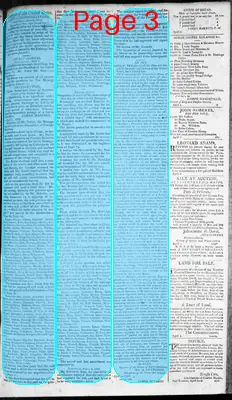
Story
April 6, 1812
Alexandria Daily Gazette, Commercial & Political
Alexandria, Virginia
What is this article about?
Record of US House of Representatives proceedings from April 1-4, 1812, passing the Embargo Act in response to President Madison's recommendation, imposing 90-day trade restrictions amid international tensions.
Clipping
OCR Quality
95%
Excellent
Full Text
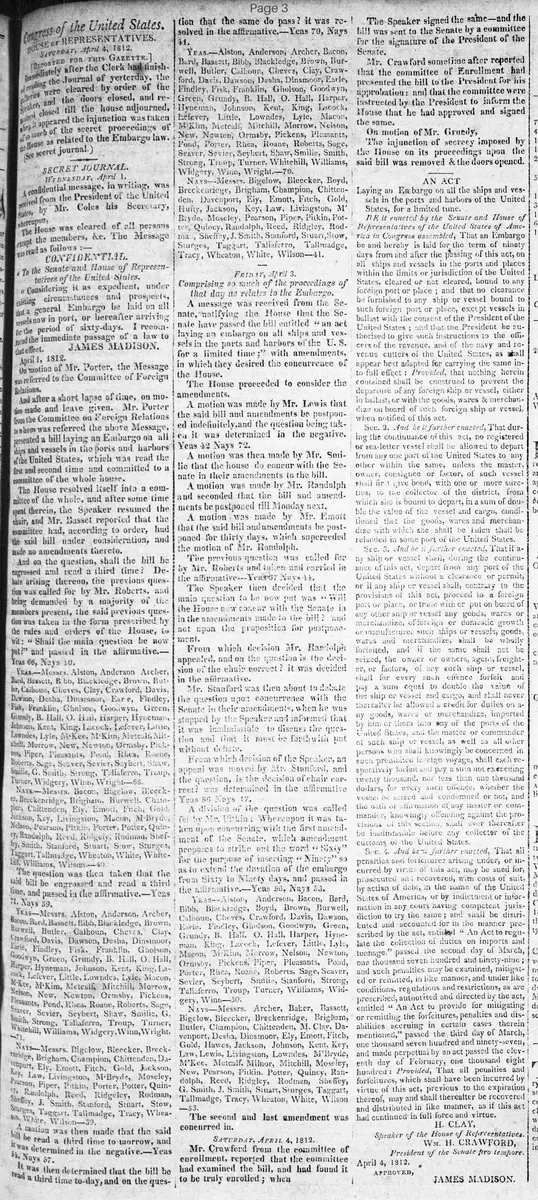
Congress of the United States.
HOUSE OF REPRESENTATIVES
Saturday, April 4, 1812.
[Reported for this Gazette.]
And the Journal yesterday. Immediately after the Clerk had finished calling the roll, the galleries were cleared by order of the Speaker, and the doors closed, and remained closed till the House adjourned. The House as related to the Embargo law. Of so much of the secret proceedings of (See secret journal.)
SECRET JOURNAL.
Received from the President of the United States, by Mr. Coles his Secretary, a confidential message, in writing, Wednesday, April 1.
Whereupon, the House was cleared of all persons except the members, &c. The Message was read as follows:--
CONFIDENTIAL.
To the Senate and House of Representatives of the United States.
Considering it as expedient, under existing circumstances and prospects, that a general Embargo be laid on all vessels now in port, or hereafter arriving, for the period of sixty days, I recommend the immediate passage of a law to that effect.
JAMES MADISON.
April 1, 1812.
On motion of Mr. Porter, the Message was referred to the Committee of Foreign Relations.
And after a short lapse of time, on motion made and leave given: Mr. Porter from the Committee on Foreign Relations to whom was referred the above Message, presented a bill laying an Embargo on all ships and vessels in the ports and harbors of the United States, which was read the first and second time and committed to a committee of the whole house.
The House resolved itself into a committee of the whole, and after some time spent therein, the Speaker resumed the chair, and Mr. Bassett reported that the committee had, according to order, had the said bill under consideration, and made no amendments thereto.
And on the question, shall the bill be engrossed and read a third time? Debate arising thereon, the previous question was called for by Mr. Roberts, and being demanded by a majority of the members present, the said previous question was taken in the form prescribed by the rules and orders of the House, to wit: "Shall the main question be now put?" and passed in the affirmative.--
Yeas 66. Nays 10.
Yeas.--Messrs. Alston, Anderson, Archer, Bard, Bassett, Bibb, Blackledge, Brown, Butler, Calhoun, Cheves, Clay, Crawford, Davis, Dawson, Desha, Dinsmoor, Earle, Findley, Fisk, Franklin, Gholson, Goodwin, Green, Grundy, B. Hall, O. Hall, Harper, Hyneman, Johnson, Kent, King, Lacock, Lefever, Little, Lowndes, Lyle, M'Kee, M'Kim, Metcalf, Mitchill, Morrow, New, Newton, Ormsby, Pickens, Piper, Pleasants, Pond, Rhea, Roane, Roberts, Sage, Seaver, Sevier, Seybert, Shaw, Smilie, G. Smith, Strong, Taliaferro, Troup, Turner, Widgery, Winn, Wright--66.
Nays.--Messrs. Bacon, Bigelow, Bleecker, Breckenridge, Brigham, Burwell, Champion, Chittenden, Ely, Emott, Fitch, Gold, Jackson, Key, Livingston, Macon, M'Bryde, Nelson, Pearson, Pitkin, Porter, Potter, Quincy, Randolph, Reed, Ridgely, Rodman, Sheffey, Smith, Stanford, Stuart, Stow, Sturges, Taggart, Tallmadge, Wheaton, White, Whitehill, Williams, Wilson.--40.
The question was then taken that the said bill be engrossed and read a third time, and passed in the affirmative.--Yeas 71. Nays 39.
YEAS--Messrs. Alston, Anderson, Archer, Bacon, Bard, Bassett, Bibb, Blackledge, Brown, Burwell, Butler, Calhoun, Cheves, Clay, Crawford, Davis, Dawson, Desha, Dinsmoor, Earle, Findley, Fisk, Franklin, Gholson, Goodwin, Green, Harper, Hyneman, Grundy, B. Hall, O. Hall, Johnson, Kent, King, Lacock, Lefever, Little, Lowndes, Lyle, Macon, M'Kee, M'Kim, Metcalf, Mitchill, Morrow, Nelson, New, Newton, Ormsby, Pickens, Pleasants, Pond, Rhea, Roane, Roberts, Sage, Seaver, Sevier, Seybert, Shaw, Smilie, G. Smith, Strong, Taliaferro, Troup, Turner, Whitehill, Williams, Widgery, Winn, Wright.--71.
Nays--Messrs. Bigelow, Bleecker, Breckenridge, Brigham, Champion, Chittenden, Davenport, Ely, Emott, Fitch, Gold, Jackson, Key, Law, Livingston, M'Bryde, Moseley, Pearson, Piper, Pitkin, Porter, Potter, Quincy, Randolph, Reed, Ridgeley, Rodman, Sheffey, J. Smith, Stanford, Stuart, Stow, Sturges, Taggart, Tallmadge, Tracy, Wheaton, White, Wilson--39.
A motion was then made that the said bill be read a third time to-morrow, and it was determined in the negative.--Yeas 51, Nays 57.
It was then determined that the bill be read a third time to-day, and on the question that the same do pass? it was resolved in the affirmative.--Yeas 70, Nays 41.
Yeas.--Alston, Anderson, Archer, Bacon, Bard, Bassett, Bibb, Blackledge, Brown, Burwell, Butler, Calhoun, Cheves, Clay, Crawford, Davis, Dawson, Desha, Dinsmoor, Earle, Findley, Fisk, Franklin, Gholson, Goodwin, Green, Grundy, B. Hall, O. Hall, Harper, Hyneman, Johnson, Kent, King, Lacock, Lefever, Little, Lowndes, Lyle, Macon, M'Kim, Metcalf, Mitchill, Morrow, Nelson, New, Newton, Ormsby, Pickens, Pleasants, Pond, Porter, Rhea, Roane, Roberts, Sage, Seaver, Sevier, Seybert, Shaw, Smilie, Smith, Strong, Troup, Turner, Whitehill, Williams, Widgery, Winn, Wright.--70.
Nays--Messrs. Bigelow, Bleecker, Boyd, Breckenridge, Brigham, Champion, Chittenden, Davenport, Ely, Emott, Fitch, Gold, Hufty, Jackson, Key, Law, Livingston, M'Bryde, Moseley, Pearson, Piper, Pitkin, Potter, Quincy, Randolph, Reed, Ridgley, Rodman, Sheffey, J. Smith, Stanford, Stuart, Stow, Sturges, Taggart, Taliaferro, Tallmadge, Tracy, Wheaton, White, Wilson--41.
Friday, April 3.
Comprising so much of the proceedings that day as relates to the Embargo.
A message was received from the Senate, notifying the House that the Senate have passed the bill entitled "an act laying an embargo on all ships and vessels in the ports and harbors of the U. S. for a limited time;" with amendments, in which they desired the concurrence of the House.
The House proceeded to consider the amendments.
A motion was made by Mr. Lewis that the said bill and amendments be postponed indefinitely, and the question being taken it was determined in the negative.
Yeas 42 Nays 72.
A motion was then made by Mr. Smith that the house do concur with the Senate in their amendments to the bill.
A motion was made by Mr. Randolph and seconded that the bill and amendments be postponed till Monday next.
A motion was made by Mr. Emott that the said bill and amendments be postponed for thirty days, which superseded the motion of Mr. Randolph.
The previous question was called for by Mr. Roberts and taken and carried in the affirmative---Yeas 67 Nays 51.
The Speaker then decided that the main question to be now put was "will the House now concur with the Senate in the amendments made to the bill?" and not upon the proposition for postponement.
From which decision Mr. Randolph appealed, and on the question is the decision of the chair correct? it was decided in the affirmative.
Mr. Stanford was then about to debate the question upon concurrence with the Senate in their amendments, when he was stopped by the Speaker and informed that it was inadmissible to discuss the question and that it must be forthwith put without debate.
From which decision of the Speaker an appeal was moved by Mr. Stanford, and the question, is the decision of chair correct? was determined in the affirmative
Yeas 86 Nays 17.
A division of the question was called for by Mr. Pitkin: Whereupon it was taken upon concurring with the first amendment of the Senate, which amendment proposes to strike out the word "Sixty" for the purpose of inserting "Ninety" so as to extend the duration of the embargo from Sixty to Ninety days, and passed in the affirmative.--Yeas 50, Nays 53.
Yeas--Alston, Anderson, Bacon, Bard, Bibb, Blackledge, Boyd, Brown, Burwell, Calhoun, Cheves, Crawford, Davis, Dawson, Earle, Findley, Gholson, Goodwin, Green, Grundy, B. Hall, O. Hall, Harper, Hyneman, King, Lacock, Lefever, Little, Lyle, Macon, M'Kim, Morrow, Nelson, Newton, Ormsby, Pickens, Piper, Pleasants, Pond, Porter, Rhea, Roane, Roberts, Sage, Seaver, Sevier, Seybert, Smilie, Stanford, Strong, Taliaferro, Troup, Turner, Williams, Widgery, Winn--50.
Nays--Messrs. Archer, Baker, Bassett, Bigelow, Bleecker, Breckenridge, Brigham, Butler, Champion, Chittenden, M. Clay, Davenport, Desha, Dinsmoor, Ely, Emott, Fitch, Gold, Hawes, Jackson, Johnson, Kent, Key, Law, Lewis, Livingston, Lowndes, M'Bryde, M'Kee, Metcalf, Milnor, Mitchill, Moseley, New, Pearson, Pitkin, Potter, Quincy, Randolph, Reed, Ridgley, Rodman, Sheffey, G. Smith, J. Smith, Stuart, Sturges, Taggart, Tallmadge, Tracy, Wheaton, White, Wilson--53.
The second and last amendment was concurred in.
Saturday, April 4, 1812.
Mr. Crawford from the committee of enrollment, reported that the committee had examined the bill, and had found it to be truly enrolled; when
The Speaker signed the same, and the bill was sent to the Senate by a committee for the signature of the President of the Senate.
Mr. Crawford sometime after reported that the committee of Enrollment had presented the bill to the President for his approbation: and that the committee were instructed by the President to inform the House that he had approved and signed the same.
On motion of Mr. Grundy, the injunction of secrecy imposed by the House on its proceedings upon the said bill was removed & the doors opened.
AN ACT
Laying an Embargo on all the ships and vessels in the ports and harbors of the United States, for a limited time.
BE it enacted by the Senate and House of Representatives of the United States of America in Congress assembled, That an Embargo be and hereby is laid for the term of ninety days from and after the passing of this act, on all ships and vessels in the ports and places within the limits or jurisdiction of the United States, cleared or not cleared, bound to any foreign port or place; and that no clearance be furnished to any ship or vessel bound to such foreign port or place, except vessels in ballast with the consent of the President of the United States: and that the President be authorised to give such instructions to the officers of the revenue, and of the navy and revenue cutters of the United States, as shall appear best adapted for carrying the same into full effect: Provided, that nothing herein contained shall be construed to prevent the departure of any foreign ship or vessel, either in ballast, or with the goods, wares & merchandise on board of such foreign ship or vessel, when notified of this act
Sec. 2. And be it further enacted, That during the continuance of this act, no registered or sea-letter vessel shall be allowed to depart from any one port of the United States to any other within the same, unless the master, owner, consignee or factor, of such vessel shall first give bond, with one or more sureties, to the collector of the district from which she is bound to depart, in a sum of double the value of the vessel and cargo, conditioned that the goods, wares and merchandise with which she shall be laden shall be relanded in some port of the United States.
Sec. 3. And be it further enacted, That if any ship or vessel shall, during the continuance of this act, depart from any port of the United States without a clearance or permit, or if any ship or vessel shall, contrary to the provisions of this act, proceed to a foreign port or place, or trade with or put on board of any other ship or vessel any goods, wares or merchandise, of foreign or domestic growth or manufacture, such ships or vessels, goods, wares and merchandise, shall be wholly forfeited, and if the same shall not be seized, the owner or owners, agent, freighter, or factors, of any such ship or vessel shall for every such offence forfeit and pay a sum equal to double the value of the ship or vessel and cargo, and shall never thereafter be allowed a credit for duties on any goods, wares or merchandise, imported by him or them into any of the ports of the United States, and the master or commander of such ship or vessel, as well as all other persons who shall knowingly be concerned in such prohibited foreign voyage, shall each respectively forfeit and pay a sum not exceeding twenty thousand, nor less than one thousand dollars, for every such offence, whether the vessel be seized and condemned or not, and the oath or affirmation of any master or commander, knowingly offending against the provisions of this section, shall ever thereafter be inadmissible before any collector of the customs of the United States.
Sec. 4. And be it further enacted, That all penalties and forfeitures arising under, or incurred by virtue of this act, may be sued for, prosecuted and recovered, with costs of suit, by action of debt, in the name of the United States of America, or by indictment or information in any court having competent jurisdiction to try the same; and shall be distributed and accounted for in the manner prescribed by the act, entitled "An Act to regulate the collection of duties on imports and tonnage." passed the second day of March, one thousand seven hundred and ninety-nine; and such penalties may be examined, mitigated or remitted, in like manner, and under like conditions, regulations and restrictions, as are prescribed, authorised and directed by the act, entitled "An Act to provide for mitigating or remitting the forfeitures, penalties and disabilities accruing in certain cases therein mentioned," passed the third day of March, one thousand seven hundred and ninety-seven, and made perpetual by an act passed the twenty-fifth day of February, one thousand eight hundred: Provided, That all penalties and forfeitures, which shall have been incurred by virtue of this act, previous to the expiration thereof, may and shall thereafter be recovered and distributed in like manner, as if this act had continued in full force and virtue.
H. CLAY,
Speaker of the House of Representatives.
WM. H. CRAWFORD,
President of the Senate pro tempore.
April 4, 1812.
APPROVED,
JAMES MADISON.
HOUSE OF REPRESENTATIVES
Saturday, April 4, 1812.
[Reported for this Gazette.]
And the Journal yesterday. Immediately after the Clerk had finished calling the roll, the galleries were cleared by order of the Speaker, and the doors closed, and remained closed till the House adjourned. The House as related to the Embargo law. Of so much of the secret proceedings of (See secret journal.)
SECRET JOURNAL.
Received from the President of the United States, by Mr. Coles his Secretary, a confidential message, in writing, Wednesday, April 1.
Whereupon, the House was cleared of all persons except the members, &c. The Message was read as follows:--
CONFIDENTIAL.
To the Senate and House of Representatives of the United States.
Considering it as expedient, under existing circumstances and prospects, that a general Embargo be laid on all vessels now in port, or hereafter arriving, for the period of sixty days, I recommend the immediate passage of a law to that effect.
JAMES MADISON.
April 1, 1812.
On motion of Mr. Porter, the Message was referred to the Committee of Foreign Relations.
And after a short lapse of time, on motion made and leave given: Mr. Porter from the Committee on Foreign Relations to whom was referred the above Message, presented a bill laying an Embargo on all ships and vessels in the ports and harbors of the United States, which was read the first and second time and committed to a committee of the whole house.
The House resolved itself into a committee of the whole, and after some time spent therein, the Speaker resumed the chair, and Mr. Bassett reported that the committee had, according to order, had the said bill under consideration, and made no amendments thereto.
And on the question, shall the bill be engrossed and read a third time? Debate arising thereon, the previous question was called for by Mr. Roberts, and being demanded by a majority of the members present, the said previous question was taken in the form prescribed by the rules and orders of the House, to wit: "Shall the main question be now put?" and passed in the affirmative.--
Yeas 66. Nays 10.
Yeas.--Messrs. Alston, Anderson, Archer, Bard, Bassett, Bibb, Blackledge, Brown, Butler, Calhoun, Cheves, Clay, Crawford, Davis, Dawson, Desha, Dinsmoor, Earle, Findley, Fisk, Franklin, Gholson, Goodwin, Green, Grundy, B. Hall, O. Hall, Harper, Hyneman, Johnson, Kent, King, Lacock, Lefever, Little, Lowndes, Lyle, M'Kee, M'Kim, Metcalf, Mitchill, Morrow, New, Newton, Ormsby, Pickens, Piper, Pleasants, Pond, Rhea, Roane, Roberts, Sage, Seaver, Sevier, Seybert, Shaw, Smilie, G. Smith, Strong, Taliaferro, Troup, Turner, Widgery, Winn, Wright--66.
Nays.--Messrs. Bacon, Bigelow, Bleecker, Breckenridge, Brigham, Burwell, Champion, Chittenden, Ely, Emott, Fitch, Gold, Jackson, Key, Livingston, Macon, M'Bryde, Nelson, Pearson, Pitkin, Porter, Potter, Quincy, Randolph, Reed, Ridgely, Rodman, Sheffey, Smith, Stanford, Stuart, Stow, Sturges, Taggart, Tallmadge, Wheaton, White, Whitehill, Williams, Wilson.--40.
The question was then taken that the said bill be engrossed and read a third time, and passed in the affirmative.--Yeas 71. Nays 39.
YEAS--Messrs. Alston, Anderson, Archer, Bacon, Bard, Bassett, Bibb, Blackledge, Brown, Burwell, Butler, Calhoun, Cheves, Clay, Crawford, Davis, Dawson, Desha, Dinsmoor, Earle, Findley, Fisk, Franklin, Gholson, Goodwin, Green, Harper, Hyneman, Grundy, B. Hall, O. Hall, Johnson, Kent, King, Lacock, Lefever, Little, Lowndes, Lyle, Macon, M'Kee, M'Kim, Metcalf, Mitchill, Morrow, Nelson, New, Newton, Ormsby, Pickens, Pleasants, Pond, Rhea, Roane, Roberts, Sage, Seaver, Sevier, Seybert, Shaw, Smilie, G. Smith, Strong, Taliaferro, Troup, Turner, Whitehill, Williams, Widgery, Winn, Wright.--71.
Nays--Messrs. Bigelow, Bleecker, Breckenridge, Brigham, Champion, Chittenden, Davenport, Ely, Emott, Fitch, Gold, Jackson, Key, Law, Livingston, M'Bryde, Moseley, Pearson, Piper, Pitkin, Porter, Potter, Quincy, Randolph, Reed, Ridgeley, Rodman, Sheffey, J. Smith, Stanford, Stuart, Stow, Sturges, Taggart, Tallmadge, Tracy, Wheaton, White, Wilson--39.
A motion was then made that the said bill be read a third time to-morrow, and it was determined in the negative.--Yeas 51, Nays 57.
It was then determined that the bill be read a third time to-day, and on the question that the same do pass? it was resolved in the affirmative.--Yeas 70, Nays 41.
Yeas.--Alston, Anderson, Archer, Bacon, Bard, Bassett, Bibb, Blackledge, Brown, Burwell, Butler, Calhoun, Cheves, Clay, Crawford, Davis, Dawson, Desha, Dinsmoor, Earle, Findley, Fisk, Franklin, Gholson, Goodwin, Green, Grundy, B. Hall, O. Hall, Harper, Hyneman, Johnson, Kent, King, Lacock, Lefever, Little, Lowndes, Lyle, Macon, M'Kim, Metcalf, Mitchill, Morrow, Nelson, New, Newton, Ormsby, Pickens, Pleasants, Pond, Porter, Rhea, Roane, Roberts, Sage, Seaver, Sevier, Seybert, Shaw, Smilie, Smith, Strong, Troup, Turner, Whitehill, Williams, Widgery, Winn, Wright.--70.
Nays--Messrs. Bigelow, Bleecker, Boyd, Breckenridge, Brigham, Champion, Chittenden, Davenport, Ely, Emott, Fitch, Gold, Hufty, Jackson, Key, Law, Livingston, M'Bryde, Moseley, Pearson, Piper, Pitkin, Potter, Quincy, Randolph, Reed, Ridgley, Rodman, Sheffey, J. Smith, Stanford, Stuart, Stow, Sturges, Taggart, Taliaferro, Tallmadge, Tracy, Wheaton, White, Wilson--41.
Friday, April 3.
Comprising so much of the proceedings that day as relates to the Embargo.
A message was received from the Senate, notifying the House that the Senate have passed the bill entitled "an act laying an embargo on all ships and vessels in the ports and harbors of the U. S. for a limited time;" with amendments, in which they desired the concurrence of the House.
The House proceeded to consider the amendments.
A motion was made by Mr. Lewis that the said bill and amendments be postponed indefinitely, and the question being taken it was determined in the negative.
Yeas 42 Nays 72.
A motion was then made by Mr. Smith that the house do concur with the Senate in their amendments to the bill.
A motion was made by Mr. Randolph and seconded that the bill and amendments be postponed till Monday next.
A motion was made by Mr. Emott that the said bill and amendments be postponed for thirty days, which superseded the motion of Mr. Randolph.
The previous question was called for by Mr. Roberts and taken and carried in the affirmative---Yeas 67 Nays 51.
The Speaker then decided that the main question to be now put was "will the House now concur with the Senate in the amendments made to the bill?" and not upon the proposition for postponement.
From which decision Mr. Randolph appealed, and on the question is the decision of the chair correct? it was decided in the affirmative.
Mr. Stanford was then about to debate the question upon concurrence with the Senate in their amendments, when he was stopped by the Speaker and informed that it was inadmissible to discuss the question and that it must be forthwith put without debate.
From which decision of the Speaker an appeal was moved by Mr. Stanford, and the question, is the decision of chair correct? was determined in the affirmative
Yeas 86 Nays 17.
A division of the question was called for by Mr. Pitkin: Whereupon it was taken upon concurring with the first amendment of the Senate, which amendment proposes to strike out the word "Sixty" for the purpose of inserting "Ninety" so as to extend the duration of the embargo from Sixty to Ninety days, and passed in the affirmative.--Yeas 50, Nays 53.
Yeas--Alston, Anderson, Bacon, Bard, Bibb, Blackledge, Boyd, Brown, Burwell, Calhoun, Cheves, Crawford, Davis, Dawson, Earle, Findley, Gholson, Goodwin, Green, Grundy, B. Hall, O. Hall, Harper, Hyneman, King, Lacock, Lefever, Little, Lyle, Macon, M'Kim, Morrow, Nelson, Newton, Ormsby, Pickens, Piper, Pleasants, Pond, Porter, Rhea, Roane, Roberts, Sage, Seaver, Sevier, Seybert, Smilie, Stanford, Strong, Taliaferro, Troup, Turner, Williams, Widgery, Winn--50.
Nays--Messrs. Archer, Baker, Bassett, Bigelow, Bleecker, Breckenridge, Brigham, Butler, Champion, Chittenden, M. Clay, Davenport, Desha, Dinsmoor, Ely, Emott, Fitch, Gold, Hawes, Jackson, Johnson, Kent, Key, Law, Lewis, Livingston, Lowndes, M'Bryde, M'Kee, Metcalf, Milnor, Mitchill, Moseley, New, Pearson, Pitkin, Potter, Quincy, Randolph, Reed, Ridgley, Rodman, Sheffey, G. Smith, J. Smith, Stuart, Sturges, Taggart, Tallmadge, Tracy, Wheaton, White, Wilson--53.
The second and last amendment was concurred in.
Saturday, April 4, 1812.
Mr. Crawford from the committee of enrollment, reported that the committee had examined the bill, and had found it to be truly enrolled; when
The Speaker signed the same, and the bill was sent to the Senate by a committee for the signature of the President of the Senate.
Mr. Crawford sometime after reported that the committee of Enrollment had presented the bill to the President for his approbation: and that the committee were instructed by the President to inform the House that he had approved and signed the same.
On motion of Mr. Grundy, the injunction of secrecy imposed by the House on its proceedings upon the said bill was removed & the doors opened.
AN ACT
Laying an Embargo on all the ships and vessels in the ports and harbors of the United States, for a limited time.
BE it enacted by the Senate and House of Representatives of the United States of America in Congress assembled, That an Embargo be and hereby is laid for the term of ninety days from and after the passing of this act, on all ships and vessels in the ports and places within the limits or jurisdiction of the United States, cleared or not cleared, bound to any foreign port or place; and that no clearance be furnished to any ship or vessel bound to such foreign port or place, except vessels in ballast with the consent of the President of the United States: and that the President be authorised to give such instructions to the officers of the revenue, and of the navy and revenue cutters of the United States, as shall appear best adapted for carrying the same into full effect: Provided, that nothing herein contained shall be construed to prevent the departure of any foreign ship or vessel, either in ballast, or with the goods, wares & merchandise on board of such foreign ship or vessel, when notified of this act
Sec. 2. And be it further enacted, That during the continuance of this act, no registered or sea-letter vessel shall be allowed to depart from any one port of the United States to any other within the same, unless the master, owner, consignee or factor, of such vessel shall first give bond, with one or more sureties, to the collector of the district from which she is bound to depart, in a sum of double the value of the vessel and cargo, conditioned that the goods, wares and merchandise with which she shall be laden shall be relanded in some port of the United States.
Sec. 3. And be it further enacted, That if any ship or vessel shall, during the continuance of this act, depart from any port of the United States without a clearance or permit, or if any ship or vessel shall, contrary to the provisions of this act, proceed to a foreign port or place, or trade with or put on board of any other ship or vessel any goods, wares or merchandise, of foreign or domestic growth or manufacture, such ships or vessels, goods, wares and merchandise, shall be wholly forfeited, and if the same shall not be seized, the owner or owners, agent, freighter, or factors, of any such ship or vessel shall for every such offence forfeit and pay a sum equal to double the value of the ship or vessel and cargo, and shall never thereafter be allowed a credit for duties on any goods, wares or merchandise, imported by him or them into any of the ports of the United States, and the master or commander of such ship or vessel, as well as all other persons who shall knowingly be concerned in such prohibited foreign voyage, shall each respectively forfeit and pay a sum not exceeding twenty thousand, nor less than one thousand dollars, for every such offence, whether the vessel be seized and condemned or not, and the oath or affirmation of any master or commander, knowingly offending against the provisions of this section, shall ever thereafter be inadmissible before any collector of the customs of the United States.
Sec. 4. And be it further enacted, That all penalties and forfeitures arising under, or incurred by virtue of this act, may be sued for, prosecuted and recovered, with costs of suit, by action of debt, in the name of the United States of America, or by indictment or information in any court having competent jurisdiction to try the same; and shall be distributed and accounted for in the manner prescribed by the act, entitled "An Act to regulate the collection of duties on imports and tonnage." passed the second day of March, one thousand seven hundred and ninety-nine; and such penalties may be examined, mitigated or remitted, in like manner, and under like conditions, regulations and restrictions, as are prescribed, authorised and directed by the act, entitled "An Act to provide for mitigating or remitting the forfeitures, penalties and disabilities accruing in certain cases therein mentioned," passed the third day of March, one thousand seven hundred and ninety-seven, and made perpetual by an act passed the twenty-fifth day of February, one thousand eight hundred: Provided, That all penalties and forfeitures, which shall have been incurred by virtue of this act, previous to the expiration thereof, may and shall thereafter be recovered and distributed in like manner, as if this act had continued in full force and virtue.
H. CLAY,
Speaker of the House of Representatives.
WM. H. CRAWFORD,
President of the Senate pro tempore.
April 4, 1812.
APPROVED,
JAMES MADISON.
What sub-type of article is it?
Historical Event
What themes does it cover?
Justice
What keywords are associated?
Embargo Act
Congressional Proceedings
1812 Legislation
Trade Restrictions
House Votes
What entities or persons were involved?
James Madison
Henry Clay
William H. Crawford
Mr. Porter
Mr. Roberts
Mr. Randolph
Where did it happen?
House Of Representatives, United States
Story Details
Key Persons
James Madison
Henry Clay
William H. Crawford
Mr. Porter
Mr. Roberts
Mr. Randolph
Location
House Of Representatives, United States
Event Date
April 1 4, 1812
Story Details
President Madison sends confidential message recommending a 60-day embargo on US vessels. House refers to Committee of Foreign Relations, which presents bill. After debates and votes, House passes bill extending to 90 days. Senate amends and concurs, President approves the Embargo Act on April 4, 1812.