Thank you for visiting SNEWPapers!
Sign up free
Editorial
November 4, 1939
Nogales International
Nogales, Santa Cruz County, Arizona
What is this article about?
Editorial defends U.S. government stability under current administration against Bernarr McFadden's criticism in Liberty magazine, citing high bond prices, reduced bank failures, and past speculation under Hoover as counterpoints. Quotes Col. Frank H. Lee's response in Joplin Southwestern.
Clipping
OCR Quality
95%
Excellent
Full Text
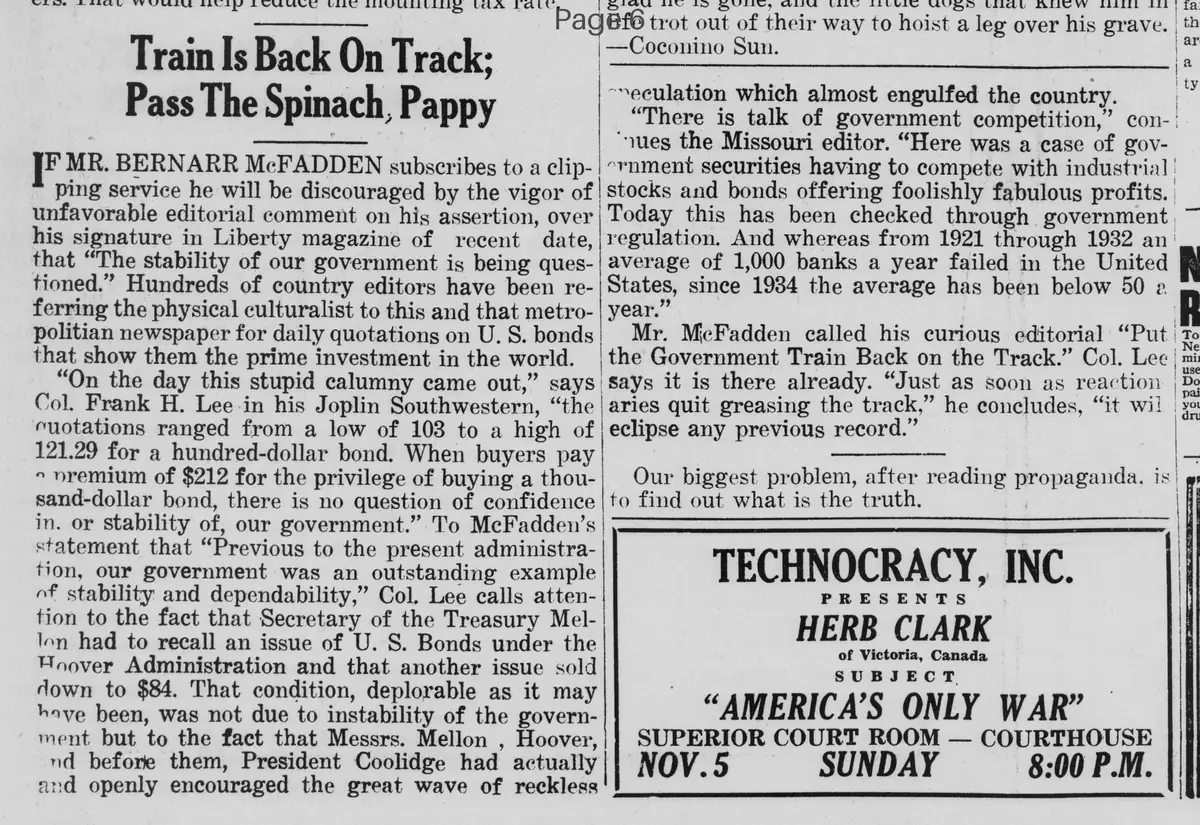
Train Is Back On Track;
Pass The Spinach, Pappy
If MR. BERNARR McFADDEN subscribes to a clipping
service he will be discouraged by the vigor of
unfavorable editorial comment on his assertion, over
his signature in Liberty magazine of recent date,
that "The stability of our government is being ques-
tioned." Hundreds of country editors have been re-
ferring the physical culturalist to this and that metro-
politan newspaper for daily quotations on U. S. bonds
that show them the prime investment in the world.
"On the day this stupid calumny came out," says
Col. Frank H. Lee in his Joplin Southwestern, "the
quotations ranged from a low of 103 to a high of
121.29 for a hundred-dollar bond. When buyers pay
a premium of $212 for the privilege of buying a thou-
sand-dollar bond, there is no question of confidence
in, or stability of, our government." To McFadden's
statement that "Previous to the present administra-
tion, our government was an outstanding example
of stability and dependability," Col. Lee calls atten-
tion to the fact that Secretary of the Treasury Mel-
lon had to recall an issue of U. S. Bonds under the
Hoover Administration and that another issue sold
down to $84. That condition, deplorable as it may
have been, was not due to instability of the govern-
ment but to the fact that Messrs. Mellon, Hoover,
and before them, President Coolidge had actually
and openly encouraged the great wave of reckless
speculation which almost engulfed the country.
"There is talk of government competition,
continues the Missouri editor. "Here was a case of gov-
ernment securities having to compete with industrial
stocks and bonds offering foolishly fabulous profits.
Today this has been checked through government
regulation. And whereas from 1921 through 1932 an
average of 1,000 banks a year failed in the United
States, since 1934 the average has been below 50 a
year."
Mr. McFadden called his curious editorial "Put
the Government Train Back on the Track." Col. Lee
says it is there already. "Just as soon as reaction-
aries quit greasing the track," he concludes, "it will
eclipse any previous record."
Our biggest problem, after reading propaganda, is
to find out what is the truth.
Pass The Spinach, Pappy
If MR. BERNARR McFADDEN subscribes to a clipping
service he will be discouraged by the vigor of
unfavorable editorial comment on his assertion, over
his signature in Liberty magazine of recent date,
that "The stability of our government is being ques-
tioned." Hundreds of country editors have been re-
ferring the physical culturalist to this and that metro-
politan newspaper for daily quotations on U. S. bonds
that show them the prime investment in the world.
"On the day this stupid calumny came out," says
Col. Frank H. Lee in his Joplin Southwestern, "the
quotations ranged from a low of 103 to a high of
121.29 for a hundred-dollar bond. When buyers pay
a premium of $212 for the privilege of buying a thou-
sand-dollar bond, there is no question of confidence
in, or stability of, our government." To McFadden's
statement that "Previous to the present administra-
tion, our government was an outstanding example
of stability and dependability," Col. Lee calls atten-
tion to the fact that Secretary of the Treasury Mel-
lon had to recall an issue of U. S. Bonds under the
Hoover Administration and that another issue sold
down to $84. That condition, deplorable as it may
have been, was not due to instability of the govern-
ment but to the fact that Messrs. Mellon, Hoover,
and before them, President Coolidge had actually
and openly encouraged the great wave of reckless
speculation which almost engulfed the country.
"There is talk of government competition,
continues the Missouri editor. "Here was a case of gov-
ernment securities having to compete with industrial
stocks and bonds offering foolishly fabulous profits.
Today this has been checked through government
regulation. And whereas from 1921 through 1932 an
average of 1,000 banks a year failed in the United
States, since 1934 the average has been below 50 a
year."
Mr. McFadden called his curious editorial "Put
the Government Train Back on the Track." Col. Lee
says it is there already. "Just as soon as reaction-
aries quit greasing the track," he concludes, "it will
eclipse any previous record."
Our biggest problem, after reading propaganda, is
to find out what is the truth.
What sub-type of article is it?
Partisan Politics
Economic Policy
What keywords are associated?
Government Stability
Us Bonds
Bernarr Mcfadden
Hoover Administration
Bank Failures
Speculation
New Deal Regulation
What entities or persons were involved?
Bernarr Mcfadden
Col. Frank H. Lee
Secretary Of The Treasury Mellon
Hoover
President Coolidge
Liberty Magazine
Joplin Southwestern
Editorial Details
Primary Topic
Defense Of Government Stability Against Mcfadden's Criticism
Stance / Tone
Supportive Of Current Administration, Critical Of Mcfadden And Past Leaders
Key Figures
Bernarr Mcfadden
Col. Frank H. Lee
Secretary Of The Treasury Mellon
Hoover
President Coolidge
Liberty Magazine
Joplin Southwestern
Key Arguments
U.S. Bond Quotations Show High Confidence In Government Stability
Mcfadden's Claim Is A Stupid Calumny
Past Bond Issues Under Hoover Administration Sold Low Due To Encouraged Speculation, Not Instability
Bank Failures Reduced From 1,000/Year (1921 1932) To Below 50/Year Since 1934 Due To Government Regulation
Government Train Is Back On Track And Will Excel Without Reactionary Interference