Thank you for visiting SNEWPapers!
Sign up free
Letter to Editor
January 30, 1845
The Voice Of Freedom
Montpelier, Brandon, Washington County, Rutland County, Vermont
What is this article about?
Cassius M. Clay writes to the Boston Atlas opposing the annexation of Texas due to its promotion of slavery, criticizing Henry Clay's stance and urging Northern Whigs to maintain uncompromising opposition to the slave power to preserve liberty and the Union.
Clipping
OCR Quality
95%
Excellent
Full Text
From the Boston Atlas.
Letter from Hon. Cassius M. Clay.
We have great pleasure in laying before our readers the following letter from that bold and noble hearted champion of human liberty, Hon. Cassius M. Clay. Would to Heaven that he could infuse his generous feelings, and his gallant spirit, into the whole host of his fellow citizens of Kentucky, and induce that gallant State to take the lead in the march of freedom, and erase from her escutcheon the only blot that now defiles it—the foul one of domestic slavery!
Lexington, Ky. Jan. 6, 1845.
To the Editors of the Boston Atlas:
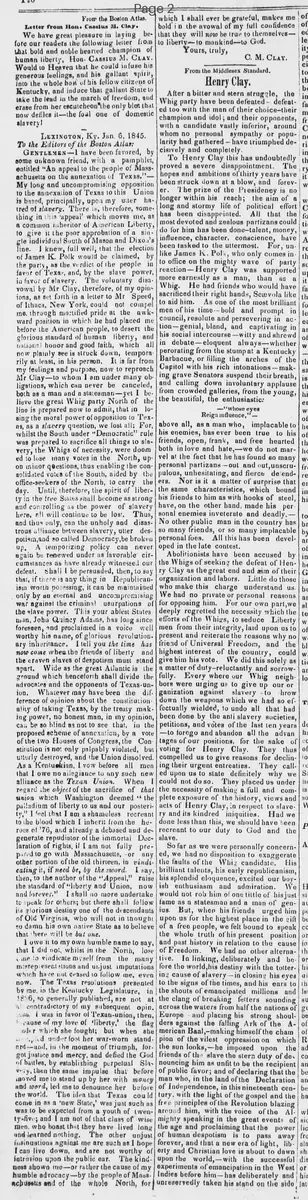
Gentlemen—I have been favored, by some unknown friend, with a pamphlet, entitled "An appeal to the people of Massachusetts on the annexation of Texas."—My long and uncompromising opposition to the annexation of Texas to this Union is based, principally, upon my utter hatred of slavery. There is, therefore, something in this 'appeal' which moves me, as a common inheritor of American Liberty, to give it the poor approbation of a single individual South of Mason and Dixon's line. I knew, full well, that the election of James K. Polk would be claimed, by the party, as the verdict of the people in favor of Texas, and, by the slave power, in favor of slavery. The voluntary disavowal by Mr. Clay, therefore, of my opinions, as set forth in a letter to Mr. Speed, of Ithaca, New York, could not compel me, through mortified pride at the awkward position in which he had placed me before the American people, to desert the glorious standard of human liberty, and national honor and good faith, which all now plainly see is struck down, temporarily at least, in his person. It is far from my feelings and purpose, now to reproach Mr. Clay—to whom I am under many obligations, which can never be canceled, both as a man and a statesman—yet I believe the great Whig party North of the line is prepared now to admit, that in losing the moral power of opposition to Texas, as a slavery question, we lost all: For, whilst the South under "Democratic" rule was prepared to sacrifice all things to slavery, the Whigs of necessity, were doomed to lose many votes in the North, upon minor questions, thus enabling the consolidated votes of the South, aided by the office-seekers of the North, to carry the day. Until, therefore, the spirit of liberty in the free States shall become as strong and controlling as the power of slavery here, all will continue to be lost. Thus, and thus only, can the unholy and disastrous alliance between slavery, utter despotism, and so called Democracy, be broken up. A temporizing policy can never again be renewed under as favorable circumstances as have already witnessed our defeat. Shall I be persuaded, then, to say that, if there is any thing in Republicanism worth possessing, it can be maintained only by an eternal and uncompromising war against the criminal usurpations of the slave power. This your ablest Statesman, John Quincy Adams, has long since foreseen, and proclaimed in a voice well worthy his name, of glorious revolutionary inheritance. I tell you the time has now come when the friends of liberty and the craven slaves of despotism must stand apart. Wide as the great Atlantic is the ground which henceforth shall divide the advocates and the opponents of Texas-union. Whatever may have been the difference of opinion about the constitutionality of taking Texas, by the treaty making power, no honest man, in my opinion, can be so blind as not to see that, in the proposed scheme of annexation, by a vote of the two Houses of Congress, the Constitution is not only palpably violated, but utterly destroyed, and the Union dissolved. As a Kentuckian, I vow before all men that I owe no allegiance to any such new alliance as the Texan Union. When I regard the object of the sacrifice of that union which Washington deemed the palladium of liberty to us and our posterity, I feel that I am a shameless recreant to the blood which I inherit from the heroes of '76, and already a debased and degenerate repudiator of the immortal Declaration of rights, if I am not fully prepared to go with Massachusetts, or any other portion of the old thirteen, in vindicating it, if need be, by the sword. I say, then, to the author of the "Appeal," raise the standard of "liberty and Union, now and forever." I shall no more undertake to speak for others; but there shall follow its glorious destiny one of the descendants of Old Virginia, who will not in thought so damn his own native State as to believe that here will be but one. I owe it to my own humble name to say, that I did not, whilst in the North, lose time to vindicate myself from the many misrepresentations and unjust imputations which have not ceased to follow me, even now. The Texas resolutions presented by me, in the Kentucky Legislature, in 1836, so generally published, are not at all contradictory of my subsequent opinions. I was in favor of Texan-union, then, because of my love of 'liberty,' the flag under which she fought; but when she trampled under foot her war-worn standard—and, in the moment of triumph, forgot justice and mercy, and defied the God of battles, by establishing perpetual Slavery, then the same impulse that before moved me to stand up by her with money and word, led me to denounce her before the world. The idea that Texas could come in as a 'new State,' was just such as was to be expected from a youth of twenty-five; and I am not of that class of wise men, who boast that they have lived long and learned nothing. The other unjust insinuations against me are such as I hope I can live down, and are not worthy of intrusion upon the public ear. The kindness shown me—or rather the cause of my humble advocacy—by the people of Massachusetts and of the whole North, for which I shall ever be grateful, makes me bold in the avowal of my full confidence that they will now be true to themselves—to liberty—to mankind—to God.
Yours, truly,
C. M. CLAY.
Letter from Hon. Cassius M. Clay.
We have great pleasure in laying before our readers the following letter from that bold and noble hearted champion of human liberty, Hon. Cassius M. Clay. Would to Heaven that he could infuse his generous feelings, and his gallant spirit, into the whole host of his fellow citizens of Kentucky, and induce that gallant State to take the lead in the march of freedom, and erase from her escutcheon the only blot that now defiles it—the foul one of domestic slavery!
Lexington, Ky. Jan. 6, 1845.
To the Editors of the Boston Atlas:
Gentlemen—I have been favored, by some unknown friend, with a pamphlet, entitled "An appeal to the people of Massachusetts on the annexation of Texas."—My long and uncompromising opposition to the annexation of Texas to this Union is based, principally, upon my utter hatred of slavery. There is, therefore, something in this 'appeal' which moves me, as a common inheritor of American Liberty, to give it the poor approbation of a single individual South of Mason and Dixon's line. I knew, full well, that the election of James K. Polk would be claimed, by the party, as the verdict of the people in favor of Texas, and, by the slave power, in favor of slavery. The voluntary disavowal by Mr. Clay, therefore, of my opinions, as set forth in a letter to Mr. Speed, of Ithaca, New York, could not compel me, through mortified pride at the awkward position in which he had placed me before the American people, to desert the glorious standard of human liberty, and national honor and good faith, which all now plainly see is struck down, temporarily at least, in his person. It is far from my feelings and purpose, now to reproach Mr. Clay—to whom I am under many obligations, which can never be canceled, both as a man and a statesman—yet I believe the great Whig party North of the line is prepared now to admit, that in losing the moral power of opposition to Texas, as a slavery question, we lost all: For, whilst the South under "Democratic" rule was prepared to sacrifice all things to slavery, the Whigs of necessity, were doomed to lose many votes in the North, upon minor questions, thus enabling the consolidated votes of the South, aided by the office-seekers of the North, to carry the day. Until, therefore, the spirit of liberty in the free States shall become as strong and controlling as the power of slavery here, all will continue to be lost. Thus, and thus only, can the unholy and disastrous alliance between slavery, utter despotism, and so called Democracy, be broken up. A temporizing policy can never again be renewed under as favorable circumstances as have already witnessed our defeat. Shall I be persuaded, then, to say that, if there is any thing in Republicanism worth possessing, it can be maintained only by an eternal and uncompromising war against the criminal usurpations of the slave power. This your ablest Statesman, John Quincy Adams, has long since foreseen, and proclaimed in a voice well worthy his name, of glorious revolutionary inheritance. I tell you the time has now come when the friends of liberty and the craven slaves of despotism must stand apart. Wide as the great Atlantic is the ground which henceforth shall divide the advocates and the opponents of Texas-union. Whatever may have been the difference of opinion about the constitutionality of taking Texas, by the treaty making power, no honest man, in my opinion, can be so blind as not to see that, in the proposed scheme of annexation, by a vote of the two Houses of Congress, the Constitution is not only palpably violated, but utterly destroyed, and the Union dissolved. As a Kentuckian, I vow before all men that I owe no allegiance to any such new alliance as the Texan Union. When I regard the object of the sacrifice of that union which Washington deemed the palladium of liberty to us and our posterity, I feel that I am a shameless recreant to the blood which I inherit from the heroes of '76, and already a debased and degenerate repudiator of the immortal Declaration of rights, if I am not fully prepared to go with Massachusetts, or any other portion of the old thirteen, in vindicating it, if need be, by the sword. I say, then, to the author of the "Appeal," raise the standard of "liberty and Union, now and forever." I shall no more undertake to speak for others; but there shall follow its glorious destiny one of the descendants of Old Virginia, who will not in thought so damn his own native State as to believe that here will be but one. I owe it to my own humble name to say, that I did not, whilst in the North, lose time to vindicate myself from the many misrepresentations and unjust imputations which have not ceased to follow me, even now. The Texas resolutions presented by me, in the Kentucky Legislature, in 1836, so generally published, are not at all contradictory of my subsequent opinions. I was in favor of Texan-union, then, because of my love of 'liberty,' the flag under which she fought; but when she trampled under foot her war-worn standard—and, in the moment of triumph, forgot justice and mercy, and defied the God of battles, by establishing perpetual Slavery, then the same impulse that before moved me to stand up by her with money and word, led me to denounce her before the world. The idea that Texas could come in as a 'new State,' was just such as was to be expected from a youth of twenty-five; and I am not of that class of wise men, who boast that they have lived long and learned nothing. The other unjust insinuations against me are such as I hope I can live down, and are not worthy of intrusion upon the public ear. The kindness shown me—or rather the cause of my humble advocacy—by the people of Massachusetts and of the whole North, for which I shall ever be grateful, makes me bold in the avowal of my full confidence that they will now be true to themselves—to liberty—to mankind—to God.
Yours, truly,
C. M. CLAY.
What sub-type of article is it?
Persuasive
Political
Ethical Moral
What themes does it cover?
Slavery Abolition
Politics
Constitutional Rights
What keywords are associated?
Texas Annexation
Slavery Opposition
Cassius Clay
Henry Clay
Whig Party
Constitutional Violation
Liberty Union
What entities or persons were involved?
C. M. Clay
To The Editors Of The Boston Atlas
Letter to Editor Details
Author
C. M. Clay
Recipient
To The Editors Of The Boston Atlas
Main Argument
the annexation of texas promotes slavery and violates the constitution, requiring an uncompromising opposition to the slave power to preserve liberty and the union; cassius m. clay disavows support for it despite past positions and urges northern resolve.
Notable Details
References Henry Clay's Disavowal
Mentions John Quincy Adams' Warnings
Recalls Own 1836 Texas Resolutions In Kentucky Legislature
Vows No Allegiance To A 'Texan Union'