Thank you for visiting SNEWPapers!
Sign up free
Story
June 3, 1914
The Daily Democrat
Anadarko, Caddo County, Oklahoma
What is this article about?
Article by P.K. Edwards sharing tips for growing high-quality sweet corn, including planting methods, recommended varieties like Golden Rod and Golden Bantam, and fertilization advice using manure and commercial fertilizers.
Clipping
OCR Quality
98%
Excellent
Full Text
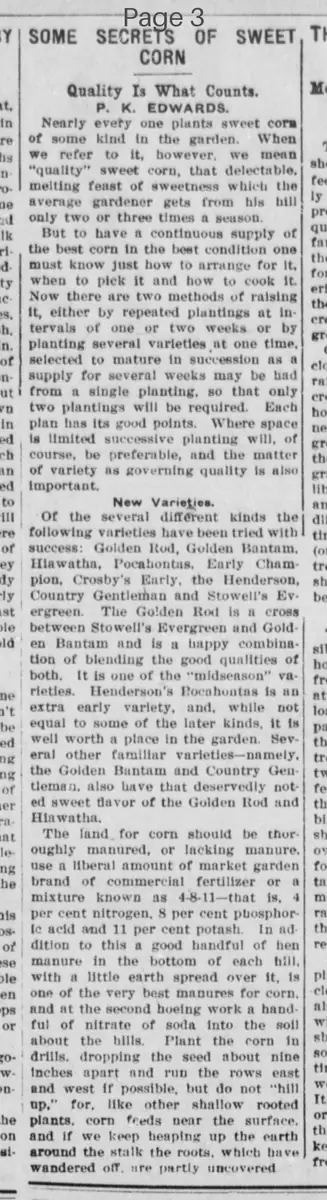
SOME SECRETS OF CORN
Quality Is What Counts.
P. K. EDWARDS.
Nearly every one plants sweet corn of some kind in the garden. When we refer to it, however, we mean "quality" sweet corn, that delectable, melting feast of sweetness which the average gardener gets from his hill only two or three times a season. But to have a continuous supply of the best corn in the best condition one must know just how to arrange for it, when to pick it and how to cook it.
Now there are two methods of raising it, either by repeated plantings at intervals of one or two weeks or by planting several varieties at one time, selected to mature in succession as a supply for several weeks may be had from a single planting, so that only two plantings will be required. Each plan has its good points. Where space is limited successive planting will, of course, be preferable, and the matter of variety as governing quality is also important.
New Varieties.
Of the several different kinds the following varieties have been tried with success: Golden Rod, Golden Bantam, Hiawatha, Pocahontas, Early Champion, Crosby's Early, the Henderson, Country Gentleman and Stowell's Evergreen. The Golden Rod is a cross between Stowell's Evergreen and Golden Bantam and is a happy combination of blending the good qualities of both. It is one of the "midseason" varieties. Henderson's Pocahontas is an extra early variety, and, while not equal to some of the later kinds, it is well worth a place in the garden. Several other familiar varieties—namely, the Golden Bantam and Country Gentleman, also have that deservedly noted sweet flavor of the Golden Rod and Hiawatha.
The land for corn should be thoroughly manured, or lacking manure, use a liberal amount of market garden brand of commercial fertilizer or a mixture known as 4-8-11—that is, 4 per cent nitrogen, 8 per cent phosphoric acid and 11 per cent potash. In addition to this a good handful of hen manure in the bottom of each hill, with a little earth spread over it, is one of the very best manures for corn, and at the second hoeing work a handful of nitrate of soda into the soil about the hills. Plant the corn in drills, dropping the seed about nine inches apart and run the rows east and west if possible, but do not "hill up," for, like other shallow rooted plants, corn feeds near the surface, and if we keep heaping up the earth around the stalk the roots, which have wandered off, are partly uncovered.
Quality Is What Counts.
P. K. EDWARDS.
Nearly every one plants sweet corn of some kind in the garden. When we refer to it, however, we mean "quality" sweet corn, that delectable, melting feast of sweetness which the average gardener gets from his hill only two or three times a season. But to have a continuous supply of the best corn in the best condition one must know just how to arrange for it, when to pick it and how to cook it.
Now there are two methods of raising it, either by repeated plantings at intervals of one or two weeks or by planting several varieties at one time, selected to mature in succession as a supply for several weeks may be had from a single planting, so that only two plantings will be required. Each plan has its good points. Where space is limited successive planting will, of course, be preferable, and the matter of variety as governing quality is also important.
New Varieties.
Of the several different kinds the following varieties have been tried with success: Golden Rod, Golden Bantam, Hiawatha, Pocahontas, Early Champion, Crosby's Early, the Henderson, Country Gentleman and Stowell's Evergreen. The Golden Rod is a cross between Stowell's Evergreen and Golden Bantam and is a happy combination of blending the good qualities of both. It is one of the "midseason" varieties. Henderson's Pocahontas is an extra early variety, and, while not equal to some of the later kinds, it is well worth a place in the garden. Several other familiar varieties—namely, the Golden Bantam and Country Gentleman, also have that deservedly noted sweet flavor of the Golden Rod and Hiawatha.
The land for corn should be thoroughly manured, or lacking manure, use a liberal amount of market garden brand of commercial fertilizer or a mixture known as 4-8-11—that is, 4 per cent nitrogen, 8 per cent phosphoric acid and 11 per cent potash. In addition to this a good handful of hen manure in the bottom of each hill, with a little earth spread over it, is one of the very best manures for corn, and at the second hoeing work a handful of nitrate of soda into the soil about the hills. Plant the corn in drills, dropping the seed about nine inches apart and run the rows east and west if possible, but do not "hill up," for, like other shallow rooted plants, corn feeds near the surface, and if we keep heaping up the earth around the stalk the roots, which have wandered off, are partly uncovered.
What sub-type of article is it?
Gardening Guide
Agricultural Advice
What keywords are associated?
Sweet Corn
Varieties
Planting Methods
Fertilizer
Gardening Tips
What entities or persons were involved?
P. K. Edwards
Where did it happen?
Garden
Story Details
Key Persons
P. K. Edwards
Location
Garden
Story Details
Provides advice on selecting and planting sweet corn varieties for continuous supply, including methods of successive planting or variety succession, recommended varieties like Golden Rod, Golden Bantam, and fertilization with manure and 4-8-11 fertilizer.