Thank you for visiting SNEWPapers!
Sign up free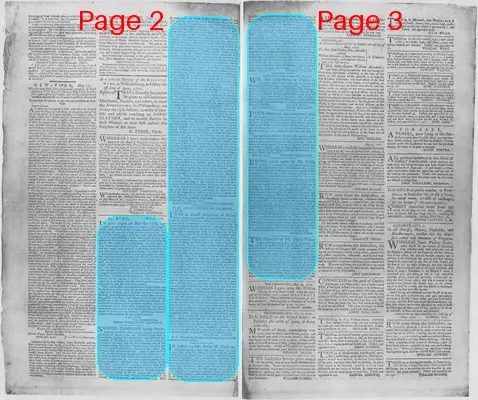
The Virginia Gazette
Williamsburg, Virginia
What is this article about?
On May 31, 1770, Philip Whitehead Claiborne writes to Mr. Rind defending his management of Captain Langborn's estate against accusations in Mrs. Langborn's advertisement. He details finances, partnership, and encloses depositions and certificates from associates attesting to his diligent and honest conduct as executor.
Merged-components note: Continuation of the letter to the editor regarding the estate dispute and advertisements, spanning pages 2 and 3 with sequential reading order and coherent topic flow.
Clippings
1 of 2
OCR Quality
Full Text
MAY 31, 1770.
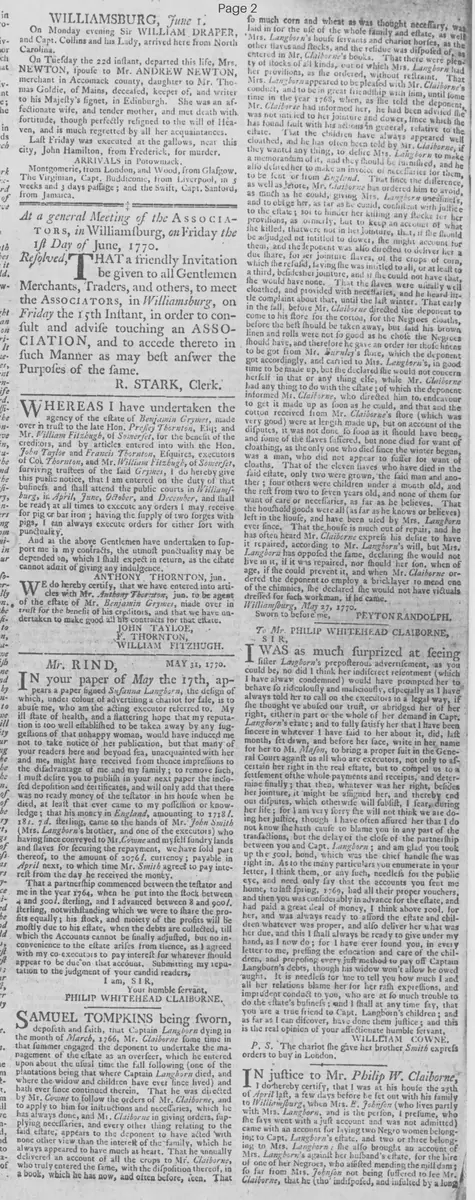
IN your paper of May the 17th, appeared an advertisement, which, under colour of advertising a chariot for sale, is to abuse me, who am the acting executor referred to. My ill state of health, and a flattering hope that my reputation is too well established to be taken away by any suggestions of that unhappy woman, would have induced me not to take notice of her publication, but that many of your readers here and beyond sea, unacquainted with her and me, might have received from thence impressions to the disadvantage of me and my family; to remove such, I must desire you to publish in your next paper the inclosed deposition and certificates, and will only add that there was no ready money of the testator in his house when he died, at least that ever came to my possession or knowledge; that his money in England, amounting to 1718 l. 18s. 7 d. sterling, came to the hands of Mr. John Smith (Mrs. Langborn's brother, and one of the executors) who having since conveyed to Mr. Cowne and myself sundry lands and slaves for securing the repayment, we have sold part thereof, to the amount of 2076 l. currency; payable in April next, to which time Mr. Smith agrees to pay interest from the day he received the money.
That a partnership commenced between the testator and me in the year 1764, when he put into the stock between 400 and 500 l. sterling, and I advanced between 800 and 900 l. sterling, notwithstanding which we were to share the profits equally: his stock, and moiety of the profits will be mostly due to his estate, when the debts are collected, till which the Accounts cannot be finally adjusted, but no inconvenience to the estate arises from thence, as I agreed with my co-executors to pay interest for whatever should appear to be due on that account. Submitting my reputation to the judgment of your candid readers,
I am, SIR,
Your humble servant,
PHILIP WHITEHEAD CLAIBORNE.
SAMUEL TOMPKINS being sworn, deposeth and saith, that Captain Langborn dying in the month of March, 1766, Mr. Claiborne some time in that summer engaged the deponent to undertake the management of the estate as an overseer, which he entered upon about the usual time the fall following (one of the plantations being that where Captain Langborn died, and where the widow and children have ever since lived) and hath ever since continued therein. That he was directed by Mr. Cowne to follow the orders of Mr. Claiborne, and to apply to him for instructions and necessaries, which he has always done, and Mr. Claiborne in giving orders, supplying necessaries, and every other thing relating to the said estate, appears to the deponent to have acted with none other view than the interest of the family, which he always appeared to have much at heart. That he annually delivered an account of all the crops to Mr. Claiborne, who truly entered the same, with the disposition thereof, in a book, which he has now, and often before, seen. That so much corn and wheat as was thought necessary, was laid in for the use of the whole family and estate, as well Mrs. Langborn's house servants and chariot horses, as the other slaves and stocks, and the residue was disposed of, as entered in Mr. Claiborne's books. That there were plenty of stocks of all kinds, out of which Mrs. Langborn had her provisions, as she ordered, without restraint. That Mrs. Langborn appeared to be pleased with Mr. Claiborne's conduct, and to be in great friendship with him, until some time in the year 1768, when, as she told the deponent, Mr. Claiborne had informed her, he had been advised she was not entitled to her jointure and dower, since which she has found fault with his actions in general, relative to the estate. That the children have always appeared well clothed, and he has often been told by Mr. Claiborne, if they wanted any thing, to desire Mrs. Langborn to make a memorandum of it, and they should be furnished, and he also desired her to make an invoice of necessaries for them, to be sent for from England. That since the difference, as well as before, Mr. Claiborne has ordered him to avoid, as much as he could, giving Mrs. Langborn uneasiness, and to oblige her, as far as he could, consistent with justice to the estate; not to hinder her killing any stocks for her provisions, as usually, but to keep an account of what she killed, that were not in her jointure, that, if she should be adjudged not entitled to dower, she might account for them, and the deponent was also directed to deliver her a due share, for her jointure slaves, of the crops of corn, which she refused, saying she was entitled to all, or at least to a third, besides her jointure, and if she could not have that, she would have none. That the slaves were usually well clothed, and provided with necessaries, and he heard little complaint about that, until the last winter. That early in the fall, before Mr. Claiborne directed the deponent to come to his store for the cotton, for the Negroes cloaths, before the best should be taken away, but said his brown linen and rolls were not so good as he chose the Negroes should have, and therefore he gave an order for those linens to be got from Mr. Burnley's store, which the deponent got accordingly, and carried to Mrs. Langborn's, in good time to be made up, but she declared she would not concern herself in that or any thing else, while Mr. Claiborne had any thing to do with the estate; of which the deponent informed Mr. Claiborne, who directed him to endeavour to get it made up as soon as he could, and that and the cotton received from Mr. Claiborne's store (which was very good) were at length made up, but on account of the disputes, it was not done so soon as it should have been, and some of the slaves suffered, but none died for want of cloathing, as the only one who died since the winter begun, was a man, who did not appear to suffer for want of cloaths. That of the eleven slaves who have died in the said estate, only two were grown, the said man and another; four others were children under a month old, and the rest from two to seven years old, and none of them for want of care or necessaries, as far as he believes. That the household goods were all (as far as he knows or believes) left in the house, and have been used by Mrs. Langborn ever since. That the house is much out of repair, and he has often heard Mr. Claiborne express his desire to have it repaired, according to Mr. Langborn's will, but Mrs. Langborn has opposed the same, declaring she would not live in it, if it was repaired, nor should her son, when of age, if she could prevent it, and when Mr. Claiborne ordered the deponent to employ a brick layer to mend one of the chimnies, she declared she would not have victuals dressed for such workman, if he came.
Williamsburg, May 27, 1770.
Sworn to before me,
PEYTON RANDOLPH.
To Mr. PHILIP WHITEHEAD CLAIBORNE,
SIR,
I WAS as much surprized at seeing sister Langborn's preposterous advertisement, as you could be, nor did I think her indiscreet resentment (which I have always condemned) would have prompted her to behave so ridiculously and maliciously, especially as I have always told her to call on the executors in a legal way, if she thought we abused our trust, or abridged her of her right, either in part or the whole of her demand in Capt. Langborn's estate: and to fully satisfy her that I have been sincere in whatever I have said to her about it, did, last month, sit down, and before her face, write in her name for her to Mr. Mason, to bring a proper suit in the General Court against us all who are executors, not only to ascertain her right in the real estate, but to compel us to a settlement of the whole payments and receipts, and determine finally: that then, whatever was her right, besides her jointure, it might be assigned her, and thereby end our disputes, which otherwise will subsist, I fear, during her life; for I am very sorry she will not think we are doing her justice, though I have often assured her that I do not know she hath cause to blame you in any part of the transactions, but the delay of the close of the partnership between you and Capt. Langborn; and am glad you took up the 500 l. bond, which was the chief handle she was right in. As to the many particulars you enumerate in your letter, I think them, or any such, needless for the public eye, and need only say that the accounts you sent me home, to last spring, 1769, had all their proper vouchers, and then you was considerably in advance for the estate, and had paid a great deal of money, I think above 1000 l. for her, and was always ready to afford the estate and children whatever was proper, and also deliver her what was her due, and this I shall always be ready to give under my hand, as I now do: for I have ever found you, in every letter to me, pressing the education and care of the children, and proposing every just method to pay off Captain Langborn's debts, though his widow won't allow he owed aught. It is needless for me to tell you how much I and all her relations blame her for her rash expressions, and imprudent conduct to you, who are at so much trouble to do the estate's business: and I shall at any time say, that you are a true friend to Capt. Langborn's children; and as far as I can discover, have done them justice; and this is the real opinion of your affectionate humble servant,
WILLIAM COWNE.
P. S. The chariot she gave her brother Smith express orders to buy in London.
IN justice to Mr. Philip W. Claiborne, I do hereby certify, that I was at his house the 25th of April last, a few days before he set out with his family to Williamsburg, when Mrs. E. Johnson (who lives partly with Mrs. Langborn, and is the person, I presume, who she says went with a just account and was not admitted) came with an account for laying two Negro women belonging to Capt. Langborn's estate, and two or three belonging to Mrs. Langborn; she also brought an account of Mrs. Langborn's against her husband's estate, for the hire of one of her Negroes, who assisted mending the mill dam; so far from Mrs. Johnson not being suffered to see Mr. Claiborne, that he (tho' indisposed, and insulted by a long and abusive advertisement) received her very politely, and paid her accounts, amounting to 3 l. 15 s., and paid her for the Negroes, but refused to pay Mrs. Langborn's account for the hire of her Negro, though he owed Mrs. Langborn's 3 l. for the hire of her Negro.
I do further certify, that I have often heard Mr. William Cowne, who is an executor with Mr. Claiborne, Speak highly in favour of his conduct, and as often condemn Mrs. Langborn. I have also seen several of Mr. Claiborne's letters to Mr. Cowne, concerning the education of the children, particularly concerning Miss Molly's writing and cyphering, wherein he desired Mr. Cowne to consult with Mrs. Langborn on that head, and have something done, for that he was apprehensive that any plan that he (Mr. Claiborne) might recommend, would be by her thought a bad one. When Mr. Claiborne lay dangerously ill in 1768, I heard Mrs. Langborn acknowledge that he was her best friend, and that she should meet with an irreparable loss in him, if he did not recover, but since her right to both jointure and dower has been questioned, I have heard her express herself quite the reverse. Certified under my hand, May 26, 1770.
WILLIAM AYLETT.
WE, the Inspectors at Pippingtree Warehouse, King William warehouse, do hereby certify that we believe all the tobacco made on Capt. Langborn's estate, since his decease, has been brought to our inspection. Mr. Claiborne gave us orders not to deliver any of the notes to Mrs. Langborn, without the executors orders, but as to his threatening to turn us out of our places, Mrs. Langborn is entirely mistaken; he never said or gave us the least reason to think he would attempt it. Given under our hands, the date aforesaid.
ROBERT KING,
Tho. Vincent,
Terry.
PHILIP MALLORY.
I have examined the account of his administration of the estate of Mr. Langborn, and find the same to be fairly and justly stated, and that there is due to him on that account the sum of 634 l. 11s. 8 d. and from Mrs. Langborn on her private account the sum of 104 l. 13s. 1 d. moiety for cash lent, and paid for her.
I was one that advised Mr. Claiborne she was not entitled to her jointure and dower, and have been consulted by him often to matters relating to that estate and other trusts, in which he always appeared to me to act with fidelity and uncommon diligence; and in every action of his life that hath come to my knowledge, deserves the character of a man of honour and honesty.
May 30, 1770.
EDMUND PENDLETON.
BEING called upon by Mr. Philip W. Claiborne, to inform the public what I know concerning the disputes that have arisen between Mrs. Langborn and himself, and of his conduct as an executor to that Lady's deceased husband, I am to declare, that some time in October or November last, at the request of Mr. Claiborne, I went with him to see Mrs. Langborn, when he, in a calm and friendly manner, told her, that he waited on her to try if they could agree upon some amicable and speedy way of settling the dispute between her and her children, respecting the division of Capt. Langborn's estate; and to know from her what it was in his conduct or behaviour that had given her offence, assuring her, at the same time, that he came with a friendly intent, and desired that she would freely enumerate every particular wherein he thought he had been wrong: Upon which she mentioned most of the articles that she has charged him with in her late advertisement: to each of which he then gave such answer as convinced me, and I thought seemed, in a great measure, to satisfy the Lady of the rectitude of his conduct, and the uprightness of his intentions. I have been several times called upon as an arbitrator where Capt. Langborn's estate was concerned, and in many other instances have been witness to Mr. Claiborne's conduct as an executor, and, upon the whole, must do him the justice to say, that I verily believe he has executed that trust faithfully.
GEORGE WEBB.
THE character of Mr. Philip W. Claiborne, Mrs. Langborn, and his conduct as an executor to her deceased husband, much abused and condemned: that Gentleman has demanded of me, as a near neighbour to Mrs. Langborn and the estate, to declare, in this public manner, what I know relative to his management of the said estate. In justice therefore to Mr. Claiborne, I must say that I have often transacted business with him, as an executor, and in every instance he appeared to act with as strict a regard to the interest of the estate as if he had been the real proprietor. The manager, Samuel Tompkins, has lived on the estate several years, and has always appeared to me to be an honest, industrious, upright man.
CARTER BRAXTON.
What sub-type of article is it?
What themes does it cover?
What keywords are associated?
What entities or persons were involved?
Letter to Editor Details
Author
Philip Whitehead Claiborne
Recipient
Mr. Rind
Main Argument
claiborne defends his actions as executor of captain langborn's estate against mrs. langborn's abusive advertisement, asserting proper financial handling, interest payments, and care for the family, supported by enclosed depositions and certificates attesting to his fidelity.
Notable Details