Thank you for visiting SNEWPapers!
Sign up free
Literary
May 20, 1899
Perrysburg Journal
Perrysburg, Wood County, Ohio
What is this article about?
Reformed thief James Simbell recounts his past: posing as Major Kelby to court housemaid Lizzy Leeds for a burglary at her employers' home, only to be trapped by her and her policeman fiancé, resulting in his arrest and seven-year sentence.
Clipping
OCR Quality
98%
Excellent
Full Text
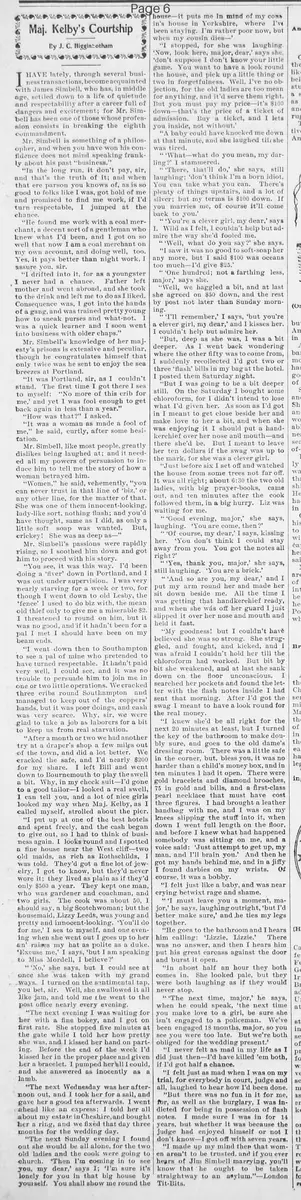
Maj. Kelby's Courtship
By J. C. Higginbotham
I have lately, through several business transactions, become acquainted with James Simbell, who has, in middle age, settled down to a life of quietude and respectability after a career full of dangers and excitement; for Mr. Simbell has been one of those whose profession consists in breaking the eighth commandment.
Mr. Simbell is something of a philosopher, and when you have won his confidence does not mind speaking frankly about his past "business."
"In the long run, it don't pay, sir, and that's the truth of it; and when that ere parson you knows of, as is so good to folks like I was, got hold of me and promised to find me work, if I'd turn respectable, I jumped at the chance."
"He found me work with a coal merchant, a decent sort of a gentleman who knew what I'd been, and I got on so well that now I am a coal merchant on my own account, and doing well, too. Yes, it pays better than night work. I assure you, sir."
"I drifted into it, for as a youngster I never had a chance. Father left mother and went abroad, and she took to the drink and left me to do as I liked. Consequence was, I got into the hands of a gang, and was trained pretty young how to sneak purses and what-not. I was a quick learner and I soon went into business with older chaps."
Mr. Simbell's knowledge of her majesty's prisons is extensive and peculiar, though he congratulates himself that only twice was he sent to enjoy the sea breezes at Portland.
"It was Portland, sir, as I couldn't stand. The first time I got there I ses to myself: 'No more of this crib for me,' and yet I was fool enough to get back again in less than a year."
"How was that?" I asked.
"It was a woman as made a fool of me," he said, curtly, after some hesitation.
Mr. Simbell, like most people, greatly dislikes being laughed at; and it needed all my powers of persuasion to induce him to tell me the story of how a woman betrayed him.
"Women," he said, vehemently, "you can never trust in that line of 'biz.' or any other line, for the matter of that. She was one of them innocent-looking, lady-like sort, nothing flash; and you'd have thought, same as I did, as only a little soft soap was wanted. But, crickey! She was as deep as—"
Mr. Simbell's passions were rapidly rising, so I soothed him down and got him to proceed with his story.
"You see, it was this way. I'd been doing a 'fiver' down in Portland, and I was out under supervision. I was very nearly starving for a week or two, for though I went down to old Lesby, the 'fence' I used to do biz with, the mean old thief only to give me a miserable $2. I threatened to round on him, but it was no good, and if it hadn't been for a pal I met I should have been on my beam ends."
"I went down then to Southampton to see a pal of mine who pretended to have turned respectable. It hadn't paid very well, I could see, and it was no trouble to persuade him to join me in one or two little operations. We cracked three cribs round Southampton and managed to keep out of the coppers' hands, but it was poor doings, and cash was very scarce." Why, sir, we were glad to take a job as laborers for a bit to keep us from real starvation.
"After a month or two we had another try at a draper's shop a few miles out of the town, and did a lot better. We cracked the safe, and I'd nearly $200 for my share. I left Bill and went down to Bournemouth to play the swell a bit. Why, in my check suit—I'd gone to a good tailor—I looked a real swell, I can tell you, and a lot of nice girls looked my way when Maj. Kelby, as I called myself, strolled about the pier.
"I put up at one of the best hotels and spent freely, and the cash began to give out, so I had to think of business again. I looks round and I spotted a fine house near the West cliff—two old maids, as rich as Rothschilds, I was told. They'd got a fine lot of jewelry, I got to know, but they'd never wore it; they lived as plain as if they'd only $500 a year. They kept one man, who was gardener and coachman, and two girls. The cook was about 50, I should say, a big Scotchwoman; but the housemaid, Lizzy Leeds, was young and pretty and innocent-looking. 'You'll do for me,' I ses to myself, and one evening when she went out I goes up to her an' raises my hat as polite as a duke.
'Excuse me,' I says, 'but I am speaking to Miss Mordell, I believe?'
'No,' she says, but I could see at once she was taken with my grand ways. I turned on the sentimental tap, you bet, sir. Well, she swallowed it all like jam, and told me she went to the post office nearly every evening.
"The next evening I was waiting for her with a fine bokey, and I got on first rate. She stopped five minutes at the gate while I told her how pretty she was, and I kissed her hand on parting. Before the end of the week I'd kissed her in the proper place and given her a bracelet. I pumped her all I could, and she answered as innocently as a lamb.
"The next Wednesday was her afternoon out, and I took her for a sail, and gave her a good tea afterwards. I went ahead like an express; I told her all about my estate in Cheshire, and bought her a ring, and we fixed that day three months for the wedding day.
"The next Sunday evening I found out she would be all alone, for the two old ladies and the cook were going to church. Then I'm coming in to see you, my dear,' says I; 'I'm sure it's lonely for you in that big house by yourself. You shall show me round the house—it puts me in mind of my cousin's house in Yorkshire, where I've been staying. I'm rather poor now, but when my cousin dies—'
"I stopped, for she was laughing.
'Now, look here, major, dear,' says she, 'don't suppose I don't know your little game. You want to have a look round the house, and pick up a little thing or two in forgetfulness. Well, I've no objection, for the old ladies are too mean for anything, and it'd serve them right. But you must pay my price—it's $100 down—that's the price of a ticket of admission. Buy a ticket, and I lets you inside, not without.'
"A baby could have knocked me down at that minute, and she laughed til she was tired.
'That—what do you mean, my darling?' I stammered.
"There, that'll do,' she says, still laughing; 'don't think I'm a born idiot. You can take what you can. There's plenty of things upstairs, and a lot of silver; but my terms is $100 down. If you marries me, of course it'll come back to you.'
"'You're a clever girl, my dear,' says I. Wild as I felt, I couldn't help but admire the way she'd fooled me.
"'Well, what do you say?' she says.
"I saw it was no good to soft-soap her any more, but I said $100 was oceans too much—I'd give $25.
"'One hundred; not a farthing less, major,' says she.
"Well, we haggled a bit, and at last she agreed on $50 down, and the rest by post not later than Sunday morning.
"'I'll remember,' I says. 'but you're a clever girl, my dear,' and I kisses her. I couldn't help but admire her.
"But, deep as she was, I was a bit deeper. As I went back wondering where the other fifty was to come from I suddenly recollected I'd got two or three 'flash' bills in my bag at the hotel. I posted them Saturday night.
"But I was going to be a bit deeper still. On the Saturday I bought some chloroform, for I didn't intend to lose what I'd given her. As soon as I'd got in I meant to get close beside her and make love to her a bit, and when she was enjoying it I should put a handkerchief over her nose and mouth—and there she'd be. But I meant to leave her ten dollars if the swag was up to the mark, for she was a clever girl.
".Just before six I set off and watched the house from some trees not far off. It was all right: about 6:30 the two old ladies, with big prayer-books, came out, and ten minutes after the cook followed them, in a big hurry. Liz was waiting for me.
"'Good evening, major,' she says, laughing. 'You are come, then?'
"Of course, my dear,' I says, kissing her. 'You don't think I could stay away from you. You got the notes all right?'
"'Yes, thank you, major,' she says, still laughing. 'You are a brick.'
"'And so are you, my dear,' and I put my arm round her and made her sit down beside me. All the time I was getting that handkerchief ready, and when she was off her guard I just slipped it over her nose and mouth and held it fast.
"My goodness! but I couldn't have believed she was so strong. She struggled, and fought, and kicked, and I was afraid I couldn't hold her till the chloroform had worked. But bit by bit she weakened, and at last she sank down on the floor unconscious. I searched her pockets and found the letter with the flash notes inside I had sent that morning. After I'd got the swag I meant to have a look round for the real money.
"I knew she'd be all right for the next 20 minutes at least, but I turned the key of the bathroom to make doubly sure, and goes to the old dame's dressing room. There was a little safe in the corner, but, bless you, it was no harder than a child's money box, and in ten minutes I had it open. There were gold bracelets and diamond brooches, $75 in gold and bills, and a first-class pearl necklace that must have cost three figures. I had brought a leather handbag with me, and I was on my knees slipping the stuff into it, when down I went full length on the floor and before I knew what had happened somebody was sitting on me, and a voice said: 'Just attempt to get up, my man, and I'll brain you.' And then he got my hands behind me, and in a jiffy I found darbies on my wrists. Of course, it was a bobby.
"I felt just like a baby, and was near crying betwixt rage and shame.
"'I must leave you a moment, major,' he says, laughing outright, 'but I'd better make sure,' and he ties my legs together.
"He goes to the bathroom and I hears him calling: 'Lizzie, Lizzie.' There was no answer, and then I hears him put his great carcass against the door and burst it open.
"In about half an hour they both comes in. She looked pale, but they were both laughing as if they would never stop.
"'The next time, major,' he says, when he could speak, 'the next time you make love to a girl, be sure she isn't engaged to a policeman. We've been engaged 18 months, major, so you see you were too late. But we're both obliged for the wedding present.'
"I never felt as mad in my life as I did just then—I'd have killed 'em both if I'd got half a chance.
"I felt just as mad when I was on my trial, for everybody in court, judge and all, laughed to hear how I'd been done.
"But there was no fun in it for me, for, as well as the burglary, I was indicted for being in possession of flash notes. I made sure I was in for 14 years, but whether it was because the judge had enjoyed himself or not I don't know—I got off with seven years.
"I made up my mind then that women aren't to be trusted, and if you ever hears of Jim Simbell marrying, you'll know that he ought to be taken straightway to an asylum."—London Tit-Bits.
By J. C. Higginbotham
I have lately, through several business transactions, become acquainted with James Simbell, who has, in middle age, settled down to a life of quietude and respectability after a career full of dangers and excitement; for Mr. Simbell has been one of those whose profession consists in breaking the eighth commandment.
Mr. Simbell is something of a philosopher, and when you have won his confidence does not mind speaking frankly about his past "business."
"In the long run, it don't pay, sir, and that's the truth of it; and when that ere parson you knows of, as is so good to folks like I was, got hold of me and promised to find me work, if I'd turn respectable, I jumped at the chance."
"He found me work with a coal merchant, a decent sort of a gentleman who knew what I'd been, and I got on so well that now I am a coal merchant on my own account, and doing well, too. Yes, it pays better than night work. I assure you, sir."
"I drifted into it, for as a youngster I never had a chance. Father left mother and went abroad, and she took to the drink and left me to do as I liked. Consequence was, I got into the hands of a gang, and was trained pretty young how to sneak purses and what-not. I was a quick learner and I soon went into business with older chaps."
Mr. Simbell's knowledge of her majesty's prisons is extensive and peculiar, though he congratulates himself that only twice was he sent to enjoy the sea breezes at Portland.
"It was Portland, sir, as I couldn't stand. The first time I got there I ses to myself: 'No more of this crib for me,' and yet I was fool enough to get back again in less than a year."
"How was that?" I asked.
"It was a woman as made a fool of me," he said, curtly, after some hesitation.
Mr. Simbell, like most people, greatly dislikes being laughed at; and it needed all my powers of persuasion to induce him to tell me the story of how a woman betrayed him.
"Women," he said, vehemently, "you can never trust in that line of 'biz.' or any other line, for the matter of that. She was one of them innocent-looking, lady-like sort, nothing flash; and you'd have thought, same as I did, as only a little soft soap was wanted. But, crickey! She was as deep as—"
Mr. Simbell's passions were rapidly rising, so I soothed him down and got him to proceed with his story.
"You see, it was this way. I'd been doing a 'fiver' down in Portland, and I was out under supervision. I was very nearly starving for a week or two, for though I went down to old Lesby, the 'fence' I used to do biz with, the mean old thief only to give me a miserable $2. I threatened to round on him, but it was no good, and if it hadn't been for a pal I met I should have been on my beam ends."
"I went down then to Southampton to see a pal of mine who pretended to have turned respectable. It hadn't paid very well, I could see, and it was no trouble to persuade him to join me in one or two little operations. We cracked three cribs round Southampton and managed to keep out of the coppers' hands, but it was poor doings, and cash was very scarce." Why, sir, we were glad to take a job as laborers for a bit to keep us from real starvation.
"After a month or two we had another try at a draper's shop a few miles out of the town, and did a lot better. We cracked the safe, and I'd nearly $200 for my share. I left Bill and went down to Bournemouth to play the swell a bit. Why, in my check suit—I'd gone to a good tailor—I looked a real swell, I can tell you, and a lot of nice girls looked my way when Maj. Kelby, as I called myself, strolled about the pier.
"I put up at one of the best hotels and spent freely, and the cash began to give out, so I had to think of business again. I looks round and I spotted a fine house near the West cliff—two old maids, as rich as Rothschilds, I was told. They'd got a fine lot of jewelry, I got to know, but they'd never wore it; they lived as plain as if they'd only $500 a year. They kept one man, who was gardener and coachman, and two girls. The cook was about 50, I should say, a big Scotchwoman; but the housemaid, Lizzy Leeds, was young and pretty and innocent-looking. 'You'll do for me,' I ses to myself, and one evening when she went out I goes up to her an' raises my hat as polite as a duke.
'Excuse me,' I says, 'but I am speaking to Miss Mordell, I believe?'
'No,' she says, but I could see at once she was taken with my grand ways. I turned on the sentimental tap, you bet, sir. Well, she swallowed it all like jam, and told me she went to the post office nearly every evening.
"The next evening I was waiting for her with a fine bokey, and I got on first rate. She stopped five minutes at the gate while I told her how pretty she was, and I kissed her hand on parting. Before the end of the week I'd kissed her in the proper place and given her a bracelet. I pumped her all I could, and she answered as innocently as a lamb.
"The next Wednesday was her afternoon out, and I took her for a sail, and gave her a good tea afterwards. I went ahead like an express; I told her all about my estate in Cheshire, and bought her a ring, and we fixed that day three months for the wedding day.
"The next Sunday evening I found out she would be all alone, for the two old ladies and the cook were going to church. Then I'm coming in to see you, my dear,' says I; 'I'm sure it's lonely for you in that big house by yourself. You shall show me round the house—it puts me in mind of my cousin's house in Yorkshire, where I've been staying. I'm rather poor now, but when my cousin dies—'
"I stopped, for she was laughing.
'Now, look here, major, dear,' says she, 'don't suppose I don't know your little game. You want to have a look round the house, and pick up a little thing or two in forgetfulness. Well, I've no objection, for the old ladies are too mean for anything, and it'd serve them right. But you must pay my price—it's $100 down—that's the price of a ticket of admission. Buy a ticket, and I lets you inside, not without.'
"A baby could have knocked me down at that minute, and she laughed til she was tired.
'That—what do you mean, my darling?' I stammered.
"There, that'll do,' she says, still laughing; 'don't think I'm a born idiot. You can take what you can. There's plenty of things upstairs, and a lot of silver; but my terms is $100 down. If you marries me, of course it'll come back to you.'
"'You're a clever girl, my dear,' says I. Wild as I felt, I couldn't help but admire the way she'd fooled me.
"'Well, what do you say?' she says.
"I saw it was no good to soft-soap her any more, but I said $100 was oceans too much—I'd give $25.
"'One hundred; not a farthing less, major,' says she.
"Well, we haggled a bit, and at last she agreed on $50 down, and the rest by post not later than Sunday morning.
"'I'll remember,' I says. 'but you're a clever girl, my dear,' and I kisses her. I couldn't help but admire her.
"But, deep as she was, I was a bit deeper. As I went back wondering where the other fifty was to come from I suddenly recollected I'd got two or three 'flash' bills in my bag at the hotel. I posted them Saturday night.
"But I was going to be a bit deeper still. On the Saturday I bought some chloroform, for I didn't intend to lose what I'd given her. As soon as I'd got in I meant to get close beside her and make love to her a bit, and when she was enjoying it I should put a handkerchief over her nose and mouth—and there she'd be. But I meant to leave her ten dollars if the swag was up to the mark, for she was a clever girl.
".Just before six I set off and watched the house from some trees not far off. It was all right: about 6:30 the two old ladies, with big prayer-books, came out, and ten minutes after the cook followed them, in a big hurry. Liz was waiting for me.
"'Good evening, major,' she says, laughing. 'You are come, then?'
"Of course, my dear,' I says, kissing her. 'You don't think I could stay away from you. You got the notes all right?'
"'Yes, thank you, major,' she says, still laughing. 'You are a brick.'
"'And so are you, my dear,' and I put my arm round her and made her sit down beside me. All the time I was getting that handkerchief ready, and when she was off her guard I just slipped it over her nose and mouth and held it fast.
"My goodness! but I couldn't have believed she was so strong. She struggled, and fought, and kicked, and I was afraid I couldn't hold her till the chloroform had worked. But bit by bit she weakened, and at last she sank down on the floor unconscious. I searched her pockets and found the letter with the flash notes inside I had sent that morning. After I'd got the swag I meant to have a look round for the real money.
"I knew she'd be all right for the next 20 minutes at least, but I turned the key of the bathroom to make doubly sure, and goes to the old dame's dressing room. There was a little safe in the corner, but, bless you, it was no harder than a child's money box, and in ten minutes I had it open. There were gold bracelets and diamond brooches, $75 in gold and bills, and a first-class pearl necklace that must have cost three figures. I had brought a leather handbag with me, and I was on my knees slipping the stuff into it, when down I went full length on the floor and before I knew what had happened somebody was sitting on me, and a voice said: 'Just attempt to get up, my man, and I'll brain you.' And then he got my hands behind me, and in a jiffy I found darbies on my wrists. Of course, it was a bobby.
"I felt just like a baby, and was near crying betwixt rage and shame.
"'I must leave you a moment, major,' he says, laughing outright, 'but I'd better make sure,' and he ties my legs together.
"He goes to the bathroom and I hears him calling: 'Lizzie, Lizzie.' There was no answer, and then I hears him put his great carcass against the door and burst it open.
"In about half an hour they both comes in. She looked pale, but they were both laughing as if they would never stop.
"'The next time, major,' he says, when he could speak, 'the next time you make love to a girl, be sure she isn't engaged to a policeman. We've been engaged 18 months, major, so you see you were too late. But we're both obliged for the wedding present.'
"I never felt as mad in my life as I did just then—I'd have killed 'em both if I'd got half a chance.
"I felt just as mad when I was on my trial, for everybody in court, judge and all, laughed to hear how I'd been done.
"But there was no fun in it for me, for, as well as the burglary, I was indicted for being in possession of flash notes. I made sure I was in for 14 years, but whether it was because the judge had enjoyed himself or not I don't know—I got off with seven years.
"I made up my mind then that women aren't to be trusted, and if you ever hears of Jim Simbell marrying, you'll know that he ought to be taken straightway to an asylum."—London Tit-Bits.
What sub-type of article is it?
Prose Fiction
What themes does it cover?
Moral Virtue
What keywords are associated?
Thief
Courtship
Burglary
Betrayal
Policeman
Redemption
Flash Notes
What entities or persons were involved?
By J. C. Higginbotham
Literary Details
Title
Maj. Kelby's Courtship
Author
By J. C. Higginbotham
Key Lines
"Women," He Said, Vehemently, "You Can Never Trust In That Line Of 'Biz.' Or Any Other Line, For The Matter Of That."
"Now, Look Here, Major, Dear,' Says She, 'Don't Suppose I Don't Know Your Little Game."
"The Next Time, Major,' He Says, When He Could Speak, 'The Next Time You Make Love To A Girl, Be Sure She Isn't Engaged To A Policeman."
"I Made Up My Mind Then That Women Aren't To Be Trusted, And If You Ever Hears Of Jim Simbell Marrying, You'll Know That He Ought To Be Taken Straightway To An Asylum."