Thank you for visiting SNEWPapers!
Sign up free
Story
March 26, 1904
The Intermountain Catholic
Salt Lake City, Salt Lake County, Utah
What is this article about?
The article defends the historical tradition that St. Peter served as bishop and was martyred in Rome, accepted by most scholars, against Protestant denials, particularly a recent lecture by a Chicago Protestant Episcopal bishop. It stresses the fact's importance for papal primacy and critiques Evangelical opposition.
Clipping
OCR Quality
98%
Excellent
Full Text
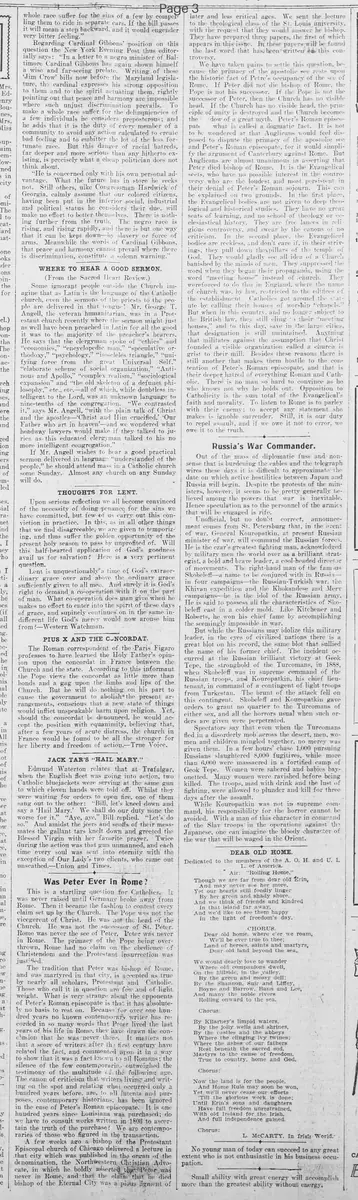
Was Peter Ever in Rome?
This is a startling question for Catholics. It was never raised until Germany broke away from Rome. Then it became the fashion to contest every claim set up by the Church. The Pope was not the vicegerent of Christ. He was not the head of the Church. He was not the successor of St. Peter. Rome was never the see of Peter. Peter was never in Rome. The primacy of the Pope being overthrown, Rome had no claim on the obedience of Christendom and the Protestant insurrection was justified.
The tradition that Peter was bishop of Rome, and was martyred in that city, is accepted as true by nearly all scholars, Protestant and Catholic. Those who call it in question are few and of light weight. What is very strange about the opponents of Peter's Roman episcopate is that it has absolutely no basis to rest on. Because for over one hundred years no known contemporary writer has recorded in so many words that Peter lived the last years of his life in Rome, they have drawn the conclusion that he was never there. It matters not that a score of writers after the first century have related the fact, and commented upon it in a way to show that it was a fact known to all Romans; the silence of the few contemporaries outweighed the testimony of the multitude of the following age.
The canon of criticism that writers living and writing on the spot and relating what occurred only a hundred years before, are, to all intents and purposes, contemporary historians, has been ignored in the case of Peter's Roman episcopate. It is one hundred years since Louisiana was purchased; do we have to consult works written in 1803 to ascertain the truth of the purchase? We are contemporaries of those who figured in the transaction.
A few weeks ago a bishop of the Protestant Episcopal church of Chicago delivered a lecture in that city which was published in the organ of the denomination, the Northwestern Christian Advocate, in which he boldly asserted that Peter was never in Rome, and that the claim that he died bishop of the Eternal City was a pious figment of later and less critical ages. We sent the lecture to the theological class of the St. Louis university, with the request that they would answer the bishop. They have prepared three papers, the first of which appears in this issue. In these papers will be found the last word that has been written on this controversy.
We have taken pains to settle this question, because the primacy of the apostolic see rests upon the historic fact of Peter's occupancy of the see of Rome. If Peter did not die bishop of Rome, the Pope is not his successor. If the Pope is not the successor of Peter, then the Church has no visible head. If the Church has no visible head, the principle of unity is destroyed and the Church becomes the shadow of a great myth. Peter's Roman episcopate is what is called a dogmatic fact. It is not to be wondered at that Anglicans would feel disposed to dispute the primacy of the apostolic see and Peter's Roman episcopate, for it would simplify the argument of Canterbury against Rome. But Anglicans are almost unanimous in asserting that Peter died bishop of Rome. It is the Evangelical sects, who have no possible interest in the controversy who are the loudest and most persistent in their denial of Peter's Roman sojourn. This can be explained on two grounds. In the first place, the Evangelical bodies are not given to deep theological and historical studies. They have no great seats of learning, and no school of theology or ecclesiastical history. They are free lances in religious controversy, and swear by the canons of no criticism. In the second place, the Evangelical bodies are reckless, and don't care if, in their strivings, they pull down the pillars of the temple of God. They would gladly see all idea of a Church banished by the minds of men. They suppressed the word when they began their propaganda, using the word "meeting house" instead of church. They were forced to do this in England, where the name of church was, by law, restricted to the edifices of the establishment. Catholics got around the statute by calling their houses of worship 'chapels.' But when in this country, and no longer subject to the British law, they still cling to their "meeting houses," and to this day, save in the large cities, that designation is still maintained. Anything that militates against the assumption that Christ founded a visible organization called a church is grist to their mill. Besides these reasons there is still another that makes them hostile to the contention of Peter's Roman episcopate, and that is their deeper hatred of everything Roman and Catholic. There is no man so hard to convince as he who knows not why he holds out. Opposition to Catholicity is the sum total of the Evangelical's faith and morality. To listen to Rome is to parley with their enemy: to accept any statement she makes is ignoble surrender. Still, it is our duty to repel assault, and if we owe it not to error, we owe it to the truth.
This is a startling question for Catholics. It was never raised until Germany broke away from Rome. Then it became the fashion to contest every claim set up by the Church. The Pope was not the vicegerent of Christ. He was not the head of the Church. He was not the successor of St. Peter. Rome was never the see of Peter. Peter was never in Rome. The primacy of the Pope being overthrown, Rome had no claim on the obedience of Christendom and the Protestant insurrection was justified.
The tradition that Peter was bishop of Rome, and was martyred in that city, is accepted as true by nearly all scholars, Protestant and Catholic. Those who call it in question are few and of light weight. What is very strange about the opponents of Peter's Roman episcopate is that it has absolutely no basis to rest on. Because for over one hundred years no known contemporary writer has recorded in so many words that Peter lived the last years of his life in Rome, they have drawn the conclusion that he was never there. It matters not that a score of writers after the first century have related the fact, and commented upon it in a way to show that it was a fact known to all Romans; the silence of the few contemporaries outweighed the testimony of the multitude of the following age.
The canon of criticism that writers living and writing on the spot and relating what occurred only a hundred years before, are, to all intents and purposes, contemporary historians, has been ignored in the case of Peter's Roman episcopate. It is one hundred years since Louisiana was purchased; do we have to consult works written in 1803 to ascertain the truth of the purchase? We are contemporaries of those who figured in the transaction.
A few weeks ago a bishop of the Protestant Episcopal church of Chicago delivered a lecture in that city which was published in the organ of the denomination, the Northwestern Christian Advocate, in which he boldly asserted that Peter was never in Rome, and that the claim that he died bishop of the Eternal City was a pious figment of later and less critical ages. We sent the lecture to the theological class of the St. Louis university, with the request that they would answer the bishop. They have prepared three papers, the first of which appears in this issue. In these papers will be found the last word that has been written on this controversy.
We have taken pains to settle this question, because the primacy of the apostolic see rests upon the historic fact of Peter's occupancy of the see of Rome. If Peter did not die bishop of Rome, the Pope is not his successor. If the Pope is not the successor of Peter, then the Church has no visible head. If the Church has no visible head, the principle of unity is destroyed and the Church becomes the shadow of a great myth. Peter's Roman episcopate is what is called a dogmatic fact. It is not to be wondered at that Anglicans would feel disposed to dispute the primacy of the apostolic see and Peter's Roman episcopate, for it would simplify the argument of Canterbury against Rome. But Anglicans are almost unanimous in asserting that Peter died bishop of Rome. It is the Evangelical sects, who have no possible interest in the controversy who are the loudest and most persistent in their denial of Peter's Roman sojourn. This can be explained on two grounds. In the first place, the Evangelical bodies are not given to deep theological and historical studies. They have no great seats of learning, and no school of theology or ecclesiastical history. They are free lances in religious controversy, and swear by the canons of no criticism. In the second place, the Evangelical bodies are reckless, and don't care if, in their strivings, they pull down the pillars of the temple of God. They would gladly see all idea of a Church banished by the minds of men. They suppressed the word when they began their propaganda, using the word "meeting house" instead of church. They were forced to do this in England, where the name of church was, by law, restricted to the edifices of the establishment. Catholics got around the statute by calling their houses of worship 'chapels.' But when in this country, and no longer subject to the British law, they still cling to their "meeting houses," and to this day, save in the large cities, that designation is still maintained. Anything that militates against the assumption that Christ founded a visible organization called a church is grist to their mill. Besides these reasons there is still another that makes them hostile to the contention of Peter's Roman episcopate, and that is their deeper hatred of everything Roman and Catholic. There is no man so hard to convince as he who knows not why he holds out. Opposition to Catholicity is the sum total of the Evangelical's faith and morality. To listen to Rome is to parley with their enemy: to accept any statement she makes is ignoble surrender. Still, it is our duty to repel assault, and if we owe it not to error, we owe it to the truth.
What sub-type of article is it?
Historical Event
Biography
What themes does it cover?
Moral Virtue
Justice
Providence Divine
What keywords are associated?
Peter In Rome
Papal Primacy
Protestant Denial
Historical Tradition
Catholic Defense
Roman Episcopate
Evangelical Sects
What entities or persons were involved?
Peter
St. Peter
Pope
Protestant Episcopal Bishop Of Chicago
Where did it happen?
Rome
Story Details
Key Persons
Peter
St. Peter
Pope
Protestant Episcopal Bishop Of Chicago
Location
Rome
Story Details
The article defends the tradition that St. Peter was bishop and martyred in Rome against Protestant denials, including a recent lecture by a Chicago bishop, emphasizing its foundational role in papal primacy and Church unity.