Thank you for visiting SNEWPapers!
Sign up free
Editorial
October 14, 1834
The New Hampshire Gazette
Portsmouth, Rockingham County, New Hampshire
What is this article about?
Editorial from Boston Statesman defends Gen. Jackson's administration for dismissing 1400 office holders in 18 months, arguing offices serve the public, not individuals, and removals were a necessary duty neglected by prior administrations like Adams'. Contrasts U.S. political freedoms with other governments.
Clipping
OCR Quality
95%
Excellent
Full Text
From the Boston Statesman.
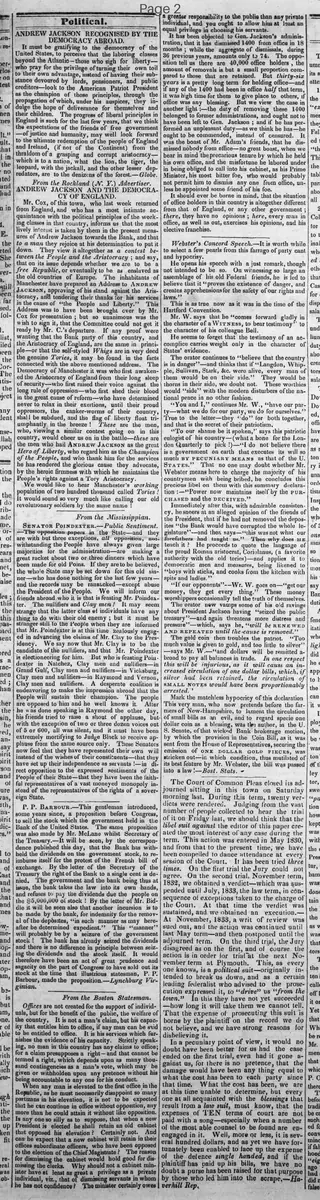
Offices are not created for the support of individuals, but for the benefit of the public, the welfare of the country. It is not a man's claim, but his capacity that entitles him to office, if any man can be said to be entitled to office. It is his services which furnishes the evidence of his capacity. Strictly speaking, no man in this country has any claims to office; for a claim presupposes a right—and that cannot be termed a right, which depends upon as many thousand contingencies as a man's vote, which may be given or withholden upon any pretence without his being accountable to any one for his conduct.
When any man is elevated to the first office in the Republic, as he must necessarily disappoint so many partizans in his elevation, it is not to be expected that he can continue in office without opposition, any more than he could attain it without like opposition. Is any one so silly as to suppose, that when a new President is elected he shall retain an old cabinet that opposed his elevation? Certainly not. And can he expect that a new cabinet will retain in their offices subordinate officers, who have been opposed to the election of the Chief Magistrate? The reason for dismissing the cabinet would hold good for dismissing the clerks. Why should not a cabinet minister have at least as great a privilege as a private individual, viz., that of dismissing servants in whom he has not confidence? The minister certainly owes a greater responsibility to the public than any private individual, and you ought to allow him at least an equal privilege in choosing his servants.
It has been objected to Gen. Jackson's administration, that it has dismissed 1400 from office in 18 months; while the aggregate of dismissals, during 36 previous years, amounts only to 74. The opposition tell us there are 40,000 office holders, the amount of removals is but a small proportion compared to those that are retained. But thirty-six years is a pretty long term for holding office-and if any of the 1400 had been in office half that term, it was high time for them to give place to others, if office was any blessing. But we view the case in another light: the duty of removing these 1400 belonged to former administrations, and ought not to have been left to Gen. Jackson; and if he has performed an unpleasant duty-as we think he has-he ought to be commended, instead of censured. It was the boast of Mr. Adam's friends, that he dismissed nobody from office--no great boast, when we bear in mind the precarious tenure by which he held his own office, and the misfortune he labored under in being obliged to call into his cabinet, as his Prime Minister, his most bitter foe, who would probably not permit him to dismiss any one from office, unless he appointed some friend of his foe.
It should ever be borne in mind, that the situation of office holders in this country is altogether different from that of England, or any other government; there, they have no opinions; here, every man in office, as well as out, exercises his opinions, and his elective franchise.
Offices are not created for the support of individuals, but for the benefit of the public, the welfare of the country. It is not a man's claim, but his capacity that entitles him to office, if any man can be said to be entitled to office. It is his services which furnishes the evidence of his capacity. Strictly speaking, no man in this country has any claims to office; for a claim presupposes a right—and that cannot be termed a right, which depends upon as many thousand contingencies as a man's vote, which may be given or withholden upon any pretence without his being accountable to any one for his conduct.
When any man is elevated to the first office in the Republic, as he must necessarily disappoint so many partizans in his elevation, it is not to be expected that he can continue in office without opposition, any more than he could attain it without like opposition. Is any one so silly as to suppose, that when a new President is elected he shall retain an old cabinet that opposed his elevation? Certainly not. And can he expect that a new cabinet will retain in their offices subordinate officers, who have been opposed to the election of the Chief Magistrate? The reason for dismissing the cabinet would hold good for dismissing the clerks. Why should not a cabinet minister have at least as great a privilege as a private individual, viz., that of dismissing servants in whom he has not confidence? The minister certainly owes a greater responsibility to the public than any private individual, and you ought to allow him at least an equal privilege in choosing his servants.
It has been objected to Gen. Jackson's administration, that it has dismissed 1400 from office in 18 months; while the aggregate of dismissals, during 36 previous years, amounts only to 74. The opposition tell us there are 40,000 office holders, the amount of removals is but a small proportion compared to those that are retained. But thirty-six years is a pretty long term for holding office-and if any of the 1400 had been in office half that term, it was high time for them to give place to others, if office was any blessing. But we view the case in another light: the duty of removing these 1400 belonged to former administrations, and ought not to have been left to Gen. Jackson; and if he has performed an unpleasant duty-as we think he has-he ought to be commended, instead of censured. It was the boast of Mr. Adam's friends, that he dismissed nobody from office--no great boast, when we bear in mind the precarious tenure by which he held his own office, and the misfortune he labored under in being obliged to call into his cabinet, as his Prime Minister, his most bitter foe, who would probably not permit him to dismiss any one from office, unless he appointed some friend of his foe.
It should ever be borne in mind, that the situation of office holders in this country is altogether different from that of England, or any other government; there, they have no opinions; here, every man in office, as well as out, exercises his opinions, and his elective franchise.
What sub-type of article is it?
Partisan Politics
What keywords are associated?
Office Removals
Jackson Administration
Political Patronage
Public Service
Presidential Appointments
Partisan Opposition
What entities or persons were involved?
Gen. Jackson
Mr. Adams
Boston Statesman
Editorial Details
Primary Topic
Defense Of Jackson's Office Removals
Stance / Tone
Supportive Of Gen. Jackson's Administration
Key Figures
Gen. Jackson
Mr. Adams
Boston Statesman
Key Arguments
Offices Exist For Public Benefit, Not Individual Claims
Capacity And Services Determine Entitlement To Office
New Presidents Can Dismiss Opposing Cabinet And Subordinates
Jackson's 1400 Dismissals In 18 Months Were A Necessary Duty Neglected By Prior Administrations
Contrast With Adams' Administration That Dismissed None Due To Constraints
U.S. Office Holders Exercise Opinions And Franchise Unlike In England