Thank you for visiting SNEWPapers!
Sign up free
Editorial
June 23, 1809
Virginia Argus
Richmond, Virginia
What is this article about?
Editorial from Virginia Argus critiques Britain's historical violations of US neutral rights, including trade restrictions, impressment, and the Chesapeake attack. It expresses skepticism about recent peace overtures, arguing they do not abandon core principles, amid Britain's European setbacks.
Clipping
OCR Quality
95%
Excellent
Full Text
Virginia Argus.
RICHMOND.
FRIDAY, JUNE 23, 1809.
PROSPECT OF PEACE WITH BRITAIN.
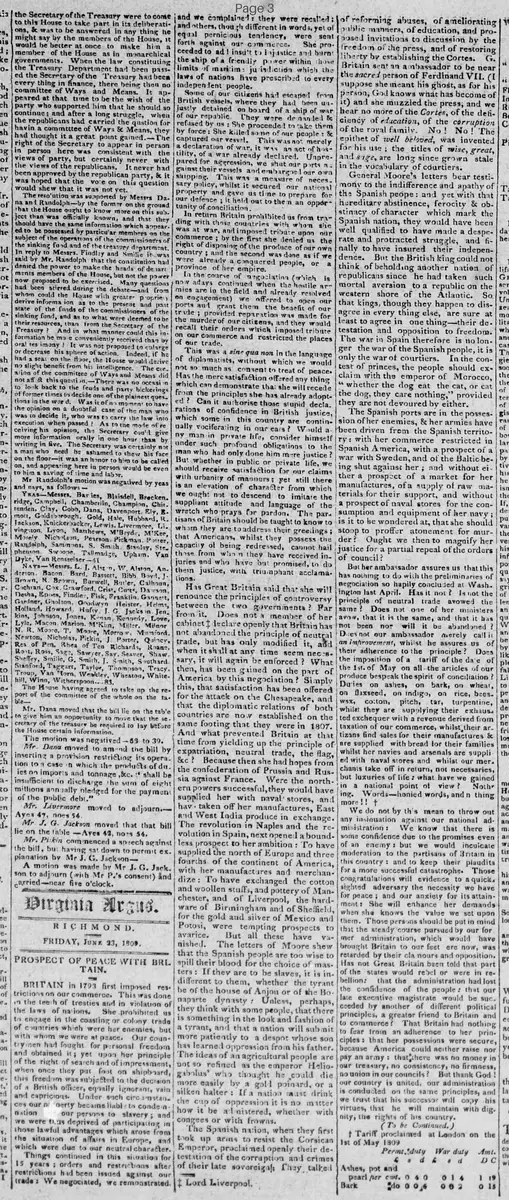
BRITAIN in 1793 first imposed restrictions on our commerce. This was done in the teeth of treaties and in violation of the laws of nations. She prohibited us to engage in the coasting or colony trade of countries which were her enemies, but with whom we were at peace. Our countrymen had fought for personal freedom and obtained it; yet upon her principle of the right of search and of impressment, when once they put foot on shipboard, this freedom was subjected to the decision of a British officer, equally ignorant, vain and capricious. Under such circumstances our liberty became liable to condemnation our persons to slavery; and we were thus deprived of participating in those lawful advantages which arose from the situation of affairs in Europe, and which were due to our neutral character. Things continued in this situation for 15 years; orders and restrictions after restrictions had been issued against our trade: We negotiated, we remonstrated, and we complained: they were recalled; and others, though different in words, yet of equal pernicious tendency, were sent forth against our commerce. She proceeded to add insult to injustice and burnt the ship of a friendly power within those limits of maritime jurisdiction which the laws of nations have prescribed to every independent people. Some of our citizens had escaped from British vessels, where they had been unjustly detained on board of a ship of war of our republic. They were demanded & refused by us: She proceeded to take them by force: She killed some of our people: & captured our vessel. This was not merely a declaration of war. it was an act of hostility, of a war already declared. Unprepared for aggression, we shut our ports again against their vessels and embargoed our own shipping. This was a measure of necessary policy, whilst it secured our national property and gave us time to prepare for our defence; it held out to them an opportunity of conciliation. In return Britain prohibited us from trading with those countries with whom she was at war, and imposed tribute upon our commerce; by the first she denied us the right of disposing of the produce of our own country; and the second was done as if we were already a conquered people, or a province of her empire. In the course of negotiation (which is nowadays continued when the hostile armies are in the field and already resolved on engagement) we offered to open our ports and grant them the benefit of our trade; provided reparation was made for the murder of our citizens, and they would recall their orders which imposed tribute on our commerce and restricted the places of our trade. This was a sine qua non in the language of diplomatists, without which we would not so much as consent to treat of peace. Has the mere satisfaction offered any thing which can demonstrate that she will recede from the principles she has already adopted? Can it authorize those stupid declarations of confidence in British justice, which some in this country are continually vociferating in our ears? Would any man in private life, consider himself under such profound obligations to the man who had only done him mere justice? But whether in public or private life, we should receive satisfaction for our claims with urbanity of manners; yet still there is an elevation of character from which we ought not to descend to imitate the suppliant attitude and language of the wretch who prays for pardon. The partisans of Britain should be taught to know to whom they are to address their greetings; that Americans, whilst they possess the capacity of being redressed, cannot hail those from whom they have received injuries and who have but promised, to do them justice, with triumphant acclamations. Has Great Britain said that she will renounce the principles of controversy between the two governments? Far from it. Does not a member of her cabinet declare openly that Britain has not abandoned the principle of neutral trade, but has only modified it, and when it shall at any time seem necessary, it will again be enforced? What then, has been gained on the part of America by this negotiation? Simply this, that satisfaction has been offered for the attack on the Chesapeake, and that the diplomatic relations of both countries are now established on the same footing that they were in 1807. And what prevented Britain at that time from yielding up the principle of expatriation, neutral trade, the flag, &c? Because then she had hopes from the confederation of Prussia and Russia against France. Were the northern powers successful, they would have supplied her with naval stores, and have taken off her manufactures, East and West India produce in exchange. The revolution in Naples and the revolution in Spain, next opened a boundless prospect to her ambition: To have supplied the north of Europe and three fourths of the continent of America, with her manufactures and merchandise: To have exchanged the cotton and woollen stuffs, and pottery of Manchester, and of Liverpool, the hardware of Birmingham and of Sheffield, for the gold and silver of Mexico and Potosi, were tempting prospects to avarice. But all these have vanished. The letters of Moore shew that the Spanish people are too wise to spill their blood for the choice of masters: If they are to be slaves, it is indifferent to them, whether the tyrant be of the house of Anjou or of the Bonaparte dynasty: Unless, perhaps, they think with some people, that there is something in the look and fashion of a tyrant, and that a nation will submit more patiently to a despot whose son has learned oppression from his father. The ideas of an agricultural people are not so refined as the emperor Heliogabalus' who thought he could die more easily by a gold poniard, or a silken halter: If a nation must drink the cup of oppression it is no matter how it be administered, whether with congees or with frowns. The Spanish nation, when they first took up arms to resist the Corsican Emperor, proclaimed openly their detestation of the corruption and crimes of their late sovereign: they talked of reforming abuses, of ameliorating public manners, of education, and proposed invitations to discussion by the freedom of the press, and of restoring liberty by establishing the Cortes. G. Britain sent an ambassador to be near the sacred person of Ferdinand VII. (I suppose she meant his ghost, as for his person, God knows what has become of it) and she muzzled the press; and we hear no more of the Cortes, of the deficiency of education, of the corruption of the royal family. No! No! The epithet of well beloved, was invented for his use; the titles of wise, great, and sage, are long since grown stale in the vocabulary of courtiers. General Moore's letters bear testimony to the indifference and apathy of the Spanish people: and yet with that hereditary abstinence, ferocity & obstinacy of character which mark the Spanish nation, they would have been well qualified to have made a desperate and protracted struggle, and finally to have insured their independence. But the British king could not think of beholding another nation of republicans since he had taken such mortal aversion to a republic on the western shore of the Atlantic. So that kings, though they happen to disagree in every thing else, are sure at least to agree in one thing -their detestation and opposition to freedom. The war in Spain therefore is no longer the war of the Spanish people, it is only the war of courtiers. In the contest of princes, the people should exclaim with the emperor of Morocco, "whether the dog eat the cat, or cat the dog, they care nothing," provided they are not devoured by either. The Spanish ports are in the possession of her enemies. & her armies have been driven from the Spanish territory: with her commerce restricted in Spanish America, with a prospect of a war with Sweden, and of the Baltic being shut against her; and without either a prospect of a market for her manufactures, of a supply of raw materials for their support, and without a prospect of naval stores for the consumption and equipment of her navy; is it to be wondered at, that she should stoop to proffer atonement for murder? Ought we then to magnify her justice for a partial repeal of the orders of council? But her ambassador assures us that this has nothing to do with the preliminaries of negotiation so happily concluded at Washington last April. Has it not? Is not the principle of neutral trade avowed the same? Does not one of her ministers avow, that it is the same, and that it has not been nor will it be abandoned? Does not our ambassador merely call it an improvement, whilst he assures us of their adherence to the principle? Does the imposition of a tariff of the date of the 1st. of May on all the articles of our produce bespeak the spirit of conciliation? Duties on ashes, on bark, on wheat, on flaxseed, on indigo, on rice, beeswax, cotton, pitch, tar, turpentine, whilst they are supplying their exhausted exchequer with a revenue derived from taxation of our commerce, whilst their artisans find sales for their manufactures & are supplied with bread for their families whilst her navies and arsenals are supplied with naval stores and whilst our merchants take off in return, not necessaries, but luxuries of life: what have we gained in a national point of view? Nothing. Words-honied words, and nothing more!! We do not by this mean to throw out any insinuation against our national administration: We know that there is some confidence due to the promises even of an enemy: but we would inculcate moderation to the partisans of Britain in this country: and to keep their plaudits for a more successful catastrophe. Those congratulations will evidence to a quick sighted adversary the necessity we have for peace; and our anxiety for its attainment: She will enhance her demands when she knows the value we set upon them. Those persons should be put in mind that the steady course pursued by our former administration, which would have brought Britain to our feet ere now, was retarded by their clamours and opposition. Has not Great Britain been told that part of the states would rebel or were in rebellion: that the administration had lost the confidence of the people: that our late executive magistrate would be succeeded by another of different political principles, a greater friend to Britain and to commerce? That Britain had nothing to fear from an adherence to her principles: that her possessions were secure, because America could neither raise nor pay an army: that there was no money in our treasury, no consistency, no firmness, no union in our councils? But thank God! our country is united, our administration is conducted on the same principles, and we trust that his successor will copy his virtues, that he will maintain with dignity, the rights of his country.
(To be Continued.)
RICHMOND.
FRIDAY, JUNE 23, 1809.
PROSPECT OF PEACE WITH BRITAIN.
BRITAIN in 1793 first imposed restrictions on our commerce. This was done in the teeth of treaties and in violation of the laws of nations. She prohibited us to engage in the coasting or colony trade of countries which were her enemies, but with whom we were at peace. Our countrymen had fought for personal freedom and obtained it; yet upon her principle of the right of search and of impressment, when once they put foot on shipboard, this freedom was subjected to the decision of a British officer, equally ignorant, vain and capricious. Under such circumstances our liberty became liable to condemnation our persons to slavery; and we were thus deprived of participating in those lawful advantages which arose from the situation of affairs in Europe, and which were due to our neutral character. Things continued in this situation for 15 years; orders and restrictions after restrictions had been issued against our trade: We negotiated, we remonstrated, and we complained: they were recalled; and others, though different in words, yet of equal pernicious tendency, were sent forth against our commerce. She proceeded to add insult to injustice and burnt the ship of a friendly power within those limits of maritime jurisdiction which the laws of nations have prescribed to every independent people. Some of our citizens had escaped from British vessels, where they had been unjustly detained on board of a ship of war of our republic. They were demanded & refused by us: She proceeded to take them by force: She killed some of our people: & captured our vessel. This was not merely a declaration of war. it was an act of hostility, of a war already declared. Unprepared for aggression, we shut our ports again against their vessels and embargoed our own shipping. This was a measure of necessary policy, whilst it secured our national property and gave us time to prepare for our defence; it held out to them an opportunity of conciliation. In return Britain prohibited us from trading with those countries with whom she was at war, and imposed tribute upon our commerce; by the first she denied us the right of disposing of the produce of our own country; and the second was done as if we were already a conquered people, or a province of her empire. In the course of negotiation (which is nowadays continued when the hostile armies are in the field and already resolved on engagement) we offered to open our ports and grant them the benefit of our trade; provided reparation was made for the murder of our citizens, and they would recall their orders which imposed tribute on our commerce and restricted the places of our trade. This was a sine qua non in the language of diplomatists, without which we would not so much as consent to treat of peace. Has the mere satisfaction offered any thing which can demonstrate that she will recede from the principles she has already adopted? Can it authorize those stupid declarations of confidence in British justice, which some in this country are continually vociferating in our ears? Would any man in private life, consider himself under such profound obligations to the man who had only done him mere justice? But whether in public or private life, we should receive satisfaction for our claims with urbanity of manners; yet still there is an elevation of character from which we ought not to descend to imitate the suppliant attitude and language of the wretch who prays for pardon. The partisans of Britain should be taught to know to whom they are to address their greetings; that Americans, whilst they possess the capacity of being redressed, cannot hail those from whom they have received injuries and who have but promised, to do them justice, with triumphant acclamations. Has Great Britain said that she will renounce the principles of controversy between the two governments? Far from it. Does not a member of her cabinet declare openly that Britain has not abandoned the principle of neutral trade, but has only modified it, and when it shall at any time seem necessary, it will again be enforced? What then, has been gained on the part of America by this negotiation? Simply this, that satisfaction has been offered for the attack on the Chesapeake, and that the diplomatic relations of both countries are now established on the same footing that they were in 1807. And what prevented Britain at that time from yielding up the principle of expatriation, neutral trade, the flag, &c? Because then she had hopes from the confederation of Prussia and Russia against France. Were the northern powers successful, they would have supplied her with naval stores, and have taken off her manufactures, East and West India produce in exchange. The revolution in Naples and the revolution in Spain, next opened a boundless prospect to her ambition: To have supplied the north of Europe and three fourths of the continent of America, with her manufactures and merchandise: To have exchanged the cotton and woollen stuffs, and pottery of Manchester, and of Liverpool, the hardware of Birmingham and of Sheffield, for the gold and silver of Mexico and Potosi, were tempting prospects to avarice. But all these have vanished. The letters of Moore shew that the Spanish people are too wise to spill their blood for the choice of masters: If they are to be slaves, it is indifferent to them, whether the tyrant be of the house of Anjou or of the Bonaparte dynasty: Unless, perhaps, they think with some people, that there is something in the look and fashion of a tyrant, and that a nation will submit more patiently to a despot whose son has learned oppression from his father. The ideas of an agricultural people are not so refined as the emperor Heliogabalus' who thought he could die more easily by a gold poniard, or a silken halter: If a nation must drink the cup of oppression it is no matter how it be administered, whether with congees or with frowns. The Spanish nation, when they first took up arms to resist the Corsican Emperor, proclaimed openly their detestation of the corruption and crimes of their late sovereign: they talked of reforming abuses, of ameliorating public manners, of education, and proposed invitations to discussion by the freedom of the press, and of restoring liberty by establishing the Cortes. G. Britain sent an ambassador to be near the sacred person of Ferdinand VII. (I suppose she meant his ghost, as for his person, God knows what has become of it) and she muzzled the press; and we hear no more of the Cortes, of the deficiency of education, of the corruption of the royal family. No! No! The epithet of well beloved, was invented for his use; the titles of wise, great, and sage, are long since grown stale in the vocabulary of courtiers. General Moore's letters bear testimony to the indifference and apathy of the Spanish people: and yet with that hereditary abstinence, ferocity & obstinacy of character which mark the Spanish nation, they would have been well qualified to have made a desperate and protracted struggle, and finally to have insured their independence. But the British king could not think of beholding another nation of republicans since he had taken such mortal aversion to a republic on the western shore of the Atlantic. So that kings, though they happen to disagree in every thing else, are sure at least to agree in one thing -their detestation and opposition to freedom. The war in Spain therefore is no longer the war of the Spanish people, it is only the war of courtiers. In the contest of princes, the people should exclaim with the emperor of Morocco, "whether the dog eat the cat, or cat the dog, they care nothing," provided they are not devoured by either. The Spanish ports are in the possession of her enemies. & her armies have been driven from the Spanish territory: with her commerce restricted in Spanish America, with a prospect of a war with Sweden, and of the Baltic being shut against her; and without either a prospect of a market for her manufactures, of a supply of raw materials for their support, and without a prospect of naval stores for the consumption and equipment of her navy; is it to be wondered at, that she should stoop to proffer atonement for murder? Ought we then to magnify her justice for a partial repeal of the orders of council? But her ambassador assures us that this has nothing to do with the preliminaries of negotiation so happily concluded at Washington last April. Has it not? Is not the principle of neutral trade avowed the same? Does not one of her ministers avow, that it is the same, and that it has not been nor will it be abandoned? Does not our ambassador merely call it an improvement, whilst he assures us of their adherence to the principle? Does the imposition of a tariff of the date of the 1st. of May on all the articles of our produce bespeak the spirit of conciliation? Duties on ashes, on bark, on wheat, on flaxseed, on indigo, on rice, beeswax, cotton, pitch, tar, turpentine, whilst they are supplying their exhausted exchequer with a revenue derived from taxation of our commerce, whilst their artisans find sales for their manufactures & are supplied with bread for their families whilst her navies and arsenals are supplied with naval stores and whilst our merchants take off in return, not necessaries, but luxuries of life: what have we gained in a national point of view? Nothing. Words-honied words, and nothing more!! We do not by this mean to throw out any insinuation against our national administration: We know that there is some confidence due to the promises even of an enemy: but we would inculcate moderation to the partisans of Britain in this country: and to keep their plaudits for a more successful catastrophe. Those congratulations will evidence to a quick sighted adversary the necessity we have for peace; and our anxiety for its attainment: She will enhance her demands when she knows the value we set upon them. Those persons should be put in mind that the steady course pursued by our former administration, which would have brought Britain to our feet ere now, was retarded by their clamours and opposition. Has not Great Britain been told that part of the states would rebel or were in rebellion: that the administration had lost the confidence of the people: that our late executive magistrate would be succeeded by another of different political principles, a greater friend to Britain and to commerce? That Britain had nothing to fear from an adherence to her principles: that her possessions were secure, because America could neither raise nor pay an army: that there was no money in our treasury, no consistency, no firmness, no union in our councils? But thank God! our country is united, our administration is conducted on the same principles, and we trust that his successor will copy his virtues, that he will maintain with dignity, the rights of his country.
(To be Continued.)
What sub-type of article is it?
Foreign Affairs
Economic Policy
War Or Peace
What keywords are associated?
British Trade Restrictions
Neutral Rights
Chesapeake Attack
Peace Negotiations
Impressment
Orders In Council
Spanish War
What entities or persons were involved?
Britain
Great Britain
United States
Chesapeake
Ferdinand Vii
General Moore
Editorial Details
Primary Topic
Skepticism About British Peace Overtures And Adherence To Neutral Trade Principles
Stance / Tone
Critical Of Britain And Her Partisans, Supportive Of Us Firmness
Key Figures
Britain
Great Britain
United States
Chesapeake
Ferdinand Vii
General Moore
Key Arguments
Britain Violated Treaties And Neutral Rights Since 1793 With Trade Restrictions And Impressment
Chesapeake Incident Was An Act Of War
Embargo Was Necessary Defense And Conciliation Opportunity
Recent Negotiations Yield Only Partial Satisfaction Without Abandoning Core Principles
Britain's European Setbacks Force Overtures, Not Genuine Change
Spanish Resistance Undermined By British Influence
Us Should Maintain Dignity And Unity Against British Partisans