Thank you for visiting SNEWPapers!
Sign up free
The Tri County News
Grand Rapids, Wood County, Ohio
What is this article about?
A Sunday school lesson on Luke 18:1-14, using two parables by Jesus to teach that effective prayer requires both persistence, as shown by a widow prevailing on an unjust judge, and humility, as the contrite publican receives mercy unlike the proud Pharisee.
Merged-components note: Merged section title with the following Sunday school lesson text into a single coherent story component.
Clipping
OCR Quality
Full Text
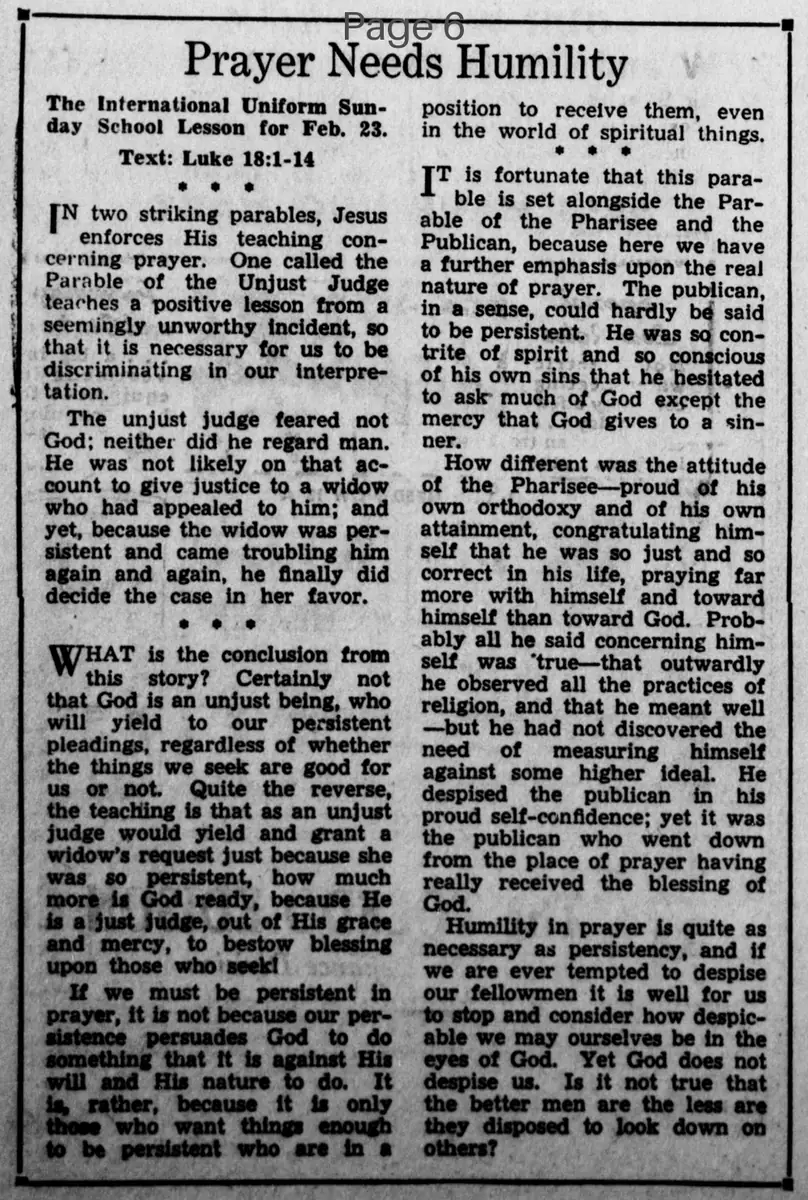
The International Uniform Sunday School Lesson for Feb. 23.
Text: Luke 18:1-14
In two striking parables, Jesus enforces His teaching concerning prayer. One called the Parable of the Unjust Judge teaches a positive lesson from a seemingly unworthy incident, so that it is necessary for us to be discriminating in our interpretation.
The unjust judge feared not God: neither did he regard man. He was not likely on that account to give justice to a widow who had appealed to him; and yet, because the widow was persistent and came troubling him again and again, he finally did decide the case in her favor.
What is the conclusion from this story? Certainly not that God is an unjust being, who will yield to our persistent pleadings, regardless of whether the things we seek are good for us or not. Quite the reverse, the teaching is that as an unjust judge would yield and grant a widow's request just because she was so persistent, how much more is God ready, because He is a just judge, out of His grace and mercy, to bestow blessing upon those who seek!
If we must be persistent in prayer, it is not because our persistence persuades God to do something that it is against His will and His nature to do. It is rather, because it is only those who want things enough to be persistent who are in a position to receive them, even in the world of spiritual things.
It is fortunate that this parable is set alongside the Parable of the Pharisee and the Publican, because here we have a further emphasis upon the real nature of prayer. The publican, in a sense, could hardly be said to be persistent. He was so contrite of spirit and so conscious of his own sins that he hesitated to ask much of God except the mercy that God gives to a sinner.
How different was the attitude of the Pharisee—proud of his own orthodoxy and of his own attainment, congratulating himself that he was so just and so correct in his life, praying far more with himself and toward himself than toward God. Probably all he said concerning himself was true—that outwardly he observed all the practices of religion, and that he meant well—but he had not discovered the need of measuring himself against some higher ideal. He despised the publican in his proud self-confidence; yet it was the publican who went down from the place of prayer having really received the blessing of God.
Humility in prayer is quite as necessary as persistency, and if we are ever tempted to despise our fellowmen it is well for us to stop and consider how despicable we may ourselves be in the eyes of God. Yet God does not despise us. Is it not true that the better men are the less are they disposed to look down on others?
What sub-type of article is it?
What themes does it cover?
What keywords are associated?
What entities or persons were involved?
Story Details
Key Persons
Story Details
Jesus uses the Parable of the Unjust Judge to teach persistence in prayer, showing how even an unjust judge grants a widow's request due to her persistence, so God, being just, will answer those who seek. The Parable of the Pharisee and the Publican emphasizes humility, as the contrite publican receives mercy while the proud Pharisee does not.