Thank you for visiting SNEWPapers!
Sign up free
The Guard
Holly Springs, Marshall County, Mississippi
What is this article about?
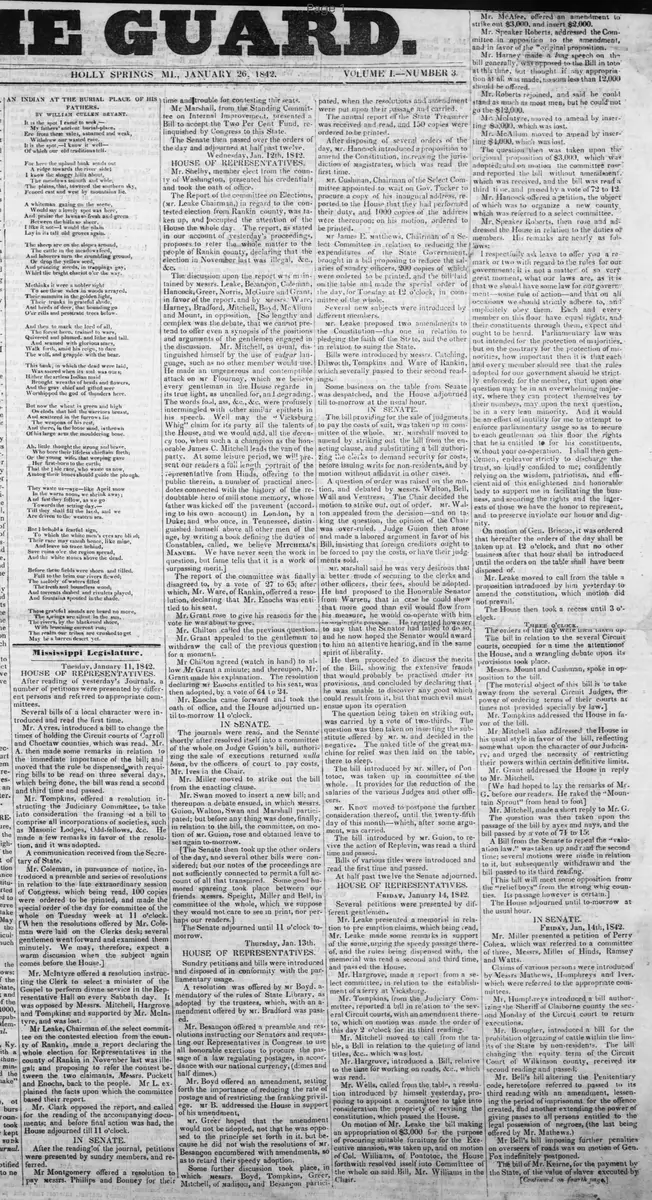
Proceedings of the Mississippi Legislature from January 11 to 17, 1842, including House and Senate sessions with introductions of bills on court times, elections, banking, postage, and constitutional amendments; debates on contested elections, judge powers, and appropriations; resolutions passed and rejected.
Merged-components note: Continuation of detailed Mississippi Legislature proceedings article split across pages 1 and 4, including resolutions on the Union Bank.
Clippings
1 of 2
OCR Quality
Full Text
Tuesday, January 11, 1842.
HOUSE OF REPRESENTATIVES.
After reading of yesterday's Journals, a number of petitions were presented by different persons and referred to appropriate committees.
Several bills of a local character were introduced and read the first time.
Mr. Ayres, introduced a bill to change the times of holding the Circuit courts of Carroll and Choctaw counties, which was read. Mr. A. then made some remarks in relation to the immediate importance of the bill; and moved that the rule be dispensed with requiring bills to be read on three several days, which being done, the bill was read a second and third time and passed.
Mr. Tompkins, offered a resolution instructing the Judiciary Committee, to take into consideration the framing of a bill to comprise all incorporations of societies, such as Masonic Lodges, Odd-fellows, &c. He made a few remarks in favor of the resolution, and it was adopted.
A communication received from the Secretary of State.
Mr. Coleman, in pursuance of notice, introduced a preamble and series of resolutions in relation to the late extraordinary session of Congress, which being read, 100 copies were ordered to be printed, and made the special order of the day for committee of the whole on Tuesday week at 11 o'clock.
When the resolutions offered by Mr. Coleman were laid on the Clerk's desk; several gentlemen went forward and examined them minutely. We may, therefore, expect a warm discussion when the subject again comes before the House.
Mr. McIntyre offered a resolution instructing the Clerk to select a minister of the Gospel to perform divine service in the Representative Hall on every Sabbath day. It was opposed by Messrs. Mitchell, Hargrove and Tompkins; and supported by Mr. McIntyre, and was lost.
Mr. Leake, Chairman of the select committee on the contested election from the county of Rankin, made a report declaring the whole election for Representatives in the county of Rankin in November last was illegal; and proposing to refer the contest between the two claimants, Messrs. Puckett and Enochs, back to the people. Mr. L. explained the facts upon which the committee based their report.
Mr. Clark opposed the report, and called for the reading of the accompanying documents; and before final action was had, the House adjourned till 11 o'clock.
IN SENATE.
After the reading of the journal, petitions were presented by sundry members, and referred.
Mr. Montgomery offered a resolution to pay Messrs. Phillips and Bonney for their time and trouble for contesting their seats.
Mr. Marshall, from the Standing Committee on Internal Improvement, presented a Bill to accept the Two Per Cent Fund, relinquished by Congress to this State.
The Senate then passed over the orders of the day and adjourned at half past twelve.
Wednesday, Jan. 12th, 1842.
HOUSE OF REPRESENTATIVES.
Mr. Shelby, member elect from the county of Washington, presented his credentials and took the oath of office.
The Report of the committee on Elections, (Mr. Leake Chairman,) in regard to the contested election from Rankin county, was taken up, and occupied the attention of the House the whole day. The report, as stated in our account of yesterday's proceedings, proposes to refer the whole matter to the people of Rankin county, declaring that the election in November last was illegal, &c., &c.
The discussion upon the report was maintained by Messrs. Leake, Besancon, Coleman, Hancock, Greer, Norris, McGuire and Grant, in favor of the report, and by Messrs. Ware, Harney, Bradford, Mitchell, Boyd, McAllum and Mount, in opposition. So lengthy and complex was the debate, that we cannot pretend to offer even a synopsis of the positions and arguments of the gentlemen engaged in the discussion. Mr. Mitchell, as usual, distinguished himself by the use of vulgar language, such as no other member would use. He made an ungenerous and contemptible attack on Mr. Flournoy, which we believe every gentleman in the House regarded in its true light, as uncalled for, and degrading. The words foul, ass, &c., &c. were profusely intermingled with other similar epithets in his speech. Well may the "Vicksburg Whig" claim for its party all the talents of the House, and we would add, all the decency too, when such a champion as the honorable James C. Mitchell leads the van of the party. At some leisure period, we will present our readers a full length portrait of the representative from Hinds, offering to the public therein, a number of practical anecdotes connected with the history of the redoubtable hero of mill stone memory, whose father was kicked off the pavement (according to his own account) in London, by a Duke; and who once, in Tennessee, distinguished himself above all other men of the age, by writing a book defining the duties of Constables, called, we believe Mitchell's Manual. We have never seen the work in question, but fame tells that it is a work of surpassing merit.
The report of the committee was finally disagreed to, by a vote of 27 to 65; after which, Mr. Ware, of Rankin, offered a resolution, declaring that Mr. Enochs was entitled to his seat.
Mr. Grant rose to give his reasons for the vote he was about to give.
Mr. Chilton called the previous question.
Mr. Grant appealed to the gentleman to withdraw the call of the previous question for a moment.
Mr. Chilton agreed (watch in hand) to allow Mr. Grant a minute: and thereupon, Mr. Grant made his explanation. The resolution declaring Mr. Enochs entitled to his seat, was then adopted, by a vote of 64 to 24.
Mr. Enochs came forward and took the oath of office, and the House adjourned until to-morrow 11 o'clock.
IN SENATE.
The journals were read, and the Senate shortly after resolved itself into a committee of the whole on Judge Guion's bill, authorizing the sale of executions returned nulla bona, by the officers of court to pay costs, Mr. Ives in the Chair.
Mr. Miller moved to strike out the bill from the enacting clause.
Mr. Swan moved to insert a new bill; and thereupon a debate ensued, in which Messrs. Guion, Walton, Swan and Marshall participated; but before any thing was done, finally, in relation to the bill, the committee, on motion of Mr. Guion, rose and obtained leave to sit again to-morrow.
The Senate then took up the other orders of the day, and several other bills were considered; but our notes of the proceedings are not sufficiently connected to permit a full account of all that transpired. Some good humored sparring took place between our friends Messrs. Speight, Miller and Bell, in committee of the whole, which we suppose they would not care to see in print, nor perhaps our readers.
The Senate adjourned until 11 o'clock to-morrow.
Thursday, Jan. 13th.
HOUSE OF REPRESENTATIVES.
Sundry petitions and bills were introduced and disposed of in conformity with the parliamentary usage.
A resolution was offered by Mr. Boyd, amendatory of the rules of State Library, as adopted by the trustees, which, with an amendment offered by Mr. Bradford was passed.
Mr. Besancon offered a preamble and resolutions instructing our Senators and requesting our Representatives in Congress to use all honorable exertions to procure the passage of a law regulating postages, in accordance with our national currency, (dimes and half dimes.)
Mr. Boyd offered an amendment, setting forth the importance of reducing the rate of postage and of restricting the franking privilege. Mr. B. addressed the House in support of his amendment.
Mr. Greer hoped that the amendment would not be adopted, not that he was opposed to the principle set forth in it, but because he did not wish the resolutions of Mr. Besancon encumbered with amendments, so as to retard their speedy adoption.
Some further discussion took place, in which Messrs. Boyd, Tompkins, Greer, Mitchell, of Madison, and Besancon participated, when the resolutions and amendment were put upon their passage and carried.
The annual report of the State Treasurer was received and read, and 150 copies were ordered to be printed.
After disposing of several orders of the day, Mr. Hancock introduced a proposition to amend the Constitution, increasing the jurisdiction of magistrates, which was read the first time.
Mr. Cushman, Chairman of the Select Committee appointed to wait on Gov. Tucker to procure a copy of his inaugural address, reported to the House that they had performed their duty, and 1000 copies of the address were thereupon, on his motion, ordered to be printed.
Mr. James E. Matthews, Chairman of a Select Committee in relation to reducing the expenditures of the State Government, brought in a bill proposing to reduce the salaries of sundry officers, 200 copies of which were ordered to be printed, and the bill laid on the table and made the special order of the day, for Tuesday at 12 o'clock, in committee of the whole.
Several new subjects were introduced by different members.
Mr. Leake proposed two amendments to the Constitution-the one in relation to pledging the faith of the State, and the other in relation to suing the State.
Bills were introduced by Messrs. Catching, Dilworth, Tompkins and Ware of Rankin, which severally passed to their second readings.
Some business on the table from Senate was despatched, and the House adjourned till to-morrow at the usual hour.
The bill providing for the sale of judgments to pay the costs of suit, was taken up in committee of the whole. Mr. Marshall moved to amend by striking out the bill from the enacting clause, and substituting a bill authorizing the clerks to demand security for costs, before issuing writs for non-residents, and by motion without affidavit in other cases.
A question of order was raised on the motion, and debated by Messrs. Walton, Bell, Wall and Ventress. The Chair decided the motion to strike out, out of order. Mr. Walton appealed from the decision-and on taking the question, the opinion of the Chair was over-ruled. Judge Guion then arose and made a labored argument in favor of his Bill, insisting that foreign creditors ought to be forced to pay the costs, or have their judgments sold.
Mr. Marshall said he was very desirous that a better mode of securing to the clerks and other officers, their fees, should be adopted. He had proposed to the Honorable Senator from Warren, that in case he could show that more good than evil would flow from his measure, he would co-operate with him in urging its passage. He regretted however to say that the Senator had failed to do so, and he now hoped the Senator would award to him an attentive hearing, and in the same spirit of liberality.
He then proceeded to discuss the merits of the Bill, showing the extensive frauds that would probably be practised under its provisions, and concluded by declaring that he was unable to discover any good which could result from it, but that much evil must ensue upon its operation.
The question being taken on striking out, was carried by a vote of two-thirds. The question was then taken on inserting the substitute offered by Mr. M. and decided in the negative. The naked title of the great machine for relief was then laid on the table, there to sleep.
The bill introduced by Mr. Miller, of Pontotoc, was taken up in committee of the whole. It provides for the reduction of the salaries of the various Judges and other officers.
Mr. Knox moved to postpone the further consideration thereof, until the twenty-fifth day of this month-which, after some argument, was carried.
The bill introduced by Mr. Guion, to revive the action of Replevin, was read a third time and passed.
Bills of various titles were introduced and read the first time and passed.
At half past twelve the Senate adjourned.
HOUSE OF REPRESENTATIVES.
FRIDAY, January 14, 1842.
Several petitions were presented by different gentlemen.
Mr. Leake presented a memorial in relation to pre-emption claims, which being read, Mr. Leake made some remarks in support of the same, urging the speedy passage thereof, and the rules being dispensed with, the memorial was read a second and third time, and passed the House.
Mr. Hargrove, made a report from a select committee, in relation to the establishment of a ferry at Vicksburg.
Mr. Tompkins, from the Judiciary Committee, reported a bill in relation to the several Circuit courts, with an amendment thereto, which on motion was made the order of this day 2 o'clock for its third reading.
Mr. Mitchell moved to call from the table, a Bill in relation to the quieting of land titles, &c., which was lost.
Mr. Hargrove, introduced a Bill, relative to the time for working on roads, &c., which was read.
Mr. Wells, called from the table, a resolution introduced by himself yesterday, proposing to appoint a committee to take into consideration the propriety of revising the constitution, which passed the House.
On motion of Mr. Leake the bill making an appropriation of $3,000 for the purpose of procuring suitable furniture for the Executive mansion, was taken up, and on motion of Col. Williams, of Pontotoc, the House forthwith resolved itself into Committee of the whole on said Bill, Mr. Williams in the Chair.
Mr. McAfee, offered an amendment to strike out $3,000, and insert $2,000.
Mr. Speaker Roberts, addressed the Committee in opposition to the amendment, and in favor of the original proposition.
Mr. Harney made a long speech on the bill generally, was opposed to the Bill in toto at this time, but thought if any appropriation at all was made, no sum less than $12,000 should be offered.
Mr. Roberts rejoined, and said he could stand as much as most men, but he could not go the $12,000.
Mr. McIntyre, moved to amend by inserting $5,000, which was lost.
Mr. McAllum moved to amend by inserting $4,000, which was lost.
The question then was taken upon the original proposition of $3,000, which was adopted; and on motion the committee rose and reported the bill without amendment, which was received, and the bill was read a third time, and passed by a vote of 72 to 12.
Mr. Hancock offered a petition, the object of which was to organize a new county which was referred to a select committee.
Mr. Speaker Roberts, then rose and addressed the House in relation to the duties of members. His remarks are nearly as follows:
I respectfully ask leave to offer you a remark or two with regard to the rules for our government; it is not a matter of so very great moment, what our laws are, as it is that we should have some law for our government-some rule of action-and that on all occasions we should strictly adhere to, and implicitly obey them. Each and every member on this floor have equal rights, and their constituents through them, expect and ought to be heard. Parliamentary law was not intended for the protection of majorities, but on the contrary for the protection of minorities. How important then it is that each and every member should see that the rules adopted for our government should be strictly enforced; for the member, that upon one question may be in an overwhelming majority, where they can protect themselves by their numbers, may upon the next question, be in a very lean minority. And it would be an effort of inutility for me to attempt to enforce parliamentary usage so as to secure to each gentleman on this floor the rights that he is entitled to for his constituents, without your co-operation. I shall then gentlemen, endeavor strictly to discharge the trust, so kindly confided to me; confidently relying on the wisdom, patriotism, and efficient aid of this enlightened and honorable body to support me in facilitating the business, and securing the rights and the interests of those we have the honor to represent, and to preserve inviolate our honor and dignity.
On motion of Gen. Briscoe, it was ordered that hereafter the orders of the day shall be taken up at 12 o'clock, and that no other business after that hour shall be introduced until the orders on the table shall have been disposed of.
Mr. Leake moved to call from the table a proposition introduced by him yesterday to amend the constitution, which motion did not prevail.
The House then took a recess until 3 o'clock.
Three o'clock.
The orders of the day were then taken up.
The bill in relation to the several Circuit courts, occupied for a time the attention of the House, and a wrangling debate upon its provisions took place.
Messrs. Mount and Cushman, spoke in opposition to the bill.
The material object of this bill is to take away from the several Circuit Judges, the power of ordering terms of their courts at times not provided specially by law.
Mr. Tompkins addressed the House in favor of the bill.
Mr. Mitchell also addressed the House in his usual style in favor of the bill, reflecting somewhat upon the character of our Judiciary, and urged the necessity of restricting their powers within certain definitive limits.
Mr. Grant addressed the House in reply to Mr. Mitchell.
We had hoped to lay the remarks of Mr. G. before our readers. He raked the "Mountain Sprout" from head to foot.
Mr. Mitchell, made a short reply to Mr. G.
The question was then taken upon the passage of the bill by ayes and nays, and the bill passed by a vote of 71 to 15.
A Bill from the Senate to repeal the valuation law, was taken up and read the second time; several motions were made in relation to it, but subsequently withdrawn and the bill passed to its third reading.
This bill will meet some opposition from the "relief boys" from the strong whig counties. Its passage however is certain.
The House adjourned until to-morrow at the usual hour.
IN SENATE.
Friday, Jan. 14th, 1842.
Mr. Miller presented a petition of Perry Cohea, which was referred to a committee of three, Messrs. Miller of Hinds, Ramsey and Watts.
Claims of various persons were introduced by Messrs. Mathews, Humphreys and Ives, which were referred to the appropriate committees.
Mr. Humphreys introduced a bill authorizing the Sheriff of Claiborne county the second Monday of the Circuit court to return executions.
Mr. Brougher, introduced a bill for the prohibition of grazing of cattle within the limits of the State by non-residents. The bill changing the equity term of the Circuit Court of Wilkinson county, received its second reading and passed.
Mr. Bell's bill altering the Penitentiary code, heretofore referred to passed to its third reading with an amendment, lessening the period of imprisonment for the offence created, and another extending the power of giving passes to all persons entitled to the legal possession of negroes, (the last being offered by Mr. Mathews.)
Mr. Bell's bill imposing further penalties on overseers of roads was on motion of Gen. Fox indefinitely postponed.
The bill of Mr. Keirne, for the payment by the State, of the value of slaves executed by Continued on fourth page.
SENATE.
The process of law, was also postponed indefinitely, upon the motion of the same Senator.
The Senate adjourned to meet at the usual hour.
HOUSE OF REPRESENTATIVES.
SATURDAY, Jan. 15th.
The journals having been read, petitions were offered and referred to Select Committees.
Several bills were reported by Select and standing committees, to whom subjects had been referred.
Mr. Harney, by leave, introduced a bill for the relief of the stockholders of the Real Estate Bank of Hinds county.
Mr. Hargrove moved to reject the bill, and thereupon a discussion took place, in which Messrs. Hargrove, Greer, Allen, Besancon, and some others, in support of the motion to reject, and Messrs. Harney, Mitchell of Hinds, Bradford and Fisher, in opposition thereto, participated.
[It is worthy of remark, that the proposition for the relief of the bankers, was sustained by the whole Whig force in the House; and we may add that the journals of past Legislatures, prove that similar propositions have, at all times, originated with, and been sustained, by the same party. Whiggery and Bankery being one and the same, it would amount to a subversion of order, "Heaven's first law," were the one to be assailed and not the other.]
The motion to reject finally prevailed, but was subsequently reconsidered, and Mr. Harney's bill took its place on the orders of the day for second reading.
[The balance of the day was occupied by the introduction of new measures, and in considering the orders of the day; but inasmuch as no discussion of general importance, or of a party character took place, our reporter does not think it necessary to chronicle, in detail, the proceedings, in addition to this fact, our columns this day, are occupied with other matter, which a full account of the Legislative proceedings, if given, would exclude.]
IN SENATE.
SATURDAY, Jan. 15, 1842.
The bill to repeal the Ladies Law, came up for a third reading--
The ayes and nays being called,
Mr. Bell made some remarks in favor of the repeal.
Mr. Hill made some remarks against the repeal.
Mr. Marshall said the law ought never to have been passed--but the Legislature had passed it, and sustained it thus far, over the opposition of himself and others--and now that it had done all the mischief it could, its repeal was moved for--for himself, he would prefer that it should rest, believing that a majority of his constituents were now in favor of it.
Mr. Ives said he had voted for the bill, but would never vote for its repeal--that his wife had never taken advantage of the law.
Mr. Marshall said he begged leave to inform the Senator that his wife had not taken advantage of said law, and if the matter was pressed he should vote for its repeal.
The bill passed by a large majority, so the tables are turned with the married ladies and their husbands so far as the Senate is concerned.
The bill regulating proceedings on attachments being called for the third reading--
Mr. Marshall offered an amendment, by way of rider; providing for the granting of attachments in certain cases not provided for-- which was adopted.
A bill from the House to prevent the Circuit Judges from holding special terms, and to dock their salaries in case they failed to reach their courts in time, was read the first time. Mr. Guion moved to suspend the rule, and read the bill a second time, forthwith.
Mr. Marshall opposed it, and on taking the vote, the motion was lost. Mr. Guion then introduced a bill to prevent the Circuit Judges from holding special terms in the county of Warren, and to stop the Circuit Court now in session from proceeding further--which was read the first and second time, and put upon its passage.
Mr. Marshall said he regretted exceedingly, the necessity which he was under of opposing a measure which was claimed to be local in its character. But a few days had lapsed since the Senate had been edified with a forcible lecture upon the ill consequences of party legislation; and now from the same quarter, a measure was pressed upon the Senate, without giving them any time to deliberate--a measure too, which came directly in conflict with the sixth and thirteenth sections of the bill of rights, and the fifteenth section of the Constitution.
A debate then ensued, between Messrs. Guion and Marshall, which lasted some time, during which, Mr. Marshall declared the Senate was about to do an act for which they would be held up in derision for a hundred years, when the vote was taken, and the bill passed by a majority of three.
HOUSE OF REPRESENTATIVES.
MONDAY, Jan. 17th.
After the usual business of the morning was disposed of, Mr. Leake moved for the reconsideration of the bill, passed on Saturday last, taking away the powers of the Judge of the first Judicial District, to hold special terms of the Circuit Court, which motion was not entertained for the reason, that the bill thereof was not then in the possession of the House.
Mr. Tompkins made some remarks at length in opposition to the re-consideration of the vote, and said that he had learned that a petition had been received from Vicksburg by Governor praying the exercise of the veto; that there were no merchants, no lawyers who signed the petition, but it was merely a few who were directly interested in holding the Court, and nine tenths of the citizens of Vicksburg were opposed to it.
The hour having arrived for taking up the orders of the day, the bill amendatory to a bill passed last session in relation to Sheriff's advertisements in newspapers, was considered in committee of the whole. Gen. Briscoe in the chair.
A lengthy debate took place in regard to the bad and good effects of the bill. The day having been nearly consumed in the discussion the bill was finally ordered to be engrossed.
Mr. Thomas H. Williams submitted resolutions instructing the Judiciary committee to report a bill to place the Union Bank in a state of liquidation, containing the following resolutions:
1st. To be guarded so as not to operate as a release of the subscribers for stock.
2d. To provide for as speedy a collection of the debts as is consistent with their ultimate security.
3d. To be so framed as to lessen the expense of the institution, and provide suitable penalties for the embezzlement or any improper use of its assets.
4th. To contain a provision for the faithful application of all the assets of the Bank that may be realized in good sound funds, to the payment of the interest on the State Bonds, to the end that justice may be done the creditors of the State and the people saved from burdensome taxation.
Mr. Williams was willing that the above should be a test of party in the house, and in accordance to his desire the ayes and noes were demanded, and the resolutions negatived by a vote of 56 to 28, or rather laid on the table for Friday next.
What sub-type of article is it?
What keywords are associated?
What entities or persons were involved?
Where did it happen?
Domestic News Details
Primary Location
Mississippi
Event Date
January 11 17, 1842
Key Persons
Outcome
various bills passed or rejected, including changes to court times, contested election resolved in favor of mr. enochs (64-24 vote), appropriation of $3,000 for executive mansion furniture (72-12 vote), repeal of ladies law in senate, resolutions on postage and banking laid on table or rejected.
Event Details
Daily proceedings of Mississippi House of Representatives and Senate, including presentation of petitions, introduction and passage of local bills on courts, elections, incorporations, postage, constitutional amendments, banking relief, and appropriations; debates on contested Rankin County election, judge powers, Ladies Law repeal, and Union Bank liquidation.