Thank you for visiting SNEWPapers!
Sign up free
Editorial
March 10, 1792
Gazette Of The United States
New York, New York County, New York
What is this article about?
An editorial in the Gazette of the United States critiques the 'rage for banks,' arguing that multiple banks divide specie deposits, heighten risks, limit credit extension, and depreciate currency without aiding trade or circulation, potentially leading to economic distress like in 1720.
Merged-components note: Continuation of the editorial essay 'ON BANKS' across pages 1 and 2.
Clippings
1 of 2
OCR Quality
98%
Excellent
Full Text
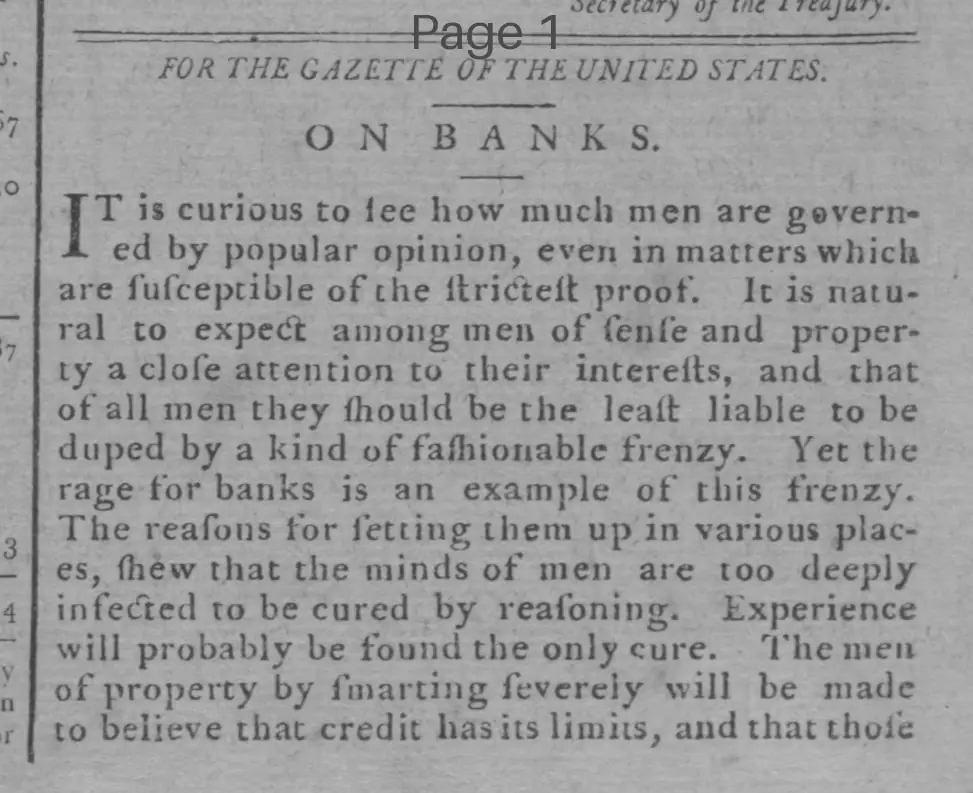
FOR THE GAZETTE OF THE UNITED STATES.
ON BANKS.
Led by popular opinion, even in matters which are susceptible of the strictest proof.
It is natural to expect among men of sense and property a close attention to their interests, and that of all men they should be the least liable to be duped by a kind of fashionable frenzy.
Yet the rage for banks is an example of this frenzy.
The reasons for setting them up in various places, show that the minds of men are too deeply infected to be cured by reasoning.
Experience will probably be found the only cure.
The men of property by smarting severely will be made to believe that credit has its limits, and that those Limits are contracted and not extended by the over multiplying these institutions.
Is the increase of banks likely to be useful to the trade and circulation of the country? Many are established—more are expected. Great errors of opinion on this head will end in great losses of property, as well as confusion public and private.
A bank is doubtless useful, and almost indispensably so to a trading nation—For by such means a man may make use of his credit as well as his money. His means of trading are increased in that proportion. He gains a new faculty—and this resource increases internal circulation.
The removing many of the obstacles which stagnate the circulation of the precious metals, is more useful than an increase of their quantity.
A good bank is so much confided in, that it may safely circulate its notes to the amount of two or three times its capital.
One great and principal resource for this safety and credit is, that all the money in a place will be lodged in its vaults for safe keeping—You have then all the credit and all the advantage of credit which there can be. Divide that specie however between several banks, what follows?
It seems to be understood that two banks will be found as good—again as one. The reverse perhaps is true. A new bank produces no new deposits of specie. There is not a dollar more money added to the circulation. A new bank divides the deposits of specie, and of course diminishes the advantages of credit. For it is manifest that two banks with small capitals, will do less than one bank with both capitals. The common demand for specie may be such as to drain the small capital to the last dollar, and in the critical events which the changes of trade and politics are constantly producing, such a small bank certainly will be shut up, unless it contracts its dealings within such limits as to be safe. Two banks in one town will do this for safety, and their mutual fears will narrow the circulation within what one bank could support. Suppose for illustration, a single bank in a town where three hundred thousand dollars is the amount of the ordinary specie deposit. The bank with a capital of as much more, is exposed to the least hazard in its dealings that the nature of things will permit.
It is altogether improbable that the whole specie will be called for at once. And this improbability gives to the bank paper its utmost circulation. The place has the whole advantage of its credit as well as money. Let us see whether by establishing three banks instead of one, the town has more than the whole—Let each bank have three hundred thousand dollars capital—Here then is three times the former capital, and each bank has but one third part of the deposits—If each bank goes on lending its bills, the circulation will be over-done three fold—of course the bills will be returned, and each bank confined to the limits of its part of the circulation. As it will have only a third of the deposits, it will be obliged in prudence to confine itself till more. Tho one bank might not be exposed to any great risk of having the whole specie taken off, each of the three banks will be exposed to it every day; and can guard against it only by contracting its dealings in proportion to the risk. It may happen any day that 100,000 dollars specie, the amount of deposit in each bank, shall be demanded; but it would be strange that 300,000 should be. The risk is not divided between the three, tho the profit is. Each runs the whole risk, and has one third only of the resource against it.
Besides the ordinary banking risks, each institution is in danger from the others—and this artificial danger is perhaps equal to all the others.
Numerous independent banks are besides unfit for extensive circulation, and as they occupy the local circulation, they neither give accommodation for great distances nor permit it to be given.
It may be said truly that two banks will offer double the amount of loans, and that this facility will induce many more persons to borrow.
If however the notes when lent out cannot be kept out circulating, they will be returned to the bank and exchanged. This will defeat the views of the bank, by depriving it of the profit arising from the use of its credit as a capital. If an extra sum, that is double the amount of the notes which one bank with the whole specie of the place would choose to circulate, should be thrown on the public, and kept circulating in consequence of setting up an additional bank, the mischief will fall on the community. Doubling the amount of the circulating medium, will inevitably depreciate the value of money. Debts will be paid with less value.
The specie in the country, with the paper of the bank of the United States, will probably be found sufficient for every purpose of trade and circulation. Adding what the banks already established will circulate, it cannot be believed that there is any necessity for new banks. They cannot be other than pernicious. They will set property afloat, and bring us in danger of such confusion and distress as happened in 1720.
ON BANKS.
Led by popular opinion, even in matters which are susceptible of the strictest proof.
It is natural to expect among men of sense and property a close attention to their interests, and that of all men they should be the least liable to be duped by a kind of fashionable frenzy.
Yet the rage for banks is an example of this frenzy.
The reasons for setting them up in various places, show that the minds of men are too deeply infected to be cured by reasoning.
Experience will probably be found the only cure.
The men of property by smarting severely will be made to believe that credit has its limits, and that those Limits are contracted and not extended by the over multiplying these institutions.
Is the increase of banks likely to be useful to the trade and circulation of the country? Many are established—more are expected. Great errors of opinion on this head will end in great losses of property, as well as confusion public and private.
A bank is doubtless useful, and almost indispensably so to a trading nation—For by such means a man may make use of his credit as well as his money. His means of trading are increased in that proportion. He gains a new faculty—and this resource increases internal circulation.
The removing many of the obstacles which stagnate the circulation of the precious metals, is more useful than an increase of their quantity.
A good bank is so much confided in, that it may safely circulate its notes to the amount of two or three times its capital.
One great and principal resource for this safety and credit is, that all the money in a place will be lodged in its vaults for safe keeping—You have then all the credit and all the advantage of credit which there can be. Divide that specie however between several banks, what follows?
It seems to be understood that two banks will be found as good—again as one. The reverse perhaps is true. A new bank produces no new deposits of specie. There is not a dollar more money added to the circulation. A new bank divides the deposits of specie, and of course diminishes the advantages of credit. For it is manifest that two banks with small capitals, will do less than one bank with both capitals. The common demand for specie may be such as to drain the small capital to the last dollar, and in the critical events which the changes of trade and politics are constantly producing, such a small bank certainly will be shut up, unless it contracts its dealings within such limits as to be safe. Two banks in one town will do this for safety, and their mutual fears will narrow the circulation within what one bank could support. Suppose for illustration, a single bank in a town where three hundred thousand dollars is the amount of the ordinary specie deposit. The bank with a capital of as much more, is exposed to the least hazard in its dealings that the nature of things will permit.
It is altogether improbable that the whole specie will be called for at once. And this improbability gives to the bank paper its utmost circulation. The place has the whole advantage of its credit as well as money. Let us see whether by establishing three banks instead of one, the town has more than the whole—Let each bank have three hundred thousand dollars capital—Here then is three times the former capital, and each bank has but one third part of the deposits—If each bank goes on lending its bills, the circulation will be over-done three fold—of course the bills will be returned, and each bank confined to the limits of its part of the circulation. As it will have only a third of the deposits, it will be obliged in prudence to confine itself till more. Tho one bank might not be exposed to any great risk of having the whole specie taken off, each of the three banks will be exposed to it every day; and can guard against it only by contracting its dealings in proportion to the risk. It may happen any day that 100,000 dollars specie, the amount of deposit in each bank, shall be demanded; but it would be strange that 300,000 should be. The risk is not divided between the three, tho the profit is. Each runs the whole risk, and has one third only of the resource against it.
Besides the ordinary banking risks, each institution is in danger from the others—and this artificial danger is perhaps equal to all the others.
Numerous independent banks are besides unfit for extensive circulation, and as they occupy the local circulation, they neither give accommodation for great distances nor permit it to be given.
It may be said truly that two banks will offer double the amount of loans, and that this facility will induce many more persons to borrow.
If however the notes when lent out cannot be kept out circulating, they will be returned to the bank and exchanged. This will defeat the views of the bank, by depriving it of the profit arising from the use of its credit as a capital. If an extra sum, that is double the amount of the notes which one bank with the whole specie of the place would choose to circulate, should be thrown on the public, and kept circulating in consequence of setting up an additional bank, the mischief will fall on the community. Doubling the amount of the circulating medium, will inevitably depreciate the value of money. Debts will be paid with less value.
The specie in the country, with the paper of the bank of the United States, will probably be found sufficient for every purpose of trade and circulation. Adding what the banks already established will circulate, it cannot be believed that there is any necessity for new banks. They cannot be other than pernicious. They will set property afloat, and bring us in danger of such confusion and distress as happened in 1720.
What sub-type of article is it?
Economic Policy
Trade Or Commerce
What keywords are associated?
Banks
Credit
Specie
Circulation
Economic Policy
Currency Depreciation
Trade
What entities or persons were involved?
Bank Of The United States
Men Of Property
Editorial Details
Primary Topic
Dangers Of Proliferating Banks
Stance / Tone
Critical Of Excessive Banks And Warning Of Economic Risks
Key Figures
Bank Of The United States
Men Of Property
Key Arguments
Multiple Banks Divide Specie Deposits Without Adding New Money
Smaller Banks Increase Risk Of Failure And Limit Credit Extension
Excess Banks Lead To Over Circulation And Currency Depreciation
One Bank Maximizes Credit And Circulation Benefits
New Banks Are Pernicious And Unnecessary Given Existing Institutions