Thank you for visiting SNEWPapers!
Sign up free
Richmond Enquirer
Richmond, Richmond County, Virginia
What is this article about?
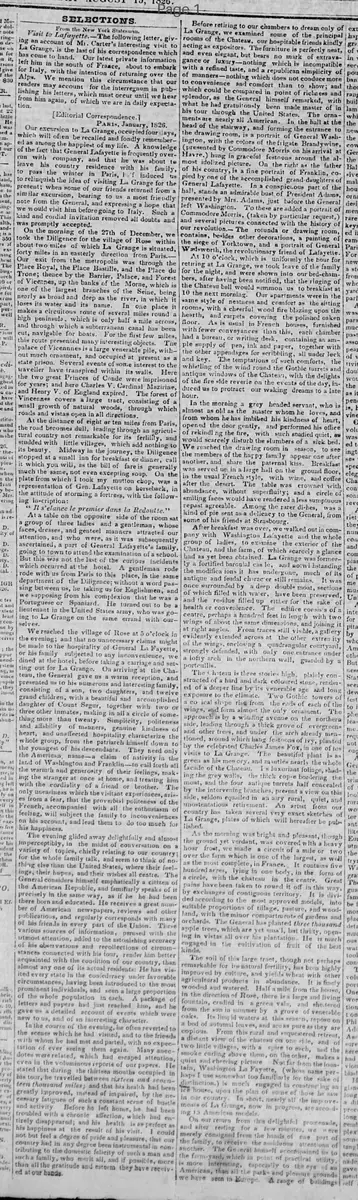
An American correspondent describes a delightful four-day visit to General Lafayette's family estate at La Grange, France, in late December 1825, highlighting the warm hospitality, American influences in the home and farm, and discussions on U.S. affairs.
Merged-components note: These components form a continuous article about a visit to Lafayette at La Grange, spanning page 1 (reading orders 39-41) and page 2 (reading order 43). The label is standardized to 'foreign_news' as it reports on international matters from a U.S. perspective; the page 2 portion was originally labeled 'story'.
Clippings
1 of 2
OCR Quality
Full Text
From the New York Statesman.
Visit to Lafayette.—The following letter, giving an account of M. Carter's interesting visit to La Grange, is the last of his correspondence which has come to hand. Our latest private information left him in the south of France, about to embark for Italy, with the intention of returning over the Alps. We mention this circumstance that our readers may account for the interregnum in publishing his letters, which must occur until we hear from him again, of which we are in daily expectation.
[Editorial Correspondence.]
PARIS, January, 1826.
Our excursion to La Grange, occupied four days, which will often be recalled and fondly remembered as among the happiest of my life. A knowledge of the fact that General Lafayette is frequently over-run with company, and that he was about to leave his country residence with his family, to pass the winter in Paris, had induced us to relinquish the idea of visiting La Grange for the present; when some of our friends returned from a similar excursion, bearing to us a most friendly note from the General, and expressing a hope that we would visit him before going to Italy. Such a kind and cordial invitation removed all doubts and was promptly accepted.
On the morning of the 27th of December, we took the Diligence for the village of Rosny within about two miles of which La Grange is situated, forty miles in an easterly direction from Paris.— Our exit from the metropolis was through the Place Royal, the Place Bastille, and the Place du Trone; thence by the Barrier, Palace, and Forest of Vincennes, up the banks of the Marne, which is one of the largest branches of the Seine, being nearly as broad and deep as the river, in which it loses its water and its name. In one place it makes a circuitous route of several miles round a high peninsula, which is only half a mile across, and through which a subterranean canal has been cut, navigable for boats. For the first few miles. this route presented many interesting objects. The palace of Vincennes is a large venerable pile, without much ornament, and occupied at present as a state prison. Several events of some interest to the traveller have transpired within its walls. Here the two great Princes of Conde were imprisoned for years; and here Charles V. Cardinal Mazarine, and Henry V. of England expired. The forest of Vincennes covers a large tract, consisting of a small growth of natural woods, through which roads and vistas open in all directions.
At the distance of eight or ten miles from Paris, the road becomes dull, leading through an agricultural country not remarkable for its fertility, and studded with little villages, which add nothing to its beauty. Midway in the journey, the Diligence stopped at a small inn for breakfast or dinner, call it which you will, as the bill of fare is generally much the same, not even excepting soup. On the plate from which I took my mutton chop, was a representation of Gen. Lafayette on horseback, in the attitude of storming a fortress, with the following inscription:
"Il s'élance le premier dans la Redoute."
At a table on the opposite side of the room sat a group of three ladies and a gentleman, whose faces, dresses, and genteel manners attracted our attention, and who were, as it was subsequently ascertained, a part of General Lafayette's family, going to town to attend the examination of a school. But this was not the last of the curious incidents which occurred at the hotel. A gentleman rode with us from Paris to this place, in the same department of the Diligence; without a word passing between us, he taking us for Englishmen, and we supposing from his complexion that he was a Portuguese or Spaniard. He turned out to be a lieutenant in the United States army, who was going to La Grange on the same errand with ourselves.
We reached the village of Rosny at 5 o'clock in the evening; and that no unnecessary claims might be made to the hospitality of General La Fayette, or his family subjected to any inconvenience, we dined at the hotel, before taking a carriage and setting out for La Grange. On arriving at the Chateau, the General gave us a warm reception, and presented us to his numerous and interesting family, consisting of a son, two daughters, and twelve grand children, with a beautiful and accomplished daughter of Count Segur, together with two or three other inmates, making in all a circle of something more than twenty. Simplicity, politeness and affability of manners, genuine kindness of heart, and unaffected hospitality characterize the whole group, from the patriarch himself down to the youngest of his descendants. They need only the American name—a claim of nativity in the land of Washington and Franklin—to call forth all the warmth and generosity of their feelings, making the stranger at once at home, and treating him with the cordiality of a friend or brother. The only uneasiness which the visitant experiences, arises from a fear, that the proverbial politeness of the French, accompanied with all the enthusiasm of feeling, will subject the family to inconveniences on his account, and lead them to do too much for his happiness.
The evening glided away delightfully and almost imperceptibly, in the midst of conversation on a variety of topics, chiefly relating to our country; for the whole family talk, and seem to think of nothing else than the United States, where their feelings, their hopes, and their wishes all centre. The General considers himself emphatically a citizen of the American Republic, and familiarly speaks of it precisely in the same way, as if he had been there born and educated. He receives a great number of American newspapers, reviews and other publications, and regularly corresponds with many of his friends in every part of the Union. These various sources of information, perused with the utmost attention, added to the astonishing accuracy of his observations and recollections of circumstances connected with his tour, render him better acquainted with the condition of our country, than almost any one of its actual residents: He has visited every state in the confederacy under favorable circumstances, having been introduced to the most prominent individuals, and seen a large proportion of the whole population in each. A package of letters and papers had just reached him, and he gave us a detailed account of events which were new to us, and of an interesting character.
In the course of the evening. he often reverted to the scenes which he had visited, and to the friends with whom he had met and parted, with no expectation of ever seeing them again. Many anecdotes were related, which had escaped attention, even in the voluminous reports of our papers. He stated that during the thirteen months occupied in his tour, he travelled between sixteen and seventeen thousand miles; and that his health had been greatly improved, instead of impaired, by the necessary fatigues of such a constant scene of bustle and activity Before he left home, he had been troubled with a chronic affection, which had entirely disappeared; and his health is as perfect as his happiness at the result of his visit. I could not but feel a degree of pride and pleasure, that our country had in any degree been instrumental in contributing to the domestic felicity of such a man and such a family, who merit all, and if possible, more than all the gratitude and esteem they have received at our hands.
Before retiring to our chambers to dream only of La Grange, we examined some of the principal rooms of the Chateau, our hospitable friends kindly acting as expositors. The furniture is perfectly neat, and even elegant, but bears no mark of extravagance or luxury—nothing which is incompatible with a refined taste, and a republican simplicity of manners—nothing which does not conduce more to convenience and comfort than to show; and which could be compared in point of richness and splendor, as the General himself remarked, with what he had gratuitously been made master of in his tour through the United States. The ornaments are nearly all American. In the hall at the head of the stairway, and forming the entrance to the drawing room, is a portrait of General Washington, with the colors of the frigate Brandywine, (presented by Commodore Morris on his arrival at Havre.) hung in graceful festoons around the almost idolized picture. On the right as the father of his country, is a fine portrait of Franklin, copied by one of the accomplished grand-daughters of General Lafayette. In a conspicuous part of the hall, stands an admirable bust of President Adams, presented by Mrs. Adams, just before the General left Washington. To these are added a portrait of Commodore Morris, (taken by particular request,) and several pictures connected with the history of our revolution.— The rotunda or drawing room, contains, besides other decorations, a painting of the siege of Yorktown, and a portrait of General Wadsworth, the revolutionary friend of Lafayette.
At 10 o'clock, which is uniformly the hour for retiring at La Grange, we took leave of the family for the night, and were shown into our bed-chambers, after having been notified, that the ringing of the Chateau bell would summon us to breakfast at 10 the next morning. Our apartments were in the same style of neatness and comfort as the sitting rooms, with a cheerful wood fire blazing upon the hearth, and carpets covering the polished oaken floor. As is usual in French houses, furnished with fewer conveniences than this, each chamber had a bureau, or writing desk, containing an ample supply of pen, ink and paper, together with the other appendages for scribbling, all under lock and key. The temptations of such comforts, the whistling of the wind round the Gothic turrets and antique windows of the Chateau, with the delights of the fire side reverie on the events of the day, induced us to protract our waking dreams to a late hour.
In the morning a grey headed servant, who is almost as old as the master whom he loves, and from whom he has imbibed his kindness of heart, opened the door gently, and performed his office of rekindling the fire, with such studied quiet, as would scarcely disturb the slumbers of a sick bed.
We reached the drawing room in season, to see the members of the happy family appear one after another, and share the paternal kiss. Breakfast was served up in a large hall on the ground floor, in the usual French style, with wine, and coffee after the desert. The table was crowned with abundance, without superfluity; and a circle of smiling faces would have rendered a less sumptuous repast agreeable. Among the rarer dishes, was a kind of pie sent as a delicacy to the General, from some of his friends at Strasbourg.
After breakfast was over, we walked out in company with Washington Lafayette and the whole group of ladies, to examine the exterior of the Chateau, and the farm, of which scarcely a glance had as yet been obtained. La Grange was formerly a fortified baronial castle, and notwithstanding the modifications it has undergone, much of its antique and feudal character still remains. It was once surrounded by a deep double moat, sections of which filled with water, have been preserved, and the residue filled up either for the sake of health or convenience. The edifice consists of a centre, perhaps a hundred feet in length with two wings of about the same dimensions, and joining it at right angles. From traces still visible, a gallery evidently extended across at the other extremity of the wings, enclosing a quadrangular courtyard, strongly defended, with only one entrance under a lofty arch in the northern wall, guarded by a portcullis.
The chateau is three stories high, plainly constructed of a hard and dark coloured stone, rendered of a deeper hue by its venerable age and long exposure to the climate. Two Gothic towers of a conical shape rise from the ends of each of the wings, and form almost the only ornament. The approach is by a winding avenue on the northern side, leading through a thick grove of evergreens and other trees, and under the arch already mentioned, around which hang festoons of ivy, planted by the celebrated Charles James Fox, in one of his visits to La Grange. The beautiful plant is as green as his memory, and mantles nearly the whole facade of the Chateau. Its luxuriant foliage, shading the grey walls, the thick copse bordering the moat, and the four antique turrets half concealed by the intervening branches, present a view on this side, seldom equalled in an airy rural, quiet, and unostentatious retirement. An artist from our country has taken several very exact sketches of La Grange, plates of which will hereafter be published.
As the morning was bright and pleasant, though the ground yet verdant, was covered with a heavy hoar frost, we made a circuit of a mile or two over the farm which is one of the largest, as well as the most complete, in France. It contains five hundred acres, lying in one body, in the form of a circle, with the chateau in the centre. Great pains have been taken to round it off in this way, by exchanges of contiguous territory. It is divided according to the most approved models, into suitable proportions of tillage, pasture, and woodland, with the minor compartments of gardens and orchards. The General has planted three thousand apple trees, which are yet small, but thrifty, opening in vistas all over his plantation— He is much engaged in the cultivation of fruit of the best kinds.
The soil of this large tract, though not perhaps remarkable for its natural fertility, has been highly improved by culture, and yields wheat with other agricultural products in abundance. It is finely wooded and watered. Half a mile from the house, in the direction of Rosny, there is a large and living fountain, cradled in a green vale, and sheltered from the sun in summer by a grove of venerable oaks. Its limpid waters at this season, repose on a bed of autumnal leaves, and are as pure as they are copious. From this rural and sequestered retreat, a distant view of the chateau on one side, and of two little villages, with a spire to each, and the smoke curling above them, on the other, makes a quiet and cheering picture Not far from the fountain, Washington La Fayette, (whose name perhaps I use somewhat too familiarly for the sake of distinction.) is much engaged in constructing an ice house, upon the plan of some of those he saw in our country. In short, nearly all the improvements of La Grange, now in progress, are according to American models.
On our return from this delightful promenade, and after resting for a few minutes, we were merely consigned from the hands of one part of the family, to receive the assiduous attentions of another. The General himself accompanied us to the farm-yard, which in point of practical utility, is more interesting, especially to the eye of an American, than all the park- and pleasure grounds we have seen in Europe. A range of buildings extends quite round an open area, containing perhaps an acre of ground. The first of these is the granary, which was once a chapel, and the turret of which is yet left standing. Men were at work in winnowing wheat of an excellent quality. The second department is appropriated to all kinds of poultry, among which are wild geese from the banks of the Mississippi. A flock of about a thousand merinos, prettily feeding at their long ranges of cribs, occupied another portion of the buildings. It was odd enough to see the little lambs bearing on their backs the same name, which had graced our triumphal arches; and to see the hero himself doting upon the construction of a new kind of piggery, upon a plan recommended in the American Farmer. Among the twenty-two cows, are eight from Switzerland, sent to the General by his friends in that country; and four of the Holkham breed, presented by Mr. Patterson, of Baltimore. The assortment of horses is as extensive as the other kinds of domestic animals. In making the circuit, we next came to the farm-house, kitchen and dairy, the walls of which are ornamented with a map of the whole plantation, designating the ground appropriated to each department. Then follows the pens containing several rare species of animals, among which are wild turkeys and partridges from the United States, (intended if possible, to be domesticated,) ducks which came as a present from the Garden of Plants, a Paris, and a pair of beautiful Mexican pheasants. For the latter, and for the American partridge, a new house is going up, to be artificially warmed by a stove. To these animals, may be added a dog from Washington, and a raccoon from our forests, who are inmates of the chateau, instead of the farm-yard. The latter is so tame, as to play about the parlour, and climb up into the General's lap.
At 5 o'clock, the bell called us to dinner, which was bountiful, and served up without any formal parade. Among the peculiar dishes were lentiles, much resembling boiled peas; and a rich kind of pastry, such as we had not found in the infinite assortment of a Paris table. A desert of apples, pears, and dry fruits, with three or four varieties of wine, including champaigne, crowned the festivities of the board. The General entertains no doubt, that the grape from which the latter is made would flourish in the United States; but whether the wine could be produced is more problematical, as it is confined to one province in France, and depends much on a peculiar quality of the soil. It is, however, my intention to send home slips of the vine, by way of experiment.
On retiring to the drawing room, a large folio volume, bound with red morocco, and richly gilt was found lying upon the table. It was presented to the general just before he sailed from Washington; and contains a transcript of all the addresses to him by the authorities of New York. These specimens of ornamental penmanship are certainly elegant, and have excited general admiration at the Chateau. By its side was a voluminous portfolio, containing portraits and autographs of public personages in France since the Commencement of the revolution—both brought out for our amusement.
After tea the ladies favored us with a great variety of songs and music upon the piano, which they play with much taste and skill. One of the number, finding that her voice and execution could contribute to the enjoyments of the social circle, and forgetting herself in endeavoring to add to the common stock of pleasure, continued to sit at the piano, till she was solicited to leave it, instead of the ordinary request to remain longer. This mark of politeness was so peculiar, that it appeared to me worthy of record and imitation. Among the musical pieces, was one or two composed in the United States, during the General's visit.
At 9 o'clock in the evening, we manifested an intention to return to Rosny that night, and set out for Paris next morning, desirous that if the hospitality of the family were not already exhausted by a visit, which seemed too long for strangers who had no other claim than simply that of being Americans, a share of it might be reserved for others, upon the republican principles of equality. But at La Grange, feelings of generosity and kindness towards even the humblest citizens of the U. States know no bounds. Favour after favour descends spontaneously upon the visitant like the dew; and in view of the paternal affection manifested on this occasion, our country might address to its illustrious benefactor the forcible apostrophe—"inasmuch as thou hast done it unto the least of these my children, thou hast done it unto me." Pretexts as plausible as genuine hospitality requires, were urged with a politeness that could not be resisted, and the result was a happy prolongation of our visit.
After breakfast on the following morning the General conducted us to his Library, which is on the third floor, in one corner of the Chateau. The windows, which in summer are shaded by a copse of trees lifting their aged branches from below, look in two directions and command a view of a rural domain such as Cincinnatus or Washington would have enjoyed, and such as its own proprietor would not exchange for an empire. In the anti-chamber, and the apartment itself, are several likenesses of his friends, transatlantic as well as European; and in several neat cases, on which the utmost care has been bestowed, are deposited all the little presents he has received from our countrymen, from the sacred memorials of his beloved Washington, down to the humblest pledges of gratitude and esteem collected in his late tour.— The whole makes an extensive museum, which is guarded with more vigilance, and is shown by this family with more delight, than would apparently be felt in exhibiting the costliest collection of diamonds. All the articles were taken out of their places for our inspection; and the history of them detailed with a familiarity, which proved how much they are valued. One of the most conspicuous of these memorials is a beautiful model of the waterworks at Philadelphia, which the General took to pieces, to point out the ingenuity of its construction.
The library itself contains about two thousand volumes of well selected books. A large proportion of these were presented by his friends.— One compartment is filled entirely with American works, containing a majority of our best publications. Additions are daily making to the collection, by the attentions of his correspondents. The Phi Beta Kappa Oration of Mr. Everett, and the Address of Mr. Webster before the Bunker Hill Association are cherished among the choicest treasures. It was a curious incident, that I should here recognize the copy of the Columbiad, which had been brought to me at New York a year previous, for examination as a specimen of splendid binding, before it was presented to Lafayette.
Having passed an hour or two in the library, and glanced at its interesting contents, we took another long walk with the ladies over the farm, pursuing a different route from what had been taken on the preceding day, and treading many a bye-path in a long circuit through the woodlands. A keen December air imparted an additional tinge to complexions naturally rosy; and to the eye of a poet. some of our fair companions, in their rambles thro tangled copses and groves of oak, might have seemed like Dryads. In the course of this promenade, one of the daughters of General Lafayette gave me a circumstantial account of his imprisonment at Olmutz, and of the sufferings both of himself and family. The story in long. and its legend
The following incidents would not be new to any of my readers. One little anecdote, however, which gave relief to the tragic tale, so much amused me that I cannot forbear to repeat it. In their flight through Germany, the female part of the General's family were obliged to assume the guise of English travellers, in order to elude the vigilance of their enemies. As they had some knowledge of the language, to which was added a similarity of national dress, they succeeded tolerably well among strangers. At length they were thrown in contact with an English waiting-maid, who had emigrated to the continent some years before. Serious fears of detection were here apprehended. But the poor girl entertaining no doubt, that the ladies were really English, although she found difficulty in understanding them; and as they were supposed to have left her native country at a much later period than herself, she came to the melancholy conclusion, that by a long residence abroad, she had lost her mother tongue!
In the midst of walks, conversations, and enjoyments like these, the hour of dinner again came round. By this time, our places at table had been as perfectly learned, as if we had become permanent inmates of the Chateau. Another evening of music and social pleasure was added to the sum of happiness. At 8 or 9 o'clock, an intention was again signified to go to Roß, in readiness for the Diligence the next morning. But "it would be madness to go to the hotel that night, where the accommodations were not good; besides, it was snowing, and the weather was unpleasant: a servant should be sent to engage places for us, and it would be easy to reach the village by 5 o'clock, the hour for the departure of the coach on the following day." In vain were any suggestions opposed to these kind persuasions; and at 10 o'clock we retired for the third night to the chambers of the Chateau.
The next morning at 7, we found both the General and his son in the drawing-room before us, with coffee upon the table, and his own coach at the door, in readiness to take us to Roß. In a few minutes more, a cordial grasp of the hand and the parting benediction of the patriarch, produced a state of feeling, which on our part admitted of few words; and we left La Grange with a full conviction, that if there is a paradise on earth, it must be found in the domestic, unsophisticated, and innocent delights of such a family, and if unalloyed happiness be the portion of any mortal, it must consist in the luxury of such feelings, and in the practice of such virtues, as are possessed by Gen. Lafayette.
What sub-type of article is it?
What keywords are associated?
What entities or persons were involved?
Where did it happen?
Foreign News Details
Primary Location
La Grange, France
Event Date
27th Of December 1825
Key Persons
Event Details
An American visitor describes a four-day stay at General Lafayette's Chateau de la Grange, including warm reception by the family, conversations about the United States, tours of the estate, farm, library, and American-influenced improvements and decorations.