Thank you for visiting SNEWPapers!
Sign up free
Story
March 18, 1866
The Daily Gate City
Keokuk, Lee County, Iowa
What is this article about?
Newspaper article from The Gate City excerpts A.D. Richardson's November 16, 1865, letter describing the rich gold and silver mines in Ruby City, Owyhee County, Idaho, including War Eagle Mountain's quartz ledges, Oro Fino and Morning Star mines, and profitable mill operations by Moore & Fogus.
Clipping
OCR Quality
85%
Good
Full Text
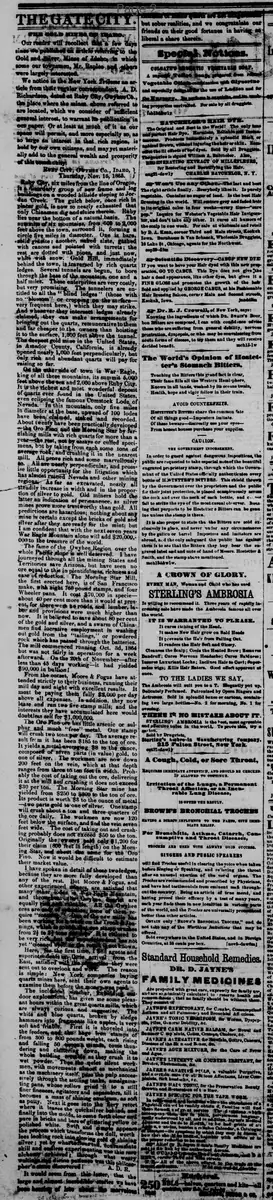
THE GATE CITY
FROM GOLD MINING REGIONS.
Our readers will recollect that a few days since we published an article referring to the Gold and Silver Mines of Idaho, in which some of our townsmen, Mr. Renlee Ppd. and others were largely interested.
We notice in the New York Tribune an article from their regular correspondent A. D. Richardson, dated at Ruby City, Owyhee Co., the place where the mines above referred to are located, which we consider of sufficient general interest, to warrant its publication in our paper; or at least as much of it as our space will permit, and more especially so, as our interest in that rich region, hold by our own citizens, and may yet materially add to the general wealth and prosperity of our city.
Ruby City, Owyhee Co., Idaho, Thursday, Nov. 16, 1865.
Ruby City, six miles from the line of Oregon, is a disorderly group of new frame and log buildings on a wooded hillside sloping to Jordan Creek. The gulch below, once rich in placer gold, is now so nearly exhausted that only Chinamen dig and sluice therein. Ruby lies near the bottom of a natural basin. The summits of all mountains, from 600 to 2,000 feet above the town, surround it, forming a circle five miles in diameter. One is bare, split granite; another, named slate, washed with canyons and pointed with turret; the rest, are dotted with pines and just now, white with snow. Gold Hill, immediately behind the town, is traversed by rich quartz ledges. Several tunnels are begun, to bore through the base of the mountain, one and a half miles. These enterprises are very costly, but very promising. The tunnelers are entitled to all the "blind ledges" (those with no, "blossom"; or cropping of the surface very frequent here,) which they may strike. And whenever they intersect ledges, already claimed; they can make arrangements for bringing out the quartz, remunerative to them and far cheaper to the owners than hoisting it to the surface, 1,500 feet above the tunnel. The deepest gold mine in the United States, in Amador County, California, is opened nearly, 1,000 feet perpendicularly, but "daily rich: and abundant quartz will pay for raising so
On the other side of town is War Eagle, king of all these mountains, its summit 5,000 feet above the sea and 2,000 above Ruby City. It is the richest and most wonderful deposit of quartz ever found in the United States, even eclipsing the famous Comstock Lode of Nevada. In this mountain, only five miles in diameter at the base, upward of 100 lodes have been claimed, staked and recorded. About twenty have been practically developed --the Oro Fino and the Morning Star by far, furnishing mills with rich quartz for more than a year-the rest, not by assays or culled specimens, but by taking from each some tons of average rock, and crushing it in the nearest mill. All prove rich and some marvellously so. All are nearly perpendicular, and promise little opportunity for the litigation which has almost ruined Nevada and other mining regions. As far as excavated, nearly all steadily increase in width and in the proportion of silver to gold. Old miners hold the latter an indication of permanence, as silver mines prove more trustworthy than gold. All predictions are hazardous; nothing about a mine is certain except the bricks of gold and silver after they are ready for the mint; but I am confident that with the next seven years War Eagle Mountain alone will add $20,000,000 to the treasure of the world.
The fame of the Owyhee Region over the whole Pacific slope is well deserved. I have journeyed through all the mining States and Territories save Arizona, but have seen no ore equal to this in plentifulness, richness and ease of reduction. The Morning Star Mill, the first erected here, is of San Francisco make, with eight 760 pound stamps, and four Wheeler pans. It cost $70,000 in specie- about 40 per cent more than it would at present, for there were no roads, and lumber, labor and provisions were much higher than now. It is believed to save about 90 per cent of the gold and silver, and a swarm of Chinamen find lucrative employment in washing out gold from the "tailings," or powdered rock which has passed through the batteries. The mill commenced running Oct. 3d, 1864 but was not fairly in operation for a week afterward. On the 20th of November--after less than 45 days working-it had yielded $90,000 in bullion!
From the outset, Moore & Fogus have attended strictly to their business, running their mill day and night with excellent results. It must be paying them fully $2,000 per day above all expenses. In addition, they now lease and run two five-stamp mills; and the interests they have accumulated here would doubtless sell for $1,000,000
The Oro Fino-ore has little arsenic or sulphur and much "free metal. One stamp will crush two tons per day. The average result from it has been $185 to the ton of ore. It yields a metal averaging $8 to the ounce, composed of seven parts (in value) gold, to one of silver. The workmen are now down 200 feet on the vein, which at that depth ranges from three to ten feet in width. Probably the cost of taking out the ore, delivering it at the mill and crushing it does not exceed $30 per ton. The Morning Star mine has yielded from $250 to $300 to the ton of ore. Its product is worth $8 to the ounce of metal -two parts gold to one of silver. One stamp will crush about a ton and three-quarters of the ore daily. The workmen are now 120 feet below the surface, and find the vein seven feet wide. The cost of taking out and crushing probably does not exceed $50 to the ton. Originally the owners paid only $1,200 for their claim (800 feet in length) on the Morning Star, and about the same for the Oro Fino. Now it would be difficult to estimate their market value.
I have spoken in detail of these two ledges, because they are more fully developed than any of the rest. But Moore & Fogus, and other experienced persons, are satisfied that many other ledges in the mountain, and through War Eagle are equally rich. Owyhee ores are none of them refractory, and require no roasting. Some workings, we are told, yield from $24 to $200 to the ton, but have not yet "cleaned up," so their exact value is not known.
Here, for the first time, I find agents and superintendents from the East, satisfied. They were sent out to overlook and work. The reason is simple: New York companies buying quartz mines here, sent their own agents to examine them before the money was paid. The inclement weather, brooding out door explorations, has given me some pleasant hours within the great quartz mills, which are always curious, and suggestive. The white and blue quartz, broken by sledge hammers into fragments like apples, is very soft and friable. First it is shoveled into the feeders and the huge Iron stamps of from 300 to 800 pounds weight, each rising and falling 50 times a minute, come thundering and clattering down, making the whole building tremble as they crush it to wet powder. Then the quiet silent workmen, with movements almost as mechanical as the machinery itself, pass the pulp successively through the settling ting pans, whose rollers grind it to a still finer fineness, agitators and separators, till it becomes a mass of shining amalgam, as soft as putty. Next it goes into the fiery retort where it leaves the quicksilver behind, and finally into the molds, to come forth clean and pure in bricks and bars of glittering yellow or polished white. Swift and simple appears the process which transforms the dull, worthless looking rock into glowing gold or shining silver; yet by what countless trials, toilsome experimenting was this rare alchemy perfected. What a valuable discovery was this philosophy. A.D. R.
It would seem from this letter, that the large and almost incredible stories we have
FROM GOLD MINING REGIONS.
Our readers will recollect that a few days since we published an article referring to the Gold and Silver Mines of Idaho, in which some of our townsmen, Mr. Renlee Ppd. and others were largely interested.
We notice in the New York Tribune an article from their regular correspondent A. D. Richardson, dated at Ruby City, Owyhee Co., the place where the mines above referred to are located, which we consider of sufficient general interest, to warrant its publication in our paper; or at least as much of it as our space will permit, and more especially so, as our interest in that rich region, hold by our own citizens, and may yet materially add to the general wealth and prosperity of our city.
Ruby City, Owyhee Co., Idaho, Thursday, Nov. 16, 1865.
Ruby City, six miles from the line of Oregon, is a disorderly group of new frame and log buildings on a wooded hillside sloping to Jordan Creek. The gulch below, once rich in placer gold, is now so nearly exhausted that only Chinamen dig and sluice therein. Ruby lies near the bottom of a natural basin. The summits of all mountains, from 600 to 2,000 feet above the town, surround it, forming a circle five miles in diameter. One is bare, split granite; another, named slate, washed with canyons and pointed with turret; the rest, are dotted with pines and just now, white with snow. Gold Hill, immediately behind the town, is traversed by rich quartz ledges. Several tunnels are begun, to bore through the base of the mountain, one and a half miles. These enterprises are very costly, but very promising. The tunnelers are entitled to all the "blind ledges" (those with no, "blossom"; or cropping of the surface very frequent here,) which they may strike. And whenever they intersect ledges, already claimed; they can make arrangements for bringing out the quartz, remunerative to them and far cheaper to the owners than hoisting it to the surface, 1,500 feet above the tunnel. The deepest gold mine in the United States, in Amador County, California, is opened nearly, 1,000 feet perpendicularly, but "daily rich: and abundant quartz will pay for raising so
On the other side of town is War Eagle, king of all these mountains, its summit 5,000 feet above the sea and 2,000 above Ruby City. It is the richest and most wonderful deposit of quartz ever found in the United States, even eclipsing the famous Comstock Lode of Nevada. In this mountain, only five miles in diameter at the base, upward of 100 lodes have been claimed, staked and recorded. About twenty have been practically developed --the Oro Fino and the Morning Star by far, furnishing mills with rich quartz for more than a year-the rest, not by assays or culled specimens, but by taking from each some tons of average rock, and crushing it in the nearest mill. All prove rich and some marvellously so. All are nearly perpendicular, and promise little opportunity for the litigation which has almost ruined Nevada and other mining regions. As far as excavated, nearly all steadily increase in width and in the proportion of silver to gold. Old miners hold the latter an indication of permanence, as silver mines prove more trustworthy than gold. All predictions are hazardous; nothing about a mine is certain except the bricks of gold and silver after they are ready for the mint; but I am confident that with the next seven years War Eagle Mountain alone will add $20,000,000 to the treasure of the world.
The fame of the Owyhee Region over the whole Pacific slope is well deserved. I have journeyed through all the mining States and Territories save Arizona, but have seen no ore equal to this in plentifulness, richness and ease of reduction. The Morning Star Mill, the first erected here, is of San Francisco make, with eight 760 pound stamps, and four Wheeler pans. It cost $70,000 in specie- about 40 per cent more than it would at present, for there were no roads, and lumber, labor and provisions were much higher than now. It is believed to save about 90 per cent of the gold and silver, and a swarm of Chinamen find lucrative employment in washing out gold from the "tailings," or powdered rock which has passed through the batteries. The mill commenced running Oct. 3d, 1864 but was not fairly in operation for a week afterward. On the 20th of November--after less than 45 days working-it had yielded $90,000 in bullion!
From the outset, Moore & Fogus have attended strictly to their business, running their mill day and night with excellent results. It must be paying them fully $2,000 per day above all expenses. In addition, they now lease and run two five-stamp mills; and the interests they have accumulated here would doubtless sell for $1,000,000
The Oro Fino-ore has little arsenic or sulphur and much "free metal. One stamp will crush two tons per day. The average result from it has been $185 to the ton of ore. It yields a metal averaging $8 to the ounce, composed of seven parts (in value) gold, to one of silver. The workmen are now down 200 feet on the vein, which at that depth ranges from three to ten feet in width. Probably the cost of taking out the ore, delivering it at the mill and crushing it does not exceed $30 per ton. The Morning Star mine has yielded from $250 to $300 to the ton of ore. Its product is worth $8 to the ounce of metal -two parts gold to one of silver. One stamp will crush about a ton and three-quarters of the ore daily. The workmen are now 120 feet below the surface, and find the vein seven feet wide. The cost of taking out and crushing probably does not exceed $50 to the ton. Originally the owners paid only $1,200 for their claim (800 feet in length) on the Morning Star, and about the same for the Oro Fino. Now it would be difficult to estimate their market value.
I have spoken in detail of these two ledges, because they are more fully developed than any of the rest. But Moore & Fogus, and other experienced persons, are satisfied that many other ledges in the mountain, and through War Eagle are equally rich. Owyhee ores are none of them refractory, and require no roasting. Some workings, we are told, yield from $24 to $200 to the ton, but have not yet "cleaned up," so their exact value is not known.
Here, for the first time, I find agents and superintendents from the East, satisfied. They were sent out to overlook and work. The reason is simple: New York companies buying quartz mines here, sent their own agents to examine them before the money was paid. The inclement weather, brooding out door explorations, has given me some pleasant hours within the great quartz mills, which are always curious, and suggestive. The white and blue quartz, broken by sledge hammers into fragments like apples, is very soft and friable. First it is shoveled into the feeders and the huge Iron stamps of from 300 to 800 pounds weight, each rising and falling 50 times a minute, come thundering and clattering down, making the whole building tremble as they crush it to wet powder. Then the quiet silent workmen, with movements almost as mechanical as the machinery itself, pass the pulp successively through the settling ting pans, whose rollers grind it to a still finer fineness, agitators and separators, till it becomes a mass of shining amalgam, as soft as putty. Next it goes into the fiery retort where it leaves the quicksilver behind, and finally into the molds, to come forth clean and pure in bricks and bars of glittering yellow or polished white. Swift and simple appears the process which transforms the dull, worthless looking rock into glowing gold or shining silver; yet by what countless trials, toilsome experimenting was this rare alchemy perfected. What a valuable discovery was this philosophy. A.D. R.
It would seem from this letter, that the large and almost incredible stories we have
What sub-type of article is it?
Historical Event
Curiosity
Adventure
What themes does it cover?
Triumph
Exploration
Fortune Reversal
What keywords are associated?
Gold Mining
Silver Mines
Quartz Ledges
War Eagle Mountain
Ruby City
Owyhee County
Mill Operations
Ore Yields
What entities or persons were involved?
A. D. Richardson
Mr. Renlee Ppd.
Moore & Fogus
Where did it happen?
Ruby City, Owyhee Co., Idaho
Story Details
Key Persons
A. D. Richardson
Mr. Renlee Ppd.
Moore & Fogus
Location
Ruby City, Owyhee Co., Idaho
Event Date
1865 11 16
Story Details
A.D. Richardson describes the rich quartz mines on War Eagle Mountain near Ruby City, including developed ledges like Oro Fino and Morning Star yielding high gold and silver values, profitable mill operations starting in 1864, and predictions of vast future wealth from the region.