Thank you for visiting SNEWPapers!
Sign up free
Gazette Of The United States & Evening Advertiser
Philadelphia, Philadelphia County, Pennsylvania
What is this article about?
U.S. House of Representatives proceedings on January 22-23: received letters on U.S.-British correspondence and Creek Indian peace proposals; debated and passed military establishment bill; introduced bankruptcy bill; discussed Baltimore memorial and Madison's commercial resolutions; received presidential message on British relations and European neutral trade issues; handled petitions and French vessel tonnage remission.
Clipping
OCR Quality
Full Text
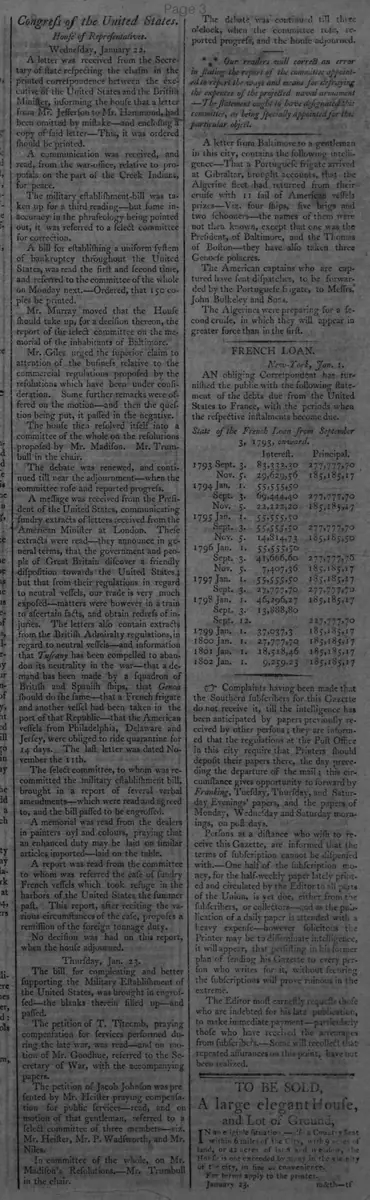
House of Representatives.
Wednesday, January 22.
A letter was received from the Secretary of state respecting the chasm in the printed correspondence between the executive of the United States and the British Minister, informing the house that a letter from Mr. Jefferson to Mr. Hammond, had been omitted by mistake—and enclosing a copy of said letter—This, it was ordered should be printed.
A communication was received, and read, from the war-office, relative to proposals on the part of the Creek Indians, for peace.
The military establishment-bill was taken up for a third reading—but some inaccuracy in the phraseology being pointed out, it was referred to a select committee for correction.
A bill for establishing a uniform system of bankruptcy throughout the United States, was read the first and second time, and referred to the committee of the whole on Monday next.—Ordered, that 150 copies be printed.
Mr. Murray moved that the House should take up, for a decision thereon, the report of the select committee on the memorial of the inhabitants of Baltimore.
Mr. Giles urged the superior claim to attention of the business relative to the commercial regulations proposed by the resolutions which have been under consideration. Some further remarks were offered on the motion—and then the question being put, it passed in the negative.
The house then resolved itself into a committee of the whole on the resolutions proposed by Mr. Madison. Mr. Trumbull in the chair.
The debate was renewed, and continued till near the adjournment—when the committee rose and reported progress.
A message was received from the President of the United States, communicating sundry extracts of letters received from the American Minister at London. These extracts were read—they announce in general terms, that the government and people of Great Britain discover a friendly disposition towards the United States : but that from their regulations in regard to neutral vessels, our trade is very much exposed—matters were however in a train to ascertain facts, and obtain redress of injuries. The letters also contain extracts from the British Admiralty regulations, in regard to neutral vessels and information that Tuscany has been compelled to abandon its neutrality in the war—that a demand has been made by a squadron of British and Spanish ships, that Genoa should do the same—that a French frigate and another vessel had been taken in the port of that Republic—that the American vessels from Philadelphia, Delaware and Jersey, were obliged to ride quarantine for 14 days. The last letter was dated November the 11th.
The select committee, to whom was re-committed the military establishment bill, brought in a report of several verbal amendments—which were read and agreed to, and the bill passed to be engrossed.
A memorial was read from the dealers in painters oil and colours, praying that an enhanced duty may be laid on similar articles imported—laid on the table.
A report was read from the committee to whom was referred the case of sundry French vessels which took refuge in the harbors of the United States the summer past. This report, after reciting the various circumstances of the case, proposes a remission of the foreign tonnage duty.
No decision was had on this report, when the house adjourned.
Thursday, Jan. 23.
The bill for completing and better supporting the Military Establishment of the United States, was brought in engrossed—the blanks therein filled up—and passed.
The petition of T. Titcomb, praying compensation for services performed during the late war, was read—and on motion of Mr. Goodhue, referred to the Secretary of War, with the accompanying papers.
The petition of Jacob Johnson was presented by Mr. Heister praying compensation for public services—read, and on motion of that gentleman, referred to a select committee of three members—viz. Mr. Heister, Mr. P. Wadsworth, and Mr. Giles.
In committee of the whole, on Mr. Madison's Resolutions.—Mr. Trumbull in the chair.
The debate was continued till three o'clock, when the committee rose, reported progress, and the house adjourned.
What sub-type of article is it?
What keywords are associated?
What entities or persons were involved?
Where did it happen?
Domestic News Details
Primary Location
United States
Event Date
Wednesday, January 22 And Thursday, Jan. 23
Key Persons
Outcome
military establishment bill passed; bankruptcy bill referred; debates on madison's resolutions continued; various petitions and reports received and referred; no decision on french vessels tonnage remission.
Event Details
House proceedings included receiving and printing omitted correspondence between Jefferson and Hammond; war-office communication on Creek Indians peace proposals; correction and passage of military establishment bill; introduction and printing of bankruptcy bill; motion on Baltimore memorial rejected; committee of the whole debate on Madison's commercial resolutions; presidential message on British relations and European neutral trade issues; memorial from painters oil dealers laid on table; report proposing remission of tonnage duty for French vessels with no decision; petitions from T. Titcomb and Jacob Johnson referred.