Thank you for visiting SNEWPapers!
Sign up free
Story
September 19, 1909
Bismarck Daily Tribune
Bismarck, Burleigh County, North Dakota
What is this article about?
Article explores hypothetical comet-Earth collision effects: catastrophe from boulder impacts, imperceptible dust due to atmospheric fusion, possible gas discomfort; highlights daily meteor protection and comet-meteor link, per Ralph B. Larkin.
Clipping
OCR Quality
95%
Excellent
Full Text
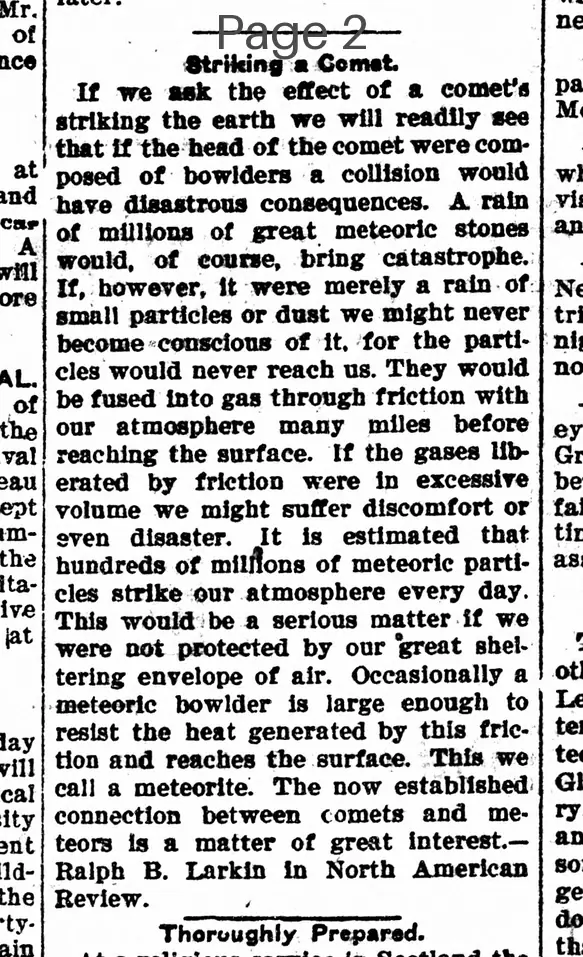
Striking a Comet.
If we ask the effect of a comet's
striking the earth we will readily see
that if the head of the comet were composed of bowlders a collision would
have disastrous consequences. A rain
of millions of great meteoric stones
would, of course, bring catastrophe.
If, however, it were merely a rain of
small particles or dust we might never
become conscious of it, for the particles would never reach us. They would
be fused into gas through friction with
our atmosphere many miles before
reaching the surface. If the gases liberated by friction were in excessive
volume we might suffer discomfort or
even disaster. It is estimated that
hundreds of millions of meteoric particles strike our atmosphere every day.
This would be a serious matter if we
were not protected by our great sheltering envelope of air. Occasionally a
meteoric bowlder is large enough to
resist the heat generated by this friction and reaches the surface. This we
call a meteorite. The now established
connection between comets and meteors is a matter of great interest.
Ralph B. Larkin in North American
Review.
If we ask the effect of a comet's
striking the earth we will readily see
that if the head of the comet were composed of bowlders a collision would
have disastrous consequences. A rain
of millions of great meteoric stones
would, of course, bring catastrophe.
If, however, it were merely a rain of
small particles or dust we might never
become conscious of it, for the particles would never reach us. They would
be fused into gas through friction with
our atmosphere many miles before
reaching the surface. If the gases liberated by friction were in excessive
volume we might suffer discomfort or
even disaster. It is estimated that
hundreds of millions of meteoric particles strike our atmosphere every day.
This would be a serious matter if we
were not protected by our great sheltering envelope of air. Occasionally a
meteoric bowlder is large enough to
resist the heat generated by this friction and reaches the surface. This we
call a meteorite. The now established
connection between comets and meteors is a matter of great interest.
Ralph B. Larkin in North American
Review.
What sub-type of article is it?
Curiosity
Extraordinary Event
Disaster
What themes does it cover?
Catastrophe
Nature
What keywords are associated?
Comet Impact
Meteoric Stones
Atmospheric Friction
Meteorites
Comets And Meteors
What entities or persons were involved?
Ralph B. Larkin
Where did it happen?
Earth's Atmosphere
Story Details
Key Persons
Ralph B. Larkin
Location
Earth's Atmosphere
Story Details
Speculates on effects of a comet striking Earth: disastrous if composed of boulders causing a rain of meteoric stones; imperceptible if dust particles fused by atmospheric friction; potential discomfort from excessive gases; notes daily meteor impacts protected by air, occasional meteorites, and connection between comets and meteors.