Thank you for visiting SNEWPapers!
Sign up free
Daily Evening Star
Washington, District Of Columbia
What is this article about?
Editorial on the Homestead Question urges resolution of public domain policy through Senator Hunter's bill, featuring graduated land prices down to 25 cents per acre, state pre-emption rights, homestead grants to settlers, and provisions for railroads and canals, balancing old and new states' interests.
Clipping
OCR Quality
Full Text
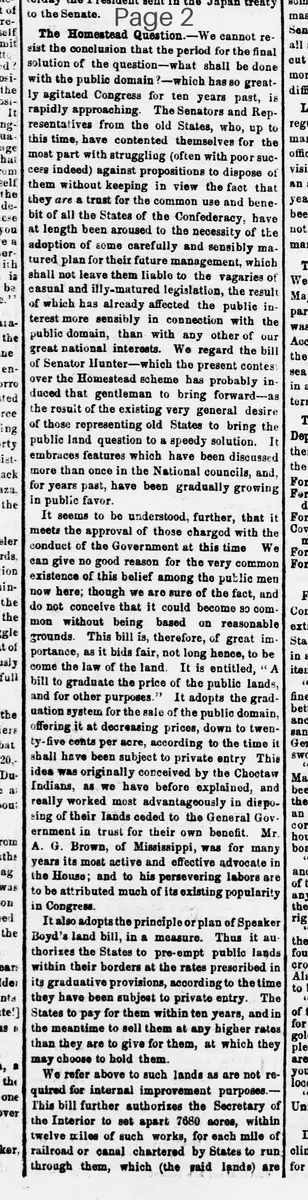
solution of the question what shall be done
with the public domain? which has so greatly agitated Congress for ten years past, is
rapidly approaching. The Senators and Representatives from the old States, who, up to
this time, have contented themselves for the
most part with struggling (often with poor success indeed) against propositions to dispose of
them without keeping in view the fact that
they are a trust for the common use and benefit of all the States of the Confederacy, have
at length been aroused to the necessity of the
adoption of some carefully and sensibly matured plan for their future management, which
shall not leave them liable to the vagaries of
casual and illy-matured legislation, the result
of which has already affected the public interest more sensibly in connection with the
public domain, than with any other of our
great national interests. We regard the bill
of Senator Hunter which the present contest
over the Homestead scheme has probably induced that gentleman to bring forward as
the result of the existing very general desire
of those representing old States to bring the
public land question to a speedy solution. It
embraces features which have been discussed
more than once in the National councils, and,
for years past, have been gradually growing
in public favor.
It seems to be understood, further, that it
meets the approval of those charged with the
conduct of the Government at this time. We
can give no good reason for the very common
existence of this belief among the public men
now here; though we are sure of the fact, and
do not conceive that it could become so common without being based on reasonable
grounds. This bill is, therefore, of great importance, as it bids fair, not long hence, to become the law of the land. It is entitled, "A
bill to graduate the price of the public lands,
and for other purposes." It adopts the graduation system for the sale of the public domain.
offering it at decreasing prices, down to twenty-five cents per acre, according to the time it
shall have been subject to private entry. This
idea was originally conceived by the Choctaw
Indians, as we have before explained, and
really worked most advantageously in disposing of their lands ceded to the General Government in trust for their own benefit. Mr.
A. G. Brown, of Mississippi, was for many
years its most active and effective advocate in
the House; and to his persevering labors are
to be attributed much of its existing popularity in Congress.
It also adopts the principle or plan of Speaker Boyd's land bill, in a measure. Thus it authorizes the States to pre-empt public lands
within their borders at the rates prescribed in
its graduative provisions, according to the time
they have been subject to private entry. The
States to pay for them within ten years, and in
the meantime to sell them at any higher rates
than they are to give for them, at which they
may choose to hold them.
We refer above to such lands as are not required for internal improvement purposes.
This bill further authorizes the Secretary of
the Interior to set apart 7680 acres, within
twelve miles of such works, for each mile of
railroad or canal chartered by States to run
through them, which (the said lands) are
to be withdrawn from sale or entry, and
are also to be paid for by these same States
upon the graduation principle, within ten
years from the time when so set apart. The
State, however, may sell them within the ten
years. This provision is not to apply to town
or village property. The bill in question also
grants a homestead of a quarter section to actual settlers, heads of families, for twenty-five
cents per acre, or for twelve and a half cents
per acre if the tract has been more than twenty
years in market, to be paid in five years after
being thus taken up.
The ninth section secures the proceeds of the sale of lands so taken up, to the children of the settler, in case of his death, after paying what may be due the United States on its account; and the eleventh section guards against frauds under the pretense of
making such settlement.
We repeat, from present appearances this
carefully-matured bill seems very likely to
embrace the principles and features on which
the great public land controversy between the
old and new States, is destined to be finally
settled.
What sub-type of article is it?
What themes does it cover?
What keywords are associated?
What entities or persons were involved?
Where did it happen?
Story Details
Key Persons
Location
United States Public Domain
Story Details
Senator Hunter's bill proposes graduated pricing of public lands from decreasing rates to 25 cents per acre based on time in market, state pre-emption rights with payment over ten years, land reservations for railroads and canals paid on graduation principle, and homestead grants of quarter sections to family heads at reduced rates payable in five years, securing inheritance for children and preventing frauds, aiming to resolve the decade-long controversy between old and new states.