Thank you for visiting SNEWPapers!
Sign up free
Editorial
September 20, 1800
Gazette Of The United States, & Daily Advertiser
Philadelphia, Philadelphia County, Pennsylvania
What is this article about?
This editorial column celebrates the impact of Rev. Abercrombie's sermon opposing Thomas Jefferson's election, noting widespread clerical support against deism and French influences. It defends the preacher against attacks from Jeffersonian papers and mentions other submissions and observations.
Merged-components note: Continuation of editorial column discussing political and literary topics
Clipping
OCR Quality
95%
Excellent
Full Text
To Readers and Correspondents.
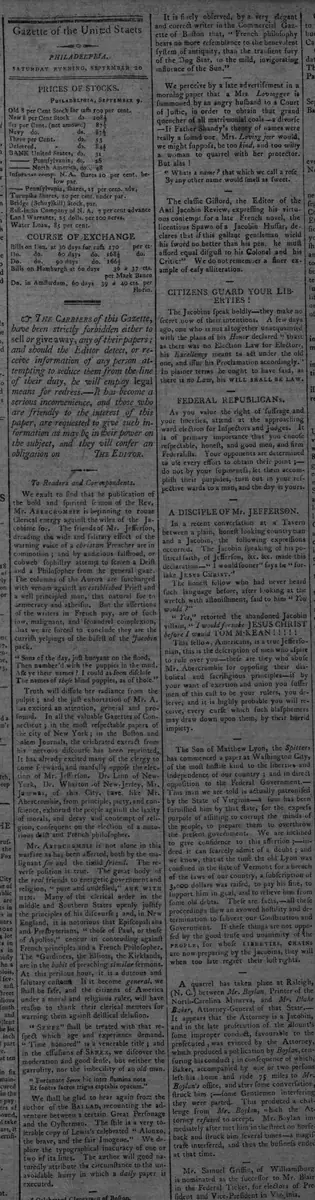
We exult to find that the publication of the bold and spirited sermon of the Rev. Mr. ABERCROMBIE is beginning to rouse Clerical energy against the wiles of the Ja-cobinic foe. The friends of Mr. Jefferson, dreading the wide and salutary effect of the warning voice of a Christian Preacher are in commotion; and by audacious falsehood, or cobweb sophistry attempt to screen a Deist and a Philosopher from the general gaze. The columns of the Aurora are surcharged with venom against an established Priest and a well principled man, that natural foe to democracy and atheism. But the assertions of the writers in French pay, are of such low, malignant, and scoundrel complexion, that we are forced to conclude they are the currish yelpings of the basest of the Jacobin pack.
"Sons of the day, just buoyant on the flood,
Then number'd with the puppies in the mud,
Ask ye their names? I could as soon disclose
The names of these blind puppies, as of those."
Truth will diffuse her radiance from the pulpit; and the just exhortation of Mr. A. has excited an attention, general and profound. In all the valuable Gazettes of Connecticut; in the most respectable papers of the city of New York; in the Boston and Salem Journals, the celebrated extract from his nervous discourse has been reprinted. It has already excited many of the clergy to come forward, and manfully oppose the election of Mr. Jefferson. Dr. Linn of New-York, Dr. Wharton of New-Jersey, Mr. Janeway, of this City, have, like Mr. Abercrombie, from principle, piety, and conscience, exhorted the people against the laxity of morals, and decay and contempt of religion, consequent on the election of a notorious deist and French philosopher.
Mr. ABERCROMBIE is not alone in this warfare as has been asserted, both by the malignant foe and the timid friend. The reverse position is true. The great body of the real friends to energetic government and religion, "pure and undefiled," ARE WITH HIM. Many of the clerical order in the middle and Southern States openly justify the principles of his discourse; and, in New England, it is notorious that Episcopalians and Presbyterians, "those of Paul, or those of Apollos," concur in contending against French principles and a French Philosopher. The Gardiners, the Eliots, the Kirklands, are in the habit of preaching similar sermons. At this perilous hour, it is a duteous and salutary custom If it become general, we shall be safe, and the citizens of America under a moral and religious ruler, will have reason to thank their clerical mentors for warning them against deistical delusion.
"Senex" shall be treated with that respect which age and experience demand. "Time honored" is a venerable title: and in the effusions of SENEX, we discover the moderation and good sense, but neither the garrulity, nor the imbecility of an old man.
"Fortunate Senex hic inter flumina nota
Et fontes sacros trigus captabis opacum."
We shall be glad to hear again from the author of the BALLAD, recounting the adventure between a certain Great Personage and the Oyster-man. The stile is a very tolerable copy of Lewis's celebrated "Alonzo, the brave, and the fair Imogene." We de-plore the typographical inaccuracy of one or two of its lines. The author will good naturedly attribute the circumstance to the unavoidable hurry in which a daily paper is executed.
It is finely observed, by a very elegant and correct writer in the Commercial Gazette of Boston that, "French philosophy bears no more resemblance to the benevolent system of antiquity, than the transient fury of the Dog Star, to the mild, invigorating influence of the Sun."
We perceive by a late advertisement in a morning paper that a Mrs. Lovingger is summoned by an angry husband to a Court of Justice, in order to obtain that grand quencher of all matrimonial coals--a divorce --If Father Shandy's theory of names were really a sound one, Mrs. Loving jeer would, we might suppose, be too kind, and too witty a woman to quarrel with her protector. But alas!
"What's a name? that which we call a rose By any other name would smell as sweet."
The classic Gifford, the Editor of the Anti Jacobin Review, expressing his virtuous contempt for a late French novel, the licentious Spawn of a Jacobin Hussar, de-clares that if this gallant gentleman wield his sword no better than his pen, he must afford equal disgust to his Colonel and his Critic:
We do not remember a finer example of easy alliteration.
We exult to find that the publication of the bold and spirited sermon of the Rev. Mr. ABERCROMBIE is beginning to rouse Clerical energy against the wiles of the Ja-cobinic foe. The friends of Mr. Jefferson, dreading the wide and salutary effect of the warning voice of a Christian Preacher are in commotion; and by audacious falsehood, or cobweb sophistry attempt to screen a Deist and a Philosopher from the general gaze. The columns of the Aurora are surcharged with venom against an established Priest and a well principled man, that natural foe to democracy and atheism. But the assertions of the writers in French pay, are of such low, malignant, and scoundrel complexion, that we are forced to conclude they are the currish yelpings of the basest of the Jacobin pack.
"Sons of the day, just buoyant on the flood,
Then number'd with the puppies in the mud,
Ask ye their names? I could as soon disclose
The names of these blind puppies, as of those."
Truth will diffuse her radiance from the pulpit; and the just exhortation of Mr. A. has excited an attention, general and profound. In all the valuable Gazettes of Connecticut; in the most respectable papers of the city of New York; in the Boston and Salem Journals, the celebrated extract from his nervous discourse has been reprinted. It has already excited many of the clergy to come forward, and manfully oppose the election of Mr. Jefferson. Dr. Linn of New-York, Dr. Wharton of New-Jersey, Mr. Janeway, of this City, have, like Mr. Abercrombie, from principle, piety, and conscience, exhorted the people against the laxity of morals, and decay and contempt of religion, consequent on the election of a notorious deist and French philosopher.
Mr. ABERCROMBIE is not alone in this warfare as has been asserted, both by the malignant foe and the timid friend. The reverse position is true. The great body of the real friends to energetic government and religion, "pure and undefiled," ARE WITH HIM. Many of the clerical order in the middle and Southern States openly justify the principles of his discourse; and, in New England, it is notorious that Episcopalians and Presbyterians, "those of Paul, or those of Apollos," concur in contending against French principles and a French Philosopher. The Gardiners, the Eliots, the Kirklands, are in the habit of preaching similar sermons. At this perilous hour, it is a duteous and salutary custom If it become general, we shall be safe, and the citizens of America under a moral and religious ruler, will have reason to thank their clerical mentors for warning them against deistical delusion.
"Senex" shall be treated with that respect which age and experience demand. "Time honored" is a venerable title: and in the effusions of SENEX, we discover the moderation and good sense, but neither the garrulity, nor the imbecility of an old man.
"Fortunate Senex hic inter flumina nota
Et fontes sacros trigus captabis opacum."
We shall be glad to hear again from the author of the BALLAD, recounting the adventure between a certain Great Personage and the Oyster-man. The stile is a very tolerable copy of Lewis's celebrated "Alonzo, the brave, and the fair Imogene." We de-plore the typographical inaccuracy of one or two of its lines. The author will good naturedly attribute the circumstance to the unavoidable hurry in which a daily paper is executed.
It is finely observed, by a very elegant and correct writer in the Commercial Gazette of Boston that, "French philosophy bears no more resemblance to the benevolent system of antiquity, than the transient fury of the Dog Star, to the mild, invigorating influence of the Sun."
We perceive by a late advertisement in a morning paper that a Mrs. Lovingger is summoned by an angry husband to a Court of Justice, in order to obtain that grand quencher of all matrimonial coals--a divorce --If Father Shandy's theory of names were really a sound one, Mrs. Loving jeer would, we might suppose, be too kind, and too witty a woman to quarrel with her protector. But alas!
"What's a name? that which we call a rose By any other name would smell as sweet."
The classic Gifford, the Editor of the Anti Jacobin Review, expressing his virtuous contempt for a late French novel, the licentious Spawn of a Jacobin Hussar, de-clares that if this gallant gentleman wield his sword no better than his pen, he must afford equal disgust to his Colonel and his Critic:
We do not remember a finer example of easy alliteration.
What sub-type of article is it?
Partisan Politics
Moral Or Religious
What keywords are associated?
Jefferson Election
Clerical Opposition
Deism
French Philosophy
Jacobins
Moral Decay
Religious Sermons
What entities or persons were involved?
Rev. Mr. Abercrombie
Mr. Jefferson
Dr. Linn
Dr. Wharton
Mr. Janeway
The Gardiners
The Eliots
The Kirklands
Aurora
Editorial Details
Primary Topic
Clerical Opposition To Jefferson's Election
Stance / Tone
Strongly Supportive Of Anti Jefferson Clergy And Moral Warnings
Key Figures
Rev. Mr. Abercrombie
Mr. Jefferson
Dr. Linn
Dr. Wharton
Mr. Janeway
The Gardiners
The Eliots
The Kirklands
Aurora
Key Arguments
Abercrombie's Sermon Rouses Clerical Energy Against Jacobinic Foes
Jefferson Supporters Attack The Sermon With Falsehoods
Sermon Reprinted Widely In Respectable Papers
Many Clergy Oppose Jefferson's Election Due To Deism And Moral Decay
Broad Support From Clergy Across States Against French Principles
Clerical Warnings Essential For Moral Governance