Thank you for visiting SNEWPapers!
Sign up free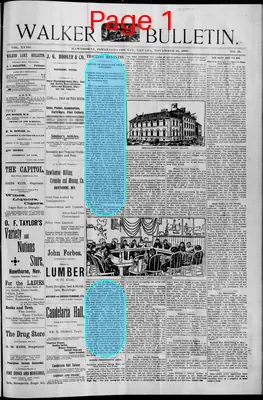
Story
November 28, 1900
Walker Lake Bulletin
Hawthorne, Esmeralda County, Mineral County, Nevada
What is this article about?
Miss Estelle Reel, superintendent of Indian schools, has successfully introduced manual training to educate Native American children, emphasizing practical skills over traditional methods, yielding gratifying results in Western agency schools.
Clipping

OCR Quality
98%
Excellent
Full Text
TEACHING REDSKINS.
METHOD OF EDUCATING INDIAN CHILDREN.
Progress Made by the Introduction of Manual Training Into Schools-Gratifying Results of an Experiment Tried by Miss Estelle Reel.
Since her appointment as superintendent of Indian schools Miss Estelle Reel has accomplished wonders by the introduction of manual methods in agency schools scattered throughout the Western States and territories. Early in her career as superintendent she became convinced, as she herself expresses it, that "among all children, Indians and whites alike, the shortest road to the brain is through the hand." In a perfunctory way manual training had been in operation before Miss Reel received her appointment, but since then it has received close attention and the results have been gratifying in the extreme. In the early days of the republic most Indian teachers sought to lift the aboriginal mind to the plane of Christian enlightenment by means of texts and sermons, catechisms and injunctions, and too commonly their efforts ended in the sad realization that the seed was sown on stony ground. Half a century ago some teachers began to realize that the chief need of the Indian is for practical education involving manual training and actual introduction into the arts and industries of their Caucasian neighbors, and the efforts of those teachers who adopted this plan were always more or less fruitful. It was not until the advent of Miss Reel that the system was given a really fair trial. The result has been so satisfactory that doubtless the work will be still further developed in future. Observers of educational progress are impressed with the increasingly practical character of instruction in our own schools; the kindergarten has passed the experimental stage and become an important educational factor; manual training has been substituted for the dreary grind of word drill, to the immeasurable benefit of pupils, and nature teaching is rapidly replacing the husks of dead knowledge in every university and in all the better normal schools and high schools, as well as in many of the primary schools throughout the country.
In speaking of the benefits accruing from this system of education Miss Reel said recently: "The benefits of this educational revolution to the children and youth of America have been very great, yet the advantages of the modern method are incomparably greater to Indian children than to their Caucasian contemporaries. Allowing for exceptional cases, the Indian child is of lower physical organization than the white child of corresponding age. His forearms are smaller and his fingers and hands less flexible; the very structure of his bones and muscles will not permit so wide a variety of manual movements as are customary among Caucasian children, and his very instincts and modes of thought are adjusted to this imperfect manual development. In like manner his face is without that complete development of nerve and muscle which gives character to expressive features; his face seems stolid because it is without the mechanism of free expression, and at the same time his mind remains measurably stolid because of the very absence of mechanism for its own expression. In short, the Indian instincts and nerves and muscles and bones are adjusted one to another, and all to the habits of the race for uncounted generations, and his offspring cannot be taught to be like the children of the white man until they are taught to do like them."
METHOD OF EDUCATING INDIAN CHILDREN.
Progress Made by the Introduction of Manual Training Into Schools-Gratifying Results of an Experiment Tried by Miss Estelle Reel.
Since her appointment as superintendent of Indian schools Miss Estelle Reel has accomplished wonders by the introduction of manual methods in agency schools scattered throughout the Western States and territories. Early in her career as superintendent she became convinced, as she herself expresses it, that "among all children, Indians and whites alike, the shortest road to the brain is through the hand." In a perfunctory way manual training had been in operation before Miss Reel received her appointment, but since then it has received close attention and the results have been gratifying in the extreme. In the early days of the republic most Indian teachers sought to lift the aboriginal mind to the plane of Christian enlightenment by means of texts and sermons, catechisms and injunctions, and too commonly their efforts ended in the sad realization that the seed was sown on stony ground. Half a century ago some teachers began to realize that the chief need of the Indian is for practical education involving manual training and actual introduction into the arts and industries of their Caucasian neighbors, and the efforts of those teachers who adopted this plan were always more or less fruitful. It was not until the advent of Miss Reel that the system was given a really fair trial. The result has been so satisfactory that doubtless the work will be still further developed in future. Observers of educational progress are impressed with the increasingly practical character of instruction in our own schools; the kindergarten has passed the experimental stage and become an important educational factor; manual training has been substituted for the dreary grind of word drill, to the immeasurable benefit of pupils, and nature teaching is rapidly replacing the husks of dead knowledge in every university and in all the better normal schools and high schools, as well as in many of the primary schools throughout the country.
In speaking of the benefits accruing from this system of education Miss Reel said recently: "The benefits of this educational revolution to the children and youth of America have been very great, yet the advantages of the modern method are incomparably greater to Indian children than to their Caucasian contemporaries. Allowing for exceptional cases, the Indian child is of lower physical organization than the white child of corresponding age. His forearms are smaller and his fingers and hands less flexible; the very structure of his bones and muscles will not permit so wide a variety of manual movements as are customary among Caucasian children, and his very instincts and modes of thought are adjusted to this imperfect manual development. In like manner his face is without that complete development of nerve and muscle which gives character to expressive features; his face seems stolid because it is without the mechanism of free expression, and at the same time his mind remains measurably stolid because of the very absence of mechanism for its own expression. In short, the Indian instincts and nerves and muscles and bones are adjusted one to another, and all to the habits of the race for uncounted generations, and his offspring cannot be taught to be like the children of the white man until they are taught to do like them."
What sub-type of article is it?
Historical Event
Biography
Personal Triumph
What themes does it cover?
Triumph
Moral Virtue
Social Manners
What keywords are associated?
Indian Education
Manual Training
Estelle Reel
Practical Education
Native American Schools
What entities or persons were involved?
Miss Estelle Reel
Where did it happen?
Western States And Territories
Story Details
Key Persons
Miss Estelle Reel
Location
Western States And Territories
Story Details
Miss Estelle Reel introduces manual training in Indian schools, achieving success by focusing on practical education to adapt Native American children to Caucasian ways, contrasting with past ineffective methods.