Thank you for visiting SNEWPapers!
Sign up free
Portland Gazette, And Maine Advertiser
Portland, Cumberland County, Maine
What is this article about?
The US government suspends negotiations with British Minister Francis J. Jackson over disputes regarding David Erskine's prior communications, leading to a breakdown in talks and Jackson's withdrawal to New York. Includes Jackson's circular letter from November 13, 1809, referencing the unaddressed Chesapeake incident and political commentary on war risks.
Clipping
OCR Quality
Full Text
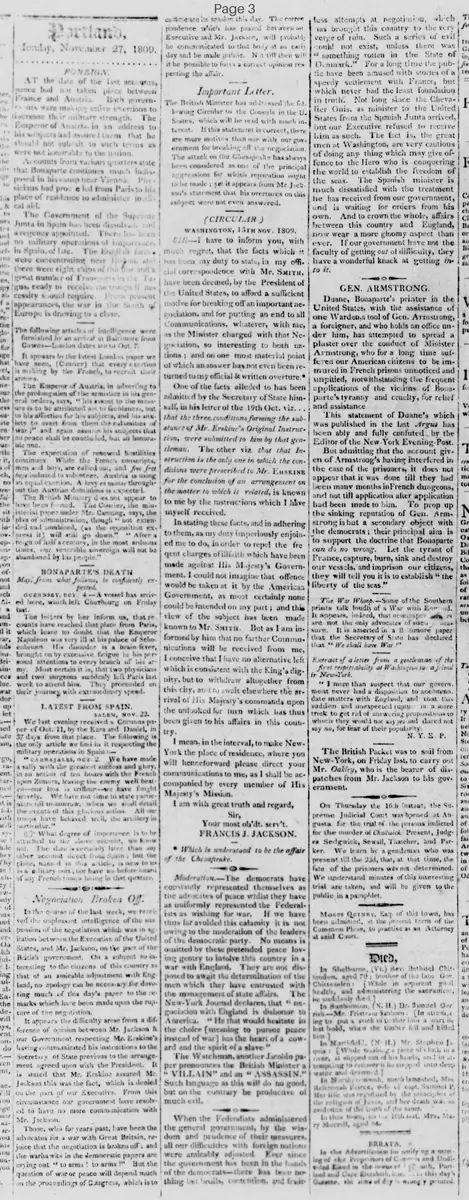
In the course of the last week, we received the unpleasant intelligence of the suspension of the negotiation which was in agitation between the Executive of the United States, and Mr. Jackson, on the part of the British government. On a subject so interesting to the citizens of this country as that of an amicable adjustment with England, no apology can be necessary for devoting much of this day's paper to the remarks which have been made upon the rupture of the negotiation.
It appears the difficulty arose from a difference of opinion between Mr. Jackson & our Government respecting Mr. Erskine's having communicated his instructions to the Secretary of State previous to the arrangement agreed upon with the President. It is stated that Mr. Erskine assured Mr. Jackson this was the fact, which is denied on the part of our Executive. From this circumstance our government have resolved to have no more communication with Mr. Jackson.
Those, who for years past, have been the advocates for a war with Great Britain, rejoice that the negotiation is broken off; and the warhawks in the democratic papers are crying out 'to arms! to arms!' But the question of war or peace will depend much on the proceedings of Congress, which is to commence its session this day. The correspondence which has passed between our Executive and Mr. Jackson, will probably be communicated to that body at an early day and be made public. Not till then will it be possible to form a correct opinion respecting the affair.
Important Letter.
The British Minister has addressed the following Circular to the Consuls in the United States, which will be read with much interest. If this statement is correct, there are more motives than one with our government for breaking off the negociation. The attack on the Chesapeake has always been considered as one of the principal aggressions for which reparation ought to be made: yet it appears from Mr. Jackson's statement that his overtures on this subject were not even answered.
(CIRCULAR)
WASHINGTON, 13TH NOV. 1809
SIR--I have to inform you, with much regret, that the facts which it has been my duty to state, in my official correspondence with Mr. SMITH, have been deemed, by the President of the United States, to afford a sufficient motive for breaking off an important negotiation, and for putting an end to all Communications, whatever, with me, as the Minister charged with that Negotiation, so interesting to both nations; and on one most material point of which an answer has not even been returned to my official & written overture.
One of the facts alluded to has been admitted by the Secretary of State himself, in his letter of the 19th Oct. viz. that the three conditions forming the substance of Mr. Erskine's Original instruction, were submitted to him by that gentleman. The other viz. that that Instruction is the only one in which the conditions were prescribed to Mr. Erskine for the conclusion of an arrangement on the matter to which it related, is known to me by the instructions which I have myself received.
In stating these facts, and in adhering to them, as my duty imperiously enjoined me to do, in order to repel the frequent charges of illfaith which have been made against His Majesty's Government, I could not imagine that offence would be taken at it by the American Government, as most certainly none could be intended on my part; and this view of the subject has been made known to Mr. SMITH. But as I am informed by him that no farther Communications will be received from me, I conceive that I have no alternative left which is consistent with the King's dignity, but to withdraw altogether from this city, and to await elsewhere the arrival of His Majesty's commands upon the unlooked for turn which has thus been given to his affairs in this country.
I mean, in the interval, to make New-York the place of residence, where you will henceforward please direct your communications to me, as I shall be accompanied by every member of His Majesty's Mission.
I am with great truth and regard,
SIR,
Your most ob'dt. serv't.
FRANCIS J. JACKSON.
Which is understood to be the affair of the Chesapeake.
Moderation.--The democrats have constantly represented themselves as the advocates of peace whilst they have as uniformly represented the Federalists as wishing for war. If we have thus far avoided this calamity it is not owing to the moderation of the leaders of the democratic party. No means is omitted by these pretended peace-loving gentry to involve this country in a war with England. They are not disposed to await the determination of the men which they have entrusted with the management of state affairs. The New-York Journal declares, that 'negotiation with England is dishonor to America.' He that would hesitate in the choice [meaning to pursue peace instead of war] has the heart of a coward and the spirit of a slave.
The Watchman, another Jacobin paper pronounces the British Minister a 'VILLAIN' and an 'ASSASSIN.'
Such language as this will do no good, but on the contrary be productive of much evil.
When the Federalists administered the general government, by the wisdom and prudence of their measures, all our difficulties with foreign nations were amicably adjusted. Ever since the government has been in the hands of the democrats--there has been nothing but bruits, contention, and fruitless attempts at negotiation, which has brought this country to the verge of ruin. Such a series of evil could not exist, unless there was 'something rotten in the State of Denmark.' For a long time the public have been amused with stories of a speedy settlement with France, but which never had the least foundation in truth. Not long since the Chevalier Onis, as minister to the United States from the Spanish Junta arrived, but our Executive refused to receive him as such. The fact is, the great men at Washington, are very cautious of doing anything which may give offence to the Hero who is conquering the world to establish the freedom of the seas. The Spanish minister is much dissatisfied with the treatment he has received from our government, and is waiting for orders from his own. And to crown the whole, affairs between this country and England, now wear a more gloomy aspect than ever. If our government have not the faculty of getting out of difficulty, they have a wonderful knack at getting into it.
GEN. ARMSTRONG.
Duane, Bonaparte's printer in the United States, with the assistance of one Warden, a tool of Gen. Armstrong; a foreigner, and who holds an office under him, has attempted to spread a plaster over the conduct of Minister Armstrong, who for a long time suffered our American citizens to be immured in French prisons unnoticed and unpitied, notwithstanding the frequent applications of the victims of Bonaparte's tyranny and cruelty, for relief and assistance.
This statement of Duane's which was published in the last Argus has been ably and fully confuted by the Editor of the New-York Evening-Post.
But admitting that the account given of Armstrong's having interfered in the case of the prisoners, it does not appear that it was done till they had been many months in French dungeons, and not till application after application had been made to him. To prop up the sinking reputation of Gen. Armstrong is but a secondary object with the democrats; their principal aim is to support the doctrine that Bonaparte can do no wrong. Let the tyrant of France, capture, burn, sink and destroy our vessels, and imprison our citizens, they will tell you it is to establish 'the liberty of the seas.'
The War Whoop.--Some of the Southern prints talk loudly of a War with England. It appears, indeed, that newspaper wars are not the only advocates of such a measure. It is asserted in a Baltimore paper that the Secretary of State has declared that 'We shall have War!'
Extract of a letter from a gentleman of the first respectability at Washington to a friend in New-York
'I more than suspect that our government never had a disposition to accommodate matters with England, and that this sudden and unexpected rupture is a mere trick to get rid of answering propositions to which they would not say yes and dared not say no, for fear of their popularity.'
N.Y.E. P.
What sub-type of article is it?
What keywords are associated?
What entities or persons were involved?
Where did it happen?
Foreign News Details
Primary Location
Washington
Event Date
13th Nov. 1809
Key Persons
Outcome
negotiation suspended; all communications ended with jackson; jackson to withdraw to new-york; unaddressed overture on chesapeake affair.
Event Details
US Executive suspends negotiations with British Minister Jackson due to dispute over whether Erskine communicated his instructions to the Secretary of State before his arrangement with the President. Jackson issues circular stating facts deemed offensive by US, leading to end of communications and his relocation to New-York. References unresponded overture on Chesapeake reparations.