Thank you for visiting SNEWPapers!
Sign up free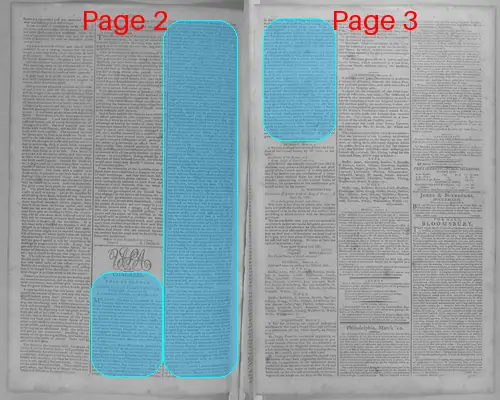
Gazette Of The United States
New York, New York County, New York
What is this article about?
In the U.S. House of Representatives in Philadelphia on February 7, Mr. Page delivered a speech opposing federal drawbacks or bounties for the fisheries, arguing they violate constitutional restrictions on export duties and could favor certain states, while emphasizing state sovereignty.
Merged-components note: Continuation of Mr. Page's speech in the House of Representatives on the Fishery Bill across pages 2 and 3.
Clippings
1 of 2
OCR Quality
Full Text
PHILADELPHIA.
HOUSE OF REPRESENTATIVES,
TUESDAY, FEBRUARY 7.
In committee of the whole, on the Fishery Bill.
CONTINUED.]
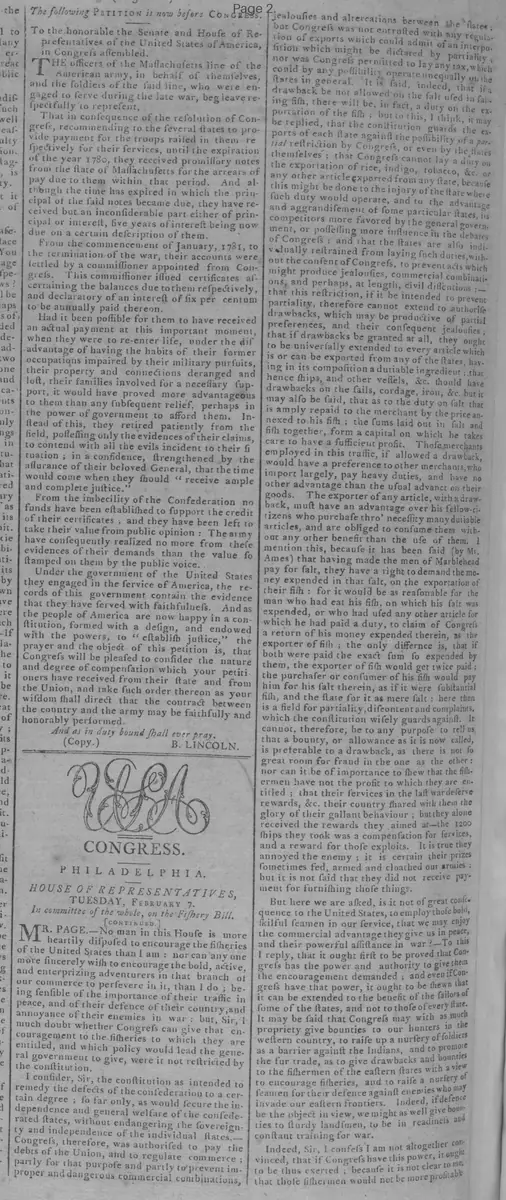
MR. PAGE.—No man in this House is more heartily disposed to encourage the fisheries of the United States than I am: nor can any one more sincerely wish to encourage the bold, active, and enterprising adventurers in that branch of our commerce to persevere in it, than I do; being sensible of the importance of their traffic in peace, and of their defence of their country, and annoyance of their enemies in war: but, Sir, I much doubt whether Congress can give that encouragement to the fisheries to which they are entitled, and which policy would lead the general government to give, were it not restricted by the constitution.
I consider, Sir, the constitution as intended to remedy the defects of the confederation to a certain degree; so far only, as would secure the independence and general welfare of the confederated states, without endangering the sovereignty and independence of the individual states.— Congress, therefore, was authorized to pay the debts of the Union, and to regulate commerce; partly for that purpose and partly to prevent improper and dangerous commercial combinations,
Such jealousies and altercations between the states but Congress was not entrusted with any regulation of exports which could admit of an interposition which might be dictated by partiality nor was Congress permitted to lay any tax, which could by any possibility operate unequally on the states in general. It is said, indeed, that if a drawback be not allowed on the salt used in curing fish, there will be, in fact, a duty on the exportation of the fish; but to this, I think, it may be replied, that the constitution guards the exports of each state against the possibility of a partial restriction by Congress, or even by the states themselves; that Congress cannot lay a duty on the exportation of rice, indigo, tobacco, &c. or any other article exported from any state, because this might be done to the injury of the state where such duty would operate, and to the advantage and aggrandizement of some particular states, in competitors more favored by the general government, or possessing more influence in the debates of Congress; and that the states are also individually restrained from laying such duties, without the consent of Congress, to prevent acts which might produce jealousies, commercial combinations, and perhaps, at length, civil dissensions;— that this restriction, if it be intended to prevent partiality, therefore cannot extend to authorizing drawbacks, which may be productive of partial preferences, and their consequent jealousies;
that if drawbacks be granted at all, they ought to be universally extended to every article which is or can be exported from any of the states, having in its composition a dutiable ingredient; that hence ships, and other vessels, &c. should have drawbacks on the sails, cordage, iron, &c. but it may also be said, that as to the duty on salt that is amply repaid to the merchant by the price annexed to his fish; the sums laid out in salt and fish together, form a capital on which he takes care to have a sufficient profit. Those merchants employed in this traffic, if allowed a drawback, would have a preference to other merchants, who import largely, pay heavy duties, and have no other advantage than the usual advance on their goods. The exporter of any article, with a drawback, must have an advantage over his fellow-citizens who purchase thro' necessity many dutiable articles, and are obliged to consume them without any other benefit than the use of them. I mention this, because it has been said (by Mr. Ames) that having made the men of Marblehead pay for salt, they have a right to demand the money expended in that salt, on the exportation of their fish: for it would be as reasonable for the man who had eat his fish, on which his salt was expended, or who had used any other article for which he had paid a duty, to claim of Congress a return of his money expended therein, as the exporter of fish; the only difference is, that if both were paid the exact sum so expended by them, the exporter of fish would get twice paid; the purchaser or consumer of his fish would pay him for his salt therein, as if it were substantial fish, and the state for it as mere salt: here then is a field for partiality, discontent and complaints, which the constitution wisely guards against. It cannot, therefore, be to any purpose to tell us that a bounty, or allowance as it is now called, is preferable to a drawback, as there is not so great room for fraud in the one as the other: nor can it be of importance to shew that the fishermen have not the profit to which they are entitled; that their services in the last war deserve rewards, &c. their country shared with them the glory of their gallant behaviour; but they alone received the rewards they aimed at—the 1200 ships they took was a compensation for services, and a reward for those exploits. It is true they annoyed the enemy; it is certain their prizes sometimes fed, armed and cloathed our armies; but it is not said that they did not receive payment for furnishing those things.
But here we are asked, is it not of great consequence to the United States, to employ those bold, skilful seamen in our service, that we may enjoy the commercial advantage they give us in peace, and their powerful assistance in war?—To this I reply, that it ought first to be proved that Congress have that power, it ought to be shewn that the encouragement demanded; and even if Congress has the power and authority to give them it can be extended to the benefit of the sailors of some of the states, and not to those of every state.
It may be said that Congress may with as much propriety give bounties to our hunters in the western country, to raise up a nursery of soldiers to the fur trade, as to give drawbacks and bounties to the fishermen of the eastern states with a view to encourage fisheries, and to raise a nursery of seamen for their defence against enemies who may invade our eastern frontiers. Indeed, if defence be the object in view, we might as well give bounties to sturdy landmen, to be in readiness and constant training for war.
Indeed, Sir, I confess I am not altogether convinced, that if Congress have this power, it ought to be thus exerted; because it is not clear to me, that those fishermen would not be more profitable to be thus exerted ; because it is not clear to me,
To the United States, if they were cultivating the lands which now lie waste, and raising animals, which would be of ten times more value than their fisheries. A nursery of virtuous families, which will produce soldiers, sailors, husbandmen and statesmen, must be preferable to a mere nursery of sailors, who generally live single, and often perish at sea. I always look upon the loss of a crew to an infant republic, as the loss almost of a new state.
I speak of this question, however, as a citizen of the United States, as a member of this House. Were I to discuss it as a citizen of Massachusetts, and in their legislature. I should say, as the state is nearly filled with inhabitants, and our fishermen increase our commerce in peace, protect us in war, and indeed even enrich us by their prizes, it is our interest to encourage them to the utmost, and to prevent their going into the service of other countries. I might therefore, as a member of the legislature of that state, do all in my power to procure bounties for them, and indeed for all the sailors belonging to that state; but I should not think of applying to Congress for their assistance, not only because I doubt their right to afford it, but because I should look upon it as in some degree derogatory to the sovereignty and independence of the state. I should look upon such an interference of Congress as a step towards swallowing up the powers of the state governments, and as consolidating the different states into one government, which the wise and virtuous in every state always protested against as dangerous to their liberties; the fear of which consolidation prevented many good men from voting for the adoption of the new government.
(Remainder of this Speech in our next.)
What sub-type of article is it?
What keywords are associated?
What entities or persons were involved?
Where did it happen?
Domestic News Details
Primary Location
Philadelphia
Event Date
Tuesday, February 7
Key Persons
Event Details
In committee of the whole on the Fishery Bill, Mr. Page expressed support for U.S. fisheries but doubted Congress's constitutional authority to provide encouragement like drawbacks or bounties on salt used in curing fish, arguing it could lead to partiality among states, violate export restrictions, and undermine state sovereignty. He suggested such support should come from states like Massachusetts rather than federal interference.