Thank you for visiting SNEWPapers!
Sign up free
Story
June 24, 1875
Shenandoah Herald
Woodstock, Shenandoah County, Virginia
What is this article about?
Philadelphia inventor John W. Keeley claims discovery of a revolutionary motor generating vapor from cold water and air at 20,000-30,000 psi, surpassing steam in power and economy. Investors form company, pay $80,000 for New England rights, plan $3M capitalization after patents.
Clipping
OCR Quality
98%
Excellent
Full Text
The Keeley Motor--What is Claimed for it
TWENTY THOUSAND POUNDS OF VAPOR TO THE SQUARE INCH--HOW THE INVENTION IS REGARDED BY ENGINEERS
AIR AND WATER HARNESSED.
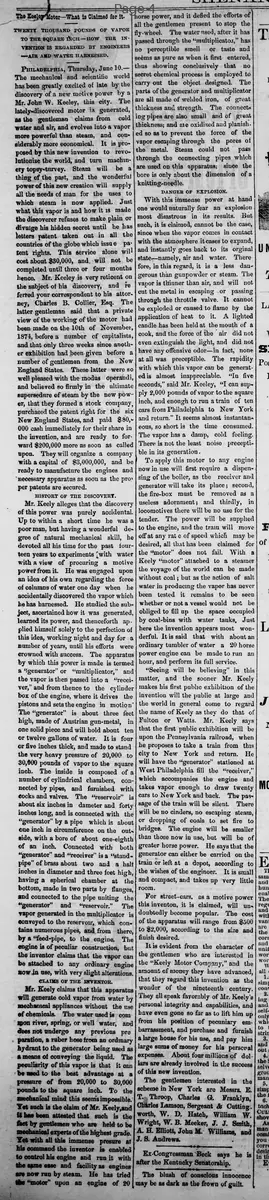
PHILADELPHIA, Thursday, June 10.--The mechanical and scientific world has been greatly excited of late by the discovery of a new motive power by a Mr. John W. Keeley, this city. The lately-discovered motor is generated, as the gentleman claims from cold water and air, and evolves into a vapor more powerful than steam, and considerably more economical. It is proposed by this new invention to revolutionize the world, and turn machinery topsy-turvy. Steam will be a thing of the past, and the wonderful power of this new creation will supply all the needs of man for the uses to which steam is now applied. Just what this vapor is and how it is made the discoverer refuses to make plain or divulge his hidden secret until he has letters patent taken out in all the countries of the globe which issue patent rights. This service alone will cost about $30,000, and will not be completed until three or four months hence. Mr. Keeley is very reticent on the subject of his discovery, and referred your correspondent to his attorney, Charles B. Collier, Esq. The latter gentleman said that a private view of the working of the motor had been made on the 10th of November, 1874, before a number of capitalists, and that only three weeks since another exhibition had been given before a number of gentlemen from the New England States. These latter were so well pleased with the modus operandi and believed so firmly in the ultimate supersedure of steam by the new power, that they formed a stock company, purchased the patent right for the six New England States, and paid $80,000 cash immediately for their share in the invention, and are ready to forward $200,000 more as soon as called upon. They will organize a company with a capital of $3,000,000, and be ready to manufacture the engines and necessary apparatus as soon as the proper patents are secured.
HISTORY OF THE DISCOVERY.
Mr. Keely alleges that the discovery of this power was purely accidental. Up to within a short time he was a poor man, but having a wonderful degree of natural mechanical skill, he devoted all his time for the past fourteen years to experiments with water with a view of procuring a motive power from it. He was engaged upon an idea of his own regarding the force of columns of water one day when he accidentally discovered the vapor which he has harnessed. He studied the subject, ascertained how it was generated, learned its power, and thenceforth applied himself solely to the perfection of this idea, working night and day for a number of years, until his efforts were crowned with success. The apparatus by which this power is made is termed a "generator" or "multiplicator," and the vapor is then passed into a "receiver," and from thence to the cylinder box of the engine, where it drives the pistons and sets the engine in motion. The "generator" is about three feet high, made of Austrian gun-metal, in one solid piece and will hold about ten or twelve gallons of water. It is four or five inches thick, and made to stand the very heavy pressure of 20,000 to 30,000 pounds of vapor to the square inch. The inside is composed of a number of cylindrical chambers, connected by pipes, and furnished with cocks and valves. The "reservoir" is about six inches in diameter and forty inches long, and is connected with the "generator" by a pipe which is about one inch in circumference on the outside, with a bore of about one-eighth of an inch. Connected with both "generator" and "receiver" is a "stand pipe" of brass about two and a half inches in diameter and three feet high, having a spherical chamber at the bottom, made in two parts by flanges, and connected to the pipe uniting the "generator" and "reservoir."
The vapor generated in the multiplicator is conveyed to the reservoir, which contains numerous pipes, and from there, by a "feed-pipe," to the engine. The engine is of peculiar construction, but the inventor claims that the vapor can be attached to any ordinary engine now in use, with very slight alterations.
CLAIMS OF THE INVENTOR.
Mr. Keely claims that this apparatus will generate cold vapor from water by mechanical appliances without the use of chemicals. The water used is common river, spring, or well water, and does not undergo any previous preparation, a rubber hose from an ordinary hydrant to the generator being used as a means of conveying the liquid. The peculiarity of this vapor is that it can be used to the best advantage at a pressure of from 20,000 to 30,000 pounds to the square inch. To the mechanical mind this seems impossible. Yet such is the claim of Mr. Keely, and if he has been attested that such is the fact by gentlemen who are held to be mechanical experts of the highest grade. Yet with all this immense pressure at his command the inventor is enabled to control his engine and run it with the same ease and facility as engines are now run by steam. He has tried the "motor" upon an engine of 20 horse power, and it worked with perfect success. seems as pure as when it first entered. parts of the generator and multiplicator thickness and strength. The connections vapor escaping through the pores of the metal. Steam could not pass through the connecting pipes which are used on this apparatus; since the bore is only about the dimension of a knitting-needle.
DANGER OF EXPLOSION.
With this immense power at hand one would naturally fear an explosion most disastrous in its results. But such, it is claimed, cannot be the case, since when the vapor comes in contact with the atmosphere it ceases to expand, and instantly goes back to its original state--namely, air and water. Therefore, in this regard, it is a less dangerous than gunpowder or steam. The vapor is thinner than air, and will not cut the metal in escaping or passing through the throttle valve. It cannot be exploded or caused to flame by the application of heat to it. A lighted candle has been held at the mouth of a cock, and the force of the air did not even extinguish the light, and did not have any offensive odor--in fact, none at all was perceptible. The rapidity with which this vapor can be generated is almost inappreciable. "In five seconds," said Mr. Keeley, "I can supply 2,000 pounds of vapor to the square inch, and enough to run a train of ten cars from Philadelphia to New York and return." It seems almost instantaneous, so short is the time consumed. The vapor has a damp, cold feeling. There is not the least noise perceptible in its generation.
To apply this motor to any engine now in use will first require a dispensing of the boiler, as the receiver and generator will take its place; second, the fire-box must be removed as a useless adornment; and thirdly, in locomotives there will be no use for the tender. The power will be supplied to the engine, and the train will move off at any rate of speed which may be desired, all that has been claimed for the "motor" does not fail. With a Keely "motor" attached to a steamer the voyage of the world can be made without coal; but as the action of salt water in producing the vapor has never been tested it remains to be seen whether or not a vessel would not be obliged to fill up the space occupied by coal-bins with water tanks. Just here the invention appears most wonderful. It is said that with about an ordinary tumbler of water a 20 horse power engine can be made to run an hour, and perform its full service. "Seeing will be believing" in this matter, and the sooner Mr. Keeley makes his first public exhibition of the invention will the public at large and the world in general come to regard the name of Keely as they do that of Fulton or Watts. Mr. Keeley says that the first public exhibition will be upon the Pennsylvania railroad, when he proposes to take a train from this city to New York and return. He will have the "generator" stationed at West Philadelphia fill the "receiver," which accompanies the engine and takes vapor enough to draw twenty cars to New York and back. The passage of the train will be silent. There will be no cinders, no escaping steam, or dropping of coals to set fire to bridges. The engine will be smaller than those now in use, but will be of greater horse power. He says that the generator can either be carried on the train or left at a depot, according to the wishes of the engineer. It is small and compact, and takes up very little room.
For street-cars, as a motive power this invention, it is claimed, will undoubtedly become popular. The cost of the apparatus will range from $500 to $2,000, according to the size and finish desired.
It is evident from the character of the gentlemen who are interested in the "Keely Motor Company," and the amount of money they have advanced, that they regard this invention as the wonder of the nineteenth century. They all speak favorably of Mr. Keeley's personal integrity and capabilities, and have even gone so far as to lift him up from his position of pecuniary embarrassment, and purchase and furnish a large house for his use, and pay him large sums of money for his personal expenses. About four millions of dollars are already involved in the success of this new invention.
The gentlemen interested in the scheme in New York are Messrs. E. T. Throop, Charles G. Franklyn, Charles Lamson, Sergeant & Cutting, Worth, W. D. Hatch, William W. Wright, W. B. Meeker, J. J. Smith, A. H. Elliott, John M. Williams, and J. S. Andrews.
TWENTY THOUSAND POUNDS OF VAPOR TO THE SQUARE INCH--HOW THE INVENTION IS REGARDED BY ENGINEERS
AIR AND WATER HARNESSED.
PHILADELPHIA, Thursday, June 10.--The mechanical and scientific world has been greatly excited of late by the discovery of a new motive power by a Mr. John W. Keeley, this city. The lately-discovered motor is generated, as the gentleman claims from cold water and air, and evolves into a vapor more powerful than steam, and considerably more economical. It is proposed by this new invention to revolutionize the world, and turn machinery topsy-turvy. Steam will be a thing of the past, and the wonderful power of this new creation will supply all the needs of man for the uses to which steam is now applied. Just what this vapor is and how it is made the discoverer refuses to make plain or divulge his hidden secret until he has letters patent taken out in all the countries of the globe which issue patent rights. This service alone will cost about $30,000, and will not be completed until three or four months hence. Mr. Keeley is very reticent on the subject of his discovery, and referred your correspondent to his attorney, Charles B. Collier, Esq. The latter gentleman said that a private view of the working of the motor had been made on the 10th of November, 1874, before a number of capitalists, and that only three weeks since another exhibition had been given before a number of gentlemen from the New England States. These latter were so well pleased with the modus operandi and believed so firmly in the ultimate supersedure of steam by the new power, that they formed a stock company, purchased the patent right for the six New England States, and paid $80,000 cash immediately for their share in the invention, and are ready to forward $200,000 more as soon as called upon. They will organize a company with a capital of $3,000,000, and be ready to manufacture the engines and necessary apparatus as soon as the proper patents are secured.
HISTORY OF THE DISCOVERY.
Mr. Keely alleges that the discovery of this power was purely accidental. Up to within a short time he was a poor man, but having a wonderful degree of natural mechanical skill, he devoted all his time for the past fourteen years to experiments with water with a view of procuring a motive power from it. He was engaged upon an idea of his own regarding the force of columns of water one day when he accidentally discovered the vapor which he has harnessed. He studied the subject, ascertained how it was generated, learned its power, and thenceforth applied himself solely to the perfection of this idea, working night and day for a number of years, until his efforts were crowned with success. The apparatus by which this power is made is termed a "generator" or "multiplicator," and the vapor is then passed into a "receiver," and from thence to the cylinder box of the engine, where it drives the pistons and sets the engine in motion. The "generator" is about three feet high, made of Austrian gun-metal, in one solid piece and will hold about ten or twelve gallons of water. It is four or five inches thick, and made to stand the very heavy pressure of 20,000 to 30,000 pounds of vapor to the square inch. The inside is composed of a number of cylindrical chambers, connected by pipes, and furnished with cocks and valves. The "reservoir" is about six inches in diameter and forty inches long, and is connected with the "generator" by a pipe which is about one inch in circumference on the outside, with a bore of about one-eighth of an inch. Connected with both "generator" and "receiver" is a "stand pipe" of brass about two and a half inches in diameter and three feet high, having a spherical chamber at the bottom, made in two parts by flanges, and connected to the pipe uniting the "generator" and "reservoir."
The vapor generated in the multiplicator is conveyed to the reservoir, which contains numerous pipes, and from there, by a "feed-pipe," to the engine. The engine is of peculiar construction, but the inventor claims that the vapor can be attached to any ordinary engine now in use, with very slight alterations.
CLAIMS OF THE INVENTOR.
Mr. Keely claims that this apparatus will generate cold vapor from water by mechanical appliances without the use of chemicals. The water used is common river, spring, or well water, and does not undergo any previous preparation, a rubber hose from an ordinary hydrant to the generator being used as a means of conveying the liquid. The peculiarity of this vapor is that it can be used to the best advantage at a pressure of from 20,000 to 30,000 pounds to the square inch. To the mechanical mind this seems impossible. Yet such is the claim of Mr. Keely, and if he has been attested that such is the fact by gentlemen who are held to be mechanical experts of the highest grade. Yet with all this immense pressure at his command the inventor is enabled to control his engine and run it with the same ease and facility as engines are now run by steam. He has tried the "motor" upon an engine of 20 horse power, and it worked with perfect success. seems as pure as when it first entered. parts of the generator and multiplicator thickness and strength. The connections vapor escaping through the pores of the metal. Steam could not pass through the connecting pipes which are used on this apparatus; since the bore is only about the dimension of a knitting-needle.
DANGER OF EXPLOSION.
With this immense power at hand one would naturally fear an explosion most disastrous in its results. But such, it is claimed, cannot be the case, since when the vapor comes in contact with the atmosphere it ceases to expand, and instantly goes back to its original state--namely, air and water. Therefore, in this regard, it is a less dangerous than gunpowder or steam. The vapor is thinner than air, and will not cut the metal in escaping or passing through the throttle valve. It cannot be exploded or caused to flame by the application of heat to it. A lighted candle has been held at the mouth of a cock, and the force of the air did not even extinguish the light, and did not have any offensive odor--in fact, none at all was perceptible. The rapidity with which this vapor can be generated is almost inappreciable. "In five seconds," said Mr. Keeley, "I can supply 2,000 pounds of vapor to the square inch, and enough to run a train of ten cars from Philadelphia to New York and return." It seems almost instantaneous, so short is the time consumed. The vapor has a damp, cold feeling. There is not the least noise perceptible in its generation.
To apply this motor to any engine now in use will first require a dispensing of the boiler, as the receiver and generator will take its place; second, the fire-box must be removed as a useless adornment; and thirdly, in locomotives there will be no use for the tender. The power will be supplied to the engine, and the train will move off at any rate of speed which may be desired, all that has been claimed for the "motor" does not fail. With a Keely "motor" attached to a steamer the voyage of the world can be made without coal; but as the action of salt water in producing the vapor has never been tested it remains to be seen whether or not a vessel would not be obliged to fill up the space occupied by coal-bins with water tanks. Just here the invention appears most wonderful. It is said that with about an ordinary tumbler of water a 20 horse power engine can be made to run an hour, and perform its full service. "Seeing will be believing" in this matter, and the sooner Mr. Keeley makes his first public exhibition of the invention will the public at large and the world in general come to regard the name of Keely as they do that of Fulton or Watts. Mr. Keeley says that the first public exhibition will be upon the Pennsylvania railroad, when he proposes to take a train from this city to New York and return. He will have the "generator" stationed at West Philadelphia fill the "receiver," which accompanies the engine and takes vapor enough to draw twenty cars to New York and back. The passage of the train will be silent. There will be no cinders, no escaping steam, or dropping of coals to set fire to bridges. The engine will be smaller than those now in use, but will be of greater horse power. He says that the generator can either be carried on the train or left at a depot, according to the wishes of the engineer. It is small and compact, and takes up very little room.
For street-cars, as a motive power this invention, it is claimed, will undoubtedly become popular. The cost of the apparatus will range from $500 to $2,000, according to the size and finish desired.
It is evident from the character of the gentlemen who are interested in the "Keely Motor Company," and the amount of money they have advanced, that they regard this invention as the wonder of the nineteenth century. They all speak favorably of Mr. Keeley's personal integrity and capabilities, and have even gone so far as to lift him up from his position of pecuniary embarrassment, and purchase and furnish a large house for his use, and pay him large sums of money for his personal expenses. About four millions of dollars are already involved in the success of this new invention.
The gentlemen interested in the scheme in New York are Messrs. E. T. Throop, Charles G. Franklyn, Charles Lamson, Sergeant & Cutting, Worth, W. D. Hatch, William W. Wright, W. B. Meeker, J. J. Smith, A. H. Elliott, John M. Williams, and J. S. Andrews.
What sub-type of article is it?
Curiosity
Extraordinary Event
Prodigy
What themes does it cover?
Exploration
Triumph
Fortune Reversal
What keywords are associated?
Keeley Motor
Vapor Invention
Water Power
Steam Replacement
Philadelphia Inventors
New England Investors
Mechanical Discovery
What entities or persons were involved?
John W. Keeley
Charles B. Collier
E. T. Throop
Charles G. Franklyn
Charles Lamson
Sergeant & Cutting
Worth
W. D. Hatch
William W. Wright
W. B. Meeker
J. J. Smith
A. H. Elliott
John M. Williams
J. S. Andrews
Where did it happen?
Philadelphia
Story Details
Key Persons
John W. Keeley
Charles B. Collier
E. T. Throop
Charles G. Franklyn
Charles Lamson
Sergeant & Cutting
Worth
W. D. Hatch
William W. Wright
W. B. Meeker
J. J. Smith
A. H. Elliott
John M. Williams
J. S. Andrews
Location
Philadelphia
Event Date
Thursday, June 10; November 10, 1874
Story Details
John W. Keeley accidentally discovers a vapor motor from water and air, generating 20,000-30,000 psi pressure without chemicals, more powerful and economical than steam. After private exhibitions, New England investors buy rights for $80,000, plan $3M company; Keeley seeks global patents.