Thank you for visiting SNEWPapers!
Sign up free
Editorial
June 11, 1804
The National Intelligencer And Washington Advertiser
Washington, District Of Columbia
What is this article about?
This editorial, part of a series refuting Federalist misrepresentations, defends Treasury Secretary Albert Gallatin against claims of leading the Whiskey Insurrection and receiving a pardon from Washington. It cites Gallatin's 1794 speech and William Findley's history to show his minor, non-criminal role in opposing the excise law.
Clipping
OCR Quality
95%
Excellent
Full Text
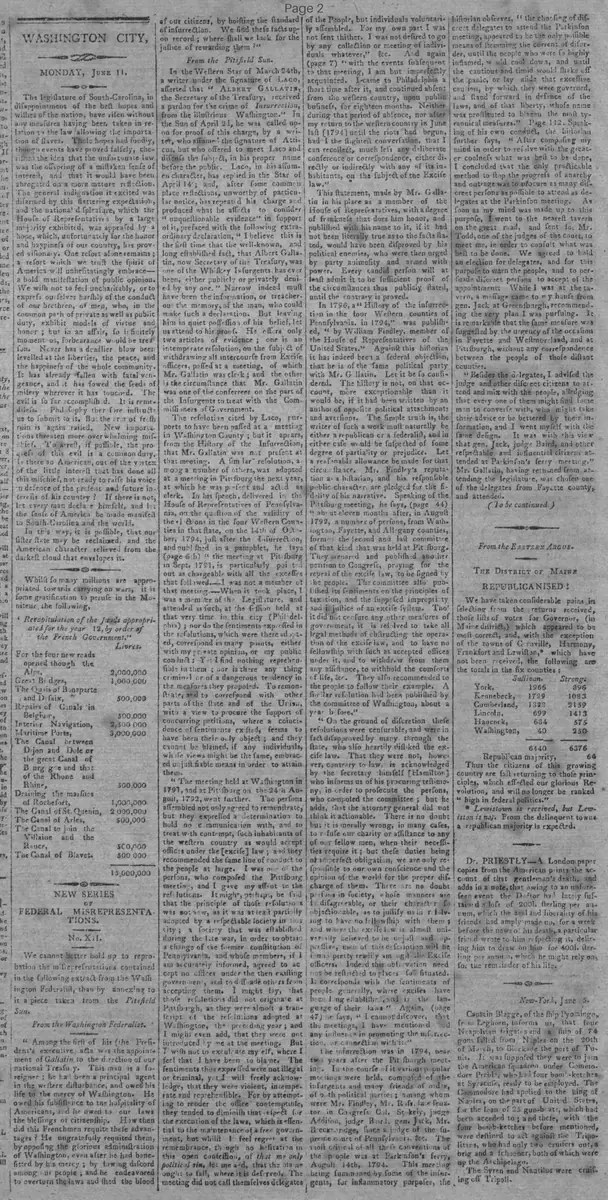
"NEW SERIES."
"FEDERAL--"MISREPRESENTATIONS."
No. XII.
We cannot better hold up to reprobation the misrepresentations contained in the following extract from the Washington Federalist, than by annexing to it a piece taken from the Pittsfield Sun.
From the Washington Federalist.
Among the first of his (the President's) executive acts was the appointment of Gallatin to the direction of our national Treasury. This man is a foreigner; he had been a principal agent in the western disturbance, and owed his life to the mercy of Washington. He owed his subsistence to the hospitality of Americans, and he owed to our laws the blessings of citizenship. How then did this Frenchman requite these advantages? He ungratefully requited them, by opposing the glorious administration of Washington, even after he had benefited by his mercy; by sowing discord among our people; and he endeavored to overturn the laws and shed the blood of our citizens, by hoisting the standard of insurrection. We find these facts upon record; where shall we look for the justice of rewarding them?
From the Pittsfield Sun.
In the Western Star of March 24th, a writer under the signature of Laco, asserted that "ALBERT GALLATIN, the Secretary of the Treasury, received a pardon for the crime of Insurrection, from the illustrious Washington." In the Sun of April 2d, he was called upon for proof of this charge, by a writer, who assumed the signature of Atticus, but who offered to meet Laco and discuss the subject, in his proper name before the public. Laco, in his own character, has replied in the Star of April 14; and, after some common place reflections, unworthy of particular notice, has repeated his charge and produced what he affects to consider "unquestionable evidence" in support of it, prefaced with the following extraordinary declaration, "I believe this is the first time that the well-known, and long established fact, that Albert Gallatin, now Secretary of the Treasury, was one of the Whiskey Insurgents, has ever been, either publicly or privately denied by any one." Narrow indeed must have been the information, or treacherous the memory, of the man, who could make such a declaration. But leaving him in quiet possession of his belief, let us attend to his proof. He offers only two articles of evidence; one is an intemperate resolution, on the subject of withdrawing all intercourse from Excise officers, passed at a meeting, of which Mr. Gallatin was clerk: and the other is the circumstance that Mr. Gallatin was one of the conferees on the part of the Insurgents to treat with the Commissioners of Government.
The resolution cited by Laco, purports to have been passed at a meeting in Washington County; but it appears, from the History of the Insurrection, that Mr. Gallatin was not present at that meeting. A similar resolution, among a number of others, was adopted at a meeting in Pittsburgh the next year, at which he was present and acted as clerk. In his speech, delivered in the House of Representatives of Pennsylvania, on the question of the validity of the elections in the four Western Counties in that state, on the 14th of October, 1794, just after the Insurrection, and published in a pamphlet, he says (page 6th) "the meeting at Pittsburgh in Sept. 1791, is particularly pointed out as chargeable with all the excesses that followed. I was not a member of that meeting.--When it took place, I was a member of the Legislature, and attended as such, at the session held at that very time in this city (Philadelphia); nor do the sentiments expressed in the resolutions, which were there adopted, correspond in many points, either with my private opinion, or my public conduct: Yet I find nothing reprehensible in them; nor is there any thing criminal or of a dangerous tendency in the measures they proposed. To remonstrate, and to correspond with other parts of the state and of the Union, with a view to procure the support of concurring petitions, where a coincidence of sentiments existed, seems to have been their only object; and they cannot be blamed, if any individuals, whose views might be the same, embraced unjustifiable means in order to attain them."
"The meeting held at Washington in 1791, and at Pittsburgh on the 24th August, 1792, went farther. The persons assembled not only agreed to remonstrate, but they expressed a determination to hold no communication with, and to treat with contempt, such inhabitants of the western country as would accept offices under the excise law; and they recommended the same line of conduct to the people at large. I was one of the persons, who composed the Pittsburgh meeting, and I gave my assent to the resolutions. It might, perhaps, be said that the principle of those resolutions was not new, as it was at least partially adopted by a respectable society in this city; a society that was established during the late war, in order to obtain a change of the former constitution of Pennsylvania, and whose members, if I am accurately informed, agreed to accept no offices under the then existing government, and to dissuade others from accepting them. I might say, that those resolutions did not originate at Pittsburgh, as they were almost a transcript of the resolutions adopted at Washington, the preceding year; and I might even add, that they were not introduced by me at the meeting. But I wish not to exculpate myself, where I feel that I have been to blame. The sentiments thus expressed were not illegal or criminal, yet I will freely acknowledge, that they were violent, intemperate and reprehensible. For by attempting to render the office contemptible they tended to diminish that respect for the execution of the laws, which is essential to the maintenance of a free government, but whilst I feel regret at the remembrance, though no hesitation in this open confession, of that my only political sin, let me add, that the blame ought to fall, where it is deserved. The meeting did not call themselves delegates of the People, but individuals voluntarily assembled. For my own part I was not sent thither. I was not desired to go by any collection or meeting of individuals whatever," &c. And again (page 7) "with the events subsequent to that meeting, I am but imperfectly acquainted. I came to Philadelphia a short time after it, and continued absent from the western country, upon public business, for eighteen months. Neither during that period of absence, nor after my return to the western country in June last [1794] until the riots had begun, had I the slightest conversation, that I can recollect, much less any deliberate conference or correspondence, either directly or indirectly with any of its inhabitants, on the subject of the Excise law."
This statement, made by Mr. Gallatin in his place as a member of the House of Representatives, with a degree of frankness that does him honor, and published with his name to it, if it had not been literally true as to the acts stated, would have been disproved by his political enemies, who were then urged by party animosity and armed with power. Every candid person will at least admit it to be sufficient proof of the circumstances thus publicly stated, until the contrary is proved.
In 1796, a "History of the insurrection in the four Western Counties of Pennsylvania, in 1794," was published, "by William Findley, member of the House of Representatives of the United States." Against this historian it has indeed been a federal objection, that he is of the same political party with Mr. Gallatin. Let it be so. Considered. The history is not, on that account, more exceptionable than it would be, if it had been written by an author of opposite political attachments and aversions. The simple truth is, the writer of such a work must naturally be either a republican or a federalist, and in either case would be suspected of some degree of partiality or prejudice. Let a reasonable allowance be made for that circumstance. Mr. Findley's reputation as a historian, and his responsible public character, are pledged for the fidelity of his narrative. Speaking of the Pittsburgh meeting, he says. (page 44) "about eleven months after, in August 1792, a number of persons, from Washington, Fayette, and Alleghany counties, formed the second and last committee of that kind that was held at Pittsburgh. They prepared and published another petition to Congress, praying for the repeal of the excise law, to be signed by the people. The committee also published its sentiments on the principles of taxation, and the supposed impropriety and injustice of an excise system. Tho' it did not censure any other measures of government, it is resolved to take all legal methods of obstructing the operation of the excise law, and to have no fellowship with such as accepted offices under it, and to withdraw from them any assistance, to withhold the comforts of life, &c. They also recommended to the people to follow their example. A similar resolution had been published by the committee of Washington, about a year before."
"On the ground of discretion these resolutions were censurable, and were in fact disapproved by many through the state, who also heartily disliked the excise law. That they were not, however, contrary to law, is acknowledged by the Secretary himself [Hamilton] who informs us of his procuring testimony, in order to prosecute the persons, who composed the committee; but he adds, that the attorney general did not think it actionable. There is no doubt but it is morally wrong, in many cases, to refuse our charity or assistance to any of our fellow men, when their necessities require it; but these duties being of imperfect obligation, we are only responsible to our own conscience and the opinion of the world for the proper discharge of them. There are no doubt persons in society, whose manners are so disagreeable, or their character so objectionable, as to justify us in resolving to have no fellowship with them; and where the excise law is almost universally believed to be unjust and oppressive, men of this description will be found pretty readily among the Excise officers. Indeed this observation need not be restricted to places so situated. It corresponds with the sentiments of people generally, where excises have been long established, and is the language of their laws." Again, (page 47) he says, "I cannot discover, that the meetings, I have mentioned had any influence in promoting the insurrection, or connection with it."
The insurrection was in 1794, near two years after the Pittsburgh meeting. In the course of it various popular meetings were held, composed of the insurgents and many friends of order, of both political parties; among whom were Mr. Findley. Mr. Ross. late senator in Congress. Col. Stokely, judge Addison, judge Baird. gen. Jack, Mr. Breckenridge, since a judge of the supreme court of Pennsylvania. &c. The most critical of all these conventions of the people was at Parkinson's ferry, August 14th, 1794. This meeting being summoned by some of the insurgents, for inflammatory purposes, the historian observes, "the choosing of discreet delegates to attend the Parkinson meeting, appeared to be the only possible means of stemming the current of disorder, until the people who were highly inflamed, would cool down, and until the cautious and timid would shake off the panic, or lay aside that excessive caution, by which they were governed, and stand forward in defence of the laws, and of that liberty, whose name was prostituted to blazon the most tyrannical measures." Page 112. Speaking of his own conduct, the. historian further says, "After composing my mind in order to resolve with the greater coolness what was best to be done, I concluded that the only practicable method to stop the progress of anarchy and outrage was to procure as many discreet persons as possible to attend as delegates at the Parkinson meeting. As soon as my mind was made up to this purpose, I went to the nearest tavern on the great road, and sent for Mr. Todd, one of the judges of the court, to meet me, in order to consult what was best to be done. We agreed to hold an election for delegates, and for this purpose to warn the people, and to persuade discreet persons to accept of the appointment: While I was at the tavern, a message came to my house from gen. Jack at Greensburgh, recommending the very plan I was pursuing. It is remarkable that the same measure was suggested by the urgency of the occasion in Fayette and Westmoreland, and at Pittsburgh, without any correspondence between the people of those distant counties."
"Besides the delegates, I advised the judge and other discreet citizens to attend and mix with the people, alleging that every one of them might find some man to converse with. who might take their advice or be bettered by their information, and I went myself with the same design. It was with this view that gen. Jack, judge Baird, and other respectable and influential citizens attended at Parkinson's ferry meeting."
Mr. Gallatin, having returned from attending the legislature, was chosen one of the delegates from Fayette county, and attended.
(To be continued.)
"FEDERAL--"MISREPRESENTATIONS."
No. XII.
We cannot better hold up to reprobation the misrepresentations contained in the following extract from the Washington Federalist, than by annexing to it a piece taken from the Pittsfield Sun.
From the Washington Federalist.
Among the first of his (the President's) executive acts was the appointment of Gallatin to the direction of our national Treasury. This man is a foreigner; he had been a principal agent in the western disturbance, and owed his life to the mercy of Washington. He owed his subsistence to the hospitality of Americans, and he owed to our laws the blessings of citizenship. How then did this Frenchman requite these advantages? He ungratefully requited them, by opposing the glorious administration of Washington, even after he had benefited by his mercy; by sowing discord among our people; and he endeavored to overturn the laws and shed the blood of our citizens, by hoisting the standard of insurrection. We find these facts upon record; where shall we look for the justice of rewarding them?
From the Pittsfield Sun.
In the Western Star of March 24th, a writer under the signature of Laco, asserted that "ALBERT GALLATIN, the Secretary of the Treasury, received a pardon for the crime of Insurrection, from the illustrious Washington." In the Sun of April 2d, he was called upon for proof of this charge, by a writer, who assumed the signature of Atticus, but who offered to meet Laco and discuss the subject, in his proper name before the public. Laco, in his own character, has replied in the Star of April 14; and, after some common place reflections, unworthy of particular notice, has repeated his charge and produced what he affects to consider "unquestionable evidence" in support of it, prefaced with the following extraordinary declaration, "I believe this is the first time that the well-known, and long established fact, that Albert Gallatin, now Secretary of the Treasury, was one of the Whiskey Insurgents, has ever been, either publicly or privately denied by any one." Narrow indeed must have been the information, or treacherous the memory, of the man, who could make such a declaration. But leaving him in quiet possession of his belief, let us attend to his proof. He offers only two articles of evidence; one is an intemperate resolution, on the subject of withdrawing all intercourse from Excise officers, passed at a meeting, of which Mr. Gallatin was clerk: and the other is the circumstance that Mr. Gallatin was one of the conferees on the part of the Insurgents to treat with the Commissioners of Government.
The resolution cited by Laco, purports to have been passed at a meeting in Washington County; but it appears, from the History of the Insurrection, that Mr. Gallatin was not present at that meeting. A similar resolution, among a number of others, was adopted at a meeting in Pittsburgh the next year, at which he was present and acted as clerk. In his speech, delivered in the House of Representatives of Pennsylvania, on the question of the validity of the elections in the four Western Counties in that state, on the 14th of October, 1794, just after the Insurrection, and published in a pamphlet, he says (page 6th) "the meeting at Pittsburgh in Sept. 1791, is particularly pointed out as chargeable with all the excesses that followed. I was not a member of that meeting.--When it took place, I was a member of the Legislature, and attended as such, at the session held at that very time in this city (Philadelphia); nor do the sentiments expressed in the resolutions, which were there adopted, correspond in many points, either with my private opinion, or my public conduct: Yet I find nothing reprehensible in them; nor is there any thing criminal or of a dangerous tendency in the measures they proposed. To remonstrate, and to correspond with other parts of the state and of the Union, with a view to procure the support of concurring petitions, where a coincidence of sentiments existed, seems to have been their only object; and they cannot be blamed, if any individuals, whose views might be the same, embraced unjustifiable means in order to attain them."
"The meeting held at Washington in 1791, and at Pittsburgh on the 24th August, 1792, went farther. The persons assembled not only agreed to remonstrate, but they expressed a determination to hold no communication with, and to treat with contempt, such inhabitants of the western country as would accept offices under the excise law; and they recommended the same line of conduct to the people at large. I was one of the persons, who composed the Pittsburgh meeting, and I gave my assent to the resolutions. It might, perhaps, be said that the principle of those resolutions was not new, as it was at least partially adopted by a respectable society in this city; a society that was established during the late war, in order to obtain a change of the former constitution of Pennsylvania, and whose members, if I am accurately informed, agreed to accept no offices under the then existing government, and to dissuade others from accepting them. I might say, that those resolutions did not originate at Pittsburgh, as they were almost a transcript of the resolutions adopted at Washington, the preceding year; and I might even add, that they were not introduced by me at the meeting. But I wish not to exculpate myself, where I feel that I have been to blame. The sentiments thus expressed were not illegal or criminal, yet I will freely acknowledge, that they were violent, intemperate and reprehensible. For by attempting to render the office contemptible they tended to diminish that respect for the execution of the laws, which is essential to the maintenance of a free government, but whilst I feel regret at the remembrance, though no hesitation in this open confession, of that my only political sin, let me add, that the blame ought to fall, where it is deserved. The meeting did not call themselves delegates of the People, but individuals voluntarily assembled. For my own part I was not sent thither. I was not desired to go by any collection or meeting of individuals whatever," &c. And again (page 7) "with the events subsequent to that meeting, I am but imperfectly acquainted. I came to Philadelphia a short time after it, and continued absent from the western country, upon public business, for eighteen months. Neither during that period of absence, nor after my return to the western country in June last [1794] until the riots had begun, had I the slightest conversation, that I can recollect, much less any deliberate conference or correspondence, either directly or indirectly with any of its inhabitants, on the subject of the Excise law."
This statement, made by Mr. Gallatin in his place as a member of the House of Representatives, with a degree of frankness that does him honor, and published with his name to it, if it had not been literally true as to the acts stated, would have been disproved by his political enemies, who were then urged by party animosity and armed with power. Every candid person will at least admit it to be sufficient proof of the circumstances thus publicly stated, until the contrary is proved.
In 1796, a "History of the insurrection in the four Western Counties of Pennsylvania, in 1794," was published, "by William Findley, member of the House of Representatives of the United States." Against this historian it has indeed been a federal objection, that he is of the same political party with Mr. Gallatin. Let it be so. Considered. The history is not, on that account, more exceptionable than it would be, if it had been written by an author of opposite political attachments and aversions. The simple truth is, the writer of such a work must naturally be either a republican or a federalist, and in either case would be suspected of some degree of partiality or prejudice. Let a reasonable allowance be made for that circumstance. Mr. Findley's reputation as a historian, and his responsible public character, are pledged for the fidelity of his narrative. Speaking of the Pittsburgh meeting, he says. (page 44) "about eleven months after, in August 1792, a number of persons, from Washington, Fayette, and Alleghany counties, formed the second and last committee of that kind that was held at Pittsburgh. They prepared and published another petition to Congress, praying for the repeal of the excise law, to be signed by the people. The committee also published its sentiments on the principles of taxation, and the supposed impropriety and injustice of an excise system. Tho' it did not censure any other measures of government, it is resolved to take all legal methods of obstructing the operation of the excise law, and to have no fellowship with such as accepted offices under it, and to withdraw from them any assistance, to withhold the comforts of life, &c. They also recommended to the people to follow their example. A similar resolution had been published by the committee of Washington, about a year before."
"On the ground of discretion these resolutions were censurable, and were in fact disapproved by many through the state, who also heartily disliked the excise law. That they were not, however, contrary to law, is acknowledged by the Secretary himself [Hamilton] who informs us of his procuring testimony, in order to prosecute the persons, who composed the committee; but he adds, that the attorney general did not think it actionable. There is no doubt but it is morally wrong, in many cases, to refuse our charity or assistance to any of our fellow men, when their necessities require it; but these duties being of imperfect obligation, we are only responsible to our own conscience and the opinion of the world for the proper discharge of them. There are no doubt persons in society, whose manners are so disagreeable, or their character so objectionable, as to justify us in resolving to have no fellowship with them; and where the excise law is almost universally believed to be unjust and oppressive, men of this description will be found pretty readily among the Excise officers. Indeed this observation need not be restricted to places so situated. It corresponds with the sentiments of people generally, where excises have been long established, and is the language of their laws." Again, (page 47) he says, "I cannot discover, that the meetings, I have mentioned had any influence in promoting the insurrection, or connection with it."
The insurrection was in 1794, near two years after the Pittsburgh meeting. In the course of it various popular meetings were held, composed of the insurgents and many friends of order, of both political parties; among whom were Mr. Findley. Mr. Ross. late senator in Congress. Col. Stokely, judge Addison, judge Baird. gen. Jack, Mr. Breckenridge, since a judge of the supreme court of Pennsylvania. &c. The most critical of all these conventions of the people was at Parkinson's ferry, August 14th, 1794. This meeting being summoned by some of the insurgents, for inflammatory purposes, the historian observes, "the choosing of discreet delegates to attend the Parkinson meeting, appeared to be the only possible means of stemming the current of disorder, until the people who were highly inflamed, would cool down, and until the cautious and timid would shake off the panic, or lay aside that excessive caution, by which they were governed, and stand forward in defence of the laws, and of that liberty, whose name was prostituted to blazon the most tyrannical measures." Page 112. Speaking of his own conduct, the. historian further says, "After composing my mind in order to resolve with the greater coolness what was best to be done, I concluded that the only practicable method to stop the progress of anarchy and outrage was to procure as many discreet persons as possible to attend as delegates at the Parkinson meeting. As soon as my mind was made up to this purpose, I went to the nearest tavern on the great road, and sent for Mr. Todd, one of the judges of the court, to meet me, in order to consult what was best to be done. We agreed to hold an election for delegates, and for this purpose to warn the people, and to persuade discreet persons to accept of the appointment: While I was at the tavern, a message came to my house from gen. Jack at Greensburgh, recommending the very plan I was pursuing. It is remarkable that the same measure was suggested by the urgency of the occasion in Fayette and Westmoreland, and at Pittsburgh, without any correspondence between the people of those distant counties."
"Besides the delegates, I advised the judge and other discreet citizens to attend and mix with the people, alleging that every one of them might find some man to converse with. who might take their advice or be bettered by their information, and I went myself with the same design. It was with this view that gen. Jack, judge Baird, and other respectable and influential citizens attended at Parkinson's ferry meeting."
Mr. Gallatin, having returned from attending the legislature, was chosen one of the delegates from Fayette county, and attended.
(To be continued.)
What sub-type of article is it?
Partisan Politics
Taxation
What keywords are associated?
Albert Gallatin
Whiskey Insurrection
Federalist Misrepresentations
Excise Law
Pittsburgh Meeting
William Findley
Parkinson's Ferry
What entities or persons were involved?
Albert Gallatin
Washington Federalist
Pittsfield Sun
Laco
Atticus
William Findley
George Washington
Alexander Hamilton
Editorial Details
Primary Topic
Refutation Of Federalist Misrepresentations About Albert Gallatin's Role In The Whiskey Insurrection
Stance / Tone
Defensive Refutation Of Partisan Attacks On Gallatin
Key Figures
Albert Gallatin
Washington Federalist
Pittsfield Sun
Laco
Atticus
William Findley
George Washington
Alexander Hamilton
Key Arguments
Gallatin Received No Pardon From Washington
Gallatin's Involvement Limited To Clerking At A Pittsburgh Meeting And Assenting To Non Criminal Resolutions
Resolutions Were Intemperate But Not Illegal, As Confirmed By Hamilton's Attorney General
Gallatin Absent During Key Insurrection Events And Worked To Stem Disorder At Parkinson's Ferry
Findley's History Supports No Direct Connection Between Meetings And Insurrection